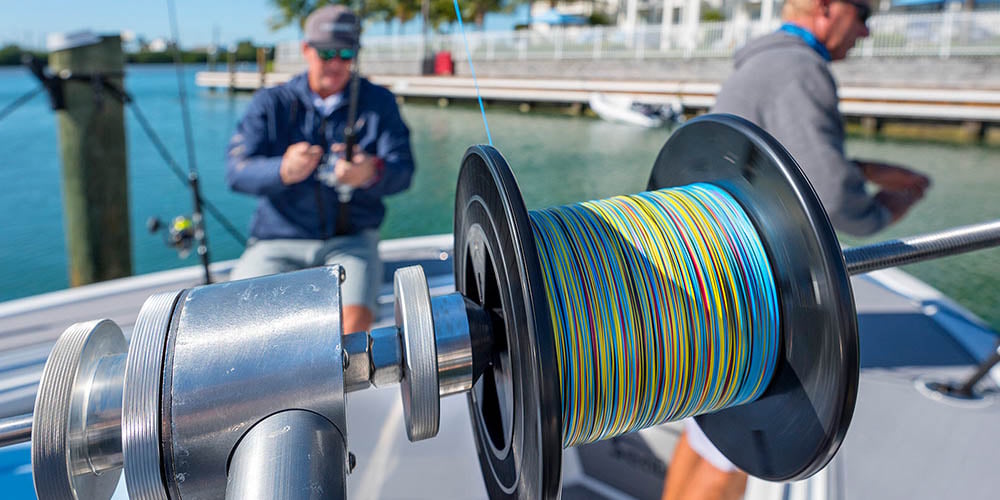
The fishing line you choose affects everything — how far you cast, whether you feel the bite, and whether you land the fish or lose it. The three main types — monofilament, fluorocarbon, and braid — each have real advantages and real trade-offs depending on your target species, technique, and conditions. This guide breaks down what matters so you can pick the right line before you hit the water.
- Monofilament vs. Thermal vs. Braided Line
- Line Strength
- Nylon, Dacron, Spectra, or Dyneema Line
- Line Diameter and Spool Capacity
- Line Color and Visibility
- Castability
- Line Stretch
- Line Memory
- Fluorocarbon Line
- Matching Line to Reel Type
- Line Care, Storage, and Replacement
- Examples for Selecting Fishing Line
- Useful Tips
- Glossary of Fishing Line Terms
- FAQ
- Conclusion
What to Look for When Choosing Fishing Line
Monofilament vs. Thermal Filament vs. Braided
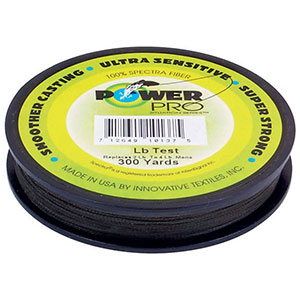
Spectra braided fishing line, like this line from Power Pro, is light, strong, and slippery, for less line noise and lower friction.
Fishing line that is extruded in a single continuous filament and left untwisted is called monofilament. It’s smooth and clear and offers moderate amounts of stretch. Monofilament is also available in special colors to improve visibility above the water while keeping it invisible to the fish. High-performance line produced by thermal bonding of small fibers is called thermal filament and has a smaller diameter per pound test than monofilament. Braided lines are a bit thicker and more common for fishing larger species — for example, fishing for large blue- and yellowfin tuna offshore.
Line Strength
The strength of fishing line is called test and is measured in pounds. It should roughly match the weight of the species you are fishing for — for example, use 30-pound test for tuna in the 30-pound range. A typical line to cast for trout would be 4-pound test.
Consider braided line of 30-pound test or more if you go after large game fish. A rule of thumb is to fish with the lightest gear possible so you don’t tire and have more fun. In competition when test is specified, anglers must use light line to land heavy fish — but that requires experience, a zest for a long fight, and above all, solid technique. Another difference: while normal fishing line is guaranteed to break above its rating, tournament line must break before the rating or the records will not be recognized.
Nylon, Dacron, Spectra, Dyneema
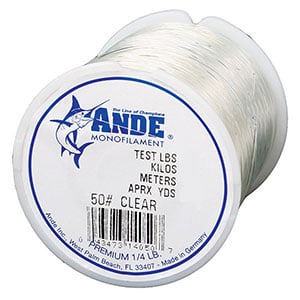
Monofilament nylon fishing line, like this Ande Premium Monofilament, is inexpensive and widely used.
Nylon, the oldest and most common synthetic fiber for fishing line, is made from linear polyamides and offers a good compromise between strength, stretch, and abrasion resistance. Dacron, developed by DuPont in the late 1950s, is based on a long-chain polyester and represents a step up from nylon in strength, flexibility, and low stretch.
Spectra and Dyneema are two modern brand names for ultra-strong polyethylene fiber used in high-tech fishing line. It is many times stronger than steel, more durable than polyester, and so light it floats. We recommend Spectra/Dyneema for higher tensile strength at smaller diameters, which reduces tackle weight and increases the amount of line that fits onto the spool. For example, 130-pound Spectra test has the same diameter as conventional 30-pound test nylon line. Spectra/Dyneema also offers better abrasion resistance, which prevents loss of bait or lure when fishing near obstacles or near the bottom where line snags or chafes against sharp objects.
Line Diameter and Spool Capacity
Pound test tells you breaking strength, but diameter tells you how much line fits on your reel and how it casts and sinks. This is why two lines with the same test rating can behave completely differently on the water — a 20-pound monofilament has a much larger diameter than a 20-pound braid, even though they share the same strength rating. Smaller diameter line packs more length onto the spool, casts with less wind resistance, and sinks faster in the water column for a given weight of lure or sinker.
This is the practical reason braid has become the default choice for anglers who need maximum line capacity on a small reel, such as those fishing deep water or trolling long spreads where running out of line mid-fight is a real risk. A reel that holds 150 yards of 12-pound monofilament might hold over 300 yards of 12-pound braid, because the braid’s diameter is roughly half. When comparing lines, check the manufacturer’s stated diameter in addition to pound test — two lines from different manufacturers rated at the same test can vary diameter by 15 percent or more depending on the raw material and manufacturing process.
Line Color and Visibility
Line color is a tool, not a cosmetic choice, and the right color depends on whether you want the fish to see the line or you want to see the line. High-visibility colors like hi-vis yellow or fluorescent green are intended to be seen by the angler above the water, making it easier to track a cast, watch for subtle strikes, and detect line movement that signals a bite — particularly useful for drift fishing, bottom fishing, or any technique where watching the line itself is part of how you detect a strike. These colors are not meant to be invisible to fish and are generally used with a length of clear or low-visibility leader between the main line and the hook.
Clear, low-visibility green, and moss or smoke-tinted lines are intended to blend into the water column and minimize the chance of a wary fish spotting the line before striking. Fluorocarbon’s near-water refractive index gives it a real visibility advantage over both clear monofilament and any colored line, which is why it remains the preferred leader material in clear water or for fish known to be leader-shy, such as bonefish, permit, and pressured bass in clear lakes. As a general rule, the clearer the water and the more pressured the fishery, the more visibility matters; in stained, murky, or fast-moving water, line color has far less effect on strike rates.
Castability
When it comes to active styles of fishing that require frequent casting, we recommend smooth, light lines because they come off the spool easier, enabling more accurate casts over longer distances.
Line Stretch
Less stretch in fishing line results in more sensitivity to feel the fish, which is what most anglers want. However, in certain situations some stretch is desirable — for example when trolling — because it acts like a shock absorber and can mean the difference between setting the hook in a soft-mouthed fish such as salmon or ripping it out.
Line Memory
Unlike in humans and computers, less memory is better when it comes to fishing lines. Memory refers to a line’s tendency to retain its shape after being wound on a spool. A line with a lot of memory “remembers” the loops it formed on the spool and springs into coils when it comes off. Lines with low or no memory stay straight off the spool, which reduces friction on guides and reels and enables longer, smoother casts.
Fluorocarbon Line
Fluorocarbon (PVDF) has become the preferred choice for leader material and finesse fishing applications. Key characteristics:
- Nearly invisible underwater: Its refractive index is close to water, making it the least visible line type to fish.
- Stiffer than monofilament with less stretch: Provides better sensitivity and hook-setting power.
- Denser than water: Sinks faster than mono, making it ideal for bottom fishing and deep presentations.
- More abrasion resistant than monofilament.
- More expensive than mono but less than most braid.
Best for: clear water fishing, leader material, finesse applications, drop-shot rigs, bottom fishing.
Not ideal for: topwater lures (it sinks) or long-distance casting (stiffer than mono).
Note: Line strength ratings are guidelines. Size up 25–30% to account for knot strength loss and shock loads.
Matching Line to Reel Type
The type of reel you fish has a direct effect on which line performs best, independent of species or technique. Spinning reels handle limp, low-memory line well and struggle with stiff, high-memory line, which tends to twist and create loops that cause wind knots during the cast. Monofilament and braid both perform well on spinning reels; stiff fluorocarbon as a main line is more prone to wind knots on spinning gear and is generally reserved for leader material in spinning applications rather than filling the entire spool.
Baitcasting and conventional reels are far more tolerant of stiffer line, since the line comes off the spool in a straight pull rather than peeling off the side of a fixed spool the way it does on a spinning reel. This is why fluorocarbon as a main line, and heavier abrasion-resistant lines in general, are more commonly spooled on baitcasting and conventional setups. Braid on a baitcasting reel requires a mono or fluoro backing or a few wraps of tape on the spool arbor, since braid has very little friction and can slip on a bare metal or plastic spool under hard hook-sets.
Line Care, Storage, and Replacement
How you store and handle line between trips affects its lifespan as much as how often you use it. UV exposure is the primary cause of monofilament and fluorocarbon degradation — line left spooled on a rod that sits in direct sunlight, on a rooftop rack, or in a rod locker with a clear hatch will degrade measurably faster than line stored in a cool, dark space. Heat accelerates the same degradation process, which is why line stored in a hot car trunk or an un-shaded boat deck box ages faster than line kept in climate-controlled storage.
Saltwater exposure also matters for any line type, not just metal components. Rinse reels and exposed line with fresh water after every saltwater trip to remove salt crystals that can work into the line's surface and accelerate wear at the rod guides. Inspect the first several feet of line nearest the lure or hook before every trip, since this section absorbs the most abrasion from structure, fish contact, and re-tying knots; a small amount of fraying or a rough, fuzzy texture here is the most common warning sign that a line is about to fail at the worst possible moment.
As a baseline replacement schedule: monofilament and fluorocarbon used regularly should be replaced once per season at minimum, and more often for anglers fishing 50 or more days a year. Braid degrades far more slowly since it isn't damaged by UV in the same way, but the line should still be re-spooled or end-for-ended (flipping the spool so the less-used end becomes the working end) every one to two seasons to keep fresh line in the zone nearest the terminal tackle, where wear concentrates.
Examples for Selecting Fishing Line
| Test | Type | Venue | Technique | Target Species |
|---|---|---|---|---|
| 2–4 lb | Mono / Fluoro | Freshwater | Spinning, casting | Trout, panfish, bass (finesse) |
| 6–10 lb | Mono / Fluoro | Inshore | Spinning, casting | Bass, walleye, redfish, flounder |
| 12–20 lb | Mono / Braid | Near shore | Trolling, casting | Stripers, snook, salmon, mahi-mahi |
| 30–80 lb | Braid + leader | Offshore | Trolling, jigging | Tuna, marlin, grouper, sharks |
Useful Tips
Line loses up to a third of its strength at the knot, so we recommend that you size fishing line generously, even though actual breaking strength typically exceeds its rating by approximately 50 percent. Use proper fishing knots to attach leaders and terminal tackle to minimize strength loss at the connection point. A line’s shock resistance withstands breakage when fish hit at high speeds, especially during trolling. If you are not sure what you are going to encounter, err on the strong side or you risk losing your catch.
For example, if you fish for fast-swimming Dorado in the 20-pound range, use 30-pound test so your line has enough strength and shock resistance (approximately 45 pounds) if the fish hits at full throttle and takes off with the bait. For a well-balanced tackle that is functional and comfortable to use, match the line class to rod and reel. Too light a line may be difficult to cast or may be broken by an excessive load. Too heavy a line can break the rod.
Glossary of Fishing Line Terms
Abrasion Resistance: A line's ability to withstand wear from contact with rocks, oyster beds, structure, or a fish's body and teeth without weakening or breaking. Fluorocarbon and braid generally offer better abrasion resistance than standard monofilament.
Backing: Inexpensive line, typically monofilament, wound onto a reel's spool before the main line to fill arbor space and provide friction so thin braided line doesn't slip on the spool.
Braid: Fishing line made by weaving multiple strands of a synthetic fiber, most commonly Spectra or Dyneema, into a single line. Braid has minimal stretch, small diameter relative to its strength, and high sensitivity.
Castability: A general term describing how smoothly and accurately a line casts, influenced by diameter, stiffness, and memory. Lower-memory, smaller-diameter lines generally cast farther and more accurately.
Denier: A unit of measurement for fiber thickness used in some braided line specifications, with higher denier indicating a thicker individual fiber strand within the braid.
Diameter: The physical thickness of a line, usually measured in millimeters or thousandths of an inch. Diameter determines spool capacity and casting performance independently of pound test.
Fluorocarbon: A dense, low-stretch synthetic line material (PVDF) with a refractive index close to water, making it the least visible line type underwater. Commonly used as leader material.
Knot Strength: The percentage of a line's rated breaking strength that remains after it is tied in a knot. Most knots reduce a line's strength by 10 to 30 percent depending on the knot type and how well it is tied.
Leader: A separate section of line, often a different material or heavier test than the main line, tied between the main line and the hook or lure. Leaders are used for abrasion resistance, reduced visibility, or shock absorption.
Memory: A line's tendency to retain the coiled shape it forms on a spool. High-memory line springs into loose coils when it comes off the reel, increasing friction and reducing casting distance and accuracy.
Monofilament: Fishing line extruded as a single continuous strand of nylon or similar polymer. Monofilament offers moderate stretch, good knot strength, and is the most affordable and forgiving line type.
Pound Test: The rated breaking strength of a line, expressed in pounds. Actual breaking strength typically exceeds the stated rating by a margin built in by the manufacturer.
Shock Strength (Shock Resistance): A line's ability to absorb a sudden, high-speed load — such as a fast-moving fish striking at full speed — without breaking, even if the load briefly exceeds the line's stated pound test.
Spool Capacity: The total length of a given line that a reel's spool can hold, which varies by line diameter rather than pound test alone.
Tippet: The final, thinnest section of leader material in a fly fishing leader system, tied directly to the fly. Tippet is sized by an "X" rating rather than pound test in most fly fishing applications.
Twist: Unwanted rotation that builds up in monofilament or fluorocarbon line over repeated casts and retrieves, particularly with spinning reels and lures that rotate, such as spinners. Excessive twist causes line to coil and tangle.
Frequently Asked Questions
Monofilament is the best starting point. It’s affordable, forgiving, easy to knot, and available everywhere. 8–12 lb monofilament handles most inshore and freshwater situations a beginner will encounter.
Both are single-strand lines, but fluorocarbon sinks, has less stretch, and is nearly invisible underwater. Monofilament floats, stretches more, and is more forgiving — making it better for topwater lures and beginners. Fluorocarbon is preferred for leader material and clear-water finesse fishing.
Braid is best when you need maximum sensitivity, thin diameter for more line on the spool, or are fishing in heavy cover or deep water where abrasion resistance matters. It has virtually no stretch, so you feel every bite. Most offshore anglers use braid with a fluorocarbon or mono leader.
Yes. Monofilament and fluorocarbon degrade with UV exposure and should be replaced at least once per season, or more frequently if you fish heavily. Braid lasts longer but should be inspected regularly for fraying or abrasion damage — particularly the last several feet closest to the terminal tackle.
Match your line strength to the average size of the fish you’re targeting. As a general rule, use line rated close to the expected fish weight, then size up 25–30% to account for shock loads, knot strength loss, and abrasion. When in doubt, go heavier — you can always adjust down once you have a feel for the fishery.
Conclusion
Make sure the line’s test matches the average weight of the targeted species, is capable of absorbing shock loads when the fish hits, and has enough strength in the knot areas.
- Bait-casting on a lake requires lighter and more sensitive line than saltwater game fishing because it is a more active style of fishing and the targeted species are smaller.
- Common monofilament has more stretch than braided high-tech line and takes up more room on the spool.
- Performance lines such as Spectra are priced higher than nylon or Dacron, but offer more sensitivity, abrasion resistance, and knot strength, with low stretch and minimal memory — we consider them a good value for serious fishing applications.
- Line with moderate stretch is good for trolling because it may be the difference between hooking the fish or ripping the hook right out of its mouth.
- Good advice when buying line is to buy plenty of it because you will find that you lose more than you expect.
View & Shop Fishing Line
We’re Here to Help!
West Marine carries monofilament, fluorocarbon, and braided fishing line from every major brand, sized for everything from finesse panfish rigs to offshore big game tackle. Whether you're spooling up for a weekend on the lake or rigging for a tuna trip, our fishing experts can help you match the right line, test, and leader to your technique. Click on our handy store locator to find a West Marine store near you.
Related: