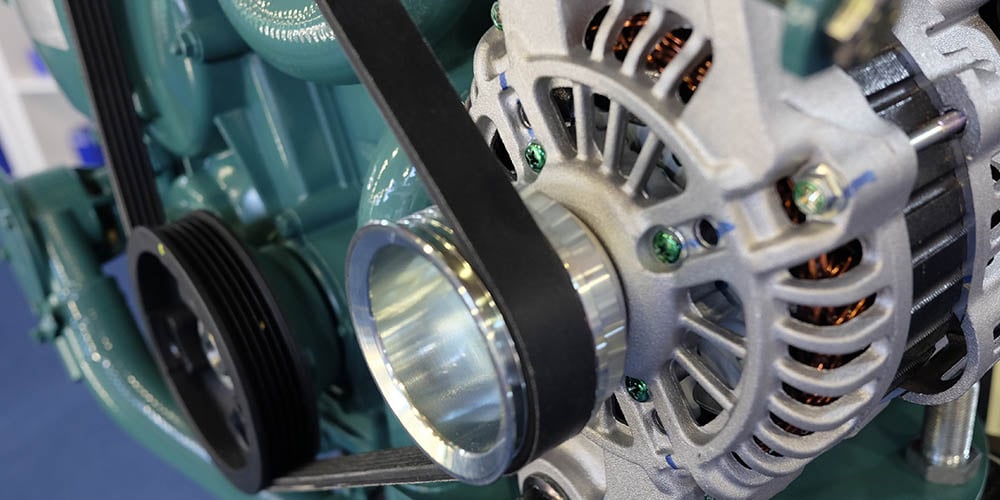
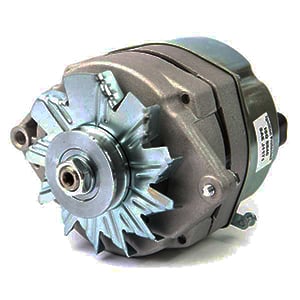
Standard marine alternators, like this 68-amp Delco-style three-wire model from Sierra, use an internal regulator suited primarily to starting batteries and light charging loads.
Selecting a Marine Alternator
The alternator is the heart of your boat's charging system. Every time the engine runs, the alternator replenishes energy consumed by electronics, pumps, lighting, refrigeration, navigation equipment, trolling motors, and onboard accessories. While factory-installed alternators are usually adequate for charging a starting battery, they are often undersized for modern boats equipped with large house battery banks, inverter systems, refrigeration, radar, Starlink, autopilots, and other high-demand electrical loads.
Selecting the right marine alternator involves much more than choosing the highest amperage rating available. The alternator must be properly matched to your battery chemistry, battery bank size, engine mounting configuration, belt drive system, wiring capacity, and charging profile. An improperly matched charging system can result in slow charging, shortened battery life, overheated alternators, slipping belts, and charging failures.
- Battery Chemistry
- Battery Capacity
- Mounting Style
- Belt Load Limitations
- Internal vs External Regulators
- Charging System Upgrades
- Alternator Performance Factors
- Alternator Glossary
- FAQs
Why Alternator Sizing Matters
One of the most common charging system mistakes is installing either too little or too much alternator for the application. A small alternator connected to a large battery bank may spend hours operating at maximum output, creating excessive heat and reducing service life. Conversely, installing a very large alternator without considering belt capacity, wiring size, and cooling requirements can create reliability issues that are even more severe.
The goal is not simply maximum output. The goal is building a balanced charging system that can safely recharge the battery bank while remaining within the limits of the engine, pulley system, wiring, and batteries themselves.
Modern charging systems should be designed around the battery bank first and the alternator second.
Battery Chemistry and Alternator Selection
The type of battery installed on your boat largely determines the charging strategy and alternator requirements.
Flooded Lead Acid Batteries
Traditional flooded batteries remain common on many boats due to their affordability and proven reliability. These batteries generally accept charging current equal to approximately 25% of total battery capacity.
For example:
- 200Ah battery bank = approximately 50A charging acceptance
- 400Ah battery bank = approximately 100A charging acceptance
- 600Ah battery bank = approximately 150A charging acceptance
Flooded batteries benefit from multi-stage charging but are generally more forgiving than AGM or lithium systems.
AGM Batteries
AGM (Absorbed Glass Mat) batteries have become one of the most popular choices for cruising boats due to their maintenance-free design, vibration resistance, and faster recharge rates.
AGM batteries typically accept charging currents between 40% and 50% of total capacity.
A 400Ah AGM bank may accept 160-200 amps during the bulk charging phase. This significantly increases recharge speed but also demands more from the alternator.
Gel Batteries
Gel batteries generally accept charging rates around 30% of capacity and require carefully controlled charging voltages. Excessive voltage can permanently damage gel batteries, making regulator selection particularly important.
Lithium Batteries
Lithium Iron Phosphate (LiFePO4) batteries have transformed marine charging systems. Unlike lead-acid batteries, lithium batteries can accept extremely high charging currents for extended periods.
While this sounds beneficial, it creates a major challenge for alternators.
A lithium bank may continuously demand maximum output from the alternator until nearly fully charged. This sustained load can quickly overheat and destroy standard alternators. Any lithium charging system should include:
- Large-frame alternator
- External multi-stage regulator
- Alternator temperature sensor
- Battery temperature sensor
- Appropriate overcurrent protection
Battery Bank Capacity
Battery capacity is measured in amp-hours (Ah). The larger the battery bank, the more charging current it can potentially absorb.
Many boaters upgrade batteries without upgrading the charging system. The result is extended engine run time, incomplete charging cycles, and reduced battery lifespan.
As a general guideline:
| Battery Bank Size | Recommended Alternator Output |
|---|---|
| 100-200Ah | 50-80A |
| 200-400Ah | 80-150A |
| 400-600Ah | 150-250A |
| 600Ah+ | 200A-350A+ |
Actual alternator sizing should always be based on battery chemistry, electrical demand, and belt limitations.
Alternator Mounting Styles
Before selecting an alternator, verify that the replacement physically fits your engine.
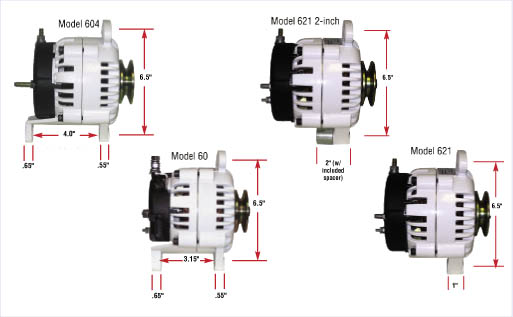
Mounting styles for Balmar 6-Series alternators.
Common mounting styles include:
- Single-foot Motorola-style mounts
- Single-foot Delco-style mounts
- Hitachi saddle mounts
- J-180 saddle mounts
When upgrading to a larger alternator, additional bracket reinforcement may be necessary because higher-output alternators place significantly greater loads on mounting hardware.
Belt Load Limitations
One of the most overlooked factors in alternator upgrades is belt capacity.
An alternator converts mechanical horsepower into electrical power. As output increases, the horsepower required to drive the alternator increases proportionally.
As a general rule:
25 amps of charging output requires approximately 1 horsepower.
This means a 200-amp alternator may require approximately 8 horsepower at full output.
Many factory V-belt systems simply cannot support these loads.
| Belt Type | Recommended Output |
|---|---|
| Single 3/8" V-Belt | Up to 80A |
| Single 1/2" V-Belt | Up to 110A |
| Dual V-Belts | Up to 310A |
| Serpentine Systems | Up to 310A+ |
Upgrading to a serpentine conversion kit is often recommended when installing alternators larger than 120 amps.
Internal vs External Regulators
The regulator controls alternator output voltage and charging behavior.
Internal Regulators
Most OEM alternators use simple internal regulators that maintain a fixed charging voltage. These work adequately for starting batteries but often fail to fully charge deep-cycle battery banks.
External Regulators
External multi-stage regulators dramatically improve charging efficiency by adjusting output during different charging stages:
- Bulk Charging
- Absorption Charging
- Float Charging
- Equalization Charging (where appropriate)
Benefits include:
- Faster recharge times
- Improved battery life
- Higher charging efficiency
- Temperature compensation
- Lithium compatibility
Charging System Upgrades by Boat Type
Cruising Sailboats
Cruising sailboats often rely heavily on alternator charging because engine run time may be limited. Upgrades typically include:
- 120A-200A high-output alternator
- External regulator
- Battery temperature sensing
- Alternator temperature sensing
Offshore Cruisers
Offshore boats often carry large house banks supporting refrigeration, autopilots, watermakers, radar, and communications equipment. Alternators in the 200A-350A range are increasingly common.
Powerboats
Twin-engine powerboats can leverage both engines for charging. Systems such as Balmar's Centerfielder allow both alternators to work together to charge a shared house bank efficiently.
Lithium Conversion Projects
Any lithium upgrade should include a complete charging system review. Many OEM charging systems were never designed to support lithium charging demands.
Additional Performance Considerations
Heat Management
Heat is the number one killer of marine alternators. Engine room temperatures often exceed 120°F, reducing output and increasing wear.
Large-frame alternators generally run cooler and survive high-output applications longer than small-case designs.
Wiring Size
High-output alternators require appropriately sized charging cables. Undersized wiring causes voltage drop, wasted output, and potential fire hazards.
Voltage Drop
Even the best alternator can perform poorly if excessive voltage drop exists between the alternator and batteries.
Temperature Sensors
Battery and alternator temperature sensors help optimize charging while preventing overheating and thermal damage.
Alternator Glossary
Alternator: Engine-driven device that converts mechanical energy into electrical energy.
Ampere (Amp): Measurement of electrical current output.
Bulk Charge: Maximum charging phase where the alternator delivers the highest current.
Absorption Charge: Charging phase where voltage remains constant and current gradually decreases.
Float Charge: Maintenance charging phase that keeps batteries topped off.
External Regulator: Separate controller that manages charging stages and output.
Battery Acceptance Rate: Maximum charging current a battery can safely absorb.
Serpentine Belt: Multi-ribbed belt capable of handling higher alternator loads than standard V-belts.
Voltage Drop: Reduction in voltage caused by resistance in wiring and connections.
Temperature Compensation: Automatic charging adjustment based on battery temperature.
Frequently Asked Questions
How many amps should my alternator produce?
The ideal output depends on battery bank size, chemistry, and electrical demand. Most cruising boats benefit from 100-200A charging systems, while larger offshore boats may require 250A or more.
Can I install the largest alternator that fits?
Not necessarily. Belt capacity, wiring size, engine mounting brackets, and cooling requirements must all support the alternator's output.
Do lithium batteries require a special alternator?
Lithium batteries generally require a high-output alternator paired with a temperature-controlled external regulator to prevent overheating and alternator failure.
What is better: internal or external regulation?
External regulators provide substantially better charging performance and battery life, particularly for AGM and lithium battery banks.
How long should a marine alternator last?
A properly sized and cooled marine alternator can last many years. Alternators that routinely operate at maximum output often experience significantly shorter service life.