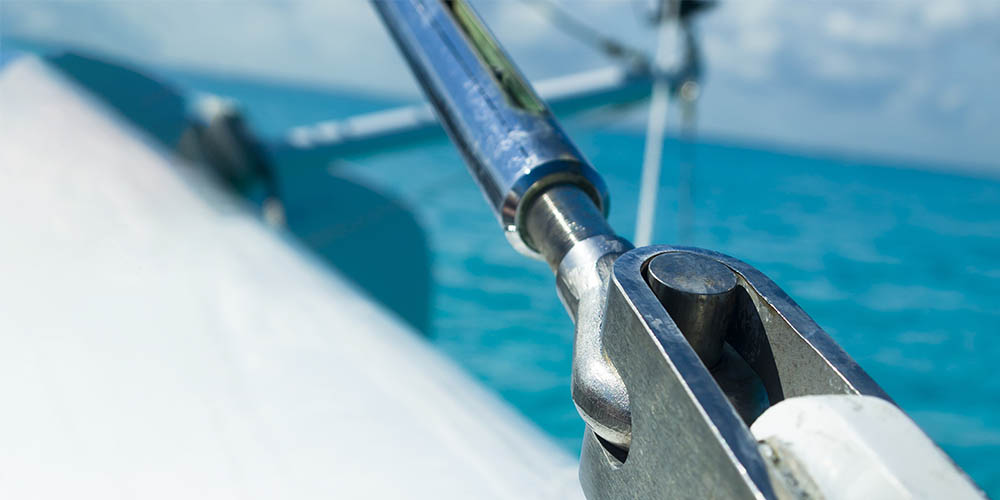
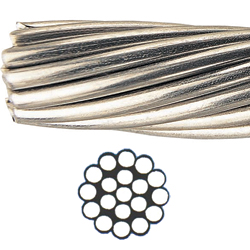
Stainless steel is a family of iron-based alloys containing at least 10.5% chromium, which gives the material its corrosion-resistant properties. Other elements are added to produce different grades with specific properties. Understanding these grades helps you make informed decisions about standing rigging, chainplates, turnbuckles, and other critical hardware.
- Type 302, 304, and 18-8
- Type 316: Extra Corrosion Resistance
- Passivation and How It Fails
- Sizing a Type 316 Rig
- Crevice Corrosion: A Real Example
- How to Prevent Crevice Corrosion
- Standing Rigging Inspection Checklist
- FAQs
Type 302, 304, and 18-8
Stainless steel alloys are grouped by crystal structure. Many austenitic stainless steels contain significant amounts of nickel, which helps stabilize their austenitic crystal structure. The widely used 300-series grades are predominantly austenitic and are common in marine applications. Types 302 and 304 are widely used for rigging, fasteners, fittings, and other hardware. Type 302 is a general-purpose corrosion-resistant stainless with good strength. Type 304 is a closely related grade with improved weldability and corrosion resistance. Type 304L is the low-carbon version of Type 304. There are many 304 sub-alloys for specific applications, providing adequate performance at an affordable price. However, 304 and other 300-series types are inadequate for some marine applications. Type 303, for example, contains sulfur or selenium to improve machinability but has poorer corrosion resistance than 304 and 316, particularly in chloride environments, making it unsuitable for most exposed marine rigging applications.
Type 316: Extra Corrosion Resistance
Type 316 contains 2–3% molybdenum and generally more nickel than Type 304, providing substantially better corrosion resistance, particularly against pitting and crevice corrosion in chloride environments. The trade-off is strength: Type 316 generally has lower strength than Type 302 or 304 in comparable product forms and conditions.
Among the best materials for high-performance rigging are "super stainless" austenitic alloys. For example, Nitronic 50, which has been used in high-performance rod rigging, delivers significantly higher strength than standard Type 316 stainless steel while maintaining excellent corrosion resistance. Another notable alloy is Aquamet 22, a high-strength, corrosion-resistant stainless steel frequently used for high-stress marine propeller shafts. Naturally, the superior performance of these advanced alloys comes with a higher price tag.
Passivation
Stainless steel relies on a thin, chromium-rich oxide film that naturally forms in the presence of oxygen to protect against corrosion. As long as this passive layer remains intact, the underlying metal is shielded. Chemical passivation treatments—typically using nitric or citric acid—enhance this protection by removing free iron and surface contaminants to promote a clean, uniform oxide layer. If damaged, the passive film usually self-heals quickly when exposed to oxygen. However, corrosion occurs when environmental conditions prevent repassivation, such as in oxygen-depleted, chloride-rich crevices.
Stainless steel can corrode through several mechanisms, including pitting and crevice corrosion, galvanic corrosion, and stress-corrosion cracking. Surface contamination, scratches, and other damage can also interfere with the passive film and increase corrosion risk.
For rod rigging, fatigue and stress-corrosion cracking are among the most serious threats. Stress concentrates at the rod head, where cracking can eventually lead to failure. Without disassembling the rig, failure is difficult to predict. Wire rigging is subjected to repeated cyclic loading as the boat sails and rolls — over a 10-year service life, this adds up to literally millions of stress cycles. The insides of lower swaged terminals and barrel turnbuckles collect water and corrode invisibly. A failure may be the first indication that your stainless has been deteriorating for years.
Sizing a Type 316 Rig
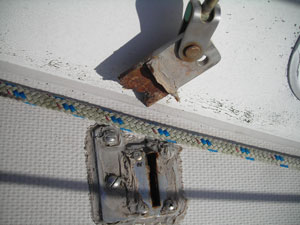
The consequences of neglect: the broken top of an upper shroud chainplate dangles from the toggle above the deck of a Catalina 30. Cover plate slathered in gray sealant masked the corrosion underneath.
Type 316 generally provides better corrosion resistance than 302 or 304, particularly in warm, chloride-rich marine environments, and may provide longer service life when corrosion is the limiting factor. If you specify 316, consider upsizing your wire by one diameter to compensate for the strength reduction.
Price this upgrade carefully before committing. While upsizing your standing rigging increases overall strength—depending on the wire’s diameter, construction, and alloy—costs can escalate rapidly. The wire itself is rarely the main expense; rather, the larger turnbuckles, swage fittings, eyes, and clevis pins required for heavier wire will significantly drive up the total budget.
Crevice Corrosion: A Real Example
The story you are about to read is true. The names have been omitted to protect the guilty.
We were helping our friends try out their rebuilt Atomic Four engine on their 1976 Catalina 30 on a perfect February day on San Francisco Bay — 15 knots of wind, glorious bright sun, 62°F temperature, two-foot chop. The engine purred as we motored out of Coyote Point Harbor, raised the main, and unfurled the jib.
We cut the engine and sailed easily along for a few minutes on a beam reach, then began grinding in the jib on the Barient winch to head up onto a beat. Let’s see how she goes to windward! Suddenly, there was a loud BANG and, looking up, we saw the top part of the mast bending alarmingly to leeward, resembling the rig on a Laser. Holy cow!
Quick and decisive action, along with a stout telephone pole mast, allowed us to save the rig. We blew the sheets, went head-to-wind, roller-furled the genoa, restarted the Atomic, and dropped the mainsail. Only then did we notice the bottom of the port upper shroud dangling limp, the turnbuckle swinging and clanging.
The trip back to the slip was drama-free. The cold beers at the dock were most welcome.
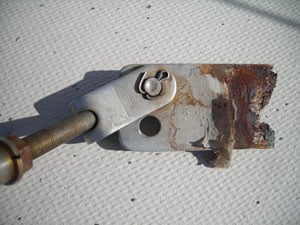
The scene of the crime: water entered at the top of the chainplate. The owners thought their rig was in good shape. Rust never sleeps. Photos: Ann Krieg
This is a classic case of crevice corrosion in an oxygen-starved environment, hidden beneath sealant. Each time the boat tacks, the chainplate flexes slightly relative to the deck it passes through. This tiny motion breaks down the bond between sealant and chainplate, allowing salt water — with its corrosive chloride content — to enter, become trapped, and corrode the stainless from within.
What to Do to Prevent Crevice Corrosion
- Wash down your boat with fresh water after every sail — even if you sail in a freshwater lake. If you can’t get to the boat as frequently as you’d like, arrange with your neighbor to hose each other’s boat down whenever one of you visits. Chainplates that are rusting just below deck level, can be a warning sign of corrosion caused by trapped moisture and contaminants in or around the chainplate assembly. Regular washdowns are the simplest and cheapest prevention available.
- Check chainplates frequently both on deck and inside the cabin for evidence that the seal has been compromised. Use a flashlight inside to check for the slightest sign of moisture or staining. Any leak at a chainplate is dangerous to the rig and — if your deck has a wood or foam core — potentially to the structural integrity of the deck as well.
- If you see any evidence of water intrusion, remove the chainplate and inspect it for crevice corrosion hidden within the thickness of the deck. Have a professional rigger assess if you are unsure. Undetected corrosion at a chainplate can cause the total loss of a rig.
- Inspect swage terminals closely. The point where wire enters a swaged fitting is where corrosion and fatigue most commonly initiate. Look for rust weeping from the bottom of the swage, discoloration, or any cracking of the swage body. These are grounds for immediate replacement.
- Polish your stainless regularly. Use a stainless steel polish like Wichard’s Wichinox. Keeping stainless steel clean and free of surface contaminants can help maintain its corrosion resistance. Polishing can also improve the surface finish and appearance, but it cannot prevent corrosion in concealed crevices. Wichard built its reputation for superior stainless hardware by polishing twice as long as the industry standard.
- Use a magnifier for a close look at your stainless rigging and fittings at each inspection. Use a magnifier to examine swages, terminals and other high-stress areas for small cracks, corrosion, or broken wire strands.
Standing Rigging Inspection Checklist
Inspect your standing rigging at the start of each season and after any incident involving heavy weather or an accidental gybe.Ten years is a widely used conservative guideline for replacing offshore standing rigging, but actual service life depends on the boat, rigging, sailing conditions, environment, and inspection findings.
- Are chainplates properly aligned with the turnbuckles, stays, and shrouds?
- Are there signs of leaking around chainplates — on deck or inside the cabin?
- Are terminal fittings (swage fittings, Hi-MOD, Norseman, Sta-Lok, etc.) free from cracks, bends, or rust weeping from the base?
- Are turnbuckles properly lubricated so they turn freely?
- Are turnbuckle barrels secured to the threads with rings, cotter pins, or tightened locknuts?
- Is the standing rigging free from broken wire strands?
- Is the mast straight — not cocked to either side or bowed in the middle?
- If the mast is stepped on deck, is the step properly supported below?
- Are there signs of galvanic corrosion at the base of the mast or where dissimilar metal fittings (winches, cleats) attach to the mast? On a painted aluminum mast, bubbles around fittings indicate corrosion. On an unpainted mast, heavy concentrations of white powder and pockmarks around fittings signal corrosion.
- Are any screws or rivets missing from sail tracks or other fittings?
- Do welds on the mast and boom appear rusted?
- Do spreaders bisect the shrouds at equal angles?
- Are spreader ends secured to the shrouds?
- Are spreader ends protected with rubber boots or tape to prevent sail chafe?
- Are all cotter pins taped to prevent sail damage?
- Do T-terminals show any signs of stress or cracking?
- Are halyard sheaves split, crushed, or badly worn?
- Are masthead mounts tight for radio antennas and wind instruments?
Frequently Asked Questions
What is the difference between Type 304 and Type 316 stainless for rigging?
Type 304 (also called 18-8) is the most common stainless steel and is adequate for many marine applications. Type 316 adds 2–3% molybdenum, making it significantly more resistant to saltwater pitting and crevice corrosion — particularly important in warm tropical waters where corrosion is most aggressive. The trade-off is that Type 316 can have lower strength than Type 304 in some wire and hardware applications, depending on the product form and manufacturing process. For standing rigging in saltwater, 316 is the preferred choice despite the strength difference.
How often should I replace my standing rigging?
Many professional riggers recommend considering replacement of standing wire and swage fittings at about 10 years, particularly for boats used offshore. Wire and swage fittings are subjected to repeated cyclic loading over their service life, and fatigue damage may not be detectable through visual inspection alone. Coastal sailors may extend this interval, but any rig showing broken strands, rust weeping from swage fittings, or cracking at terminals should be replaced immediately regardless of age. Have your rigging professionally inspected if you are planning a significant offshore passage.
What causes crevice corrosion in stainless steel chainplates?
Crevice corrosion occurs when salt water becomes trapped in a confined space with limited oxygen — such as beneath deck sealant at a chainplate penetration. Each tack flexes the chainplate slightly, breaking the seal and allowing salt water to enter. Once trapped, the chloride ions in salt water attack the stainless oxide layer and corrode the metal from within. The damage is hidden beneath the sealant and may be severe before any visible rust appears on deck.
What is the 10-year rule for standing rigging?
Many professional riggers use 10 years as a conservative guideline for considering replacement of standing wire rigging and swage fittings. The appropriate service life depends on the boat, rigging, sailing conditions, environment, and inspection findings
Related Articles
- How to Correctly Coil Rope
- Removing a Halyard from Your Mast
- Maximum Working Load
- Selecting Line for Running Rigging
- When and How to Replace Your Lifelines
