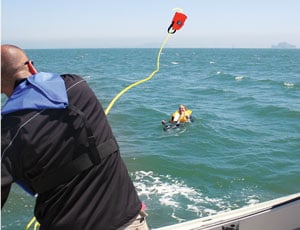
Throw rope bags are helpful when rescuing overboard crew members.
A throw rope bag is a wonderful addition to your safety arsenal. Their core function is to allow you or your crew to throw a line accurately. Many boaters have no problem tossing a line to someone on the dock or to a capsized boat, but having a throw bag on board ensures that any member of your crew will be able to effectively throw a line in an emergency.
With throw rope bags, you are virtually assured of an accurate toss. The floating line is stored inside a soft nylon bag, which also contains a small piece of foam to ensure that the bag floats and SOLAS reflective tape to make it easy to see. The bitter end of the line has a loop in it which is placed over the non-throwing hand to secure it. With a gentle underhand toss, as if you were pitching a horseshoe, you can send the bag and line out 50' to 70', right to your victim or docking helper.
If the Intended Recipient Misses the Line
If the intended recipient somehow misses the line, you can pull it back and do one of the following:
- Restuff the line in the bag (too slow!)
- Coil the line quickly, then throw it like a conventional line, or
- Drag the bag in the water to pick up some weight and use it like a monkey's fist to get the line to the victim.
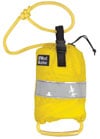
A throw rope is a great addition to your safety gear and is required for offshore races.
How to Re-Pack the Throw Rope Bag
Returning the line to the bag requires some technique. We've found the easiest method is to throw the line over the shoulder and—while holding the bag in the right hand—feed the line into the bag with the left hand. The line must be stuffed, or flaked into the bag—coiling it and then putting it inside the bag causes one big tangle.
Cheap, effective and an embarrassment preventer, a throw rope bag is a great addition to your boat. Whether passing a line to another boat or snaring a crew overboard, you can master the technique with a modest amount of practice.
Offshore Racing Requirements
Offshore sailboat racers note: The 2018-2019 Offshore Special Regs, which set equipment requirements for racing, list a heaving line in section 4.22.7: "a heaving line shall be provided 15m - 25m (50ft. - 75ft.) length readily accessible to cockpit." The Throw Rope Bag meets this requirement.
Whether you race offshore or cruise coastally, keeping a throw rope bag clipped within reach of the cockpit is one of the simplest and most effective crew overboard preparedness steps you can take. Pair it with a complete crew overboard kit including a throwable PFD and other essential safety gear for a fully prepared boat.
Throw Rope Bag FAQ
A throw rope bag is a soft nylon bag containing a floating line, a small foam insert to keep the bag buoyant, and SOLAS reflective tape for visibility. The bitter end of the line has a loop that goes over the non-throwing hand. With a gentle underhand toss, you can accurately deliver the line 50 to 70 feet to a person overboard or a vessel needing a line.
Place the loop at the bitter end of the line over your non-throwing hand to secure it, then use a gentle underhand toss similar to pitching a horseshoe. The weight of the bag pulls the line out as it flies, delivering it accurately to the target without the tangle risk of a coiled line. Practice the throw before you need it in an emergency.
Pull the line back and either coil it quickly for a conventional throw, or drag the bag in the water briefly to add weight and use it like a monkey's fist for a second attempt. Restuffing the bag for a second throw is too slow in an emergency. Practice both recovery methods before you need them.
Throw the line over your shoulder, hold the bag in your right hand and use your left hand to feed the line in by stuffing or flaking it loosely into the bag. Never coil the line before putting it back in the bag — coiling creates tangles that will cause the line to jam on the next throw.
Yes. The Offshore Special Regs list a heaving line of 15m to 25m (50 to 75 feet) in length as required equipment, readily accessible to the cockpit (section 4.22.7). A throw rope bag meeting this length requirement satisfies the regulation. Even for non-racing boaters, keeping a throw bag accessible in the cockpit is a best practice for any offshore or coastal passage.