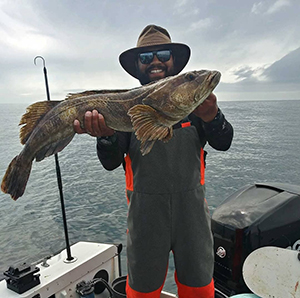
Miguel is an experienced boater you’ll find on the water nearly every weekend.
If you are new to trailer boating, backing a boat down a launch ramp under the critical, impatient gaze of more experienced boaters can be unnerving. Recognizing this, we reached out to West Marine crewmember Miguel Maldonado, who has boating in his blood. Miguel routinely trailers his 25-foot Steiger Craft Chesapeake along the California coast where he enjoys fishing and crabbing on Monterey Bay. In this article, Miguel provides some useful advice and tips to help you build confidence and enjoy a safe trailering experience.
- Before You Trailer Your Boat
- Getting on the Road
- The Staging Area
- Once in the Water
- Retrieving Your Boat
- Be the Better Boater
- FAQs
Before You Trailer Your Boat
Miguel says, “trailering can be stressful if you’re new to it.” He also says, “The important thing is to keep calm, slow down and watch your surroundings. You may have anywhere from 15’–35’ of extra length behind you, which will cut down on your acceleration and require your braking distance to double, if not triple.” Miguel explains that you should become familiar with how long it takes you to safely bring your vehicle and trailer up to speed and to a stop before driving on a highway. He recommends you take slow, easy turns and brake before you think you need to, with gentle pressure to ease into a stop.
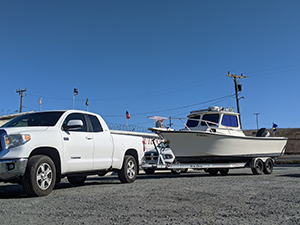
The larger the boat, the greater the stopping distance and the wider the turning radius.
Take turns wider than you normally would, and “remember that your trailer doesn’t retrace your path the way the back wheels of your car do; it follows the direction you pull it, meaning it may cut over corners unless you take it wide.” When reversing, remember that any sharp turns will push the trailer to pivot to a 90° angle in the opposite direction. Practice backing up with your trailer in an empty parking lot or your neighborhood. Miguel recommends that you pretend “your passenger has a cake in their lap that you don’t want to spill, tilt or drop.”
Getting on the Road
Miguel recommends that you make sure your trailer is ready for the road. “Give your trailer a quick checkup. Plug in your trailer lights and make sure they’re all working like they’re supposed to, and are connected with enough extra length to make turns — but not so much length that the cables drag on the road. Verify that the trailer lights light up when you turn on your vehicle headlights and hazard lights. If your trailer has emergency brakes, verify that they work while stationary. Ensure the ball and hitch are connected securely, and cross your safety chains in an X pattern underneath the hitch so that, if the hitch becomes disconnected, it will fall on the chains and keep your trailer from smacking into the road at speed.”
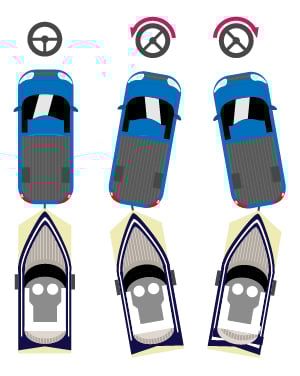
When backing up, turn left to push the back of your trailer right, and right to push it left.
The Staging Area
Once you’ve safely made it to the boat ramp, Miguel recommends that you look for a staging area. “Do not enter the staging area until you are ready to get your boat in the water; no one wants to wait behind someone who’s just passing the time until their friend shows up. Once in the staging area, put your fenders on your boat, raise your antennas, remove straps and prepare your dock lines. Remember, this is a quick-moving line. If you need to take time to transfer coolers, bags, gear or anything else to your boat, do so in a parking lot and then move to the staging line so you aren’t pressured to throw everything in at the last minute.”
If your boat has a transom plug, make sure it’s in place before you put your boat in the water. As Miguel explains, “failure to do so will cause your boat to begin to sink soon after launch.” Miguel also notes that you should “have a pair of wheel chocks ready for placement behind your vehicle’s tires after you have backed down the launch ramp.”
Miguel recommends having someone spot you and provide an extra set of eyes when you launch your boat.
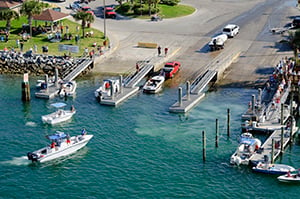
Launch ramps can be very busy, so be sure to prepare ahead of time!
Backing a boat down a launch ramp into the water can be stressful and requires patience and the careful, slow movements discussed earlier. “Ensure your fenders are out, your dock lines are ready, fuel is topped off and your keys are in the ignition.” Miguel also recommends watching videos online to get a feel for the process, or launching with an experienced friend to ensure you’re doing so safely and efficiently.
Once in the Water
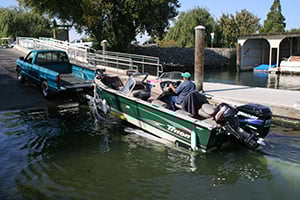
Once your boat is in the water, common courtesy requires that you walk your boat to the end of the dock to make room for the other boaters waiting to enter the water. Return to your vehicle and trailer, move it to the parking area, and hurry back. “If your boat is at the end of the dock, and the dock is full of other boaters waiting for you to head out, you’re probably taking too long. Get into your boat and out of the way quickly so other boaters can enjoy their day, too,” Miguel says, “but remember to keep calm. Rushing can lead to accidents, so your real goal here is to be as efficient as possible before and after you launch.” Take your time with the parts you are worried about or need to practice. Holding up other boaters leads to stress, which leads to hastiness and accidents.
Retrieving Your Boat
Boat retrieval — loading the boat back onto the trailer at the end of the day — is often harder than launching and deserves the same preparation. Before you head to the ramp, make sure another boater is holding your dock line while you retrieve your vehicle and trailer from the parking lot. Never leave a boat tied to a ramp dock unattended for long — it blocks the ramp for other returning boaters.
Back the trailer down until approximately one-third of the bunks or rollers are submerged. If you go too deep, the boat will float past the trailer rather than onto it. Drive the boat onto the trailer slowly under low power, aimed at the centerline. Use your guide-on posts to align the hull before you contact the bunks — arriving off-center and trying to correct once on the trailer damages both the hull finish and the bunk carpets.
Once the bow contacts the bow stop, secure the winch strap, attach your transom tiedown straps, and remove the drain plug if you’re in saltwater (do this at the ramp, not later in the parking lot — salt water sitting in the bilge during the drive home accelerates corrosion). Then pull forward out of the water, move to a safe area, and complete the remainder of your post-trip checklist before getting on the road.
Be the Better Boater
Miguel stresses the need for situational awareness. “Constantly check your surroundings, respect the direction and speed of other boats and act accordingly. Defensive boating is the key to safe boating. Always keep your eyes open for hazards like rocks, buoys that indicate rules or underwater obstacles, floating debris, sea animals, paddlers or other non-boaters in the water — plus green boaters who aren’t aware of their surroundings or haven’t learned the basics yet.” Venture forth with caution, learn and understand the capabilities of your boat, and be honest with yourself about your level of boating expertise. Constantly reassess your abilities when facing increased wave action, unique hazards, or challenging weather. Miguel always recommends, “If you don’t know, drive slow.”
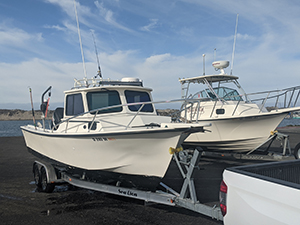
Check over your boat and trailer before driving back home.
Miguel points out that, “Conditions on the water constantly change. Check the marine weather report a day or two before heading out, and check it closely the morning of your trip. Remember that nice weather always brings out more boaters, which will mean dealing with more traffic. This is another time your situational awareness will be tested and you’ll need to be on top of your game.”
Learning to manage your boat safely is like learning to drive a car. With practice, all of this will become second nature to you, and we hope you enjoy every moment. Be safe out there.
Frequently Asked Questions
How do I back a boat trailer without jackknifing?
The key is small corrections. When backing, place one hand at the bottom of the steering wheel — the trailer will go in the same direction your hand moves. Turn a little, observe, correct. The most common mistake is overcorrecting, which causes the trailer to swing too far and requires a full pull-forward to reset. In a parking lot, practice backing toward a specific target at slow speed until you can consistently place the trailer where you intend. It takes repetition, not special skill. Miguel’s advice: pretend there’s a cake in your passenger’s lap. That mindset alone slows most people down enough to stop jackknifing.
What should I check before leaving for the boat ramp?
Before every trip: confirm the trailer lights work (test all functions — running, brake, and turn signals); check that the ball and coupler are locked and the safety chains are crossed in an X beneath the hitch; verify the winch strap is tight and the bow is seated on the bow stop; confirm transom tiedown straps are attached; check tire pressure on the trailer; check that the transom plug is on board (it’s easy to leave it at home). If you have bearing protectors, a quick visual check that the grease piston hasn’t recessed fully takes five seconds. Do all of this in your driveway, not in the staging area.
Why should I cross the safety chains in an X pattern?
If the trailer separates from the hitch ball while moving, the coupler will drop. Safety chains crossed in an X beneath the hitch catch the coupler before it hits the road, keeping the trailer from grinding down the pavement, swinging sideways, or separating completely from the vehicle. Chains that are not crossed or are dragging on the road cannot perform this function. The chains should be short enough to stay off the ground but long enough to allow the vehicle to turn without binding.
What is a staging area at a boat ramp and how should I use it?
The staging area is the waiting area adjacent to the launch ramp where boats queue before backing down. It is not for organizing gear, waiting for late crew members, or rigging tackle. Every minute you spend in the staging area that is not directly advancing your readiness to launch is a minute you are slowing down everyone behind you. When you pull into staging, everything that can be done should already be done: gear loaded, fenders deployed, dock lines prepared, plug verified, electronics on. The only tasks for staging are the ones that physically cannot be done until you are adjacent to the water.
What do I do if I drop the boat in a parking lot or hit something backing down the ramp?
Stay calm. If someone is directing you and you lose orientation, stop, get out, and look. Most ramp incidents happen because the driver kept moving when uncertain. A momentary pause costs nothing; a collision costs significantly. If you feel something was wrong during the launch — the boat didn’t seat correctly, a strap tangled, you heard an odd sound — pull out and inspect before continuing. The small delay is always less costly than discovering the problem after you’re on the road at 65 mph.