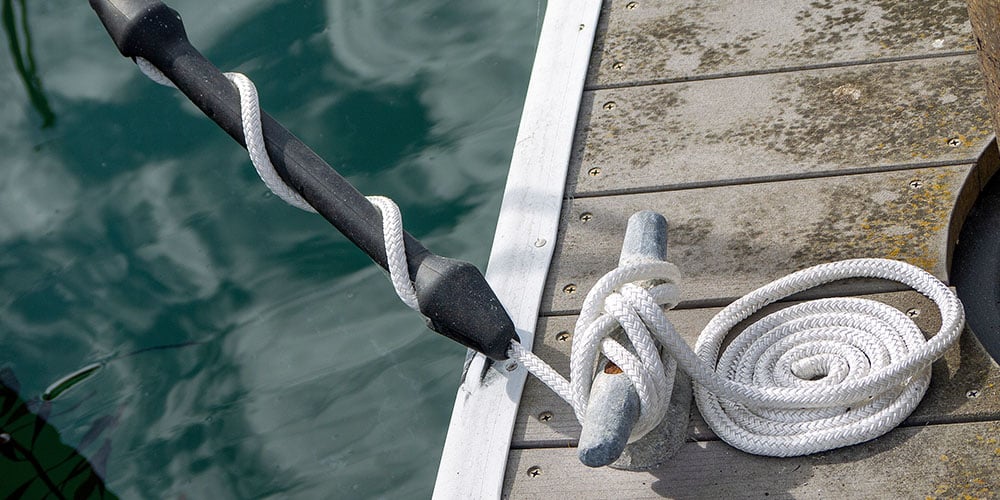
Are your dock lines green, stiff, or starting to fray? Then it’s time to replace them. We’ll walk you through how to choose the right dock lines for your boat and give you some common upgrades that will make yours look great and last longer.
- Best Dock Line Fiber and Construction Types
- Transient vs. Permanent Dock Lines
- How Long Should Dock Lines Be?
- What Dock Line Diameter Do I Need?
- Customizing Your Permanent Dock Lines
- How to Keep Dock Lines from Chafing
- How to Tie a Boat to Dock Hardware
- How to Tie Spring Lines on a Dock
- How to Wash Your Dock Lines
- FAQs
| Skill Level | |
|---|---|
| Tying a cleat hitch: 1 out of 10 | |
| Tying a boat to a dock using bow, stern, and spring lines: 2 out of 10 | |
| Assembling a permanent set of dock lines: 5 out of 10 | |
| Tools Required | Shopping List |
|
Three-strand eye splices:
Whipping the bitter end:
Cutting chain:
|
|
Best Dock Line Fiber and Construction Types
Dock lines should be made from nylon, a synthetic fiber with a superior combination of strength and stretch. Nylon is strong (though it shrinks and loses about 10–15% of its strength when wet), durable, and stretchy — three-strand nylon stretches up to 16% of its length when loaded to 15% of its breaking strength, absorbing shocks effectively. Low-stretch lines like worn-out polyester double braid are less desirable for docking because they transmit shocks from waves directly to dock cleats and deck hardware. There are three main construction types for dock lines.
Three-Strand Dock Lines
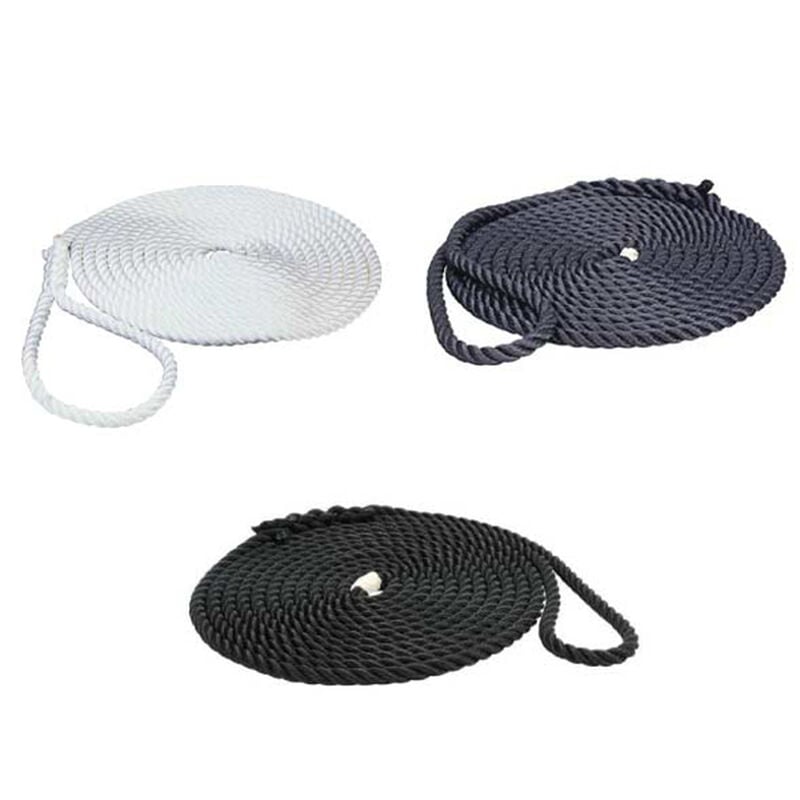
Three-strand line has a knobby finish, is easy to splice, and is the most affordable. It also has the most stretch of the three types, making it the best shock absorber — ideal for exposed slips or anchorages with significant wave action or boat traffic.
Double Braid Dock Lines
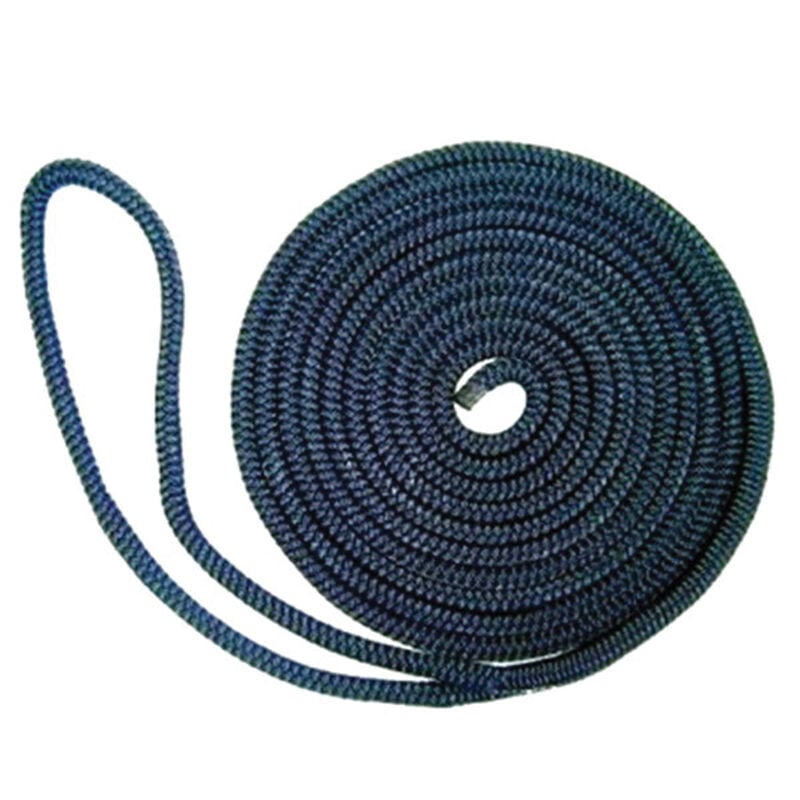
Double braid is somewhat stronger for a given size, has about half of three-strand’s stretch, and is available in many colors so you can coordinate your dock lines with your trim or canvas. The smoother surface is easier on hands than three-strand.
Mega Braid Dock Lines
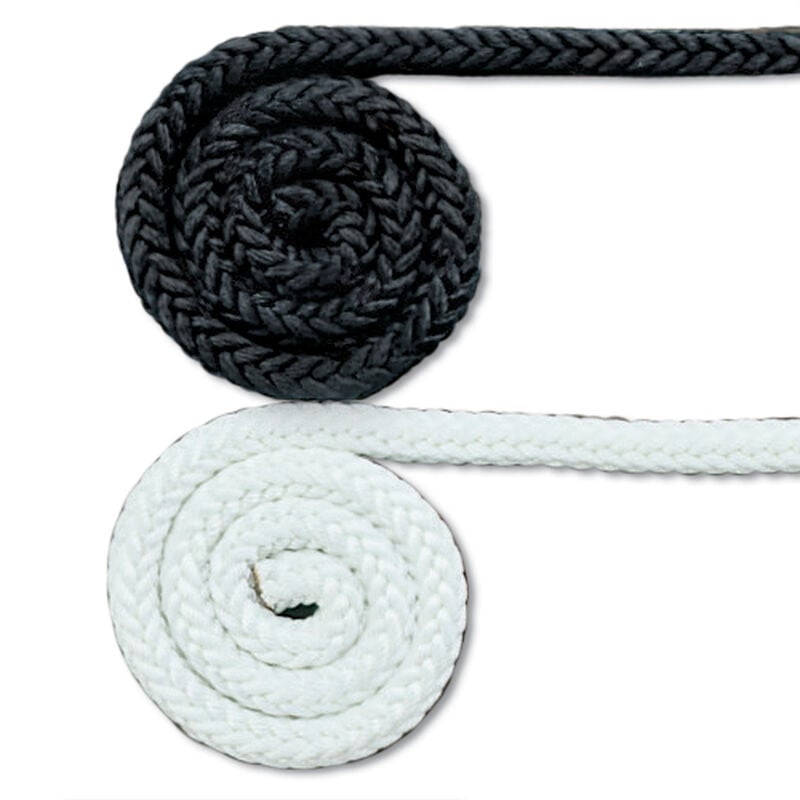
Mega Braid is a 12-strand single braid from New England Ropes. Single braids are very supple and limp — easy to coil and handle. Mega Braid is frequently the choice for boats above 70’. It is harder to splice, so boaters may want to order custom Mega Braid from West Marine Rigging. Available in white or black.
Transient vs. Permanent Dock Lines
When your boat is away from its regular slip, you need designated dock lines aboard — preferably with spliced eyes — ready for use wherever you tie up. These are transient dock lines.
Transient dock lines are generally purchased pre-made with an eye splice at one end and a whipped bitter end. The eye passes easily around a cleat or piling by someone on the dock and the bitter end is adjusted aboard. They are available in dozens of diameter and length combinations.
Permanent dock lines are attached to the hardware of your slip. They must be protected from chafe — the enemy of all lines in constant use. Use leather, rubber, or fabric chafe gear where the line passes through chocks, and possibly a chafe sleeve on the eye where it goes around the deck cleat. At the dock, protect lines using eye splices and shackles if the dock has rings, or eye splices and short lengths of chain if the dock has cleats. Permanent dock lines should be cut to fit the specific boat in the slip. Trailerable boats that don’t have a permanent berth may only carry transient dock lines.
How Long Should Dock Lines Be?
Bow and stern lines should be about two-thirds of the boat’s length. Spring lines run aft from the bow to the dock (an after spring) and forward from the stern to the dock (a forward spring) and should be as long as the boat.
This rule works well in practice. On Chuck’s 21’ Zodiac, he bought 15’ white three-strand lines for the bow and stern and 20’ lines for the springs — perfect. Tom uses blue double braid dock lines for his Newport 30 sailboat. He bought 25’ bow and stern lines, trimmed them to 20’, whipped the ends with waxed whipping twine, burned the ends, and dipped them in Flexible Vinyl Rope Dip for a clean, professional look. The spring lines were 35’, trimmed to 30’ with the same finishing.
What Dock Line Diameter Do I Need?
The same rule that applies to anchor line also works for dock lines: 1/8” of line diameter for every 9’ of boat length. Larger lines wear longer but stretch less — and stretch matters for absorbing shock loads from waves and passing boat wakes.
| Boat Length | Dock Line Diameter |
|---|---|
| Up to 27’ | 3/8” |
| 28’–31’ | 7/16” |
| 32’–36’ | 1/2” |
| 37’–45’ | 5/8” |
| 46’–54’ | 3/4” |
| 55’–63’ | 7/8” |
| 64’–72’ | 1” |
Even if your boat is under 20’, 3/8” is a comfortable size to handle. Lines that are too small stretch excessively and wear out prematurely. Lines that are too large may not fit your cleats correctly and won’t stretch enough to absorb shock loads.
Heavier boats may need larger diameter lines. A heavy Grand Banks trawler or fully loaded cruising sailboat might use the rule of 1/8” per 8’ of boat length instead: 3/8” for boats to 24’, 1/2” for boats to 32’, 5/8” for boats to 40’.
Customizing Your Permanent Dock Lines
Transient dock lines are simple and generic — choose the right length and diameter and you’re done. At your home slip, customize your permanent lines to exact lengths so that when you return, you simply drop them over the cleats or bollards and you’re done — no adjusting, no fiddling.
How to Keep Dock Lines from Chafing
Chafe is damage caused by lines rubbing on surfaces. It is inevitable, but can be reduced by avoiding abrupt line angle changes and by using abrasion-resistant pads — lengths of leather or hose called chafing gear. Even smooth, large-radius surfaces abrade nylon and polyester lines over time.
Chafe guards provide a sacrificial surface that takes the damage without reducing the line’s breaking strength. The type of hardware on the dock or piling determines the best type of splice and chafe protection. For rings or eyebolts, an eye splice around a thimble and a galvanized shackle is ideal. For cleats, a short loop of anchor chain around the base of the cleat through a galvanized thimble works exceptionally well. Either method will last far longer than simply tying the line directly to the dock hardware.
How to Tie a Boat to Dock Hardware
In our local harbor we have large galvanized dock cleats, so we use a loop of chain about a foot in diameter through the center of the cleat and the thimble, closed with a chain link or common shackle. If the chain ever needs replacement, cut it off with a hacksaw. This method completely eliminates chafe at the dock and also prevents dock lines from being stolen. Your marina may use galvanized eyes or other connection points — adapt accordingly with shackles or other suitable hardware.
How to Tie Spring Lines on a Dock
Spring lines run from the same cleats as bow and stern lines but in the opposite direction, keeping the boat parallel to the dock and preventing fore-and-aft movement. You may not use four lines every time you tie up for lunch or fuel, but a forward spring will make your boat sit more securely at the dock.
To make a line fast to a cleat: take a full turn around the base, then a turn across the cleat, then a locking hitch. That’s all you need — simple to tie and simple to untie. If you can’t remember the proper cleat hitch, keep in mind the boater’s refrain: “If you can’t tie knots, tie lots!”
How to Wash Your Dock Lines
If your double braid dock lines have become stiff and dingy, you can make them look like new again by putting them in an old pillowcase and running them through a top-loading washing machine with liquid laundry detergent and a little fabric softener. The pillowcase keeps the lines from wrapping around the agitator and binding up the machine. Use more than one pillowcase to balance the load. Do not try this in a front-loading washer — our friends ruined their marina’s community washing machine this way.
Frequently Asked Questions
What is the difference between three-strand, double braid, and Mega Braid dock lines?
Three-strand has the most stretch (up to 16%), making it the best shock absorber for exposed slips and rough conditions. It is easy to splice and the least expensive. Double braid has about half the stretch of three-strand, is stronger for the same diameter, and comes in many colors. Mega Braid is a very supple 12-strand single braid preferred on larger boats above 70’ where handling ease and low weight matter. For most recreational boats, double braid is the best all-around upgrade from three-strand; three-strand remains the right choice where maximum shock absorption is needed.
What dock line length do I need?
Bow and stern lines should be approximately two-thirds of the boat’s length. Spring lines (which run fore and aft along the dock to prevent the boat from moving forward and backward) should be approximately equal to the boat’s length. For a 30-foot boat: bow and stern lines of about 20 feet, spring lines of about 30 feet. Cut permanent dock lines to the exact lengths that work in your slip to eliminate adjustment on every docking.
What diameter dock line do I need for my boat?
Use 1/8” of diameter per 9 feet of boat length as a starting rule. Up to 27 feet: 3/8”. Up to 36 feet: 1/2”. Up to 45 feet: 5/8”. Heavy displacement boats (trawlers, fully loaded cruising sailboats) should use the rule of 1/8” per 8 feet instead. Lines that are too small stretch excessively and wear out quickly; lines that are too large won’t fit cleats properly and won’t stretch enough to absorb shock loads.
Why is chafe protection important for permanent dock lines?
Permanent dock lines are in constant use, constantly moving as the boat moves with wind, current, and passing wakes. Every point where the line contacts a chock, cleat, piling, or dock hardware is a chafe point. Without protection, a line can be chafed through in a matter of days at an active marina — and a parted dock line at 2 AM in bad weather is a serious problem. Chafe guards, leather wraps, and the chain-through-cleat method at the dock eliminate or dramatically reduce this risk. It’s one of the most important and most overlooked aspects of boat docking.


