The best anchor depends on where you anchor, not just what size your boat is. Sand, mud, grass, and rock all favor different anchor designs — and most experienced boaters carry at least two. This guide breaks down every anchor type, how to size one for your boat, and which designs hold best in which bottom conditions.
- Anchor Type Chart
- What Style or Category?
- What Weight Range Fits My Boat?
- What Are the Typical Bottom Conditions?
- Holding Power
- Materials to Choose From
- Stowage in a Roller or Locker
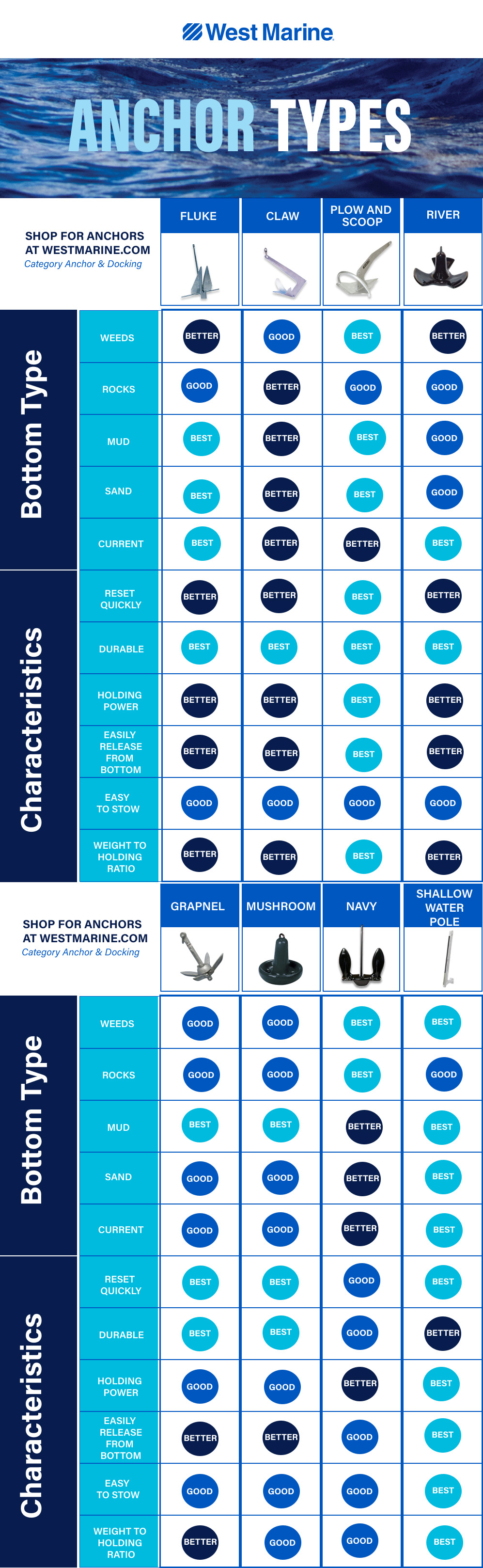
Which Style or Category of Anchor?
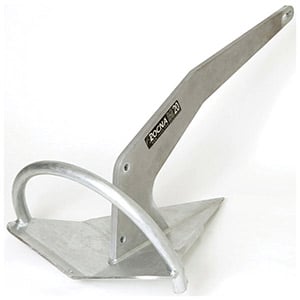
Rocna Anchors stand out for their holding power, setting ability, and ease of use.
Choose between the two most common anchor styles, the fluke and the plow, or if you are boating in a small boat on protected inland waters, the inland type.
The most popular type is the fluke anchor, also called the Lightweight or Danforth — which includes the West Marine Traditional and Performance2 anchors — and is often the only anchor on many smaller boats. Light and easy to weigh, it stows flat and holds well in mud or sand. Its excellent holding power-to-weight ratio means you can use a lighter anchor compared to other types, but it doesn’t hold well in grassy or rocky surfaces. Its flukes and stock (the wide crossbar at the top) are more prone to fouling on rocks or the anchor rode.
Plow and scoop anchors — the “single point” style represented by the Manson Supreme, Rocna, CQR, Delta, and Claw — have the best all-around holding ability in varying bottom conditions. They generally reset themselves easily if the wind or current changes direction. The newest scoop designs, like the Manson and Rocna, include round “roll bars” that self-right the anchor, automatically turning it right side up for consistent setting. Plow and scoop anchors hold more effectively in grass, mud, and sand, and do not have projecting flukes that foul easily. Their shape makes stowing them more awkward — a bow roller or bowsprit is the best solution. Heavier powerboats and cruising sailboats often use plows as primary anchors.
Claw anchors set easily and perform well in most conditions. They handle most bottom types but struggle with hard bottoms like clay or in heavy grass.
Mushroom anchors are a popular choice for smaller boats and personal watercraft. Their small size makes them easy to stow, and many are PVC-coated for easy cleaning. They are not suitable as primary anchors for overnight or storm use.
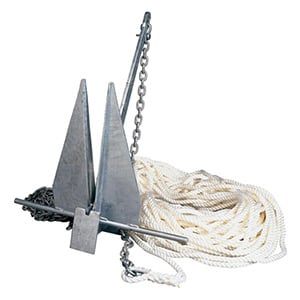
West Marine Traditional Anchor and Rode Package combines a Danforth-style fluke anchor, spliced three-strand line with galvanized Proof Coil chain, thimble, and shackles. Excellent small boat rode at a value price.

Delta is a modern plow-style anchor popular on boats with bow rollers.
Use Two Anchors of Different Styles
Most boating experts agree that for greatest anchoring security, you should carry two anchors of different styles — one Danforth-style fluke anchor and one plow or scoop. The type of bottom — mud, grass, sand, or rock — will dictate different choices, as will the size and windage of the boat, wind conditions, and sea state. Some anchoring situations also call for more than one anchor simultaneously.
You sometimes need to set two anchors in a crowded anchorage, with anchors at the bow and stern to limit swinging. Two anchors set from the bow at a 60° angle are another good way to improve security against swinging and dragging, and they allow you to shorten the rodes and use less scope. In heavy weather, where one anchor may not have enough holding power, setting a second anchor may be critical. Remember that as wind speed doubles, the force on the boat and ground tackle increases by four times — a 40-knot wind puts four times the load on your system as a 20-knot wind.
What Weight Range Fits My Boat?
Choose an anchor sized for your boat and the locations and weather where you anchor. Take the anchor manufacturer’s suggested sizes into account and consider your boating style. Do you typically anchor for two hours or two weeks, in a lake or in the Atlantic Ocean?
Sizing an anchor reinforces, with some limits, the “bigger is better” idea. If your engine fails and you are drifting toward a lee shore, having a properly sized anchor ready could save your boat. But raising the anchor by hand, with no electric windlass, calls for light and efficient ground tackle. The key is matching anchor weight to your boat’s displacement and windage — not just its length.
| Boat Length | Boat Weight (approx.) | Fluke Anchor (Danforth) | Plow / Scoop Anchor | Claw Anchor |
|---|---|---|---|---|
| Up to 20’ | Up to 2,500 lbs | 4–8 lb | 7–10 lb | 7–10 lb |
| 20’–25’ | 2,500–5,000 lbs | 8–13 lb | 10–15 lb | 10–15 lb |
| 25’–35’ | 5,000–10,000 lbs | 13–22 lb | 15–25 lb | 15–25 lb |
| 35’–45’ | 10,000–20,000 lbs | 22–35 lb | 25–35 lb | 25–35 lb |
| 45’–60’ | 20,000–40,000 lbs | 35–60 lb | 35–55 lb | 35–55 lb |
| Over 60’ | 40,000+ lbs | 60+ lb | 55+ lb | 55+ lb |
Weights are guidelines. Size up in exposed anchorages, heavy weather, or high-windage boats. Always follow anchor manufacturer recommendations for your specific model.
Holding Power
Weight is important, but what you’re looking for when buying an anchor is holding power, which may have little relation to the anchor’s size and weight. When an anchor penetrates the surface of the seabed, suction created by the bottom material plus the weight of material above the anchor creates resistance. In rocky bottoms, anchors can’t dig in but rather snag on protrusions and hold precariously.
The holding power of modern anchors is remarkable, varying between 10 and 200 times the anchor’s weight — some 5 lb anchors can hold in excess of 1,000 lbs. For a detailed look at holding power, see the West Advisor article Anchor Testing, where you can download Bill Springer’s write-up on our tests from the October 2006 issue of Sail Magazine. The technology is virtually unchanged from this period.
What Are the Typical Bottom Conditions?
Anchors need to develop enough resistance in the seabed to withstand the force of wind and waves on the boat. An anchor’s ability to develop resistance is entirely dependent on its ability to engage and penetrate the seabed. In all of our anchor tests, one conclusion is consistent: the selection of a suitable bottom is a much more critical factor than the design of the anchor itself.
One important term to understand is “false setting.” This happens when an anchor appears to have set firmly — you back down and it doesn’t drag — but has actually caught on a root, rock protrusion, or clump of vegetation rather than properly penetrating the seabed. A falsely set anchor can break free suddenly when load increases or direction changes. Grassy and rocky bottoms have the highest probability of false setting. Always verify your set by backing down steadily with the engine and checking your position against fixed landmarks before trusting any anchorage, and monitor periodically throughout your stay.
| Bottom Type | Best Anchor Types | Notes |
|---|---|---|
| Sand | Fluke (Danforth), Scoop (Rocna, Manson) | Most anchors perform well — highest holding power in hard sand |
| Mud | Fortress (adjustable fluke angle), Fluke anchors | Needs broad fluke area; Fortress adjusts to 45° for deeper penetration |
| Rock | Plow (CQR, Delta), Claw, Grapnel | Anchors snag rather than dig in — high structural strength required |
| Grass / Weed | Scoop (Rocna, Manson Supreme, CQR, Delta) | High false-setting risk — weight matters more than design; size up |
| Clay / Shale | Heavier versions of any type; Scoop preferred | Hard to penetrate — anchor weight is the primary factor |
| Mixed / Unknown | Scoop (Rocna, Manson Supreme) | Best all-around choice when bottom conditions are unpredictable |
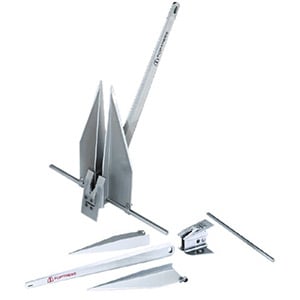
The Fortress, an aluminum-magnesium Danforth-style anchor, showed remarkable holding power in our 2006 anchor tests — the 21 lb FX37 sustained over 5,000 lb of load.
Sand: Fine-grained sand is relatively easy for anchors to penetrate and offers consistently high holding power. Most anchors hold greatest tension in hard sand. Pivoting-fluke anchors and non-hinged scoop anchors are the best types in sand. The Rocna performed excellently in our anchor tests in sand.
Mud: Mud has low shear strength and requires anchor designs with a broader shank-to-fluke angle and greater fluke area to penetrate deeply to where the mud has greater shear strength. Mud is frequently only a thin layer over another material — anchors that penetrate through to the underlying material hold more. Fortress anchors have greater holding power in mud because they can be adjusted from their standard 32° to a broad 45° fluke angle.
Rocky bottoms: Holding power depends more on where you drop the hook than on anchor type. Plow-shaped or grapnel-type anchors with high structural strength generally work best — including the Claw, CQR, Delta, Rocna, and Manson Supreme.
Shale, clay, and grassy bottoms: Anchor weight, more than design, is often the most important factor. CQR, Delta, Rocna, and Manson Supreme anchors are favored for their ability to penetrate vegetation. These conditions have a high probability of false setting — always verify your set by backing down firmly.
Materials to Choose From
You have three options: galvanized steel, Grade 316 stainless steel, or lightweight aluminum-magnesium alloy. Most boaters choose galvanized for cost reasons, with the added advantage of the highest tensile strength for the weight. Stainless anchors dress up the bow of your vessel. Owners of ultralight sailboats and sailboat racers who care greatly about weight in the bow can choose the aluminum-magnesium Fortress anchor, the Guardian, or the Manson Racer. Aluminum-magnesium anchors offer holding power comparable to heavier galvanized anchors of the same design at a fraction of the weight.
Stowage in Roller and Lockers
Plow and scoop anchors have curved shanks that self-launch more easily on a bow roller and are the most common choice if you’re using a windlass and want remote-control operation. Fluke anchors stow flat in a locker but require more effort to deploy from a bow roller since they do not self-orient. If your boat has a fixed bow roller and windlass, choose your anchor based on roller compatibility first — confirm with the manufacturer that the shank dimensions and head geometry fit your specific roller before purchasing.
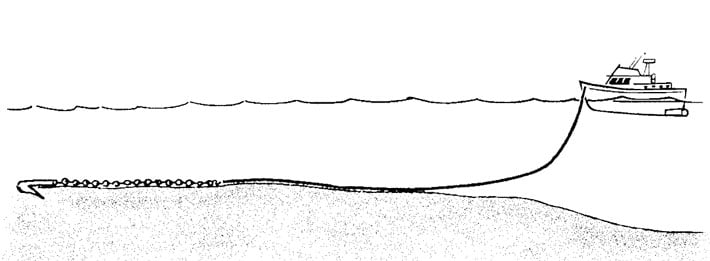
Scope: The ratio of rode length to the height (distance from the bow chock to the bottom) is critical for safe anchoring. More scope is generally better. This example shows about a 4:1 scope.
Frequently Asked Questions
What type of anchor is best for my boat?
The best answer for most boaters is two anchors of different types. A fluke (Danforth-style) anchor is the standard choice for sand and mud — light, strong holding power-to-weight ratio, and easy to stow flat. A plow or scoop anchor (Rocna, Manson Supreme, CQR, Delta) is the best all-around choice for varied bottoms including grass, mixed, and open roadsteads where you may not know the bottom composition. Carrying both gives you options: use the plow or scoop as your primary, and the fluke as a second anchor for two-anchor setups or for conditions where the fluke excels.
How do I choose the right size anchor for my boat?
Use the sizing table above, based on boat length and displacement. A high-windage powerboat or motorsailor with a large superstructure needs a larger anchor than a low-profile racing sailboat of the same length. When in doubt, size up — a slightly heavier anchor is far less consequential than one that drags in a storm. Always check the anchor manufacturer’s specific sizing chart for the model you are considering, as different designs have different holding power per pound.
What is the appropriate scope for anchoring?
Scope is the ratio of rode length to the vertical distance from your bow chock to the bottom. The minimum in calm protected conditions is 5:1 — 50 feet of rode for 10 feet of water depth measured to the bow chock. In open anchorages, overnight stays, or any conditions with wind above 15 knots, 7:1 is the correct minimum. In storm conditions or in exposed anchorages with surge, 10:1 is appropriate if swinging room permits. Greater scope reduces the angle of pull on the anchor and dramatically improves holding power by keeping the shank closer to horizontal. A steep angle of pull is the most common cause of anchor dragging — more scope, not a heavier anchor, is usually the right first response.
Should I use chain or rope for my anchor rode?
Most cruising and offshore boats use a combination: a length of chain at the anchor end spliced to a nylon rope tail. Chain adds weight that keeps the shank angle low and horizontal, resists chafe against rocks and coral on the bottom, and its catenary acts as a shock absorber for surge loads. West Marine recommends a minimum of one boat length of chain as the chain leader for a rope-chain combination rode. All-chain rodes provide maximum chafe resistance and catenary effect but are heavy and require a windlass. All-rope rodes are lighter and easier to handle by hand but provide less catenary and are vulnerable to chafe at the anchor end.
How do I ensure my anchor holds properly?
After deploying the anchor, pay out the full scope before testing the set. Back down slowly with the engine in reverse while watching fixed bearings ashore. If the anchor sets, gradually increase reverse power until backing down firmly. A properly set anchor will hold the boat stationary against moderate engine power. If the anchor drags, haul it, reposition, and try again — don’t trust a dragging anchor to hold in wind and current. Monitor your position periodically, especially if conditions change overnight.
Related Articles
- Anchor Rollers
- Anchor Testing
- Anchoring for the Racing Sailor
- Selecting an Anchor Rode
- Upgrading Your Anchor Rode


