
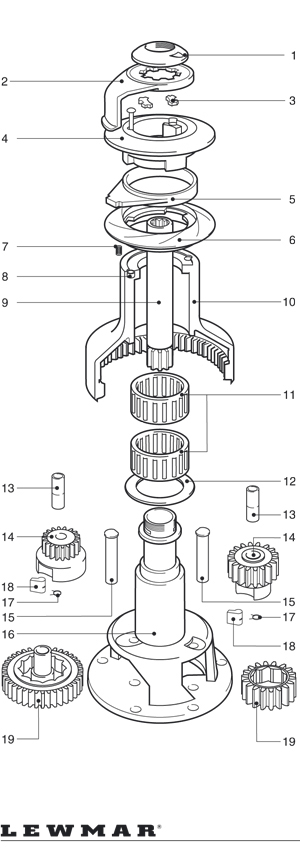
Know your winch: 1. ‘O’ Ring 2. Feeder arm 3. Collet 4. Upper crown 5. Stripper ring 6. Lower crown 7. Spring 8. Spring cup 9. Main spindle 10. Drum 11. Roller bearing assembly 12. Drum washer 13. Gear spindle sleeve 14. Pawl gear 15. Gear spindle 16. Center stem 17. Pawl spring 18. Pawl 19. Ratchet gear.
Keep your winches in top shape without denting your wallet by servicing them yourself. Regular maintenance prolongs the life of these expensive machines and keeps them functioning properly. Although they may look fine on the outside, poor maintenance results in friction and inefficiency and allows corrosion to take hold. Dirt and metal grind down surfaces every time the winch is used.
Your boat’s winches should be serviced at least once or twice during the sailing season depending on how much you sail, and again in the fall when the boat is hauled. Service them immediately if:
- Ratcheting seems sluggish or sticky: Pawls may have been greased instead of oiled. Clean any grease off and oil the pawls — grease causes pawls to stick, which can allow the winch drum to spin backward under load.
- The winch doesn’t turn freely: Refer to the winch manual and clean, grease, and oil the winch. Check for damaged springs, pawls, or bearings.
- The winch turns in both directions: Indicates a pawl problem. Pawls may be stuck in grease or damaged and need replacement.
- Preparation
- Disassembly, Cleaning, and Inspection
- Lubrication
- Reassembly and Ongoing Care
- How to Service an Andersen Winch
- FAQs
Preparation
Winches vary by manufacturer and by the number of speeds they have, so having your winch service manual handy is essential. If you don’t have the manual, most manufacturers offer a PDF version online, along with YouTube videos with step-by-step instructions. Lewmar, Harken, and Andersen all maintain service documentation on their websites.
Replacement parts in the form of a service kit should be purchased before you start. Anyone who has serviced a winch has seen pawls fly and springs leap into the bilge. A proven tip: cut a hole the diameter of the winch drum in the center of a shallow box (a soda-can flat from a grocery store works perfectly). Slip the box over the winch before you begin and secure it with masking tape. All parts stay in the box, not on the deck and overboard.
To reduce confusion during reassembly, place parts down in the order you removed them, then clean them in that same order. When you set each cleaned part back in its spot, the parts are always in sequence for quick reassembly. Take photos with your phone as you go — a picture of every stage of disassembly costs nothing and is invaluable when you are looking at a pile of small parts wondering what goes where. Disposable nitrile gloves keep grease, solvent, and grime off your hands.
Disassembly, Cleaning, and Inspection
Disassembly varies by make and model and involves more parts if the winch has multiple speeds or a self-tailer. Refer to the manufacturer’s service manual for your specific model. The following is a general guide for basic winches.
Removing the drum: On Lewmar models, unscrew the cap at the top of the drum surrounding the winch handle socket — modern Lewmar winches require no tools. On Harken winches, use a flat screwdriver to unscrew the top screw in the bottom of the handle socket, then remove the top cap and lift off the drum. Self-tailing winches require removing the stripper arm and self-tailing jaws before the drum can come off. When pulling the drum, watch for bearings stuck inside that are ready to drop — losing a bearing roller overboard ends your day early. Have a small container ready to catch any loose rollers as the drum comes free.
Removing internal components: Remove and clean the drum, bearings, and washer. Remove the spindle retaining collets or “keys” (Lewmar) and lift out the main spindle. On two-speed winches, use a small screwdriver to lift out the gear spindle and remove the gears. Place each part in the box in the order removed. When you clean each piece, set it back in its spot on the paper. Parts always stay in sequence for reassembly.
Cleaning: Use a tub with solvent-based cleaner — mineral spirits, diesel, or a commercial degreaser all work. Do not use gasoline, which can damage plastic parts. Use a lint-free cloth for most surfaces; an old toothbrush reaches into gear teeth effectively. Dry all parts thoroughly before applying any lubricant. Leftover solvent on a surface will break down any oil or grease applied over it, leaving parts effectively unlubricated even though they look coated.
Inspecting pawls, springs, and bearings: Remove, clean, and inspect pawls and springs carefully. Look for wear, pitting, or distortion and replace as needed. Check for broken springs — a broken spring is not always obvious until the pawl fails to return to its engaged position under its own tension. Lewmar recommends replacing pawls every five years and installing new springs every time you service the winch — springs are inexpensive and a broken spring causes immediate failure. Check bearings, gears, and spindles for wear and corrosion. Inspect the winch base for rot in teak pads and cracks around bolt holes. Check the inside of the drum for wear, particularly on anodized aluminum drums where deep grooves from line contact indicate significant wear.
Lubrication
Once everything is completely dry and all solvent residue is wiped away, lubricate as follows. Getting lubrication right is the most critical part of a winch service — the right lubricant in the right place determines how well the winch functions, and the wrong lubricant in the wrong place causes immediate failure.
- Pawls: Use light machine oil only — not grease, not WD-40, not spray lubricant. Grease is viscous enough to slow or prevent the pawl’s rapid snapping action. A pawl that cannot snap cleanly against the ratchet gear allows the drum to spin freely in both directions, which can result in a sudden, dangerous release of line under load. A single drop of light machine oil on each pawl pivot point is the correct application.
- Spindles, gears, and bearings: Use a brush to spread a light, even coat of dedicated winch grease on all spindle surfaces, gear teeth including those inside the drum, and all bearing surfaces. The key word is light — a thin, even film is what you are after. Do not pack the winch with grease. Excess grease traps salt and water inside the mechanism, turning every service into a more difficult job and accelerating the corrosion you are trying to prevent. If the winch looks like it was packed with axle grease when you opened it, that is the problem, not the solution.
Reassembly and Ongoing Care
With parts in order and lubricated, reassembly is straightforward. Reverse the disassembly sequence, using your photos as a reference. If you placed parts in order throughout, you should have the winch back together quickly without leftover pieces. If a part does not go in smoothly, check your photos — do not force components. Most assembly problems result from something being out of sequence or oriented incorrectly.
Test the winch before wrapping up: the drum should rotate freely in the wind direction and ratchet positively in the load direction. Insert the winch handle and apply light pressure — there should be no slipping or roughness. If anything feels wrong, disassemble and check before the boat leaves the dock.
Once all winches are serviced, a few ongoing habits extend the time between full services:
- Flush with fresh water after every outing — particularly after saltwater sailing. A quick rinse of the drum, handle socket and base with a hose prevents grit and salt crystals from being ground into surfaces each time a line loads up on the drum. This single habit extends service intervals more than anything else.
- Cover winches when not in use — UV, rain, and airborne grit all accelerate wear on exposed surfaces. A simple canvas cover keeps the drum and hardware protected during storage and between sails.
- Service annually at minimum — or immediately at the first sign of sluggishness, sticking, or bidirectional rotation. Catching problems early costs minutes and a few dollars in springs. Ignoring them costs a full service at best, a replacement winch at worst.
Well-maintained winches last decades. The many “plastic classic” boats still sailing on their original 1970s-vintage Barient winches are proof: proper maintenance, not replacement, is what keeps these machines working season after season.
How to Service an Andersen Winch
The video below covers servicing an Andersen winch. Some parts differ from Lewmar, Harken, and other manufacturers, but the process is essentially the same across brands: disassemble in order, clean thoroughly, dry completely, oil the pawls, grease everything else lightly, reassemble in reverse.
Sailboat Winch Servicing FAQ
Pawls are spring-loaded ratchet components that must snap in and out rapidly as the winch drum rotates. Grease is viscous enough to slow or prevent this action — a pawl stuck in grease can allow the drum to spin freely in both directions, which removes all ratchet function and can cause sudden, dangerous loss of line control under load. Light machine oil lubricates the pawl pivot without interfering with the spring action. This is the single most common winch servicing mistake and the most critical distinction to get right.
At minimum, once a year — ideally at the start and end of the sailing season, and again after heavy use. Boats that sail frequently in saltwater should service more often. Service immediately if you notice sluggish ratcheting, the drum not turning freely, or the drum rotating in both directions. Lewmar specifically recommends replacing pawls every five years and springs at every service regardless of their apparent condition — springs are inexpensive and a broken one causes immediate failure.
Mineral spirits, diesel fuel, or a commercial degreaser all work well. Avoid gasoline — it can swell and damage plastic winch components. Use a lint-free cloth for most surfaces and an old toothbrush for gear teeth and tight spaces. Dry all parts completely before applying any lubricant — solvent residue on a surface will break down freshly applied oil or grease, leaving the part unlubricated even though it appears wet.
Cut a hole the diameter of the winch drum in the center of a shallow cardboard flat — the kind cases of soda cans come in. Slip this over the winch and tape it in place before starting disassembly. All small parts — pawls, springs, collets, bearings — fall into the box rather than rolling across the deck and overboard. Combined with laying parts out in the order they were removed, it makes reassembly significantly faster and eliminates the frustration of hunting for a missing spring in the bilge.
Yes, but it takes more time and care. Two-speed winches have additional gear sets that must be disassembled, cleaned, and reassembled in correct sequence. Self-tailing winches add a stripper arm and jaw mechanism that must be removed before the drum comes off. Download the manufacturer’s service manual for your specific model and watch the corresponding YouTube video before starting. Taking photos at each disassembly step is particularly important for these more complex winches — the sequence for reassembly is less intuitive than a single-speed model.