Electric Outboard Motor Guide: How They Work, What to Buy, and Everything In Between
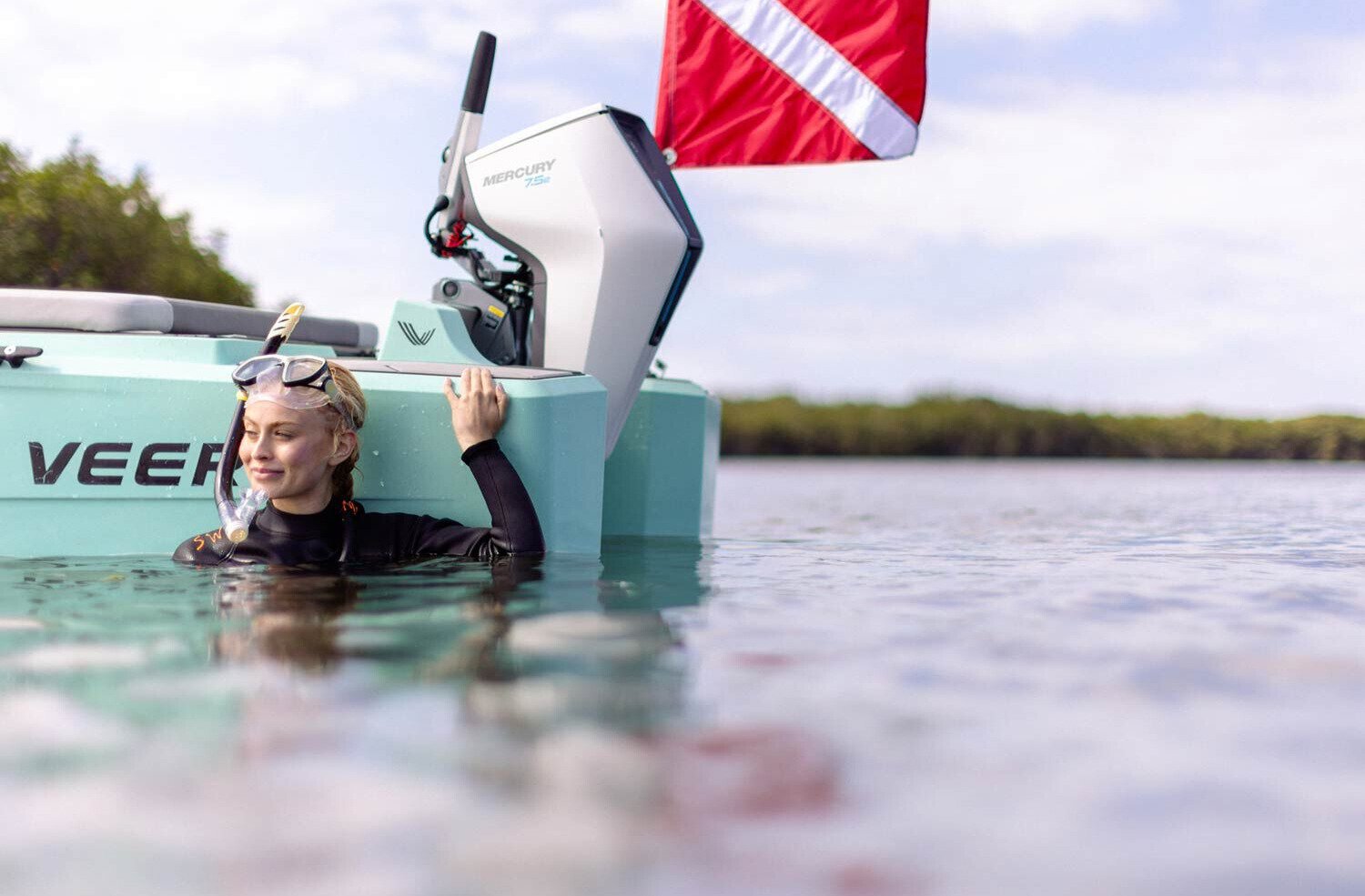
An electric outboard motor is a battery-powered propulsion system mounted on a boat's transom or stern. It converts electrical energy stored in rechargeable batteries directly into thrust — with no gasoline, no oil changes, no exhaust, and no combustion components to maintain. The result is quieter, cleaner, simpler boating that more and more recreational boaters are choosing as their primary or secondary propulsion.
This guide covers everything you need to know about electric outboard motors: how they work, how to choose the right horsepower and voltage system, how to plan battery range, how to install and maintain your motor, and who electric propulsion is the right fit for.
Shop Electric Outboard Motors at West Marine
Shop Marine Batteries for Electric Motors
West Advisor: Electric & Hybrid Propulsion Systems
Explore Every Aspect of Electric Outboard Motors
Whether you're comparing brands, sizing a motor for your boat, or researching remote control options, use the links below to dive deeper into the topics most relevant to your electric boating setup.
-
Best Electric Outboard Motor Brands – Compare top-rated brands including Newport, Elco, Torqeedo, Mercury, and more for reliability, performance, and value.
-
Electric Outboard Motor Horsepower Guide – Find the right HP rating for your boat type and learn how power output affects speed, range, and battery requirements.
-
How Electric Outboard Motors Work: Complete Guide – A deep dive into the technology behind brushless motors, motor controllers, and battery management systems.
-
Remote-Controlled Electric Outboard Motors – Explore models with wireless remote, foot-pedal, and smartphone app control capabilities for hands-free operation.
What Is an Electric Outboard Motor?
Electric outboard motors fall within the broader category of electric marine propulsion, which includes two main configurations:
- Electric Inboard Motors: Built into the hull and connected to a fixed driveshaft. Common in sailboats and larger vessels where weight is less critical than efficiency over long passages.
- Electric Outboard Motors: Mounted externally on the transom or stern. Steerable, removable, and available in a wide range of power levels from sub-1 HP to 100+ HP equivalent. The most popular electric propulsion format for recreational boating.
Unlike gasoline outboards, electric outboard motors have no fuel system, no exhaust system, and no internal combustion components — meaning no spark plugs to replace, no carburetors to clean, no oil changes, and no winterization beyond battery storage. They run on rechargeable battery banks (lithium-ion, AGM, or lithium iron phosphate) and are controlled via tiller handle, wireless remote, foot pedal, or smartphone app depending on the model.
How Do Electric Outboard Motors Work?
Electric outboard motors work by converting electrical energy stored in a battery bank into mechanical rotational energy that spins a propeller to generate thrust. The process is straightforward and involves far fewer moving parts than a gasoline engine:
- Battery Power: A marine battery bank (lithium-ion or AGM) supplies direct current (DC) electricity to the system.
- Motor Controller: A throttle control or digital interface regulates voltage and amperage flow from the battery to the motor. Higher throttle = more current = more thrust. The controller also provides thermal protection, diagnostics, and in advanced systems, real-time smartphone monitoring.
- Brushless DC Motor (BLDC): Most modern electric outboards use a brushless motor for maximum efficiency, longer operational life, and reduced heat generation. Brushless motors are fully sealed and waterproof on quality units.
- Shaft and Propeller: The motor turns a shaft connected to a propeller, generating forward or reverse thrust with instant, smooth torque delivery — no gear-shifting, no rev-matching, no throttle lag.
One of the most notable characteristics of electric motors is instant torque — maximum pulling power is available from zero RPM, giving electric outboards exceptionally smooth and responsive acceleration, particularly at low speeds where precise boat control matters most.
Read our complete guide: How Electric Outboard Motors Work
West Advisor: Electric & Hybrid Propulsion Systems
Key Components of an Electric Outboard Motor System
Understanding each component of your electric outboard system helps when selecting the right setup, troubleshooting problems, and planning upgrades:
- Electric Motor: The central propulsion unit — typically sealed, waterproof, and corrosion-resistant. Brushless BLDC motors are standard on modern mid- to high-power units.
- Battery Bank: The energy source that determines range, speed, and power. Common voltages include 12V, 24V, 36V, and 48V. Lithium iron phosphate (LiFePO4) batteries are widely preferred for lighter weight, longer cycle life, and superior depth-of-discharge versus AGM.
- Battery Management System (BMS): An essential safety and longevity component that monitors individual battery cell voltages, temperature, and current — preventing overcharge, over-discharge, and thermal runaway.
- Motor Controller: Modulates power delivery between the battery and motor. Includes thermal protection, soft-start logic, and diagnostics. Advanced systems also enable regenerative braking and consumption monitoring.
- Throttle Interface: Connects to the controller via tiller handle, wireless remote, foot pedal, or app. Controls both speed and direction. See our guide to remote-controlled electric outboard motors.
- Cooling System: Smaller motors (under ~10 HP) are typically air-cooled. Higher-output motors use active liquid cooling for sustained thermal stability at high power output.
- Battery Charger: Required to replenish the battery bank from shore power, a generator, or solar. Shop marine battery chargers at West Marine. Always use a charger rated for your specific battery chemistry.
Optional features on premium models include solar charging input ports, integrated GPS and chartplotter connectivity, and real-time power monitoring via Bluetooth or Wi-Fi apps.
Advantages of Electric Outboard Motors for Recreational Boaters
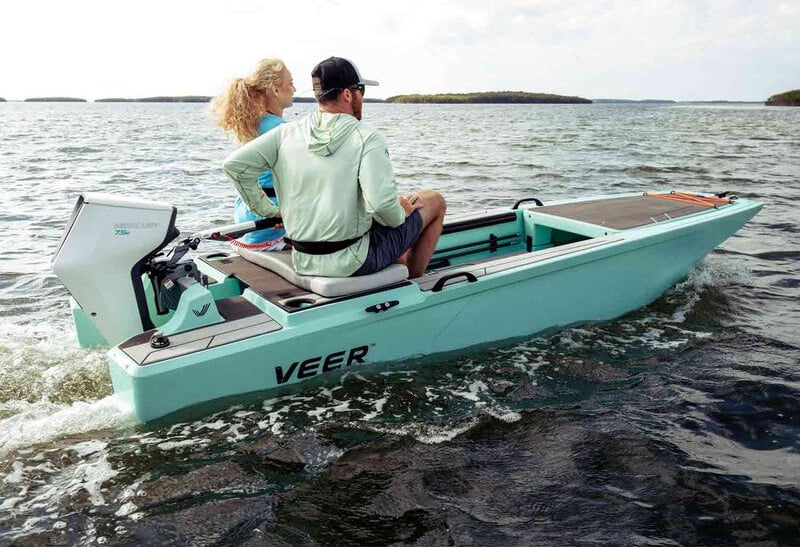
Recreational boaters are adopting electric outboards for practical reasons that go well beyond environmental values. Here's why the switch makes sense for most recreational applications:
- Near-Silent Operation: Electric motors produce virtually no noise at low and moderate throttle settings. Transformative for fishing (engine noise spooks fish), wildlife observation, and peaceful cruising in quiet waterways.
- Zero Fuel and No Oil Changes: No trips to the gas dock, no fuel spills, no mixing. You charge at home or at the marina and go. Operating costs can be pennies per hour versus dollars per hour for a gasoline motor.
- Drastically Reduced Maintenance: No spark plugs, no carburetors, no impeller, no fuel filters, no throttle body cleaning. Routine care consists primarily of rinsing the lower unit and keeping the battery charged. Shop marine battery maintainers at West Marine.
- Smooth, Instant Acceleration: Brushless electric motors deliver 100% torque from rest, providing exceptionally smooth low-speed control — ideal for docking, navigating tight channels, and slow trolling passes.
- Access to Restricted Waterways: Many inland lakes, wildlife refuges, and protected areas allow only electric motors. An electric outboard opens up boating destinations that are completely off-limits to gasoline-powered boats.
- Lower Long-Term Cost of Ownership: The higher upfront cost is typically offset within 3–5 years through fuel and maintenance savings — particularly for boaters who spend significant time on the water each season.
- Zero Emissions: No hydrocarbons, no CO₂ from combustion, no oil or fuel contamination in the water — particularly critical in freshwater ecosystems, tidal marshes, and drinking water reservoirs.
Learn more: Electric & Hybrid Marine Propulsion Systems
Electric Outboard Motor Horsepower Guide: Which Power Level Is Right for Your Boat?
Electric outboard motors are available in power levels ranging from sub-1 HP to well over 100 HP equivalent. Matching the right power tier to your specific boat and use case is critical for achieving the performance and range you expect. Here's how the major tiers break down:
Small Electric Outboard Motors: 2–5 HP
- Best for kayaks, canoes, small inflatables, dinghies, and sailboat tenders
- Lightweight and portable — most models under 20 lbs, easily carried in one hand
- Typical top speed: 5–7 knots on a light displacement hull
- Low battery draw delivers long runtime — often 4–8 hours at moderate speed
- Typically runs on a 12V single battery — the simplest and lowest-cost electric setup
- Browse 2–5 HP electric outboard motors at West Marine
Mid-Range Electric Outboard Motors: 6–10 HP
- Well suited to mid-sized aluminum fishing boats, small pontoon boats, and skiffs up to ~1,500 lbs loaded
- Balanced performance for day cruising, fishing, and light towing applications
- Typical top speed: 7–12 knots depending on hull type and load
- Requires a 24V or 36V battery system — two or three 12V batteries wired in series
- Plan for 3–5 hours at cruising throttle on a standard 100Ah battery setup
- Browse 6–10 HP electric outboard motors at West Marine
High-Output Electric Outboard Motors: 15–25 HP
- Designed for heavier planing hulls, larger pontoons, and vessels up to ~3,000 lbs loaded
- Capable of achieving planing speeds on appropriate hulls — 12–20+ knots
- Requires a 48V battery system, often with large-capacity LiFePO4 configurations
- Active liquid cooling standard on most models for sustained high-output operation
- Often includes GPS integration, app connectivity, and regenerative charging
- Browse 15–25 HP electric outboard motors at West Marine
High-Power Electric Outboard Motors: 40–100+ HP
- Purpose-built for larger center consoles, sport boats, and commercial applications
- High-voltage systems (48V–96V+) with large-capacity battery banks, often 200Ah+
- Top brands in this category include Torqeedo, Elco, and the Mercury Avator high-power series
- Professional installation strongly recommended — complex wiring, thermal management, and BMS integration required
- Browse 40–100 HP electric outboard motors at West Marine
For a complete breakdown of electric outboard horsepower selection by boat type, see our Electric Outboard Motor Horsepower Guide.
Electric Outboard Motor Voltage Systems: 12V vs. 24V vs. 36V vs. 48V Explained
The voltage of your electric outboard motor system directly determines what battery configuration you need, how much power the motor can deliver, and what speed and range are achievable. Here's a plain-language breakdown of each voltage tier:
12V Electric Outboard System
12V systems are designed for low-power applications where simplicity and budget-friendliness are the priorities. A single standard 12V marine battery powers the motor — making installation as simple as it gets. 12V limits maximum output to roughly 2–3 HP equivalent, topping out at 4–5 knots on a lightweight hull. Best suited to small tenders, kayaks, and canoes where quiet auxiliary propulsion is the goal.
24V Electric Outboard System
24V systems strike a practical balance and are the most common configuration for mid-range motors in the 5–10 HP range. Two 12V batteries wired in series deliver the voltage needed for meaningful thrust on mid-sized fishing boats and pontoons. A 24V, 100Ah lithium setup stores 2,400 watt-hours — typically enough for 3–5 hours of cruising at moderate throttle. Shop 24V marine battery systems at West Marine.
36V Electric Outboard System
36V systems use three 12V batteries in series and are common in higher-end trolling motor applications and mid-power electric outboards in the 8–15 HP range. Higher voltage means lower current draw for equivalent power — reducing heat generation and extending battery runtime. Shop 36V marine battery setups at West Marine.
48V Electric Outboard System
48V is the standard for higher-output electric outboards (15–25+ HP equivalent). At 48V, the motor can produce significantly more power than a 24V system using the same current, with less heat and wire loss. A 48V, 100Ah lithium battery stores 4,800 watt-hours — at 1,200W average draw (moderate cruising on a 15 HP motor), that's roughly 4 hours of runtime. 48V systems require careful wiring and thermal management but are well worth it for the power and efficiency gains. Shop 48V lithium marine batteries at West Marine and browse 48V-compatible marine chargers.
Battery Selection and Range Planning for Electric Outboard Motors
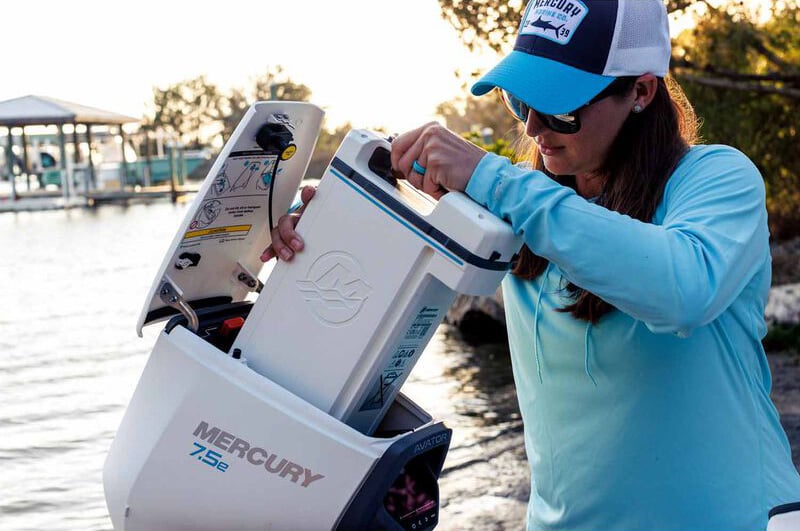
The battery system is the most consequential — and often most expensive — component of an electric outboard setup. Getting it right determines how long you stay on the water, how fast you travel, and how reliably the system performs over time.
How to Calculate Your Range: The Watt-Hour Formula
The key battery metric is watt-hours (Wh) — the total usable energy stored:
Watt-hours = Battery Voltage × Amp-Hours (Ah)
Example: A 48V, 100Ah lithium battery stores 4,800Wh. If your motor draws 1,200W at cruising speed, you have approximately 4 hours of runtime. Multiply by your average speed (7 knots) and you get roughly 28 nautical miles of range. Always reduce your estimate by 20–30% for real-world conditions.
To estimate range for your setup:
- Find your motor's watt draw at your planned cruising throttle (usually in the motor's spec sheet)
- Divide battery watt-hours by motor draw to get estimated runtime in hours
- Multiply runtime by average speed to estimate nautical mile range
- Apply a 20–30% safety buffer for wind, current, and load variation
Factors That Affect Real-World Range
- Hull type: Planing hulls are efficient at speed but power-hungry at low throttle; displacement hulls extend range dramatically at trolling speeds.
- Boat weight and load: More weight means more power draw and shorter runtime.
- Wind and sea state: Headwinds and chop can double or triple power draw versus calm conditions.
- Throttle discipline: Cruising at 70% throttle versus 100% can nearly double range — electric motors reward moderation.
- Battery age and temperature: Cold lithium batteries lose significant capacity. Warm them before use in cold weather for best performance.
Lithium vs. AGM Marine Batteries for Electric Outboards
Lithium iron phosphate (LiFePO4) has become the clear choice for electric boating: it weighs roughly half as much as equivalent AGM, accepts up to 100% depth of discharge versus ~50% for AGM, charges significantly faster, and lasts 2,000–4,000 charge cycles versus 300–500 for AGM. The higher upfront cost is typically recovered within 2–3 AGM replacement cycles. Shop lithium and AGM marine batteries at West Marine.
For all-day boating, consider adding a secondary battery bank or supplemental solar charging with a marine solar charging system.
Shop All Marine Batteries at West Marine
Shop Marine Battery Chargers at West Marine
How Fast Can an Electric Outboard Motor Go?
Speed depends on motor power, hull design, loaded weight, and conditions. Here are realistic real-world speed estimates across the major power tiers:
- 2–5 HP electric outboard: 5–7 knots — ideal for kayaks, dinghies, and tenders on calm water
- 6–10 HP electric outboard: 7–12 knots — suitable for small fishing boats, pontoons, and displacement sailboats
- 15–25 HP electric outboard: 12–20 knots — capable of planing light to mid-weight hulls
- 40–100 HP electric outboard: 20–30+ knots — high-performance electric for larger sport and center console boats
Electric outboard motors especially shine at low and intermediate speeds where their instant torque makes docking, slow maneuvering, and precise boat positioning noticeably smoother than an equivalent gasoline motor. For fishing applications, near-silent low-speed operation is often more valuable than outright top speed.
Find the Right HP for Your Boat: Electric Outboard Horsepower Guide
Shop Electric Outboards by Horsepower at West Marine
Can You Retrofit Your Boat with an Electric Outboard Motor?
Yes — most small to mid-sized recreational boats can be converted to electric propulsion with straightforward modifications. Here's what to evaluate before beginning a retrofit:
- Transom Structural Integrity: The transom must support the motor's weight and thrust forces. Inspect for rot, delamination, or damage before mounting. Reinforce if necessary using marine epoxy and structural materials.
- Battery Placement and Weight Distribution: Lithium batteries are heavy — place them carefully to maintain the hull's designed trim angle. Use marine battery boxes for secure, protected mounting.
- Marine-Grade Wiring: High-current DC wiring requires marine-grade tinned copper wire of the correct gauge and waterproof marine connectors throughout. Undersized wire creates voltage drop and fire risk.
- Fusing and Circuit Protection: Every circuit must be properly fused close to the battery with DC-rated marine fuses and circuit breakers. Never use automotive fuses in a marine electrical system.
- Throttle and Control Compatibility: Confirm whether the motor uses a tiller handle, remote throttle, or foot pedal and that the control system matches your intended use case.
- Charging Infrastructure: Plan where and how you'll charge. Shore power is most common; a marine solar panel system can provide supplemental charging underway or at anchor.
For complex installations involving 48V systems, high-amperage wiring, or BMS integration, professional installation by a certified marine electrician is strongly recommended.
Electric Outboard Motor Maintenance: What's Required
One of the most compelling advantages of electric outboards is dramatically reduced maintenance versus gasoline engines. No oil changes, no spark plugs, no fuel system service, no winterization complexity. That said, electric outboards are not entirely maintenance-free:
- Rinse the lower unit after saltwater use: Salt is corrosive to motor housing, shaft seals, and hardware. Flush with fresh water after every saltwater outing. Shop motor flush attachments at West Marine.
- Inspect and clean electrical connections: Check all terminals and connectors for corrosion or looseness. Apply dielectric grease to all connections to prevent moisture intrusion.
- Inspect and clear the propeller: Remove and inspect the propeller regularly for fishing line, weeds, and damage. Even minor prop damage reduces efficiency meaningfully.
- Replace sacrificial anodes: Replace zinc anodes when 50% consumed — especially critical in saltwater to prevent galvanic corrosion.
- Battery care and proper charging: Charge to manufacturer-recommended levels (typically 80–100% for regular use, ~50% for storage). Never over-discharge. Use a smart marine charger matched to your battery chemistry.
- System diagnostics: Most modern electric outboards provide diagnostic data via controller display or smartphone app — review power consumption, motor temperature, and battery state data regularly.
- Off-season storage: Store batteries in a cool, dry location at approximately 50% charge. Never store a lithium battery fully discharged. Cover the motor with a fitted motor cover.
Legal, Safety, and Compliance Considerations for Electric Outboard Motors
- Waterway regulations: Many inland lakes, wildlife preserves, and drinking water reservoirs permit only electric motors. Check with your state wildlife agency or local authority before boating in a new area.
- Lithium battery installation: Must be properly secured in a ventilated, waterproof enclosure with appropriate fusing and a BMS. Follow ABYC E-13 standards for lithium battery installations.
- Marine-grade electrical components only: Use marine-rated tinned copper wire, waterproof connectors, and DC-rated marine fuses and breakers throughout. Automotive components are unsafe in a marine environment.
- Thermal management and BMS: High-voltage lithium systems can generate significant heat. Install thermal shutoffs and use a BMS with over-temperature, over-current, and over-voltage protection.
- Kill switch requirement: Many states require an operator kill switch even on electric motors. Shop engine kill switches at West Marine.
- Fire safety: Maintain a USCG-approved fire extinguisher onboard any vessel with a high-voltage battery system.
Environmental Impact of Electric Outboard Motors
Electric outboard motors deliver tangible environmental benefits that matter for the long-term health of the waterways we all depend on:
- Zero in-water pollution: No fuel leaks, no oil sheen, no hydrocarbon exhaust — critical in freshwater ecosystems, tidal marshes, and drinking water reservoirs.
- Dramatically reduced noise pollution: Quiet operation minimizes disturbance to aquatic wildlife and nesting birds in protected natural areas.
- Lower lifetime carbon footprint: Even accounting for battery manufacturing, lifecycle emissions of an electric outboard powered by grid electricity are significantly lower than a gasoline motor over 5–10 years.
- Renewable energy compatibility: Electric outboards can be powered by solar, wind, or hydro electricity — making truly carbon-neutral boating achievable today with a marine solar panel system.
- Access to protected waters: Electric-only waterways represent some of the most pristine boating destinations in the country — accessible only to electric motor owners.
Learn more: Why Electric Outboards Are Better for the Environment
Budgeting for a Complete Electric Outboard Motor Setup
The upfront cost is higher than a comparable gasoline motor, but total cost of ownership over 5–10 years is typically lower when you account for fuel savings, reduced maintenance, and longer component lifespans. Here's a realistic setup cost breakdown:
- 2–5 HP electric outboard motor: $500–$2,500 depending on brand and features
- 10 HP electric outboard motor: $2,500–$5,000
- 20–25 HP electric outboard motor: $5,000–$10,000+
- LiFePO4 battery (48V, 100Ah): $1,200–$2,500. Browse marine lithium batteries at West Marine.
- Marine battery charger: $150–$600. Browse marine battery chargers at West Marine.
- Wiring, connectors, fuses, and battery box: $200–$600. Browse marine wiring at West Marine.
- Optional solar charging system: $300–$1,500. Browse marine solar panels at West Marine.
Ongoing costs are minimal — electricity costs pennies per charge. Over a 10-year ownership period, fuel and maintenance savings frequently exceed the initial cost premium of going electric.
Shop Electric Outboard Motors at West Marine
Is an Electric Outboard Motor Right for Your Boating Lifestyle?
Electric Outboard Motors Are Ideal For:
- Anglers: Quiet, stealthy approach on shallow flats, lakes, and rivers — without spooking fish. An electric outboard effectively combines primary propulsion and trolling capability in one unit.
- Freshwater lake boaters: Especially on electric-only lakes and reservoirs where gasoline is prohibited.
- Eco-conscious boaters: Anyone who prioritizes minimizing environmental footprint and preserving waterway health.
- Day cruisers and casual boaters: Predictable day trips within a defined range, with overnight charging at home or at the marina.
- Small boat and tender owners: Kayaks, canoes, inflatables, and sailboat dinghies benefit enormously from a quiet, lightweight electric auxiliary motor.
- Boaters who value simplicity: No pre-season tune-ups, no winterization complexity, no fuel mixing. Plug in and go.
Gasoline May Still Be the Better Choice For:
- Long-range offshore cruisers where battery weight and charging logistics make extended passages impractical
- Commercial vessels with continuous high-power requirements where required battery capacity would be prohibitively large
- Boaters in remote locations without shore power charging infrastructure
- High-speed performance boating where 30+ knot speeds are a primary priority and battery weight limits output
Electric Outboard Motor Guide: Key Takeaways
- Electric outboard motors use battery power and brushless motors to deliver silent, clean, low-maintenance propulsion for recreational boats of all sizes.
- Voltage systems range from 12V (low-power, simple) to 48V+ (high-output, efficient) — match voltage to your horsepower requirements and battery capacity goals.
- Motor power ranges from 2–5 HP for kayaks and tenders to 100+ HP for larger performance boats.
- Plan range realistically using the watt-hour formula and build in a 20–30% safety buffer for real-world conditions.
- Lithium iron phosphate (LiFePO4) batteries are the clear choice for electric outboard applications — lighter, longer-lasting, and more efficient than AGM.
- Total cost of ownership over 5–10 years is typically lower than gasoline equivalents, despite a higher upfront investment.
- Electric outboards open up electric-only waterways that gasoline-powered boats cannot legally access.
Frequently Asked Questions: Electric Outboard Motors
Q: How long do electric outboard motors last?
- Most quality electric outboard motors are rated for 3,000–5,000+ hours of operation — comparable to or exceeding many gasoline motors.
- Brushless motors have no contact wear, so the limiting factor is usually bearing and seal life rather than motor degradation.
- Lithium batteries typically last 7–10 years or 1,000–4,000 charge cycles depending on chemistry and charging discipline.
Q: Can I use an electric outboard motor in saltwater?
- Yes — many electric outboards are specifically designed for saltwater use with corrosion-resistant materials and sealed components.
- Rinse the motor thoroughly with fresh water after every saltwater outing to remove salt deposits.
- Inspect and replace sacrificial zinc anodes regularly to prevent galvanic corrosion.
- Apply dielectric grease to all electrical connections and terminals.
- Confirm the motor is rated for saltwater operation before purchasing.
Q: What size battery do I need for a 10 HP electric outboard?
- A 10 HP equivalent electric outboard typically requires a 48V system with at least 100Ah lithium capacity (4,800Wh total).
- For all-day use (4+ hours at moderate throttle), consider 150–200Ah — either a single larger battery or two 100Ah batteries in parallel.
- Always verify the specific battery recommendation in your motor manufacturer's documentation.
Q: How do I calculate range for my electric outboard?
- Multiply battery voltage by amp-hour capacity to get total watt-hours (e.g., 48V × 100Ah = 4,800Wh).
- Divide watt-hours by the motor's average power draw at your cruising throttle to get estimated runtime.
- Multiply runtime by average speed to estimate range. Apply a 20–30% safety buffer for real-world conditions.
Q: What are the top safety practices for electric outboard motors?
- Use only marine-rated tinned copper wire and marine-grade DC fuses and breakers — never automotive components.
- Install a Battery Management System (BMS) with over-temperature, over-current, and over-voltage protection.
- Keep all battery compartments ventilated, dry, and secured against movement.
- Use a smart charger matched to your battery chemistry and never leave batteries on charge unattended for extended periods.
- Keep a USCG-approved fire extinguisher accessible onboard at all times.
Q: What is the difference between an electric outboard motor and a trolling motor?
- A trolling motor is designed exclusively for very slow, quiet fishing-speed boat control — typically 2–5 mph maximum. It is not intended as a primary propulsion system.
- An electric outboard motor is a full-range propulsion system capable of cruising and planing speeds in addition to slow trolling speeds — it can serve as the boat's only engine.
- Electric outboards are more powerful, more feature-rich, and more versatile than trolling motors — but also more expensive for a given thrust level.
- Many anglers use both: an electric outboard for primary propulsion and a dedicated trolling motor for precision fishing-speed control.
More Electric Outboard Motor Resources from West Marine
- Shop All Electric Outboard Motors at West Marine
- Best Electric Outboard Motor Brands Guide
- Electric Outboard Motor Horsepower Guide
- How Electric Outboard Motors Work: Complete Guide
- Remote-Controlled Electric Outboard Motors
- Boat Motor Buyer's Guide: Outboard, Inboard & Trolling Motors
- 4-Stroke Outboard Motor Buyer's Guide
- Shop Trolling Motors at West Marine
- Shop Marine Batteries for Electric Motors
- Shop Marine Battery Chargers
- Shop Marine Solar Panels & Charging Systems
- Shop Outboard Propellers
- Shop Marine Wiring & Cable
- Shop Marine Fuses & Breakers
- West Advisor: Electric & Hybrid Propulsion Systems