Get the Right Battery

Starting
This battery is for boaters who only need a quick burst of power to crank the engine with minimal electronics use, or for those with a two-battery setup where one is dedicated strictly to starting.
Starting Performance: Better
Cycling Performance: *
Repeated Deep Discharges: *
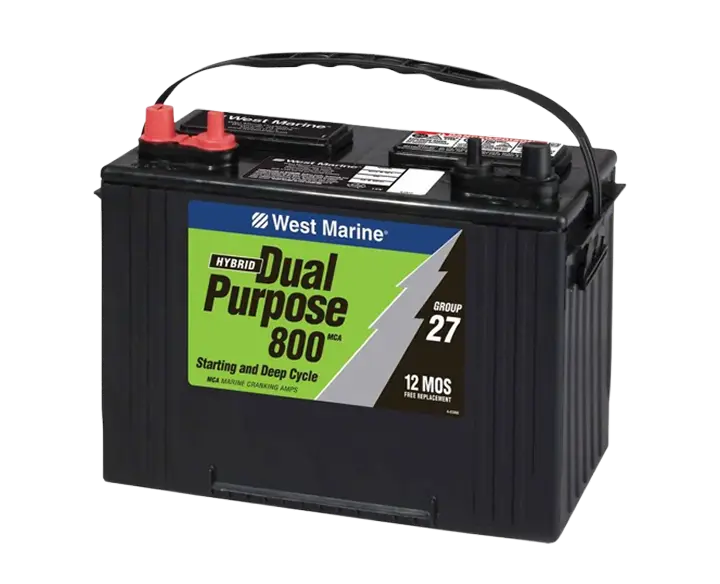
Dual Purpose
This is a hybrid designed for boaters who need one battery to do two jobs: provide enough power to crank the engine while also having the stamina to run electronics like fish finders, lights, and stereos when the motor is off.
Starting Performance: Good
Cycling Performance: Good
Repeated Deep Discharges: Good
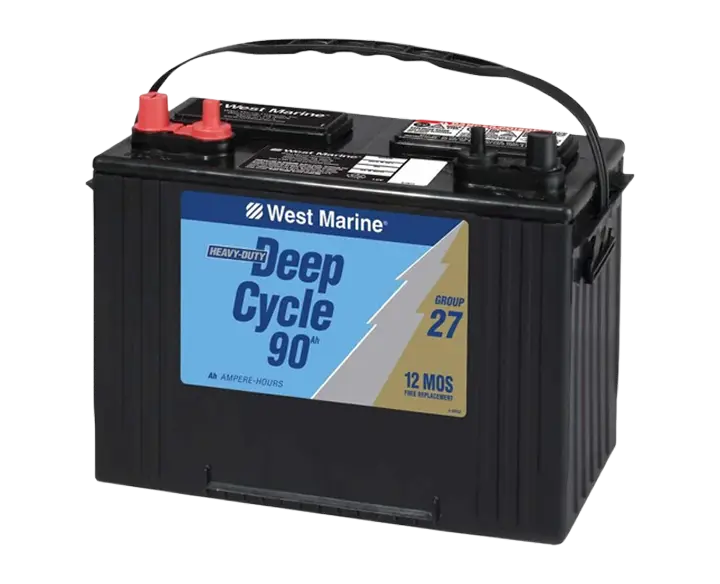
Heavy-Duty Deep Cycle
As a ”marathon runner,“ this battery provides steady, long-term power for electronics and trolling motors that stay on for hours. It is built to be repeatedly drained and recharged, making it a workhorse for everything except high-speed engine starting.
Starting Performance: Good
Cycling Performance: Better
Repeated Deep Discharges: Better

AGM
This elite all-rounder combines high-performance engine starting with massive energy storage for electronics. Its advanced AGM design makes it essentially maintenance-free and up to 20 times more resistant to the vibration of wave-pounding than standard batteries.
Starting Performance: Best
Cycling Performance: Best
Repeated Deep Discharges: Best
* Not recommended




Shop Boat Batteries
Marine batteries store electrical energy so electrical loads like lights, motors and pumps can operate. When boats have charging devices like alternators, solar panels or wind generators, batteries store electricity so charging devices don’t have to operate simultaneously with items that require electricity.
Marine Battery Types Explained
Marine batteries are engineered to handle vibration, deep discharge cycles, and harsh moisture conditions that standard automotive batteries cannot withstand. Choosing the correct type depends on how you use your boat, how much power you need, and how often the battery will be discharged and recharged. Most vessels use a combination of starting batteries for engine ignition and deep-cycle batteries for onboard electronics, trolling motors, and accessories. Understanding the differences helps ensure reliable performance, longer lifespan, and safe operation on the water.
Starting Batteries
Designed to deliver short bursts of high current to start engines.
Deep-Cycle Batteries
Provide steady power over long periods for trolling motors, electronics, lights, and appliances.
Dual-Purpose Batteries
Combine starting capability with moderate deep-cycle performance for smaller boats.
Lithium vs AGM vs Flooded Marine Batteries
Each battery chemistry offers different advantages depending on performance needs, budget, and charging setup.
Lithium (LiFePO4)
-
Lightest weight
-
Longest lifespan (often 3,000–5,000 cycles)
-
Fast charging capability
-
Consistent voltage output
-
Highest upfront cost
AGM (Absorbed Glass Mat)
-
Maintenance-free and spill-proof
-
Good vibration resistance
-
Reliable performance for most recreational boaters
-
Moderate weight and cost
Flooded Lead-Acid
-
Lowest initial cost
-
Requires periodic maintenance
-
Heaviest option
-
Reliable for basic starting applications
Lithium batteries are increasingly popular for trolling motors and electronics due to their lightweight design and long runtime, while AGM batteries remain a dependable all-around choice for many boats.
Battery Chemistries
Each of the battery types mentioned above is offered with a choice of battery chemistries, which are flooded lead acid, gel, AGM (Absorbed Glass Matt) and most recently, Lithium Iron Phosphate, such as those supplied to us by Relion. Your choice of battery chemistries should be based on the performance you desire balanced against how much you are willing to spend.
What are battery group numbers?
Just like the batteries used to power flashlights or drum-beating pink rabbits (D, C, AA, etc.), boat batteries come in standard sizes designated by their Group number. Battery group numbers denote the size of the case, location of the battery terminals and general configuration. A battery’s group number does not imply purpose, capacity, quality or other characteristics.
Marine Battery Sizing Guide
Selecting the correct battery size involves more than physical dimensions. Capacity, power demands, and runtime expectations all play a role.
Key factors to consider:
-
Amp-hour (Ah) rating: Determines how long the battery can deliver power
-
Reserve Capacity (RC): Indicates runtime under load
-
Marine Cranking Amps (MCA): Critical for engine starting
-
Group size: Ensures proper fit in your battery compartment
Boats with high electronics usage, trolling motors, or overnight power needs typically require larger deep-cycle capacity or multiple batteries wired in parallel.
Cold Cranking Amps (CCA)
The term “Cold Cranking Amps” is used to quantify a battery’s ability to crank over an engine. Technically, this is the number of amps a battery can deliver at 0°F for 30 seconds without having the voltage drop below 7.2 volts. What this means to boat owners is that large engines, especially diesels and high compression gas engines require a high CCA rating.
Marine Cranking Amps (MCA)
Marine Cranking Amps (MCA) are identical in concept to CCA, except that they are measured at 32°F, which makes the numbers higher.
Note: The temperatures mentioned above in regard to CCA and MCA are used to standardize the measurement. We’re not implying that you would use your boat when the temperature is 0°F.
Battery Recommendations by Boat Type
Different vessels place very different demands on their electrical systems.
Small Boats & Skiffs
Often use a single dual-purpose battery for starting and accessories.
Bass Boats
Typically require separate batteries for engine starting and trolling motors, often in multi-battery banks.
Cruisers & Sailboats
Use dedicated house battery banks to power navigation equipment, lighting, refrigeration, and onboard systems.
Offshore Fishing Boats
May require high-capacity systems to support electronics, pumps, and extended engine use.
Choosing a battery system matched to your vessel improves reliability and reduces the risk of power loss offshore.
Trolling Motor Battery Requirements
Trolling motors demand sustained power over long periods, making deep-cycle batteries essential.
Important considerations:
-
Voltage requirements (12V, 24V, or 36V systems)
-
Amp-hour capacity for desired runtime
-
Weight considerations for boat balance
-
Compatibility with onboard chargers
Lithium batteries are increasingly favored for trolling motors due to their lighter weight and ability to maintain performance even as charge levels drop.
Marine Battery Charging Considerations
Using the correct charger is critical for safety, battery health, and performance.
-
Match charger type to battery chemistry
-
Use smart marine chargers with multi-stage charging profiles
-
Ensure proper ventilation during charging
-
Verify compatibility with lithium batteries if upgrading
Improper charging can reduce lifespan, cause overheating, or damage onboard electrical systems.
Marine Battery Safety Guidance
Marine environments present unique safety challenges including vibration, moisture, and confined spaces.
Best practices include:
-
Secure batteries to prevent movement in rough conditions
-
Protect terminals from corrosion and accidental short circuits
-
Ensure adequate ventilation for lead-acid batteries
-
Use properly rated cables and connections
Routine inspection helps prevent unexpected failures and improves overall safety on the water.
Marine Battery Installation Tips
Proper installation ensures optimal performance and longevity.
-
Confirm correct polarity before connecting cables
-
Clean terminals and apply corrosion protection
-
Use marine-grade wiring and hardware
-
Verify battery is firmly secured in an approved tray
For multi-battery systems, proper wiring configuration is essential to maintain voltage and capacity requirements.
Want To Learn More About Boat & Marine Batteries?
For more about marine batteries and what to consider when choosing batteries for your boat, please read our West Advisor articles How to Select a Marine Battery and Are Lithium Batteries a Good Choice for You?
Did you know that we offer free battery testing in all of our stores? learn about the program in our West Marine's Battery Testing Program West Advisor article.
Marine Battery & Charging FAQ
- Choose the right charger: Use a charger that matches your battery type (e.g., lead-acid, AGM, lithium).
- Connect the charger: Attach the positive cable to the positive terminal and the negative cable to the negative terminal.
- Set the charger: Set the charger to the appropriate mode for your battery type.
- Monitor the charging process: Keep an eye on the charger to ensure the battery is not overheating.
- Disconnect: Once fully charged, turn off the charger and disconnect it from the battery.