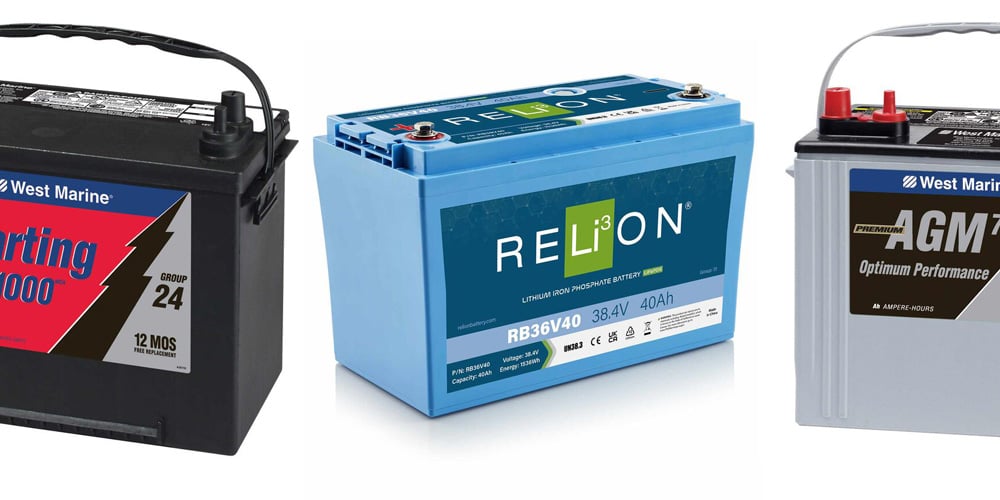
When shopping for marine batteries, West Marine customers are often surprised by the tremendous variation in price between the batteries we sell. This price difference largely comes down to battery chemistry, construction and performance. West Marine offers flooded batteries and sealed batteries whose chemistries include AGM, gel and lithium iron phosphate. Throughout this discussion, we refer to lithium iron phosphate batteries as “lithium” for short.
Much of the sticker shock stems from the price of lithium batteries, which can easily cost over one thousand dollars. In our West Advisor article Are Lithium Batteries a Good Choice for You?, we discuss how the high price of lithium batteries can be offset over time by their superior performance compared to flooded, AGM and gel batteries. But given the superior performance of lithium batteries, are they necessarily the best choice for every boater? Not always. For many boaters, the best battery is the one that delivers the energy their boat needs at a price they can afford.
- Battery Types: Starting, Deep Cycle and Dual Purpose
- Create an Energy Budget
- Amp-Hour Capacity
- Reserve Minutes
- Choose a Starting Battery with the Cranking Amps You Need
- Flooded Lead-Acid Batteries
- AGM Batteries
- Gel Batteries
- Lithium Iron Phosphate Batteries
- Battery Life in Charging Cycles
- So What Is the Best Battery for You?
- Marine Battery FAQ


High cranking power for quick engine start
Starting your Engine: Very good
Powering Electronics: Poor
Extending your day on the water: Poor

Starting your engine, powering electronics and accessories
Starting your Engine: Good
Powering Electronics: Fair
Extending your day on the water: Fair

Long lasting power for trolling motors, electronics and accessories
Starting your Engine: Fair
Powering Electronics: Good
Extending your day on the water: Very good

Superior durable technology for starting, trolling motors, and powering electronics and accessories
Starting your Engine: Very good
Powering Electronics: Very good
Extending your day on the water: Very good

Longest lasting, all-in-one solution for powering all your onboard systems
Starting your Engine: Very good*
Powering Electronics: Very good
Extending your day on the water: Very good
High cranking power for quick engine start
Starting your Engine: Very good
Powering Electronics: Poor
Extending your day on the water: Poor
Starting your engine, powering electronics and accessories
Starting your Engine: Good
Powering Electronics: Fair
Extending your day on the water: Fair
Long lasting power for trolling motors, electronics and accessories
Starting your Engine: Fair
Powering Electronics: Good
Extending your day on the water: Very good
Superior durable technology for starting, trolling motors, and powering electronics and accessories
Starting your Engine: Very good
Powering Electronics: Very good
Extending your day on the water: Very good
Longest lasting, all-in-one solution for powering all your onboard systems
Starting your Engine: Very good*
Powering Electronics: Very good
Extending your day on the water: Very good
*Applies to select models only.
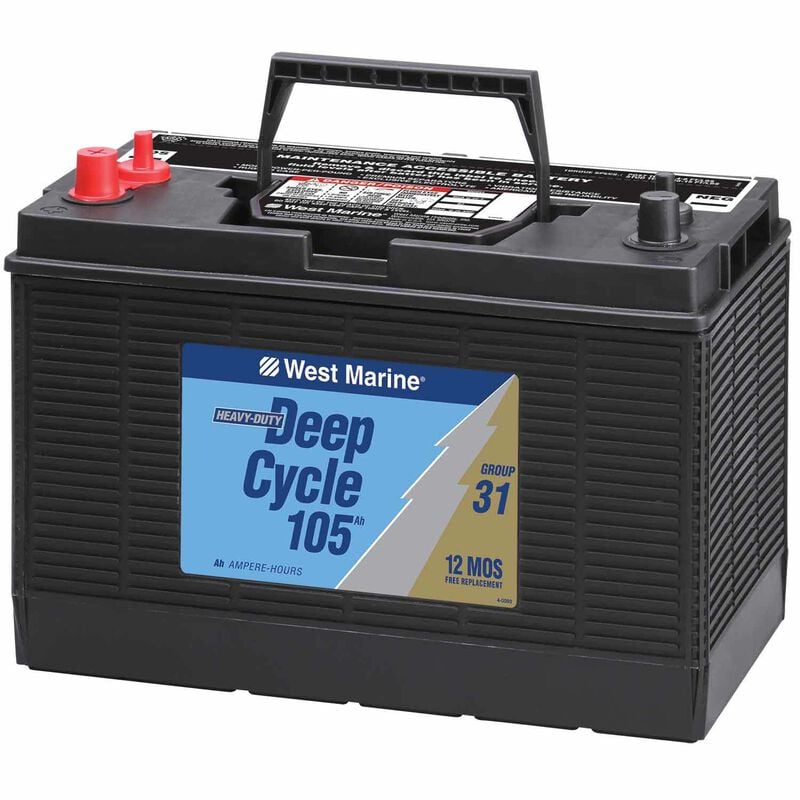
Battery Types: Starting, Deep Cycle and Dual Purpose
West Marine offers three different types of batteries: starting, deep cycle and dual-purpose. When choosing a battery, first consider how the battery will be used. Will it start an engine, power house loads or do both? Starting batteries are built to deliver a short burst of high current. Deep cycle batteries are built to deliver power over a longer period and tolerate repeated discharge and recharge cycles. Dual-purpose batteries provide a compromise between starting ability and deep cycle performance.
It is also important to consider the best use for each battery chemistry. Flooded batteries are offered in starting, deep cycle and dual-purpose variations. The AGM batteries we offer are designed for dual-purpose use. The gel batteries we offer are designed for deep cycle use. The lithium batteries we offer are nearly all for deep cycle use, with the exception of RELiON's HP line of dual-purpose batteries like the RB100-HP Lithium Dual Purpose Battery, which is suitable for engine starting or deep cycle applications. For an expanded discussion of starting, deep cycle and dual-purpose batteries, see our West Advisor article How to Select a Marine Battery.
Choosing the right battery type is not just about price. It affects starting reliability, run time, charging speed, maintenance, weight, battery life and how much usable energy you can safely draw from the battery bank.
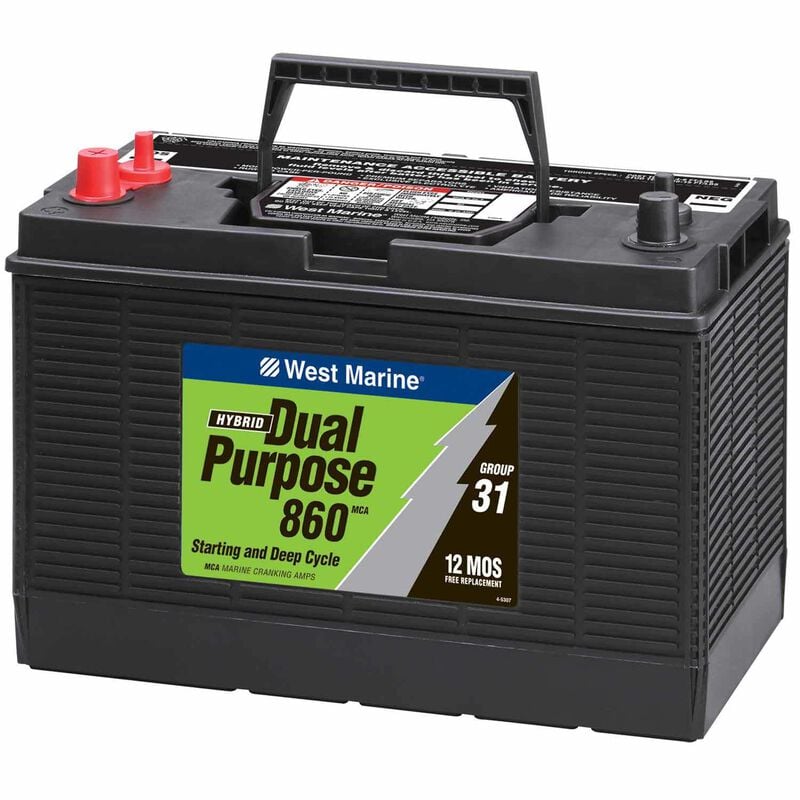
Dual-purpose batteries are designed for deep cycle and engine starting applications.
Create an Energy Budget
In addition to choosing the right type of battery, the battery or batteries you select must have enough capacity, rated in amp-hours and reserve minutes, to meet your boat’s energy needs. Deep cycle batteries must have adequate capacity to power house loads like running lights, electronics, cabin lights, 12-volt appliances, pumps, refrigeration, stereos and other onboard loads.
To make the correct selection, first create an energy budget for your boat and then match your needs with batteries that contain the amp-hour capacity and reserve minutes rating you need. List each load, estimate its amperage draw and multiply by the number of hours you expect to use it between recharging. The total gives you a realistic picture of how much battery capacity your boat needs. For more on energy budgets and sizing house batteries, see our West Advisor article Sizing Your House Battery Bank.
Amp-Hour Capacity
Amp-hour capacity refers to the total amount of electrical energy a battery can store and supply over a period of time. For example, a West Marine Group 31 deep cycle battery with 105 amp-hour capacity can theoretically supply 1 amp of current for 105 hours, 2 amps for 52.5 hours and so on. In actual use, the amount of time a battery can supply power depends on the current draw, temperature, battery age, battery chemistry and how deeply the battery can safely be discharged.
Lead-acid batteries, including flooded, AGM and gel, should generally not be deeply discharged on a regular basis if long battery life is important. Lithium batteries can usually deliver a much higher percentage of their rated capacity without the same level of damage, provided they are used with compatible charging systems and proper battery management.
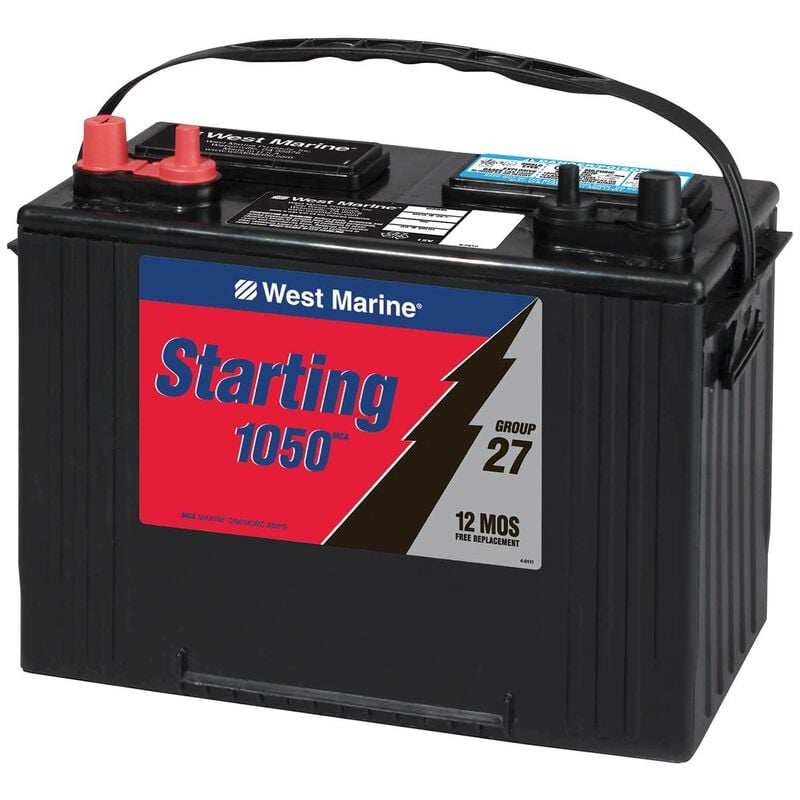
Flooded batteries, like this Group 27, offer dependable performance and are the least expensive option.
Reserve Minutes
Reserve minutes is an industry standard that defines how long a battery can sustain a load of 25 amps before it drops to 10.5 volts at 80°F. Here is where it gets interesting: Under this definition, how many available amps do we have if we take the 105 amp-hour Group 31 battery mentioned above, which has a reserve capacity of 185 minutes, and place it under a 25 amp load at 80°F? Answer: 185 ÷ 60 = 3.08 hours. 3.08 hours x 25 amps = 77.08 amps, which is far below the battery's 105 amp-hour rating.
What accounts for this? Without getting too technical, this can be explained in terms of Peukert's law, which describes how a battery's voltage will drop based on the load placed on it. The point is that the entire rated amp-hour capacity of a flooded, AGM or gel battery will not be available to power house loads. This is why for flooded, AGM and gel deep cycle batteries, we recommend 3–4 times your daily energy consumption in battery amp-hour capacity. This helps avoid damaging deep discharges and reduces recharging time. Due to the extremely low internal resistance of lithium iron phosphate batteries, nearly all of their rated amp-hour capacity is available to power house loads.
Choose a Starting Battery with the Cranking Amps You Need
To crank over an engine, starting batteries are designed to release a large number of amps over a short period of time. CCA is the number of amps a battery can deliver for 30 seconds at 0°F while maintaining voltage above 7.2 volts. MCA is similar but measured at 32°F instead of 0°F. MCA ratings are 20–25% higher than CCA because batteries work better at higher temperatures. Since very few boats are used in sub-zero weather, MCA is often a more realistic marine rating to consider. Consult your engine owner’s manual to determine whether a battery’s MCA rating is adequate to crank your engine.
Do not undersize a starting battery. Electronics, pumps and accessories may still function with a weak battery, but engines require high current at the moment of starting. A battery that barely meets cranking requirements when new may become unreliable as it ages or when temperatures drop.
Flooded Lead-Acid Batteries
Based on proven technology that has changed little since the days of our grandparents, flooded lead-acid batteries are the least expensive battery chemistry. While they are reliable and can provide plenty of power, flooded batteries require regular maintenance, such as checking electrolyte levels and topping off with distilled water.
Flooded batteries remain a practical choice for budget-conscious boaters, day cruisers and owners who do not mind routine maintenance. They are also more forgiving of overcharging than some sealed batteries, but they must be installed upright and vented properly.
Pros:
- Cost the least compared to AGM, gel and lithium
- Handle overcharging better than AGM, gel and lithium
- Available in starting, deep cycle and dual-purpose options
- Good choice for budget-conscious boaters with simple electrical needs
Cons:
- Produce hydrogen gas when charging, so battery boxes and compartments must be vented to allow gas to escape safely
- Must be periodically inspected and topped off with distilled water when cell levels get low
- Self-discharge at a relatively high rate of six to seven percent per month, so they require off-season charging
- Must be installed in an upright position
- Do not tolerate high amounts of vibration as well as AGM
- Less usable capacity than lithium when long cycle life is desired
AGM Batteries
Many boaters are switching to AGM, or Absorbent Glass Mat, batteries for a performance improvement over flooded batteries.
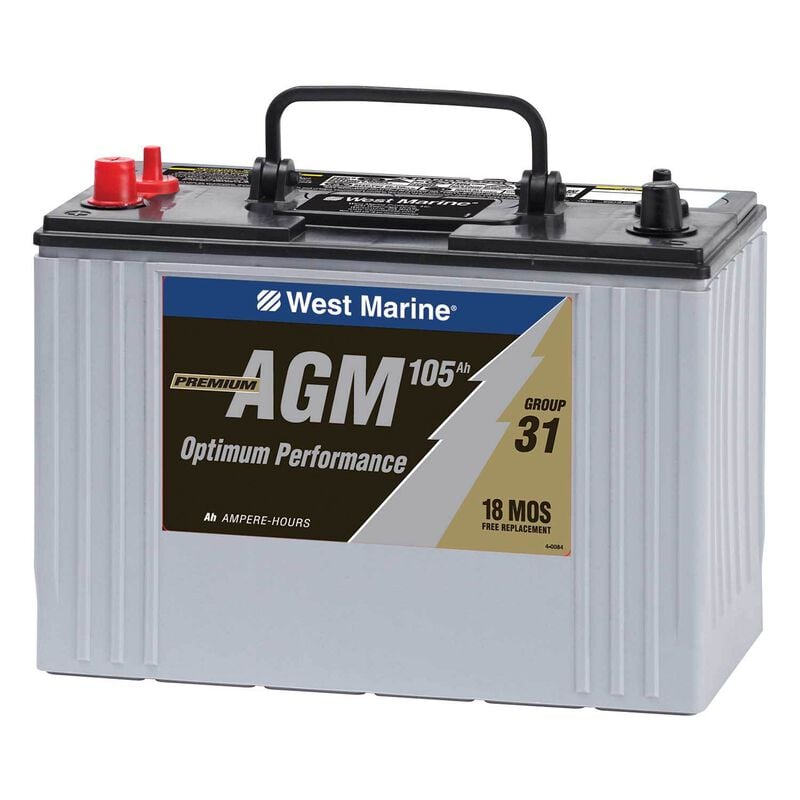
AGM batteries offer excellent shock and vibration resistance.
The construction of AGM batteries consists of positive and negative lead plates sandwiched between fine, highly porous microfiber separators that absorb and hold the electrolyte, which, like flooded batteries, is a mixture of water and sulfuric acid. The sandwiched construction provides more plate support and better shock and vibration protection compared to flooded batteries.
Unlike flooded batteries, which release hydrogen gas along with oxygen, AGM batteries have internal pressure valves that allow oxygen produced on the positive plates to migrate to the negative plates and recombine with hydrogen, producing water. This design allows AGM batteries to be sealed and maintenance-free.
Also unlike flooded batteries, which are offered in different versions for starting, deep cycle or dual-purpose use, the chemistry of AGM batteries enables them to function well for both engine starting and deep cycle applications.
Pros:
- Sealed, maintenance-free design
- Do not emit dangerous hydrogen gas to the atmosphere during normal operation
- Can be mounted in any position
- Up to twice the cycle life of flooded batteries
- Excellent shock and vibration resistance
- Lower internal resistance allows greater starting power and charge acceptance
- Work well as dual-purpose batteries for deep cycle and engine starting applications
- Low 3% monthly discharge rate
Cons:
- Higher cost compared to flooded batteries
- More sensitive to overcharging compared to flooded batteries
- Still heavier than lithium batteries with less usable capacity over the battery’s life
Gel Batteries
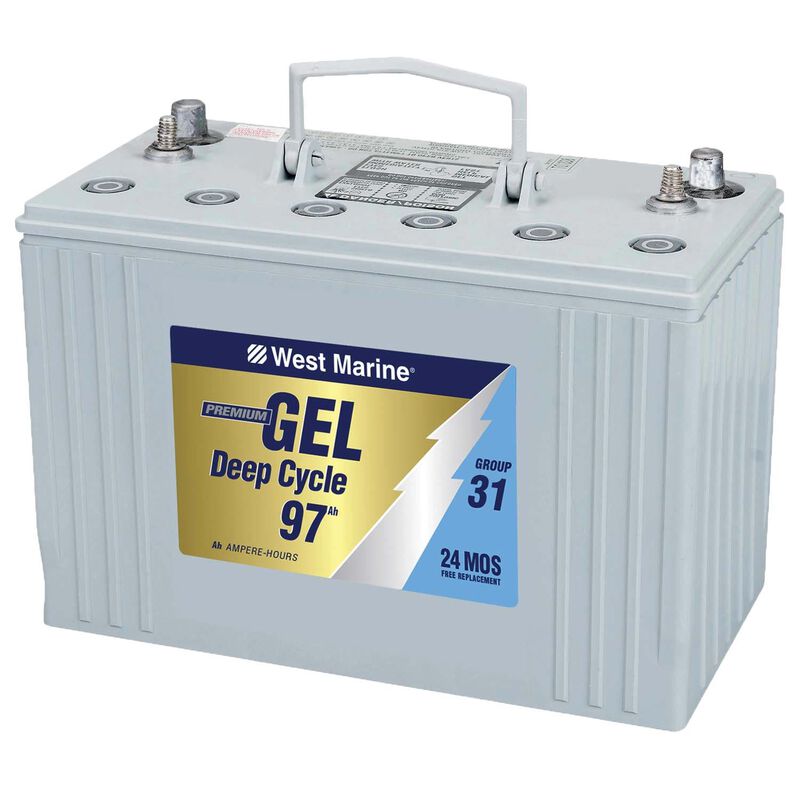
Gel batteries offer greater cycle life compared to flooded.
Gel batteries are a type of sealed lead-acid battery that uses a gel electrolyte instead of liquid. They are similar to AGM batteries in terms of maintenance requirements, but can be more expensive. Because gel batteries are primarily designed for deep cycle applications, they are not a good choice for engine starting applications. In addition, compared to AGM, flooded or lithium batteries, gel batteries typically perform better with slower rates of recharging, so they are not a good choice for boaters who need rapid recharge times to get back on the water.
Pros:
- Sealed, maintenance-free design
- Greater cycle life compared to flooded batteries
- Tolerate deep discharges better than flooded batteries
- Sealed design eliminates the need to add water or check electrolyte levels
- Spill proof and can be mounted in any position
- Low 3% monthly discharge rate
Cons:
- Higher cost compared to flooded or AGM
- Can be damaged by exposure to high temperatures
- Not optimal for engine starting applications
- Recharge at a slower rate compared to other battery chemistries
Lithium Iron Phosphate Batteries
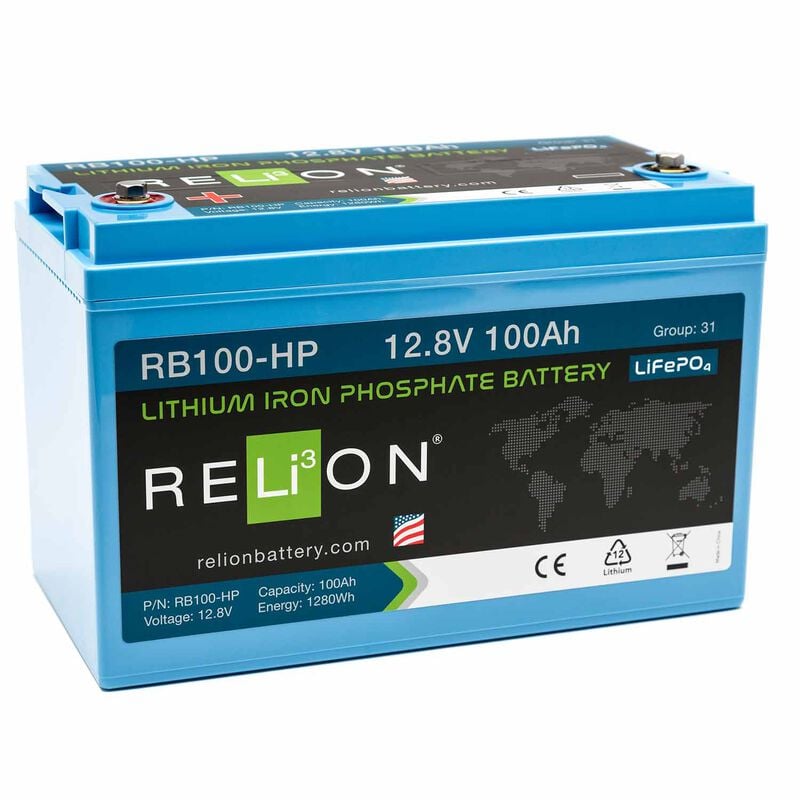
RELiON's HP series of batteries are true dual-purpose batteries for engine starting and deep cycle applications.
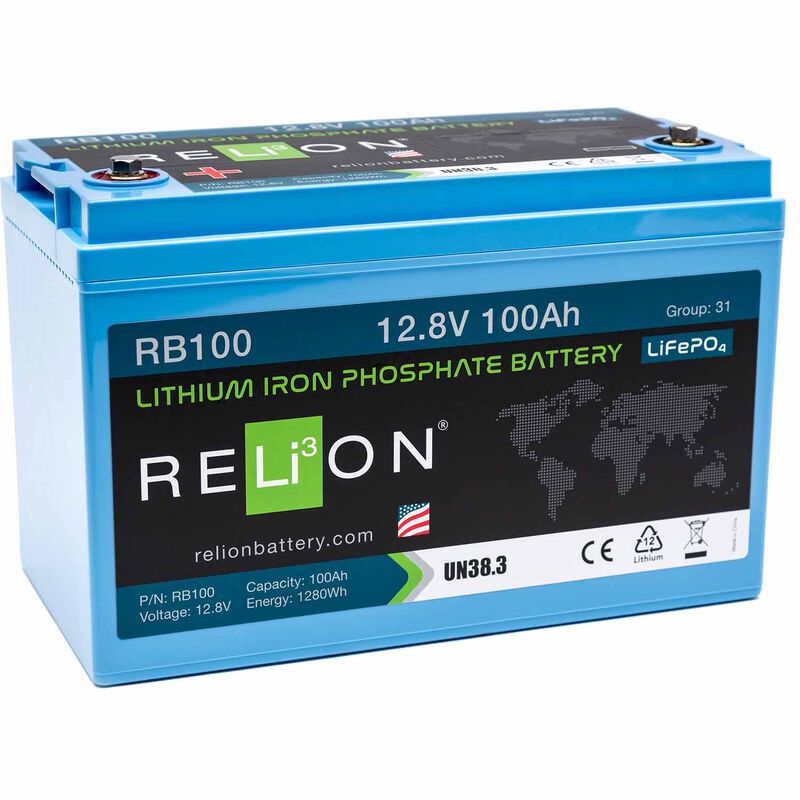
Lithium batteries are the newest and most expensive type of battery, but they offer multiple advantages. Compared to flooded, AGM and gel batteries, maintenance-free lithium batteries weigh the least, have the longest lifespan, recharge more quickly and can be discharged to a very low state of charge without damage. Compared to other battery chemistries, lithium batteries also deliver more usable amp-hours over their life. The extremely low self-discharge rate of lithium means you don’t have to keep them on a charger during the off season like lead-acid batteries.
However, lithium batteries are the most susceptible to damage from incompatible charging, hence they require charging systems with a lithium battery charging profile. Before switching to lithium, confirm compatibility with your battery charger, alternator, solar controller, battery monitor, inverter/charger and any battery management system requirements.
Pros:
- Longest lifespan of any marine battery type
- Tolerate deep discharges better than other battery types
- Compact and weigh less compared to flooded, AGM and gel batteries
- Can be recharged much faster than flooded, AGM or gel
- Produce more usable amp-hours over their life compared to flooded, AGM or gel
- Extremely low self-discharge rate
- Strong choice for trolling motors, house banks and high-demand electrical systems
Cons:
- Much more expensive than AGM, gel or flooded
- Require a compatible charging system to prevent damage
- Can be damaged if exposed to high temperatures
- Limited options for use as starting batteries
- May require system upgrades before installation
Battery Life in Charging Cycles
The useful life of marine batteries can be quantified in charging cycles. A charging cycle is the combination of a discharge and recharge event. A standard flooded battery has a typical cycle life of 300 charging cycles. High-performance AGM batteries have a cycle life of around 500 cycles. For both flooded and AGM batteries, these figures are based on up to 50% depth of discharge, which is a safe level of discharge for these types of batteries. Moving up in performance, gel batteries are capable of up to 75% depth of discharge and up to 500 charging cycles. Leading the pack in performance are lithium batteries, which have a typical life of 3,500 cycles down to 80% depth of discharge. That is 7X more cycles than gel, 7X more cycles than AGM and nearly 12X more cycles than flooded.
The table below shows how flooded, AGM, gel and lithium batteries compare. Prices are based on select Group 31 batteries as of 3/10/2023. For a deeper dive into how flooded, AGM, gel and lithium batteries compare, please read our West Advisor article Are Lithium Batteries a Good Choice for You?.
| Battery Type | Depth of Discharge | Cycle Life | Usable Ah Over Lifespan | Battery Price* |
|---|---|---|---|---|
| Flooded Lead Acid | 50% | 300 | 15,000 | $205.00 |
| High Performance AGM | 50% | 500 | 25,000 | $383.00 |
| Gel | 75% | 500 | 37,500 | $510.00 |
| Lithium | 80% | 3500 | 280,000 | $1,160.00 |
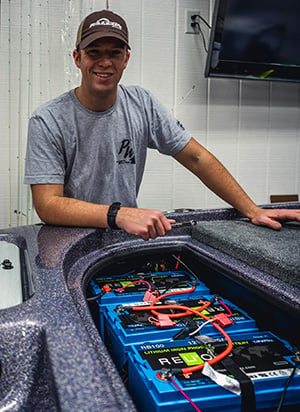
Patrick Walters, Elite Series Pro Angler next to his RELiON battery installation.
So What Is the Best Battery for You?
The best battery for your boat is one that delivers the energy your boat needs at a price you can afford. This means different things to different boaters. If you are a long-distance cruiser accustomed to living aboard, a long-term investment in lithium batteries can make sense. Sponsored tournament bass anglers who want to maximize trolling motor run time are also strong candidates for lithium. However, if you are a day cruiser or coastal angler on a budget, lithium batteries may be overkill. In that case, flooded, gel or AGM batteries may be the better choice.
For many boaters, AGM offers the best balance of performance, maintenance-free convenience, dual-purpose capability and cost. Flooded batteries remain a reliable budget option for simple systems. Gel batteries work best where deep-cycle use and slower charging are acceptable. Lithium batteries deliver the highest performance and longest life, but they require the highest upfront investment and charging-system compatibility.
Marine Battery FAQ
What is the best marine battery for most boats?
For many recreational boats, AGM batteries offer the best balance of starting power, deep-cycle capability, maintenance-free operation, vibration resistance and cost. Flooded batteries are usually the lowest-cost choice, while lithium batteries provide the highest performance for boaters who can justify the investment.
What is the difference between starting and deep cycle batteries?
Starting batteries deliver a short burst of high current to crank an engine. Deep cycle batteries are designed to provide steady power over a longer period and tolerate repeated discharge and recharge cycles. Dual-purpose batteries are designed to do both jobs reasonably well.
Are lithium marine batteries worth it?
Lithium batteries can be worth it for boaters who need long run time, fast recharging, lighter weight and high usable capacity. They are especially useful for trolling motors, house banks and high-demand electrical systems, but they require a compatible charging setup and cost more upfront.
Can I use a deep cycle battery to start my engine?
Only if the battery is rated for engine starting and meets the MCA or CCA requirements in your engine owner’s manual. Many deep cycle batteries are not designed to provide the high burst current needed for reliable starting.
How many amp-hours do I need for my boat?
The right amp-hour capacity depends on your energy budget. Add up the amperage draw of your electronics, lights, pumps, appliances and other loads, then multiply by expected hours of use between charging. For flooded, AGM and gel batteries, allow extra capacity to avoid deep discharges.
Related: