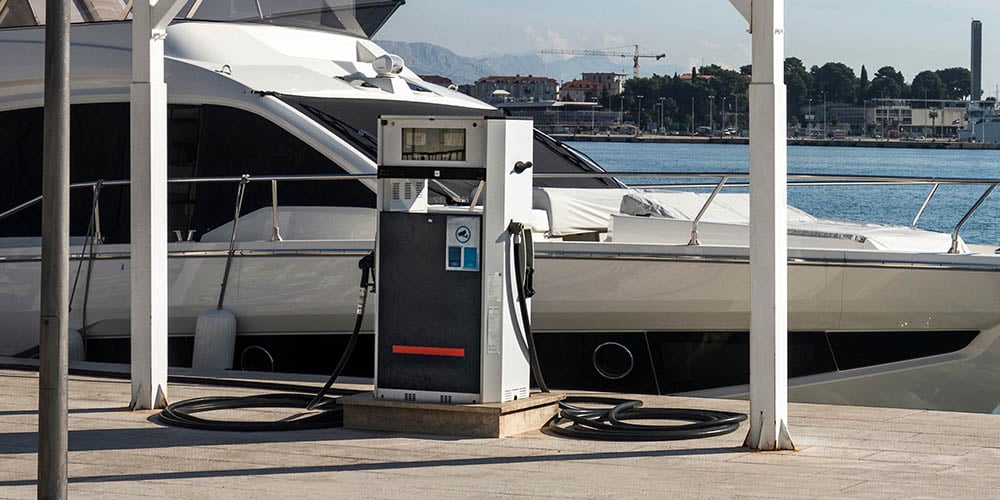
Fuel economy might not have been a concern when you first bought your boat, but with gas prices on the rise the cost of fuel is top of mind for most boaters right now. We'll give you some tips on how to make your boat more fuel efficient so you'll feel less pain at the pump.
How to Cut Your Fuel Costs
1. Keep the Bottom Clean
A fouled bottom increases the drag on your boat meaning your engine has to work harder and burn more fuel in the process. Regularly applying bottom paint and Propspeed will both go a long way to keeping your hull and your running gear free of barnicles and other marine growth.
2. Tune Your Engine
Follow your engine manufacturer's service recommendations. Poorly running cooling or fuel systems will negatively impact fuel mileage and neglecting regular maintenance will also shorten the life of your engine. We carry outboard engine service kits for all major outboard manufacturers to make it easier to keep your engine running optimally.
3. Drive Smart
Handle throttles smoothly and only apply as much power as the situation requires. Getting your boat on plane quickly will actually save fuel though, so don't be too tentaive.
4. Don't Push Water
Proper trim is essential to good fuel economy. Plowting, kiting and porposing all make your boat burn more fuel than necessary. If your boat does not trim properly, invest in trim tabs. Outboard powered boats can benefit from bolt-on hydrofoils.
5. Check Your Prop
Unless the blades are perfectly true, your boat propeller will fail to provide maximum thrust. Blades with nicks and dings create power-robbing turbulence and should be reconditioned.
Make a test run with your boat loaded the way you generally use it to be sure the fitted prop doesn't allow your engine to exceed the recommended wide open throttle (WOT) rpm. If fuel efficiency is the goal, then a bit too much pitch is usually preferable to a bit too little.
For more prop selection advice, check out our Selecting a Propeller West Advisor Article
6. Lighten the Boat
Hauling around extra gear burns extra fuel, so make sure you only bring what you need for the trip. Fuel has weight too, so only bring as much as you need for the trip while still obeying the rule of thirds: one third of the fuel to get to the destination, one third to return and one third in reserve.
7. Install a Fuel Flow Sensor
A fuel flow sensor networks with your NMEA 2000 multifunction display or instruments, and tells you in real time exactly how much fuel your engine is consuming. This information allows you to accurately adjust both throttles and trim for maximum economy even as wind and sea conditions change.
A flow sensor also keeps up with total fuel consumed and it has the added value of providing early warning of developing engine and running gear problems or fouling.
8. Repower
A too-small engine works harder and burns more fuel, meaning that in some case upgrading to a higher horsepower engine can actually be the more economical choice. 4-stroke outboards are generally more efficient than 2-stoke outboards as well so keep that in mind when it's time to upgrade.
Gallons per Hour versus Miles per Hour
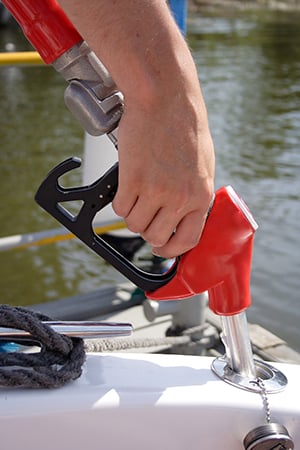
It's no surprise to anyone that's ever swiped their card at the gas dock that boats burn a lot of fuel. While most anyone who drives a car is familiar with “miles per gallon” measure of fuel efficiency, for boats think “gallons per hour”.
A rough approximation of what this means for a gasoline outboard powered boat is to take the horsepower of the motor and divide it by 10. So for example, a 225 horsepower outboard running at full throttle will burn about 22.5 gallons per hour. That's a lot of fuel, but there are driving behaviors that can help bring that figure down from the jump
Throttling back to 75 percent of full throttle can result in up to 50 percent less fuel burned. Throttling back even more will further reduce fuel consumption, but you can only throttle back so much before your time to destination is later than you need it to be. So the issue becomes, how much fuel are you willing to burn in order to arrive at your destination within the right time frame?
That is the proverbial “sweet spot” and will give you your ideal cruising speed and RPMs
How to Determine Your Boat’s Most Efficient Cruising Speed
To figure the optimum RPMs at which to run your engine that will get you to where you want to go at a cost and within a time frame you are willing to accept, create a four-column table like the one that appears below.
| RPM | MPH | GPH | MPG |
|---|---|---|---|
| 1000 | |||
| 1500 | |||
| 2000 | |||
| 2500 | |||
| 3000 | |||
| 3500 | |||
| 4000 | |||
| 4500 | |||
| 5000 | |||
| 5500 | |||
| 5700 |
Next, take your boat out and run it at each of the RPMs that appear in the left hand column. When making your runs, make sure you always run the boat in the same direction.
Then, using a GPS and your boat’s fuel flow gauge, fill in the MPH and the GPH for each of the RPM entries. After finishing your runs, you will need to do some, math. For each row in the table, divide MPH by GPH and note the answer under MPG.
Following is an example of the table filled in with values taken from a Yamaha Performance Bulletin for single Yamaha F300XSB2 outboard motor mounted on Pursuit DC 246 Boat. To this table we have added additional columns (with values italicized) where we assume a fuel cost of $4.00 per gallon:
| RPM | MPH | GPH | MPG | Fuel Cost/G | Cost/HR | Cost/20 M Trip | Time to Arrive |
|---|---|---|---|---|---|---|---|
| 1000 | 5.2 | 1.3 | 4 | 4 | 5.2 | 20.02 | 3.85 HR |
| 1500 | 7.1 | 2.1 | 3.38 | 4 | 8.4 | 23.68 | 2.82 HR |
| 2000 | 8.6 | 3.8 | 2.26 | 4 | 15.2 | 35.26 | 2.32 HR |
| 2500 | 9.3 | 5.5 | 1.69 | 4 | 22 | 47.3 | 2.15 HR |
| 3000 | 11.1 | 7.1 | 1.56 | 4 | 28.4 | 51.12 | 1.80 HR |
| 3500 | 15.4 | 9.4 | 1.64 | 4 | 37.6 | 48.88 | 1.30 HR |
| 4000 | 23 | 12.4 | 1.85 | 4 | 49.6 | 43.15 | 0.87 HR |
| 4500 | 33.6 | 15.7 | 2.14 | 4 | 62.8 | 37.05 | 0.59 HR |
| 5000 | 39.2 | 20.5 | 1.91 | 4 | 82 | 41.82 | 0.51 HR |
| 5500 | 43.8 | 26.5 | 1.65 | 4 | 106 | 48.76 | 0.46 HR |
| 5700 | 45 | 26.7 | 1.69 | 4 | 106.8 | 46.99 | 0.44 HR |
From the table above you can see that at planing speed the best fuel economy is 2.14 MPG at 4500 RPM and that the fuel cost to arrive at a 20 mile destination would be $37.05. The table also indicates that the travel time would be 0.59 of an hour. Of course the results that you get will vary with your boat type, boat weight, prop pitch, motor type and environmental factors such as wind speed, wind direction and wave action.
Fuel Flow Sensors
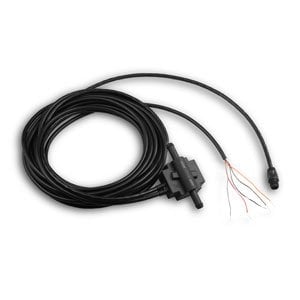
Garmin's GFS 10 Fuel Flow Sensor.
If constructing a table like the one above seems a bit tedious, there is another approach—one that will help you determine your fuel efficient “sweet spot” regardless of wave action or conditions. That approach is to install a fuel flow sensor.
When connected to a NMEA 2000 multifunction display or instrument, these sensors keep you abreast in real time of your fuel use in gallons per hour, how much fuel you have used and your remaining range based on current RPMs and how much fuel you have left. The dynamic nature of the algorithym enables you to accurately adjust throttles and trim for maximum economy even as wind and sea conditions change.
The Rule of Thirds
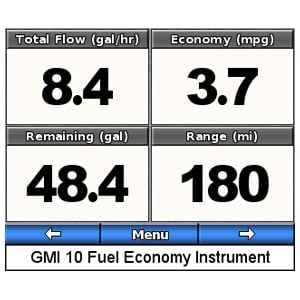
Fuel use in gallons per hour, miles per gallon, fuel remaining and range as seen on multifunction display.
Running out of fuel is a leading cause of boater distress. To avoid running out of fuel, when planning for a trip, always follow the Rule of Thirds. This rule dictates that you reserve one-third of your available fuel for arriving at your destination and one third of your fuel for the return trip. The remaining third should be held in reserve for unforeseen circumstances such as unexpected weather or towing another boat.
So for example, if you own the Pursuit DC 246 boat powered by the Yamaha outboard referenced above and plan on making a 20 mile trip while traveling at your “sweet spot” (33.6 MPH while turning 4500 RPM where you will burn 2.14 GPH), the minimum amount of fuel you will need to carry is 28.03 gallons. The easy way to calculate this is to triple the distance and divide that by 2.14. (3 x 20 = 60 miles/2.14=28.03 gallons)
Keep Your Engine Tuned Up
As mentioned above, keeping your engine tuned up and following a program of regular engine maintenance will help to contain your fuel costs. For do-it-yourselfers and professionals alike, West Marine offers a complete selection of outboard motor, inboard and inboard/outboard parts.


