20 Common Boating Mistakes New Boaters Make — and How to Avoid Them
Every boater makes mistakes — the difference between a bad day and a tragedy is usually preparation. Whether you're heading out for the first time or refreshing your skills before a new season, understanding the most common boating errors is one of the fastest ways to become a safer, more confident skipper.
This guide walks through 20 of the most common mistakes new boaters make on the water, explains what causes them, and gives you concrete steps to prevent each one. For the gear side of preparedness, see our guide to U.S. Coast Guard Required Safety Equipment. If you're heading to the ramp, our companion piece on boat launch ramp mistakes covers everything from transom plugs to trailer backing.
- Question 1: Exceeding weight capacity
- Question 2: Failing to check the weather
- Question 3: Docking too fast
- Question 4: Misunderstanding right-of-way
- Question 5: Running aground
- Question 6: Overestimating your skills
- Question 7: Missing required safety equipment
- Question 8: Skipping the float plan
- Question 9: Neglecting engine maintenance
- Question 10: Improper anchoring
- Question 11: Underestimating fuel consumption
- Question 12: Ignoring wake in no-wake zones
- Question 13: Improper engine trim
- Question 14: Docking in tidal areas
- Question 15: No VHF radio onboard
- Question 16: Overloading with passengers
- Question 17: Misreading navigational markers
- Question 18: Over-relying on electronics
- Question 19: Skipping safety drills
- Question 20: Spring launch after winter storage
Question 1: What is a common mistake new boaters make regarding their boat's capacity?
- A) Forgetting to bring safety gear
- B) Exceeding the boat's weight capacity
- C) Not checking the fuel level
- D) Overloading with fishing equipment
Correct Answer: B) Exceeding the boat's weight capacity
New boaters routinely underestimate how quickly weight accumulates — passengers, coolers, gear, fuel, and water all add up. Overloading affects the boat's stability, freeboard, and handling, increasing the risk of swamping or capsizing, particularly in rough conditions or during sudden weight shifts.
How to avoid it: For boats 20 feet and under, the U.S. Coast Guard capacity plate — located near the helm — states the Maximum Persons, Maximum Gross Load, and combined capacity for persons, motor, and equipment. Never exceed any of these limits. For boats over 20 feet, rated capacity is in the owner's manual, manufacturer's specifications, or on a manufacturer's plate. When in doubt, contact the dealer or manufacturer directly. See also our guide on Coast Guard Required Equipment for the full list of what every vessel must carry.
Question 2: What common mistake can turn a sunny day into a dangerous situation on the water?
- A) Forgetting sunscreen
- B) Not wearing life jackets
- C) Failing to check the weather forecast
- D) Overestimating fuel efficiency
Correct Answer: C) Failing to check the weather forecast
Marine weather can change with little warning. A calm morning can become a dangerous afternoon squall within hours, especially in coastal and Great Lakes environments. Boaters who leave the dock without checking the forecast have no baseline to compare against as conditions deteriorate — and no plan for where to shelter.
How to avoid it: Make weather review a mandatory step in your pre-departure routine. Use NOAA's marine weather forecasts — they provide wind, wave height, and visibility broken down by zone. Check updates throughout the day if you're out for more than a few hours. Understanding how local geography affects weather (afternoon sea breezes, thunderstorm patterns, fog windows) builds situational awareness that protects you before conditions become dangerous.
Question 3: Why do new boaters often struggle when docking?
- A) They don't use their GPS
- B) They approach too slowly
- C) They misjudge distance and approach too fast
- D) They don't have enough crew to help
Correct Answer: C) They misjudge distance and approach too fast
Unlike a car, a boat doesn't stop when you take your foot off the throttle — it coasts. New boaters carry too much speed into the slip or dock because they don't account for that momentum, especially in tight quarters with wind or current pushing the bow. The result is contact with the dock, pilings, or adjacent boats.
How to avoid it: Approach at the slowest speed that gives you steerage. Have fenders deployed and dock lines ready before you begin your approach — not during it. Practice low-speed maneuvering in open water first so you understand how your boat responds to short bursts of throttle in both forward and reverse. See our guide on docking tips for new boaters for a step-by-step approach technique.
Question 4: What error can lead to dangerous collisions when two boats approach each other?
- A) Ignoring speed limits
- B) Misunderstanding right-of-way rules
- C) Forgetting to anchor
- D) Turning off the engine too soon
Correct Answer: B) Misunderstanding right-of-way rules
Collisions between vessels are among the most preventable accidents on the water — and misunderstanding which boat has the right of way is the most common contributing factor. The USCG Navigation Rules (the "Rules of the Road") define exactly who must give way and who must hold course in every meeting, crossing, and overtaking situation.
How to avoid it: Learn the fundamental rules: vessels meeting head-on both turn to starboard; when crossing, the vessel with the other on its starboard side gives way; a vessel being overtaken has right of way. For a complete explanation of Navigation Rules with diagrams, see the BoatU.S. Foundation Rules of the Road guide. Taking a formal U.S. Power Squadrons or USCG Auxiliary boating safety course covers these rules in depth.
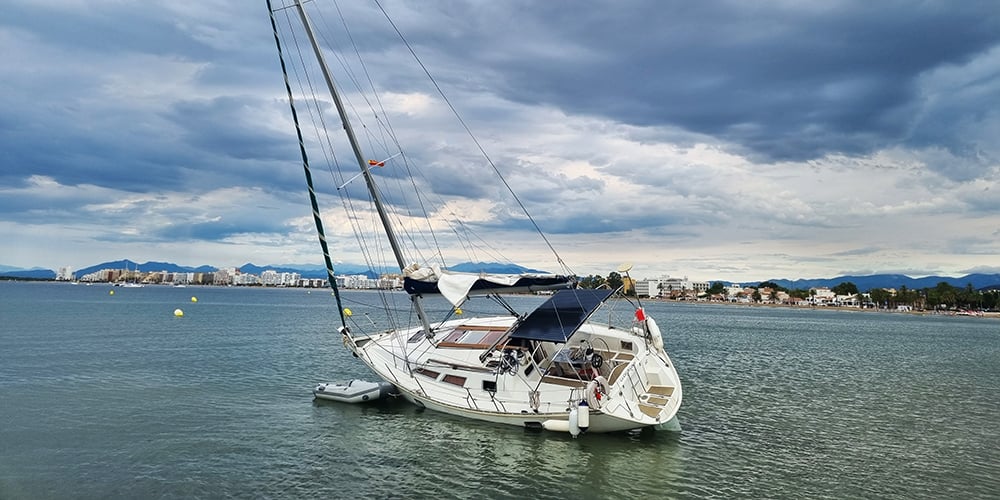
Question 5: What can cause a boat to run aground?
- A) Not paying attention to fuel levels
- B) Poorly secured anchor
- C) Failing to monitor depth charts and tide tables
- D) Excessive speed
Correct Answer: C) Failing to monitor depth charts and tide tables
Running aground is one of the most common on-water incidents reported to the Coast Guard, and it's almost always preventable. Water depths change dramatically with tide — areas that have several feet of water at high tide can be inches deep at low tide. Unfamiliar channels and unmarked shoals are particularly dangerous because there's nothing visible on the surface to warn you.
How to avoid it: Know your boat's draft before you leave the dock. Use current nautical charts and a depth sounder to monitor depth continuously in unfamiliar water. Before departure, consult a tide table to know when high and low water will occur during your trip — plan accordingly for shallow areas. Slow down any time you enter unfamiliar or shallow water. Over-relying on GPS chartplotters without understanding how to interpret the underlying chart data is a separate but related hazard — see Question 18.
Question 6: What common mistake do new boaters make when planning long trips?
- A) Not bringing enough snacks
- B) Overestimating their boating skills
- C) Setting the anchor improperly
- D) Misjudging fuel capacity
Correct Answer: B) Overestimating their boating skills
Confidence grows faster than competence in the early stages of boating. New boaters who have handled calm, familiar water successfully often underestimate how much harder conditions become in open water, strong currents, heavy traffic, or rough seas. Skill gaps that never matter in easy conditions become serious hazards when the situation changes.
How to avoid it: Build experience progressively — start with short trips in familiar, protected water before attempting longer passages or open-water crossings. Take a formal boating safety course through the USCG Auxiliary or United States Power Squadrons — both offer hands-on instruction that goes well beyond the basics. Always file a float plan before any trip that takes you out of VHF radio range of shore.
Question 7: What critical safety mistake do new boaters often make?
- A) Forgetting sunscreen
- B) Leaving food unsecured
- C) Not bringing required safety equipment
- D) Ignoring fuel levels
Correct Answer: C) Not bringing required safety equipment
The U.S. Coast Guard requires every recreational vessel to carry specific safety equipment, and the requirements scale with vessel length and type. Operating without proper life jackets, fire extinguishers, or visual distress signals isn't just dangerous — it exposes you to fines and can create serious liability in the event of an accident.
How to avoid it: Before every season — and before every trip on an unfamiliar boat — verify your safety gear against the USCG requirements for your vessel class. Our guide to U.S. Coast Guard Required Equipment for Recreational Vessels lists minimum requirements and recommends additional items worth carrying beyond the legal minimum.
Question 8: Why is filing a float plan important?
- A) It ensures you follow safety rules
- B) It informs someone of your trip in case something goes wrong
- C) It helps track your fuel usage
- D) It's a requirement for all boaters
Correct Answer: B) It informs someone of your trip in case something goes wrong
If you're overdue and no one knows your intended route, search and rescue teams have to cover a much larger area — time that matters in a medical emergency or sinking. A float plan costs five minutes to complete and gives rescuers a specific starting point.
How to avoid it: Before every trip, leave a float plan with a trusted person on shore — a friend, family member, or marina staff. It should include your departure point, intended route, destination, expected return time, vessel description, and the names of everyone aboard. Our guide How to File a Boating Float Plan covers exactly what to include and who to leave it with.
Question 9: What's a critical mistake regarding engine maintenance?
- A) Over-revving the engine
- B) Skipping regular maintenance checks
- C) Turning the engine off in rough seas
- D) Forgetting to clean the engine
Correct Answer: B) Skipping regular maintenance checks
Engine failure is one of the most common reasons boaters call for a tow, and the majority of cases are the result of deferred maintenance — low oil, clogged fuel filters, degraded impellers, or corroded connections that were never addressed. An engine that fails offshore or in a shipping channel creates a dangerous situation fast.
How to avoid it: Follow the manufacturer's recommended maintenance schedule and run through a pre-departure engine check before every trip: oil level, fuel level and quality, raw water impeller condition (annually), belts, hoses, and battery connections. Our library of engine maintenance guides covers outboard, inboard, and I/O systems with specific schedules and how-to instructions.
Question 10: What's a common anchoring error that new boaters make?
- A) Using too much anchor line
- B) Failing to set the anchor properly
- C) Choosing an anchor that's too heavy
- D) Anchoring too close to the shore
Correct Answer: B) Failing to set the anchor properly
An anchor that isn't properly set drags — sometimes slowly, sometimes suddenly — and a boat that drags anchor at night or in deteriorating weather can end up on rocks, a shoal, or in another vessel's anchorage before anyone on board realizes what's happening.
How to avoid it: Use an anchor sized for your boat and matched to the bottom type (mud, sand, rock, or grass all have different optimal anchor designs). Deploy 5 to 7 times the water depth in scope — this low angle is what allows most anchors to dig in and hold. After paying out the rode, back down slowly on the engine to confirm the anchor is set before shutting off. See our guides Selecting the Right Anchor and How to Anchor Securely for anchor selection charts and step-by-step technique.
Question 11: What common mistake do new boaters make regarding fuel?
- A) Using the wrong type of fuel
- B) Underestimating fuel consumption
- C) Forgetting to refuel
- D) Using too much fuel at once
Correct Answer: B) Underestimating fuel consumption
Fuel consumption varies dramatically with speed — a boat running at wide-open throttle may burn three to four times as much fuel per mile as the same boat at cruise speed. New boaters who don't account for return trip fuel, headwinds, or extra time on the water regularly find themselves calling for a tow from a very preventable situation.
How to avoid it: Use the "rule of thirds" — one-third of your fuel for the trip out, one-third for the return, and one-third held as reserve. For guidelines on calculating consumption at different speeds and how to stretch your range, see our West Advisor article Stretch Your Fuel Dollars.
Question 12: What issue arises when boaters fail to control their wake?
- A) Capsizing in rough waters
- B) Causing damage to docks and boats in no-wake zones
- C) Running aground
- D) Misjudging the boat's capacity
Correct Answer: B) Causing damage to docks and boats in no-wake zones
A large wake in a marina, anchorage, or narrow channel can knock a small boat off its fenders, slam vessels into docks, injure people standing on deck, and disturb swimmers or kayakers nearby. Many jurisdictions issue fines for excessive wake damage, and civil liability for damage to other vessels can be significant.
How to avoid it: Reduce speed well before entering any no-wake zone, marina, or anchorage — not at the sign. Be aware that your wake continues long after you pass; look back and confirm it isn't causing problems. Near small boats, kayaks, or paddleboards, slow to the speed that produces no wake regardless of posted limits.
Question 13: How can improper trim affect your boat?
- A) It can reduce fuel efficiency
- B) It can cause the boat to capsize
- C) It can slow the boat down
- D) It can prevent the anchor from setting properly
Correct Answer: A) It can reduce fuel efficiency
A bow-heavy trim angle causes the hull to plow through the water rather than plane efficiently, dramatically increasing fuel consumption and reducing top speed. Improper fore-and-aft weight distribution compounds this — a boat with too much weight aft planes poorly and handles unpredictably.
How to avoid it: Distribute weight evenly from side to side and load heavier items low and toward the center of the boat. Use your trim tabs or outboard trim to fine-tune the bow angle once on plane — nose slightly down helps acceleration, trimmed out improves top speed and efficiency once you're up. Learning to read your boat's behavior at different trim settings pays dividends in fuel savings and ride quality.
Question 14: Why do new boaters sometimes struggle when docking in tidal areas?
- A) They don't adjust speed correctly
- B) They don't consider the effects of tides and currents
- C) They rely too much on crew members
- D) They forget to check their navigation systems
Correct Answer: B) They don't consider the effects of tides and currents
Current changes everything about a docking approach. A boat fighting a strong ebb current may need full throttle just to reach the slip. The same boat with a flood current behind it will arrive much faster than expected. Ignoring current is the most common reason controlled docking approaches become uncontrolled ones.
How to avoid it: Check tide tables before arriving at the marina and identify whether the current will be with you or against you. Plan to approach into the current wherever possible — this gives you more control and makes the boat easier to stop. Practice slow-speed maneuvering — backing, filling, and pivoting — in open water before attempting a current-affected dock. See also Question 3 on general docking technique.
Question 15: Why is not having a VHF radio on board a mistake?
- A) VHF radios help you find your location
- B) It's required by law
- C) It allows for communication in emergencies
- D) It enhances navigation systems
Correct Answer: C) It allows for communication in emergencies
A cell phone has no reliable range offshore and no ability to broadcast a distress call to all nearby vessels simultaneously. VHF Channel 16 is monitored by the Coast Guard and most commercial and recreational vessels at all times — a Mayday call on Channel 16 reaches every vessel within radio range instantly. There is no equivalent on a smartphone.
How to avoid it: Install a fixed-mount VHF radio at the helm of any boat used beyond protected waters. Carry a handheld VHF radio as a backup — it also serves as your primary radio on small boats where a fixed mount isn't practical. Learn how to issue a Mayday call (Channel 16, identify vessel, location, nature of distress, number of people aboard) before you need to use it.
Question 16: What can happen when a boat is overloaded with passengers?
- A) The boat can capsize more easily
- B) The boat can use more fuel
- C) The boat can slow down significantly
- D) The boat can misfire its engine
Correct Answer: A) The boat can capsize more easily
Passenger overloading raises the center of gravity and reduces freeboard — the distance between the waterline and the gunwale. A boat with too many people aboard becomes dramatically less stable in beam seas or when passengers move suddenly. Small open boats are particularly vulnerable; even a moderate wake from a passing vessel can ship water over the side if freeboard is minimal.
How to avoid it: Never exceed the maximum persons or gross load rating on your capacity plate. On boats without a plate (over 20 feet), consult the owner's manual for rated capacity. Count everyone — including children — when calculating passenger load, and ensure everyone aboard is wearing or has immediate access to a properly fitted life jacket.
Question 17: What's a key skill for avoiding collisions or groundings?
- A) Reading tide tables
- B) Interpreting navigational markers
- C) Checking GPS regularly
- D) Communicating with other boaters
Correct Answer: B) Interpreting navigational markers
Buoys, daymarks, and lights define safe channels, warn of hazards, and indicate restricted areas. A boater who can't read these markers is navigating without the most basic contextual information the waterway provides. "Red Right Returning" — red markers on the starboard side when returning from sea — is the starting point, but the full system covers lateral markers, isolated danger marks, safe water marks, and special-purpose buoys.
How to avoid it: Study the U.S. Aids to Navigation system before your first trip. A boating safety course covers this in detail; the USCG Aids to Navigation guide is also a reliable free reference. When in unfamiliar waters, cross-reference your chartplotter with the physical markers around you before altering course.
Question 18: Why is it risky to rely too much on electronic navigation systems?
- A) They can malfunction or lose signal
- B) They are difficult to understand
- C) They drain the boat's battery
- D) They are not allowed in certain areas
Correct Answer: A) They can malfunction or lose signal
GPS chartplotters can lose satellite signal, suffer power failures, display outdated chart data, or simply fail at the worst moment. Boaters who can't navigate without them are genuinely helpless when the screen goes dark — and offshore or in poor visibility, that's a life-safety issue.
How to avoid it: Learn to navigate using paper charts as your primary backup. Know how to take a compass bearing, identify your position using aids to navigation, and estimate your position by dead reckoning. West Marine carries both print-on-demand nautical charts and traditional rolled paper charts for your cruising area. Keep a handheld compass aboard as a backup to your chartplotter's built-in compass.
Question 19: What's a common mistake boaters make when preparing for emergencies?
- A) They practice too many safety drills
- B) They skip safety drills altogether
- C) They don't check their fuel
- D) They don't adjust their trim
Correct Answer: B) They skip safety drills altogether
In a real emergency — fire, flooding, or a crew member overboard — the difference between a controlled response and panic is almost entirely determined by whether the crew has practiced what to do. People do not perform complex procedures correctly under acute stress unless those procedures have become automatic through repetition.
How to avoid it: Run a crew briefing before every trip with new passengers and conduct full safety drills periodically with your regular crew. Cover man-overboard recovery, fire extinguisher locations and use, life jacket locations, and distress signaling. A Lifesling rescue sling is one of the most effective tools for recovering a person overboard onto a boat without going in after them — every boat venturing offshore or into open water should carry one.
Question 20: After storing their boat during the winter, what critical mistake do some boaters make before launching in the spring?
- A) Leaving the fuel tank full
- B) Forgetting to replace the transom plug
- C) Removing the boat's registration
- D) Failing to clean the hull
Correct Answer: B) Forgetting to replace the transom plug
The transom plug is typically removed in the fall to drain standing water and prevent freeze damage during winter storage. It's one of the most commonly forgotten reinstallation steps in the spring — and one of the most consequential. Without it, water floods the bilge the moment the boat enters the water.
How to avoid it: Make checking the transom plug the first item on your spring commissioning list and your pre-launch checklist every time. Many boaters hang the plug on the ignition key or attach it to the helm during storage as a physical reminder. Keep a spare plug onboard. For a complete spring commissioning walkthrough, see our Spring Boat Commissioning Checklist and our companion page on common boat launch ramp mistakes — where this same error ranks as the number one pre-launch mistake.
Build Good Habits Before You Need Them
Most boating accidents have at least one preventable element — a missing piece of safety equipment, a skipped weather check, or a skill that was never practiced. The boaters who stay safe aren't necessarily more experienced; they're more prepared.
Start with a written pre-departure checklist, take a formal boating safety course if you haven't already, and build your skills progressively before attempting demanding conditions. The time invested pays off every time you come back to the dock without incident.
Related Guides
- U.S. Coast Guard Required Safety Equipment for Recreational Vessels
- How to File a Boating Float Plan
- 20 Boat Launch Ramp Mistakes — and How to Avoid Them
- DIY Trailering Checklist
- Selecting the Right Anchor
- How to Anchor Securely
- Stretch Your Fuel Dollars
- Engine Maintenance Guides
- Shop: Fixed-Mount VHF Radios
- Shop: Handheld VHF Radios
- Shop: Lifesling Rescue Slings
- Shop: Life Jackets and PFDs
Common Boating Mistakes — Frequently Asked Questions
What is the most dangerous mistake a new boater can make?
Not wearing or carrying properly fitted life jackets is consistently the most deadly mistake in boating fatality statistics. The U.S. Coast Guard reports that in the overwhelming majority of drowning deaths, the victim was not wearing a life jacket. Every person aboard should have an accessible, correctly sized PFD at all times.
How do I know if I'm overloading my boat?
For boats 20 feet and under, check the USCG capacity plate near the helm — it lists maximum persons, maximum gross load, and the combined weight of persons, motor, and gear. For boats over 20 feet, consult the owner's manual or manufacturer's specifications. Never exceed any listed limit.
How do I avoid running aground?
Know your boat's draft, use current nautical charts and a depth sounder in unfamiliar water, consult tide tables before departure, and slow down in shallow or unfamiliar areas. Chartplotters are helpful but not infallible — always cross-reference with physical aids to navigation and paper charts.
What is the rule of thirds for boat fuel?
The rule of thirds means using one-third of your fuel tank for the outbound leg, reserving one-third for the return trip, and keeping the final third as an emergency reserve. This prevents the most common cause of tow calls — running out of fuel.
Do I really need a VHF radio if I have a cell phone?
Yes. Cell phones have limited offshore range and cannot broadcast simultaneously to all nearby vessels. VHF Channel 16 is monitored by the Coast Guard and most vessels at all times — a Mayday on Channel 16 instantly reaches everyone within range. A fixed-mount VHF radio is essential for any boat operating beyond protected inshore waters; a handheld VHF radio is a critical backup.
Why is checking the weather so important before boating?
Marine weather can change rapidly, and conditions that are safe at departure can become dangerous within hours. Checking NOAA marine forecasts before leaving the dock — and monitoring updates throughout the day — gives you the information to make informed decisions about whether and when to head back to port.
What should a float plan include?
A float plan should include your departure point, planned route, destination, expected return time, vessel description (make, model, color, registration number), and the names and contact information of everyone aboard. Leave it with a trusted person on shore who knows to contact the Coast Guard if you're significantly overdue.