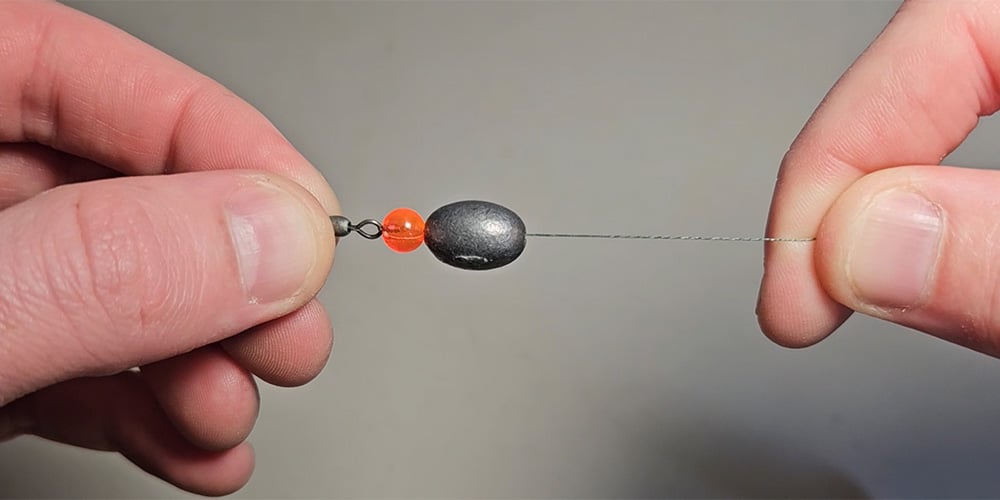
How to put on a fishing sinker: split shot, rubber core, and sliding weights
Trying to get your bait deeper? A fishing sinker is your best friend and has been a staple of tackle boxes for generations. The right fishing weight gets your bait into the strike zone faster, helps you cast farther, and can make the difference between a fish that commits and one that spits the hook. We'll walk you through the three most common sinker types — split shot, rubber core, and sliding sinkers — so you can rig up confidently at any fishing spot. For help choosing your line before you rig, see our fishing line selection guide.
How to attach a split shot sinker

Split shot sinkers work well to get just enough weight on the line to sink your bait. They are especially effective with light baits like salmon eggs, worms, or grasshoppers, and are one of the most popular fishing weights for trout, panfish, and stream fishing. Their biggest advantage is speed — you can crimp them on or pop them off in seconds without cutting the line.
- Position the split shot 1–2 feet above the hook.
- Set the line inside the groove of the weight.
- Pinch the sides of the weight closed with needle-nose pliers. Do not over-crimp — excess pressure can nick or weaken the line.
- Tug on the sinker to confirm it is secure. If it slides, add a small amount of additional pressure with your pliers.
How to attach a rubber core sinker
Rubber core sinkers are generally heavier than split shots, making them better suited for fishing deeper water or faster current. Like split shots, they attach and remove without cutting the line — but they lock with a twist rather than a crimp, which is gentler on monofilament and fluorocarbon. They are a versatile choice for anglers who frequently change depths throughout the day.
- Position the sinker 2 feet above the hook.
- Push the line into the slot so it contacts the rubber core inside.
- Hold the line in place, then grip the rubber tabs at each end of the sinker and twist them in opposite directions to lock the line.
- To remove, simply untwist the rubber tabs to release the line.
How to put on a sliding sinker (egg sinker / Carolina rig)

Sliding sinkers — also called egg sinkers or bullet weights — are the foundation of Carolina rigs, Texas rigs, and other popular bottom fishing rigs. Unlike fixed sinkers, they move freely along the line when a fish strikes, so the fish feels no resistance and is less likely to drop the bait before you set the hook. They are one of the most effective setups for bass, catfish, and redfish.
- Feed the main line from your reel through the hole in the center of the sinker.
- Tie the end of the main line to a swivel using a uni knot. Not sure how? Watch our how to tie a uni knot video.
- Attach a leader line to the other end of the swivel using a second uni knot.
- Tie your hook to the far end of the leader using a palomar knot or your preferred knot. Need a refresher? See our how to tie a palomar knot video.
Get local fishing help at West Marine
West Marine is your local resource for fishing tackle, rigging advice, and gear matched to what's biting in your area. We offer free line spooling and locally assorted tackle in most stores, with knowledgeable anglers on staff who can help you pick the right sinker, line, and rig for your next trip. Find your nearest West Marine store.
Related guides:
- Our 4 best-selling fishing lines and leaders
- How to select the right fishing line
- How to tie 3 essential fishing knots
- How to tie a uni knot
- How to tie a palomar knot
Shop all fishing sinkers and weights at West Marine →
Fishing sinker FAQ
Fishing sinkers add weight to your line, helping your bait sink to the desired depth. They are essential for bottom fishing, casting in windy conditions, and presenting bait naturally in the strike zone.
Place the split shot sinker 1–2 feet above the hook, set the line into the groove, and gently crimp it closed with pliers. Tug to confirm it holds. Avoid over-crimping, which can nick the line.
Rubber core sinkers are ideal for deeper water where you need more weight than a split shot provides. They attach and remove by twisting the rubber tabs — no pliers needed — making depth adjustments fast and line-friendly.
A sliding sinker threads onto the main line and moves freely, so a fish can pick up the bait without feeling resistance. A swivel above the hook stops the sinker and allows you to attach a leader. It is the core of Carolina and Texas rig setups.
They can if over-crimped. Use gentle, even pressure with needle-nose pliers and tug the sinker to test hold before casting. If it slips, add a small amount of additional pressure rather than clamping hard all at once.
Yes. Rubber core and sliding sinkers are especially easy to remove and reuse. Split shots can be reused but may lose holding strength after repeated crimping. Check all sinkers for cracks or corrosion before reuse.
For fixed sinkers like split shots and rubber cores, place them 1–2 feet above the hook. This gives your bait a more natural presentation and reduces the risk of the sinker spooking fish near the strike zone.
Heavier sinkers such as pyramid or bank sinkers anchor best in moving water and surf. For sliding applications in current, heavier egg sinkers maintain better bottom contact while still allowing fish to strike without resistance.
Yes. Because sliding sinkers move freely on the line, fish can pick up the bait without feeling tension, which leads to more confident strikes and better hooksets. This is especially effective for cautious species like trout and catfish.
Absolutely. Sliding sinkers are a key component of both Carolina and Texas rigs. They keep your bait on or near the bottom while allowing fish to strike without feeling the weight, improving hookup rates significantly.