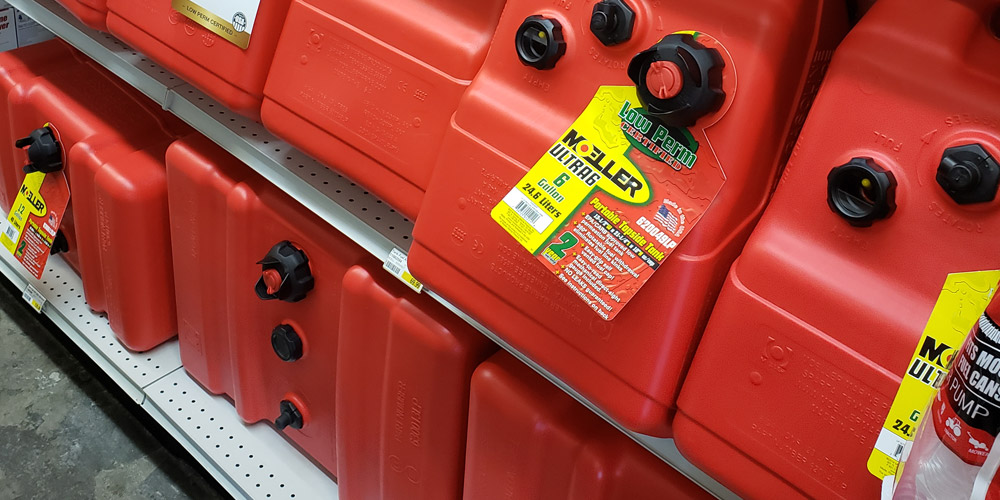
Portable marine fuel tanks and fuel lines may look the same as they did decades ago, but changes mandated by the California Air Resources Board (CARB) and the United States Environmental Protection Agency (EPA) have significantly changed how they work — and in some cases created a frustrating experience for boaters unfamiliar with the new designs. This guide explains how today's EPA-compliant fuel tanks and fuel lines differ from those of the past, and what you need to know to use them safely and without hassle.
In this guide:
- EPA changes to fuel lines and primer bulbs
- The CARB/EPA mandate explained
- Two approaches to EPA compliance
- Non-venting EPA compliant tanks
- New West Marine and Moeller EPA certified tanks (2022+)
- Features and benefits comparison
- Never overfill your tank
- EPA fuel tank FAQ
EPA mandated changes to marine fuel lines and primer bulbs
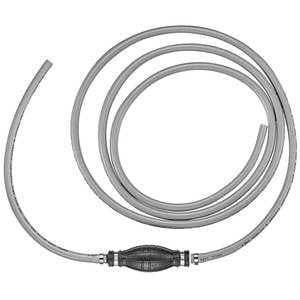
In 2009, fuel lines and primer bulbs were redesigned to include an internal barrier layer that prevents fuel vapor evaporation. This additional layer makes fuel line assemblies significantly less pliable and more susceptible to permanent kinking. Purchasing the correct length fuel line is critical — the stiffer material requires a larger bend radius than older rubber fuel line assemblies, and forcing a tight bend can permanently damage the line.
About the CARB/EPA mandate
Since January 1, 2011, CARB and the EPA have required that all portable fuel systems manufactured for use with outboard motors follow a near-zero-emissions policy. EPA certified tanks must hold a minimum of 5psi of internal pressure generated by ambient temperature changes or warming from the sun.
Before the 2011 mandates, fuel tanks included a fill cap with a manually operated vent that allowed users to release vapor pressure to the atmosphere. Leaving this vent open also prevented engine-stalling vacuum from developing in the tank. In the open position, the tank became an “open system” that continuously released fuel vapors to the environment. To meet the new regulations, EPA certified tanks no longer include this feature.
Meeting the regulations: two approaches to EPA compliance
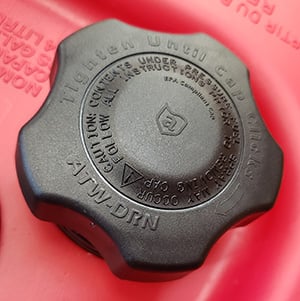
Manufacturers have taken two distinct approaches to meeting EPA requirements: non-venting and venting tank designs. Both are valid paths to EPA compliance. What matters most is that you understand which type of tank you have and follow the correct procedures for each.
Non-venting EPA compliant tanks
Examples of non-venting tanks include post-2011 Attwood EPA compliant portable fuel tanks and 2011–2022 West Marine fuel tanks of the same design. These tanks are distinguished by a fill cap that allows air to enter the tank but does not allow gasoline vapors to escape — unless you loosen or remove the cap manually.
One drawback of non-venting tanks is that ambient temperature changes or direct sun can cause them to swell. This is normal and not cause for alarm, but to limit swelling: do not overfill the tank, and shield it from direct sunlight. Excessive pressure in these tanks can also force fuel through the fuel line and flood or stall the engine, and can cause messy and hazardous fuel spraying when fuel lines are connected or disconnected. West Marine offers two retrofits to address these problems.
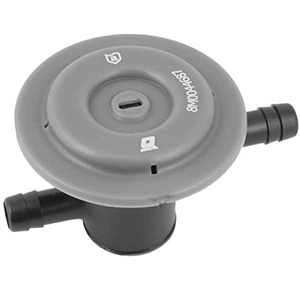
To prevent engine flooding, owners of non-venting tanks should install a fuel demand valve between the primer bulb and the tank. FDV valves serve two functions: they prevent pressurized fuel from flowing freely through the fuel line to the engine, and they allow fuel to flow at atmospheric pressure when the engine creates demand downstream. A manual override enables fuel flow in case the valve is blocked.
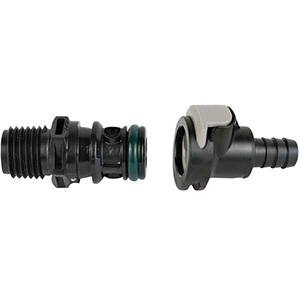
To prevent hazardous fuel spray when connecting or disconnecting the fuel line, loosen the fuel fill cap first to relieve tank pressure before handling the line. Since users often forget this step, we strongly recommend an EPA-compliant sprayless fuel line connector for the tank.
While the FDV valve and sprayless connector can be purchased separately, the simplest solution is the West Marine Platinum Fuel Line Assembly — an all-in-one EPA compliant kit that includes the FDV valve, primer bulb, fuel line, sprayless tank connector, and a choice of engine connectors compatible with a wide range of outboard motors.
To minimize tank swelling, shield the tank from direct sun and store it in a cool location when not in use.
New West Marine and Moeller EPA certified portable fuel tanks (2022 and newer)
In 2022, West Marine and marine fuel tank manufacturer Moeller partnered to introduce a new type of EPA compliant portable fuel tank. Like all EPA certified tanks, these must hold up to 5psi of pressure. The most significant difference from older non-venting designs is the multi-function fill cap, clearly identifiable by the red button in its center.
Understanding how the multi-function cap works — and following the correct connection and disconnection procedures — is the key to a trouble-free experience with this newer generation of tanks.
Features and benefits of new West Marine and Moeller EPA certified tanks
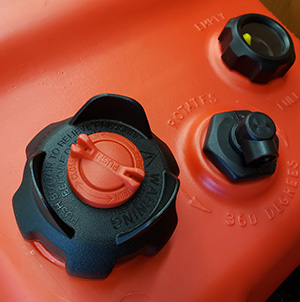
Multi-function cap features:
- Includes a vacuum valve that allows air to enter the tank as the engine draws down fuel.
- Does not vent pressure out of the tank unless it exceeds 5psi, at which point a built-in poppet valve opens automatically to reduce pressure.
- Includes a red button that can be manually pressed to completely vent pressure from the tank before fuel lines are connected or removed — eliminating the need for a sprayless connector.
- Includes a user-operated valve that completely seals the tank for storage.
Additional tank features:
- Heavier wall construction reduces swelling compared to older designs.
- Half-gallon fuel reserve sump at the tank bottom for extra range.
- Fuel pickup connection rotates 360° for easy fuel line connection from any angle.
- Glass fuel gauge sight window that won’t discolor or cloud from UV exposure.
- High-profile fill cap that sits above the level of the fuel pickup connection, protecting it from impact damage in tight spaces.
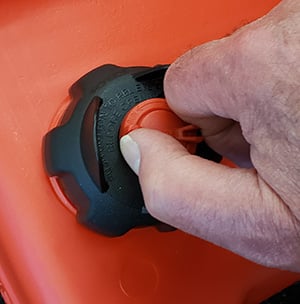
Connecting the fuel line — order of operation:
- Rotate the red button counter-clockwise to the open position. Note: this does not vent the tank — it only opens the vacuum valve.
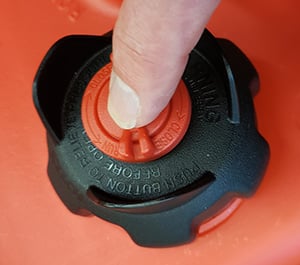
- Depress the red button and hold for several seconds to release any pressure built up in the tank.
- Connect the fuel line to the tank.
- Pump the primer bulb to prime the engine for starting.
Disconnecting the fuel line — order of operation:
- Depress the red button and hold for several seconds to release any pressure built up in the tank.
- Disconnect the fuel line assembly from the tank.
- Rotate the red button clockwise to the closed position to prevent damp air from entering and condensing inside.
- Store the tank out of direct sunlight in a cool, dry place.
Final recommendation: never overfill your portable fuel tank
Regardless of tank type, never fill a portable fuel tank beyond its rated capacity. Tanks are designed with headspace at the top to accommodate fuel expansion — and gasoline expands more than most boaters expect.
The coefficient of expansion for gasoline is 0.069% per degree Fahrenheit of temperature increase. If you fill a 6-gallon tank to the brim at 60°F, by the time the temperature reaches 90°F the gasoline will have expanded to slightly over 6.12 gallons. That extra 0.12 gallon must go somewhere: it will leak from the tank flanges, escape through the 5psi pressure relief valve, or in a worst-case scenario split the tank. The calculation: (0.069/100) × 30°F temperature increase × 6 gallons = 6.12 gallons.
West Marine and Moeller EPA certified tank comparison
| West Marine EPA certified tank (2022+) | Moeller EPA certified tank | |
|---|---|---|
| Wall thickness | Thick walls minimize swelling | OEM quality construction reduces swelling |
| Fuel line connection | Rotates 360° for easy connection | Rotates 360° for easy connection |
| Fuel gauge sight window | Glass lens — UV resistant | Glass lens — UV resistant |
| FDV valve required | No | No |
| Built-in pressure relief valve | Yes — 5psi poppet valve in cap | Yes — 5psi poppet valve in cap |
| Manual pressure vent button | Yes | Yes |
| Fuel reserve sump | 0.5 gal. limp-home capacity | 0.5 gal. limp-home capacity |
| Ethanol compatible | Yes | Yes |
Shop EPA-compliant portable fuel tanks and accessories
West Marine carries the full range of EPA-certified West Marine and Moeller portable fuel tanks along with a Fuel Demand Valve, sprayless connector, and fuel line assemblies for non-venting tank setups. Visit your nearest store for help identifying your tank type and choosing the right accessories.
EPA-compliant portable fuel tank FAQ
EPA-compliant fuel lines include an internal vapor barrier layer that reduces flexibility. They require a larger bend radius than older rubber fuel lines, and forcing a tight bend can permanently kink the assembly. Always buy the correct length for your installation.
Non-venting tanks trap vapor pressure inside and require manual cap loosening or an FDV valve to manage it safely. Newer venting tanks — like 2022+ West Marine and Moeller designs — use a multi-function cap with a built-in 5psi pressure relief valve and a manual vent button, eliminating the need for an FDV or sprayless connector.
Pressure built up inside a non-venting EPA fuel tank can force fuel through the line when disconnected. Always vent the tank first — loosen the fill cap on non-venting tanks, or depress the red button on 2022+ West Marine and Moeller tanks — before connecting or removing the fuel line.
A sprayless fuel line connector prevents pressurized fuel from spraying when connecting or disconnecting the fuel line on non-venting EPA tanks. It is strongly recommended for older non-venting designs. Newer West Marine and Moeller tanks with the multi-function cap and vent button do not require one.
Yes. All West Marine and Moeller EPA-certified portable fuel tanks are ethanol-compatible, built with materials that resist ethanol-related degradation and corrosion in marine fuel systems.