
This Lagoon 42 catamaran boasts a 1600 watt solar system that charges two RELiON RB-300 LT lithium batteries that power a Magnum 3000 watt inverter for running navigation equipment, lighting, three refrigerators, one freezer, a freshwater maker, a washer/dryer, a smart TV, plenty of cooking gadgets such as a rice maker, mixer and blender, an espresso maker, a coffee grinder, computers, and camera gear.
Many boaters are considering replacing lead acid batteries with Lithium Ion batteries. If you are considering making the switch to Lithium batteries, this article will answer the most important questions so you can make an informed choice. Topics covered include safety, performance, charging requirements, cost, weight, and the most common marine applications for Lithium Iron Phosphate batteries sold by West Marine.
The term Lithium Ion encompasses multiple chemistries having slightly different compositions. This results in variations of energy and power density, lifespan, cost, and safety. Common battery types are Lithium Cobalt Oxide (LCO), Lithium Manganese Oxide (LMO) and Lithium Iron Phosphate (LFP). Lithium Iron Phosphate is the most thermally stable and safest of the Lithium-Ion chemistries available. At West Marine, we view safety and reliability as the top priorities, which is why we recommend Lithium Iron Phosphate batteries for use on boats.
Throughout this article, the term “Lithium battery” refers specifically to the RELiON and Mastervolt branded Lithium Iron Phosphate (LFP) batteries sold by West Marine. Here is what sets them apart from lead-acid, gel and AGM chemistries.
Key Advantages of Lithium Batteries
- More usable power with no voltage sag under load
- Charge at a much faster rate — up to 5x quicker than lead-acid
- Dramatically longer cycle life for lower long-term cost
- Significantly lighter weight for better boat performance
- Built-in intelligence with a battery management system (BMS)
Lithium Batteries Deliver More Usable Power
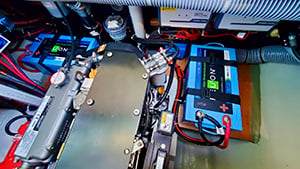
RELiON lithium ion batteries installed on Lagoon 42 catamaran.
Lithium batteries operate at a consistent voltage through the vast majority of their discharge cycle. Lead-acid batteries, by contrast, show a steady voltage drop from the moment they begin discharging, which means the power available to your electronics, motors, and lights decreases throughout the day. Lithium eliminates this “voltage sag,” delivering steady, full-power performance whether your bank is at 90% or 20% state of charge. This helps to guarantee the dependable performance of electrical equipment and motors.
In practical terms, a 100Ah Lithium Iron Phosphate battery provides 80Ah of reliably usable energy at consistent voltage. A 100Ah lead-acid battery should only be discharged to 50% — giving you 50Ah of usable capacity, delivered at diminishing voltage throughout the cycle. That is 60% more usable energy per battery, delivered more consistently, from Lithium.
Lithium Batteries Charge at a Much Faster Rate
Lithium batteries are very efficient while charging due to their consistent or flatter voltage in the middle of the charging curve. Lithium Iron Phosphate battery chemistry allows fast charging with accepted charge currents as high as 50% or more of the battery’s amp hour rating. This means that with the right size charger, a fully depleted 100Ah Lithium battery can be returned to 100% in as little as two hours — compared to eight hours or more for an equivalent lead-acid battery under the same conditions. Finally, because Lithium batteries do not require a full charge after every use, they can be left in a partial state of charge without causing harm or shortened lifespan, making them ideal for the unpredictable charge opportunities common on boats. These differences are summarized in the table below.
Table 1: Charging times of 100Ah Group 31 Lithium Iron Phosphate, Flooded Lead Acid and Gel/AGM Batteries*
| Charging Amps | Discharge Level | Lithium | Flooded LA | Gel, AGM |
|---|---|---|---|---|
| 10 | 0.5 | 5 hr. | 8 hr. | 8 hr. |
| 20 | 0.5 | 2.5 hr. | 4 hr. | 4 hr. |
| 50 | 0.5 | 1 hr. | Not feasible | Not feasible |
| 10 | 1 | 10 hr. | 16 hr. | 16 hr. |
| 20 | 1 | 5 hr. | 8 hr. | 8 hr. |
| 50 | 1 | 2.5 hr. | Not feasible | Not feasible |
Lithium batteries offer far greater cycle life.
A “cycle” is the combination of a discharge and recharge event that is over 5% of the battery’s amp-hour capacity. A standard flooded lead acid battery has a typical cycle life of 250 cycles. A high-performance AGM battery has a cycle life of around 500 cycles. For both a flooded lead acid and AGM battery those life cycles are based on up to 50% depth of discharge. If you discharge to 80% or more, you can reduce the cycle life by over 50% based on the frequency of discharge or age of the battery. In comparison, a Lithium Iron Phosphate battery has a typical cycle life of 3,500 cycles down to 80% depth of discharge. That is 3,000 more cycles than a high-performance AGM with 60% more usable energy. Put simply: one Lithium battery will outlast fourteen flooded lead-acid batteries and seven high-performance AGM batteries under equivalent daily cycling conditions.
Table 2: Cycle Life and Available Amp-hours Over Lifespan of 100Ah Group 31 Batteries
| Battery Type | Depth of Discharge | Cycle Life | Usable Ah Over Lifespan | % Versus Lithium |
|---|---|---|---|---|
| Flooded Lead Acid | 0.5 | 250 | 12,500 | 4% |
| High Performance AGM | 0.5 | 500 | 25,000 | 9% |
| Lithium Iron Phosphate | 0.8 | 3500 | 280,000 | 100% |
Lithium Batteries Weigh Less
Lithium batteries weigh much less than their lead acid counterparts. A Group 31 Lithium Iron Phosphate battery weighs approximately 26.5 lbs compared to 60 lbs for flooded lead-acid and 69 lbs for AGM — a weight reduction of more than 55% for equivalent or greater usable capacity. Because of this, serious sailboat racers, who are always looking to gain an edge by reducing the weight of their boats, are an obvious application for lithium batteries. Powerboat owners can benefit as well; since the reduced weight of lithium batteries results in better weight distribution and less draft, they can get on a plane faster with less fuel consumption. On cruising liveaboards carrying four, six, or eight batteries, switching to Lithium can eliminate several hundred pounds of ballast, meaningfully affecting trim and fuel economy across a season.
Table 3: Weights of Group 31 Flooded and AGM Compared to RELiON R100 Lithium Battery
| Flooded Lead Acid | AGM | Lithium |
|---|---|---|
| 60 lb. | 69 lb. | 26.5 lb. |
Is the cost of Lithium batteries justified?

Bonita, Yoshi and their hound Marley enjoy an off-the-grid, solar powered lifestyle on their cutter-rigged sloop Nandji. According to Yoshi, the couple switched to dependable RELiON lithium batteries because, "Our lead acid batteries were simply not handling the constant strain we would put on them daily and they eventually died after just eighteen months."
Cost is often the first thing that comes to mind when it comes to lithium batteries. In a group 31 size a Lithium battery typically costs 7 times more than a traditional lead-acid battery, and 3 times more than a high-performance AGM. The higher cost has been the primary barrier against boaters adopting lithium batteries. However, the true cost of ownership is far less than lead-acid when considering life span and performance. Lithium typically has around 10 times the lifespan of a traditional lead acid and 7 times the lifespan of a high-performance AGM. If you assumed a battery on a boat was cycled once per day, then a flooded lead acid battery would typically last a year, a high-performance AGM would last a little over a year, and a Lithium would last nearly 10 years. That means over a ten-year period you would purchase roughly ten lead-acid batteries or seven AGM batteries to match the service life of a single Lithium. When replacement cost, installation labor, and the performance advantages of Lithium are factored in, most boaters with moderate to heavy usage find Lithium reaches cost parity within two to four years. RELiON backs their Lithium Iron Phosphate batteries with a 10-year warranty and reports virtually zero returns — a direct result of the protection the built-in BMS provides.
A Built-In Battery Management System (BMS) Protects Your Investment
RELiON Lithium batteries include an internal battery management system (BMS) that protects against harmful conditions before they occur. Think of this as the intelligence system that guards against users damaging their investment. A BMS makes sure each cell in the battery remains within safe limits. A well-designed battery management system can help maximize the lifetime and ensure the safe operation over a wide range of conditions. Conditions that the BMS protects against are over-voltage, under-voltage, over current, over-temperature and short circuit protection. When a BMS enters protection mode, the cell pack is electrically disconnected from the battery terminals and the battery voltage is no longer available. When the fault condition is removed the BMS will recover, and voltage is restored. We should mention that due to the protection the BMS provides against abuse or user error, RELiON (who warranties their batteries for 10 years) reports virtually zero returns. For more information about the BMS, please consult the applicable RELiON spec sheet or owner’s manual.
What type of battery charger do Lithium batteries require?
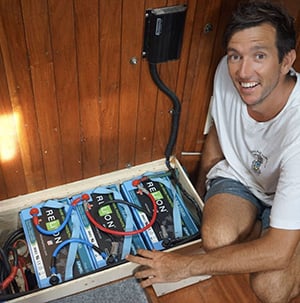
Yoshi shows off his RELiON lithium battery installation.
In standard conditions, Lithium batteries have a flatter voltage profile which allows the charger to provide maximum current longer resulting in faster charge times than lead-acid. For that reason, to maximize the potential of a lithium battery we recommend pairing it with a charger that has a designated Lithium charge profile. A charger programmed for lead-acid will under-charge a Lithium battery or, in some cases, attempt to apply an absorption or equalization stage that the BMS will reject by disconnecting the battery. A charger with a proper Lithium profile delivers a constant current phase followed by a brief constant voltage phase, then stops — matching exactly how a Lithium battery wants to be charged. West Marine offers multiple chargers compatible with Lithium like the ProMariner ProNautic and ProSport HD battery chargers. Additionally, all Mastervolt battery chargers, DC to DC converter, and Inverter/Chargers are Lithium compatible.
When the BMS disconnects the battery, it disconnects it from the charging sources and the loads, so while the battery will be protected, disconnecting a battery from the entire electrical system could have other adverse effects.
Battery Monitoring
Since Lithium provides consistent voltages throughout the discharge cycle, voltage is no longer an accurate measure of state of charge. A traditional voltmeter that provided insight into the level of charge in a lead-acid battery will not be effective for monitoring lithium batteries. With lead-acid, voltage drops steadily as the battery discharges. With Lithium, voltage stays consistent from 100% down to roughly 20%, then drops sharply — meaning by the time a voltmeter shows a problem, the battery may already be close to BMS disconnection. The only way to accurately measure the state of charge of lithium is with a State of Charge (SoC) monitor that uses coulomb counting: tracking every amp flowing in and out of the battery in real time to calculate remaining capacity. We recommend SoC meters with shunts that monitor all the amperage flowing in and out of the battery. West Marine offers multiple SoC meters like the Blue Sea Systems M2 DC Multimeter with SoC.
What Size Lithium Batteries Do You Need?
As discussed earlier one of the primary benefits of Lithium batteries is the ability to deeply discharge vs lead-acid. When selecting the proper amp hour size or quantity of lithium batteries we still recommend creating an energy budget as outlined in the West Advisor Article Sizing Your House Battery Bank. The only difference is when creating an energy budget with Lithium you don’t have to be concerned with restricting your depth of discharge to 50%. For example, if your energy budget per day is 120Ah with lead-acid we recommend a 3-4 multiple resulting in a battery bank 360-480Ah. With Lithium the Ah per day multiple can be 1.5-2, or in this example 180-240Ah — fewer batteries, less weight, and less space, while delivering more reliable power throughout the day. For most boaters this will allow the use of less and/or smaller Lithium batteries in a boat that previously used lead-acid.
Just like with lead-acid batteries, connecting Lithium batteries in parallel to increase capacity is acceptable. For example, wired in parallel 3X 100Ah batteries will result in a 300Ah bank. However, it is recommended to consult your battery’s owner’s manual for designing battery banks of five or more batteries.
Charging Lithium Batteries with an Alternator
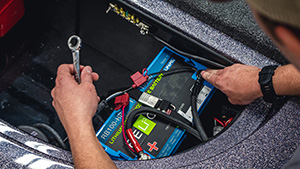
Patrick Walters, Elite Series Pro Angler installing a RELiON lithium battery. Tournament bass anglers appreciate the performance and reliability of RELiON lithium batteries which enable them to fish longer before they need to recharge.
Lithium batteries have been in wide marine use and successfully charged by alternators for several years now. Like with standard AC battery chargers it is critical to ensure your alternator/regulator is compatible with Lithium. Anytime the battery’s BMS determines charging in unsafe levels it will disconnect the battery from the system. With AC charging this is not a major issue, but with alternator charging that could mean your alternator is running with no battery present which could back feed and damage components — including the alternator, regulator, and sensitive electronics on the DC system. For that reason, we recommend only pairing lithium batteries with alternators and regulators with designated lithium profiles. West Marine offers multiple external regulators from Balmar and Mastervolt that work with lithium.
A recommended alternative to changing out an alternator is to install a DC-to-DC converter. These devices allow you to leave the alternator connected to the existing lead-acid battery bank. The DC-to-DC converter then connects the lead acid bank to the lithium bank and appropriately isolates, and properly charges, the lithium bank using the existing alternator — with no modification to the alternator or regulator required. For most boaters upgrading an existing vessel from lead-acid to Lithium house power, this is the cleanest, lowest-risk installation path. West Marine offers multiple DC-to-DC converters in various sizes and styles from Mastervolt.
Engine Starting
While the characteristics of Lithium batteries make them ideal for house power applications, most lithium batteries are not designed for engine starting. The typical peak current on a standard RELiON battery is 200A and it should not be used for engine starting. Fortunately, West Marine does offer the HP line of batteries from RELiON that has a peak current of 800A for two seconds — sufficient for starting a wide range of marine gasoline and diesel engines. This is one of the only Lithium batteries designed and rated for engine starting in the industry. Like other Lithium batteries, the RELiON HP series is also a deep cycle battery making it a true dual-purpose option: one battery handles both starting and house duties, simplifying the electrical system while maintaining all the weight and cycle-life advantages of Lithium.
Connecting Lithium Batteries in Series
Series connections may also be needed when sizing a battery bank for the correct voltage. For example, boaters will often connect 3 x 12V Lithium batteries in series to power a 36V trolling motor. One must be selective though as not all Lithium battery models are designed to be wired in series. The series capability is listed on all RELiON battery specification sheets. For example, the RB100 battery allows for connecting up to six 12V batteries in series for a total of 72 volts. Keep in mind, the best way to charge a battery bank connected in series, is to use a charger that has a dedicated charging lead to each bank like the ProSport HD line of battery chargers.
One of the additional benefits of lithium is the availability of batteries at a nominal voltage above 12V. West Marine offers multiple 24V lithium batteries. This enables 24V customers to simply purchase one battery to achieve their system voltage and then connect them in parallel if more capacity is desired — simplifying installation and reducing connection points.
Can Lithium batteries benefit you?

Patrick Walters, Elite Series Pro Angler next to his RELiON battery installation.
How you use your boat will be one of the largest factors in determining if Lithium makes sense. We have found that boaters with heavy electrical load requirements are the ideal candidates for a Lithium battery system. Lithium is not the right choice for every boat — occasional weekend boaters who cycle their batteries infrequently may not recoup the upfront cost quickly enough to justify the switch. But for boaters who spend significant time aboard, run heavy electrical loads, or rely on their battery bank as a primary power source, Lithium Iron Phosphate is the most capable and cost-effective marine battery chemistry available today.
Examples of Lithium Battery Applications
- Trolling motor batteries because Lithium allows the angler to fish longer with consistent motor thrust from full charge to empty
- Cruisers who want to travel further and stay at a destination longer, benefiting from faster solar or generator recharge times and larger usable capacity
- Boats with large power devices like stereo amplifiers, gyros, and air conditioners, where sustained current draw shortens lead-acid life quickly but has little impact on Lithium cycle count
- Generator alternative. The combination of an Inverter Charger and appropriately sized Lithium battery bank replaces the noise, hassle, and maintenance of a generator while giving the boater the same comforts of home
While Lithium may not be right for all boat applications, we hope this article has given you the information to determine if Lithium is right for your next battery replacement.
Related:
- What is the Best Battery for You?
- How to Select a Marine Battery
- West Marine's Battery Testing Program
- Sizing Your House Battery Bank
- Do-it-Yourself: Installing a Second Battery
Lithium Marine Batteries FAQ
Lithium batteries offer longer life, faster charging, more usable power, lighter weight, and built-in battery management systems. These advantages make them ideal for boaters with higher energy demands and a desire for low-maintenance power solutions.
Yes. Lithium Iron Phosphate (LiFePO4) batteries are among the safest lithium chemistries available. Brands like RELiON and Mastervolt include advanced Battery Management Systems (BMS) that prevent overcharging, overheating, and short circuits, ensuring reliable marine use.
With the right charger, lithium batteries can charge in as little as 1–2.5 hours, thanks to their flat voltage profile. This rapid charging ability outpaces flooded lead-acid and AGM batteries, which typically require 4–16 hours to reach full charge.
We recommend using a charger with a dedicated lithium charging profile, such as ProMariner ProNautic or Mastervolt models. These chargers optimize charging performance and protect battery health, especially when paired with an internal BMS.
Most lithium batteries are not designed for engine starting. However, West Marine offers RELiON's HP series lithium batteries, which are engineered for high peak current and are safe for starting marine engines while also supporting deep cycling.
Lithium batteries are significantly lighter—often weighing less than half of a comparable lead-acid battery. For example, a Group 31 lithium battery weighs around 26.5 lbs versus 60–70 lbs for AGM or flooded lead-acid batteries.
Lithium Iron Phosphate batteries can last over 3,500 cycles at 80% depth of discharge, far outpacing AGM (around 500 cycles) and flooded lead-acid (about 250 cycles). This makes lithium batteries ideal for long-term performance and heavy usage.
Yes. You can connect lithium batteries in parallel to increase capacity or in series to increase voltage. Be sure to confirm your specific battery model supports series configurations and follow the manufacturer's guidelines for wiring and charging.
Yes. Because lithium batteries maintain a steady voltage during discharge, voltage readings alone aren't accurate. A State of Charge (SoC) monitor with a shunt is recommended to track real-time energy usage and battery health accurately.
Although lithium batteries are more expensive upfront, their long life, deep discharge capability, fast charging, and low maintenance often result in a lower total cost of ownership over time—especially for boats with heavy or frequent energy demands.