What Boarding Ladders Do
Boarding ladders allow boaters to get in and out of the water from the deck or swim step of a boat and aid in boarding from a dinghy. Although they can sometimes assist in retrieving a crew member overboard, they are typically of little use in rough seas. We’ll help you choose the right one for your boat.
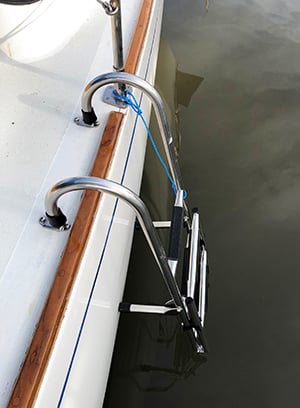
West Marine 5-Step Gunwale-Mount Boarding Ladder installed on the author’s Cal 40, mounted in the gated area of the lifelines.
How Boarding Ladders Work
Boat ladders must extend below the water surface to be effective. Ladders with at least 2–3 rungs below the surface give most swimmers enough support to climb aboard. This means the ladder must either fold or be removed when underway to avoid drag and damage.
For crew overboard retrieval, a boarding ladder is only useful in calm or moderate conditions — an exhausted, cold, or injured person in rough water will have great difficulty climbing even a well-designed ladder. A hoisting tackle or Lifesling system used in combination with a sturdy ladder is the most reliable retrieval setup for offshore use.
Common Ladder Types
- Over-the-gunwale ladders are the most common choice for runabouts and small sailboats. Hooks vary in width to match different gunwale dimensions. They deploy quickly and store compactly.
- Swim step ladders hang down from powerboat swim steps and retract underneath or fold up onto the step. Because the swim step is already close to the water, these typically need only 1–3 steps.
- Platform ladders create a mini swim step on one side of the outboard or outdrive, with a platform and side rails for easier boarding from the water.
- Transom ladders on sailboats hinge up and down and are often designed to complement the appearance of the pushpit.
- Removable ladders fit into brackets bolted to the hull or deck. Keyhole slots hold the ladder securely while allowing quick removal for storage.
- Telescoping ladders extend downward from a compact collapsed length, making them practical for boats with higher freeboard where a fixed-length ladder would be impractically long when stored. They are increasingly common on center consoles and larger powerboats.
Many ladders fold in half so they can be left in place without dragging in the water. In the folded position they can still be used when boarding from a dinghy, and extended when swimming. Rope ladders are flexible, collapsible, and lightweight, but are not suitable as a primary boarding ladder — their flexibility makes them difficult to climb, particularly for a tired or cold swimmer. Test any rope ladder in calm, controlled conditions before relying on it as your sole reboarding method.
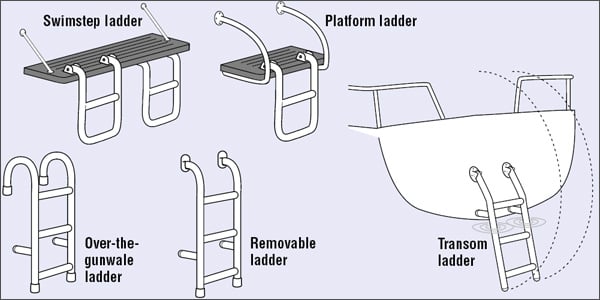
Common boarding ladder types: over-the-gunwale, swim step, platform, and transom configurations.
What to Look for When Choosing a Boarding Ladder
Comfort and Security
Broad, nonskid treads matter more than they might appear — 1” stainless tubing is remarkably painful underfoot after a swim. Look for ladders that stand off away from the hull to provide finger and toe clearance between the ladder and the boat. Side rails that extend above deck level give a secure handhold when stepping from the ladder onto the boat. The more confident a tired swimmer can feel on the ladder, the better.
Construction
Ladders are made from non-corroding materials: stainless steel, aluminum, and plastic. Aluminum is lighter and less expensive; stainless steel looks better and is stronger. Plastic treads are comfortable and require no maintenance. For offshore or saltwater use, stainless steel is the preferred choice for durability and appearance over time.
Load Capacity
Check the manufacturer’s rated load capacity before purchasing. For crew overboard retrieval use, a ladder should be rated for at least 300 pounds — an exhausted, gear-laden crew member plus the dynamic loading of climbing from the water can exceed the static weight of the person alone. A ladder that is adequate for casual swimming may not be appropriate as a safety device.
Where to Mount Your Boarding Ladder
Mount the ladder where steps extend far enough into the water to make boarding easy, at a location that is accessible and convenient. Stern ladders are common on sailboats but this is frequently where the boat’s motion is greatest, making boarding more difficult in any chop. On sailboats with a fixed pushpit, a better location may be amidships near the cockpit where the lifeline gate is located — lower freeboard and less motion than the stern.
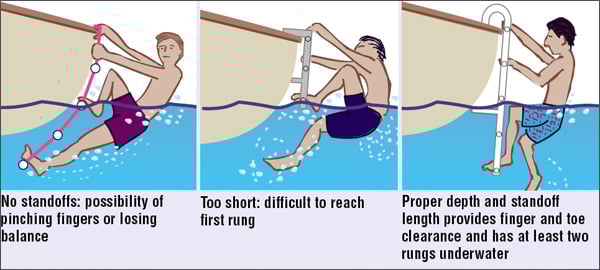
Mounting location examples: gunwale-mount on a runabout, stern ladder on a powerboat, and lifeline-gate mounting on a sailboat.
Installing a Boarding Ladder
A reliable boarding ladder is an important component of your boat’s safety equipment as well as its water fun. As an owner of an offshore racing sailboat, I wanted a ladder usable with my Lifesling 2 for crew overboard recovery. The Lifesling 2 is an excellent device for throwing to a person in the water, but getting them back aboard requires either a hoisting tackle, a sturdy boarding ladder, or both.

The bottom of the ladder sits just above the waterline when folded, keeping it clean. A blue Amsteel keeper lanyard is secured around the base of the stanchion as a backup retention in case the ladder disengages from the mounting clips.
My first choice was the Sea-Dog 5-Step Boarding Ladder, selected for its light weight, easy storage, and low cost. Those virtues were overwhelmed by the product’s deficiencies — it was extremely unstable and provided zero confidence when trying to climb from a kayak onto the ladder.
I ultimately bought the West Marine 5-Step Gunwale-Mount Boarding Ladder shown in the photos on this page. It is mounted in the gated area of my Cal 40’s lifelines, and I purchased a second set of mounting sockets so the ladder can be deployed on either side of the boat. My boat’s freeboard (waterline to deck) is about 36 inches. With the ladder folded, the bottom sits approximately 1.5 inches above the water’s surface. Deployed, two steps are under water. The blue Amsteel keeper lanyard is secured around the base of the stanchion — a backup retention measure in case the ladder somehow disengages from the mounting clips while in use.
Two practical installation notes: purchase a second set of mounting sockets if your boat benefits from dual-side deployment, and always add a keeper lanyard. A ladder lost overboard during a crew overboard situation becomes a serious problem at the worst possible moment.
Frequently Asked Questions
How many steps does a boarding ladder need?
At minimum, 2–3 rungs should be below the water surface when the ladder is deployed. The total number of steps depends on your boat’s freeboard — the distance from the waterline to the deck. Higher freeboard requires more steps. Swim step ladders generally need only 1–3 steps total because the step is already close to the water. For gunwale-mount or transom ladders on boats with 3–4 feet of freeboard, 4–6 steps are typical.
What is the difference between a folding and a telescoping boarding ladder?
A folding ladder folds in half at a hinge point, allowing it to be left deployed in the folded position (useful for dinghy boarding) and extended fully for swimming. A telescoping ladder collapses from the bottom up to a shorter stored length, then extends downward when needed. Telescoping ladders are well-suited for boats with higher freeboard where a full-length folded ladder would be unwieldy to store. Both types keep the ladder out of the water when not fully deployed.
Can a boarding ladder be used for crew overboard recovery?
In calm or moderate conditions, yes — a sturdy boarding ladder is a useful component of a crew overboard retrieval system. In rough seas, an exhausted or injured person will likely be unable to climb a ladder without assistance. For offshore use, combine a boarding ladder with a Lifesling and a hoisting tackle so you can bring a person alongside and lift them partially from the water before they need to climb independently. A rope ladder should never be relied upon as the primary crew overboard recovery device.
Where is the best place to mount a boarding ladder on a sailboat?
Near the cockpit at the lifeline gate, rather than at the stern. The stern has more boat motion in any seaway, making boarding more difficult. The lifeline gate location offers lower relative freeboard on many boats and more stable footing on deck. Mount the ladder so it can be deployed quickly without having to move through the boat — in a crew overboard situation, seconds matter.
What should I look for in a boarding ladder for crew overboard use?
Wide, nonskid treads rather than bare tubing. Rails that extend above deck level for a handhold when stepping aboard. Rigid construction that holds its position when loaded — a wobbly ladder is dangerous for a tired swimmer. A rated load capacity of at least 300 pounds. Secure mounting hardware with a keeper lanyard as backup retention. The ability to deploy quickly with one hand if necessary.