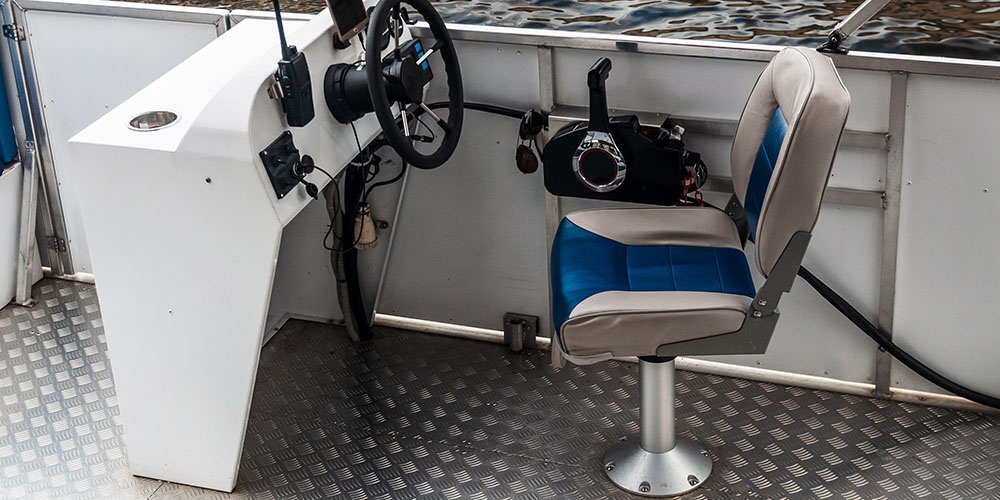
Boat seating ranges from simple fixed helm chairs to fully adjustable multi-position systems with shock absorption and power controls. Getting the right combination of pedestal, connector, and seat makes the difference between a comfortable day on the water and an exhausting one. This guide walks you through each decision in order, from the deck up.
- ABYC Type A vs. Type B Seats
- Types of Boat Seats
- Seat Materials
- Step 1: Choose the Pedestal
- Step 2: Choose the Connectors
- Step 3: Choose the Seat
- Shock-Absorbing Seats
- Installation Considerations
- FAQs
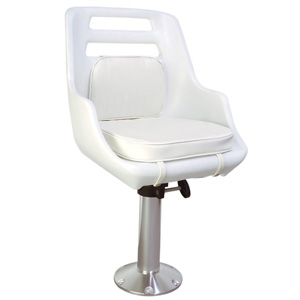
The West Marine Skipper Chair and Pedestal Package includes the chair, pedestal, and connector — everything you need for a complete helm seating installation.
ABYC Type A vs. Type B Seats
Before selecting any seat or pedestal system, the most important question is how the seat will be used while the boat is moving. The American Boat and Yacht Council (ABYC) defines two seat categories that determine the structural and locking requirements for the entire assembly:
- Type A seats are “designed for occupancy while the vessel is underway at any boat speed.” These seats must meet stricter load and locking requirements because occupants may experience significant forces at planing speeds. Helm seats and captain’s chairs used at the helm of a planing powerboat must be Type A rated.
- Type B seats are “designed for occupancy only at boat speeds not exceeding 5 miles per hour.” Fishing seats, cockpit seating, and seats used only at anchor or slow trolling speeds may be Type B.
If you are replacing or upgrading a helm seat on a boat that is used at planing speeds, confirm that the seat and all components (pedestal, connectors, fasteners) are Type A rated. Using an undersized or Type B component in a Type A application is a safety risk in rough water or an emergency maneuver.
Types of Boat Seats
Understanding the main seat categories helps narrow your selection before you get to pedestal and connector choices.
- Helm / captain’s chairs: Fully upholstered seats with armrests, backrests, and often adjustable lumbar support. Designed for the helmsman’s position. Available in low-back and high-back versions. High-back chairs provide more support on long runs; low-back designs improve visibility. Most helm chairs mount on a pedestal and connector system.
- Fishing / tournament seats: Simpler, often lighter construction focused on functionality over comfort. Many feature a flip-up bottom cushion for stand-up fishing. Some have built-in rod holders, cup holders, or arm rests. Designed for use at slower speeds or at anchor.
- Folding seats: Fold flat against the gunwale, transom, or seat base when not in use. Useful on smaller boats or in areas where space is needed for fishing or boarding. Available in wall-mount, floor-mount, and jump-seat configurations.
- Lounge / bench seats: Wider seats designed for passenger comfort rather than the helmsman. Often used on bow areas, stern platforms, or along the gunwale. May be fixed or on a swivel base.
- Jump seats / leaning posts: Compact seats or seat cushions designed for standing support or brief sitting. Common on center console boats where the leaning post also houses rod storage and cooler space.
- Cooler seats / seat boxes: A seat top mounted on a storage box or cooler. Common on smaller fishing boats where space efficiency is essential.
Seat Materials
Marine seating is exposed to UV radiation, salt spray, rain, and constant sun. Material selection determines how long a seat looks good and holds up.
- Marine vinyl: The standard for marine seating. Marine-grade vinyl is UV-stabilized, mildew-resistant, and easy to clean. It comes in various grades — heavier weight vinyl lasts longer and resists cracking in sun exposure. Look for double-stitched seams with UV-resistant thread. Standard automotive or furniture vinyl is not appropriate for the marine environment and will crack and fade within one or two seasons.
- Foam density: Higher-density foam holds its shape longer and provides better support, but adds weight. Closed-cell foam resists water absorption, which prevents mildew growth inside the cushion. Open-cell foam is lighter but retains water if the cover is compromised. Most quality marine seats use closed-cell or layered foam construction.
- Frame materials: Aluminum frames are light and corrosion-resistant. Stainless steel hardware resists rust in saltwater environments. Avoid untreated steel or chrome-plated parts that will pit and rust in a marine environment. Powder-coated aluminum is a strong and durable finish choice.
Step 1: Choose the Pedestal
Design the seating system from the deck up. The pedestal is the foundation — everything else builds on it. Boat seat pedestals fall into two main types:
- Fixed-base pedestals use a ring base that bolts permanently to the deck or sole. They are stable and secure but the installation is permanent. Available in fixed heights and in adjustable versions with a locking mechanism to set height.
- Removable pedestals use a deck-mounted base plate into which the pedestal slides or locks. The seat assembly can be removed entirely, freeing deck space for fishing or other activities. Removable types include pin-lock and wedge-lock designs.
Choosing pedestal height: The goal is an ergonomic seated position at the helm with thighs approximately parallel to the deck, feet resting comfortably on the floor, and adequate visibility over the windscreen. A seat that is too low strains the back; one that is too high causes fatigue in the legs. Most pedestal systems offer height adjustment of several inches — measure the distance from your deck to the desired seat height before purchasing, and verify the pedestal range covers that dimension.
For a simple fixed helm position, a base, pedestal, connector, and seat are all you need. For a more versatile setup — one that will serve multiple uses or multiple crew members of different heights — choose a pedestal with positive-locking height adjustment.
Step 2: Choose the Connectors
The connector is the interface between the pedestal and the seat. Connectors determine how the seat can be positioned and adjusted. Options include:
- Fixed spider / base plate: Mounts the seat directly to the pedestal in a fixed position. Simple, secure, and low-profile. The right choice when you do not need rotation or adjustment.
- Swivel: Allows the seat to rotate 360° and lock in any position. Essential for helm seats where the operator needs to face aft occasionally, and useful for fishing seats where the angler needs to turn to face any direction. Look for a positive-locking swivel that cannot rotate unexpectedly underway.
- Fore and aft slider: Allows the seat to slide forward and backward on a track, adjusting the distance from the helm or console. Useful when the seat will be used by operators of different heights or leg lengths.
- Shock absorber: Mounts between the pedestal and the seat to absorb vertical impacts. Essential for high-speed planing boats in choppy conditions. See the Shock-Absorbing Seats section below.
Connectors can often be combined — a swivel on top of a slider, for example — to build a highly adjustable system. Confirm that combined connectors do not exceed the height requirements of your installation and that all locking mechanisms meet ABYC Type A requirements if the seat will be used at speed.
Step 3: Choose the Seat
Choose a boat seat that meets the full range of uses you anticipate — now and in the future. A seat that works well for day fishing may not be adequate for a long offshore run, and comfort matters more over a four-hour passage than it does for a short trip across the bay.
Consider the following when selecting the seat itself:
- Backrest height: High-back seats provide full lumbar and shoulder support for long runs. Low-back seats offer a smaller profile and better rearward visibility, which some helmsmen prefer.
- Armrests: Folding or fixed armrests add comfort on long passages but can interfere with movement. Removable armrests offer the best of both.
- Seat width: Wider seats are more comfortable but take up more deck space. Measure your available installation space before selecting seat width.
- Flip-up bottom: A seat with a flip-up cushion converts to a standing position without removing the seat assembly. Popular on fishing boats where standing at the console or gunwale is common.
- Weight capacity: Verify the seat and pedestal system is rated for the anticipated user weight. ABYC specifies minimum load requirements by seat type.
ABYC compliance: ABYC standards specify materials, fastener requirements, and load criteria for seat assemblies. All components should meet these minimum standards. Key requirements include: fasteners of #10 diameter or larger, spaced to provide required strength in all directions, and not threaded into sole panels of plywood alone. Woods used in the installation must be treated for the marine environment. Ferrous metals must be hot-dipped galvanized, electroplated, or stainless steel. Copper and copper alloys must not be used in contact with aluminum.
Shock-Absorbing Seats
If your boat planes at speed in rough water, a shock-absorbing seat system is one of the most meaningful upgrades available. Running a planing powerboat in a chop transfers significant vertical impact to the helmsman through the seat — over a long day, this causes back and neck fatigue and can contribute to long-term injury.
Shock-absorbing mechanisms mount between the pedestal and the seat. They use springs, hydraulics, or elastomeric dampers to absorb vertical impacts before they reach the occupant. The result is a dramatically smoother ride at the helm, particularly in 1–2 foot chop at speed. The tradeoff is added height between the pedestal and seat — verify your total stack height (base + pedestal + shock absorber + connector + seat) fits your installation before purchasing.
If you are retrofitting a shock-absorbing system to an existing installation, measure the current total height from deck to top of the seat, then subtract the height of the shock absorber to determine how much you may need to shorten the pedestal to maintain the same final seating height.
Installation Considerations
A properly installed seat system is secure at any speed and in any sea state. Poorly installed pedestals are one of the most common sources of seating failure and can cause injury in rough conditions.
- Core access: Most fiberglass boat decks have a balsa or foam core. Drilling through a cored deck without sealing the core around the fastener holes allows water intrusion that degrades the core over time. Drill oversize, fill with epoxy, and re-drill to the fastener diameter to seal the core completely.
- Backing plates: Use a stainless steel or aluminum backing plate on the underside of the deck to distribute the load across a wider area. Pedestals carry significant fore-and-aft and lateral loads at speed, and fasteners pulling through the deck without a backing plate is a failure mode that occurs more often than expected.
- Fastener size and material: Use stainless steel fasteners of #10 diameter or larger as specified by ABYC. Never use untreated steel or brass fasteners in a deck installation.
- Sealant: Apply marine sealant (silicone, polysulfide, or polyurethane, depending on the substrate) to all deck penetrations to prevent water ingress around the fasteners.
- Check and retorque: After the first season, check all pedestal fasteners and retorque as needed. Deck installations settle slightly as sealant cures and under the loads of normal use.
Frequently Asked Questions
What is the difference between a Type A and Type B boat seat?
ABYC Type A seats are rated for occupancy at any speed, including planing speeds. They must meet stricter structural and locking requirements. Type B seats are rated for use only at speeds of 5 mph or less — appropriate for trolling seats, fishing chairs, and cockpit seating used at anchor or slow speeds. For any helm seat on a planing boat, all components should be Type A rated.
How do I determine what pedestal height I need?
Sit in your current seat or in a chair of similar height and check your position at the helm: thighs roughly parallel to the deck, feet flat on the floor, and a clear sightline over the windscreen. Measure from the deck to the underside of where you want the seat cushion. That is your target seat height. Subtract the seat cushion thickness and any connector height from this number to determine the pedestal length needed. Most pedestal systems offer adjustability of several inches, so you need to be within that range of your target height.
Can I install a boat seat myself?
Yes, most fixed and removable pedestal seat installations are within the skill range of a handy boat owner. The key steps that require care are sealing the deck core around fastener holes (critical on cored decks) and installing an adequate backing plate on the underside of the deck. If you are not comfortable drilling through your deck or do not have access to the underside of the deck from below, professional installation is worthwhile.
What is a shock-absorbing seat and do I need one?
A shock-absorbing seat mechanism mounts between the pedestal and the seat and uses springs or dampers to absorb vertical impacts before they reach the occupant. They significantly reduce fatigue and back strain on planing boats running in chop. If you regularly run at speed in rough water, a shock absorber is one of the highest-value comfort upgrades available. If you fish at slow speeds or are primarily at anchor, a standard fixed connector is adequate.
What materials should I look for in a marine seat?
Look for marine-grade UV-stabilized vinyl (not automotive or furniture vinyl), closed-cell foam that resists water absorption, double-stitched seams with UV-resistant thread, and aluminum or stainless steel hardware. Avoid any seat with chrome-plated steel hardware, untreated steel frame components, or vinyl that is not specifically rated for marine outdoor use — these will deteriorate quickly in a saltwater environment.