Article Contents
- Top 5 Tips for Choosing Boat Plumbing Fittings
- Introduction
- Silicon Bronze: The Below-Waterline Standard
- Brass: Where It Belongs and Where It Does Not
- Marelon: The Engineered Composite Alternative
- Generic Plastic Fittings
- Material Comparison by Application
- Dezincification: The Hidden Failure Mode
- Inspection and Replacement
- Shop Fittings at West Marine
- FAQs
Top 5 Tips for Choosing Boat Plumbing Fittings
- Know the Material. Bronze is the preferred choice for most below-the-waterline applications because of its strength and corrosion resistance. Use only marine-grade fittings designed for the intended application.
- Avoid Mixing Incompatible Metals. Dissimilar metals can accelerate galvanic corrosion when they're in contact in a marine environment. Whenever possible, match fittings, valves, and fasteners with compatible materials.
- Don't Confuse Brass with Bronze. Standard brass fittings should not be used for below-the-waterline applications or in applications that expose them to seawater, as they can fail from dezincification. Verify that a fitting is marine bronze or an approved marine composite before installing it below the waterline.
- Inspect Through-Hull Fittings Regularly. At least once a season, check fittings, seacocks, and hose connections for corrosion, cracks, discoloration, leaks, or signs of wear. Early detection helps prevent costly repairs and improves onboard safety.
- Replace Aging Components Before They Fail. Even high-quality marine fittings have a service life. If you discover corrosion, cracking, seized valves, or evidence of dezincification, replace the affected components promptly rather than waiting for a failure.
Introduction
The fittings and valves in your boat’s plumbing system are among the most consequential hardware on the boat. A failed above-waterline fitting is an inconvenience. A failed below-waterline fitting is a potential sinking. Material selection — bronze, brass, Marelon, or plastic — determines how each fitting performs, how long it lasts, and whether it is appropriate for its location. This guide covers the properties of each material, where each belongs, and what to watch for when inspecting existing fittings.
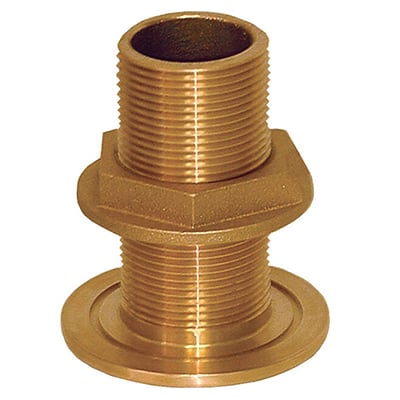
Silicon bronze thru-hull fittings and seacocks are the standard for below-waterline plumbing on fiberglass, wood, and steel boats.
Silicon Bronze: The Below-Waterline Standard
Silicon bronze is an alloy of copper, silicon, and small amounts of other metals. It is the material of choice for below-waterline fittings, thru-hull fittings, seacocks, strainer bodies, and valves on the vast majority of production and custom boats. The reasons are well established over more than a century of marine use:
- Corrosion resistance: Silicon bronze is highly resistant to galvanic corrosion in seawater. Unlike brass, it does not suffer from dezincification (the selective corrosion of zinc from the alloy that weakens the fitting from the inside out) because it contains no zinc.
- Strength: Silicon bronze is strong enough to withstand the shear forces that can be applied to a thru-hull fitting in a grounding or collision. A properly installed bronze thru-hull and seacock assembly will bend before it breaks — giving warning rather than catastrophic failure.
- Track record: Well-maintained silicon bronze fittings can last 30, 40, and in some cases 60+ years in continuous service. The material is proven and its failure modes are well understood.
- Bonding compatibility: Silicon bronze is electrically compatible with the bonding systems used on most fiberglass and wood boats. When properly bonded and protected with zinc anodes, it forms a stable part of the boat’s cathodic protection system.
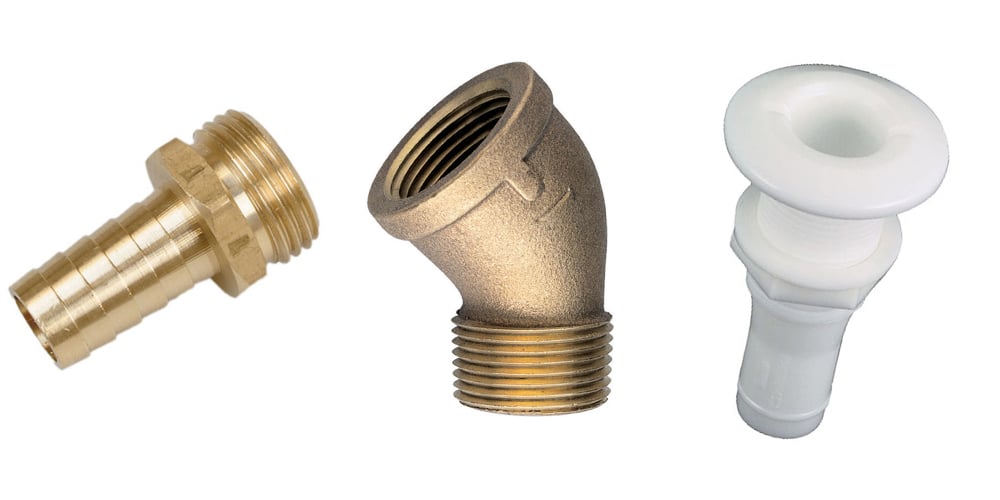
Assembling a bronze below-waterline system: Use bronze for the thru-hull fitting itself, the seacock or ball valve mounted directly to it, and any 90° or 45° street ells needed to change direction. Once the bronze fittings are aligned, thread a bronze hose barb into each outlet and connect with ABYC-grade exhaust or sanitation hose secured with stainless steel hose clamps. All connections below the waterline should use two hose clamps per fitting.
What to watch for: Inspect bronze fittings annually for the pink or reddish cast that indicates dezincification. Wait — if bronze contains no zinc, why can it dezincify? It cannot. But not everything sold as “bronze” is silicon bronze. Some fittings are made of naval brass (which does contain zinc) and are incorrectly labeled or sold as bronze. The distinction matters enormously below the waterline. If a fitting has a pinkish or red coloration, treat it as compromised and replace it before relaunching.
Brass: Where It Belongs and Where It Does Not
Brass is an alloy of copper and zinc, and the zinc content is precisely what makes it unsuitable for raw water plumbing below the waterline. In seawater, galvanic action selectively removes the zinc from the alloy in a process called dezincification, leaving behind a porous, weakened copper structure that looks intact but has lost most of its structural strength. A dezincified brass fitting may hold pressure until it is disturbed — and then fail catastrophically with almost no warning.
The risk is serious enough that ABYC standards explicitly prohibit the use of brass thru-hull fittings and seacocks below the waterline. Despite this, brass fittings occasionally appear in raw water plumbing on older boats, either through ignorance, cost-cutting, or because brass was mistakenly sold as bronze. Finding one is never a pleasant surprise.
Where brass is appropriate on a boat:
- Above-waterline plumbing that is not subject to raw seawater exposure — freshwater supply lines, compressed air lines, some fuel system fittings
- Deck fittings, cleats, and hardware above the waterline where it is not in direct contact with raw seawater
- Interior plumbing that is never submerged
Where brass must never be used:
- Thru-hull fittings
- Seacocks and sea valves
- Any raw water plumbing below or at the waterline
- Cockpit drain fittings that may be submerged at heel
Marelon: The Engineered Composite Alternative
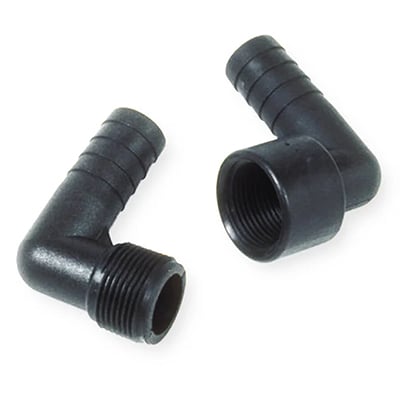
Marelon fittings are UL/ABYC approved and ISO certified for both above- and below-waterline use. They require no bonding and will not corrode.
Marelon is a glass-reinforced polymer composite developed by Forespar specifically to address the corrosion and galvanic problems associated with metal fittings in marine plumbing. It is not a generic plastic — it is an engineered material with significantly different properties from PVC, nylon, or other common plastics, and it should not be treated as equivalent to those materials.
Properties of Marelon:
- Zero corrosion: Marelon does not corrode, oxidize, dezincify, or suffer galvanic attack. It is entirely inert in seawater.
- No bonding required: Because Marelon is non-conductive, it cannot participate in galvanic corrosion and does not need to be connected to the boat’s bonding system. This is a significant advantage in “hot marina” environments where stray DC current can accelerate galvanic corrosion in bonded metal systems.
- ABYC and USCG approved: Marelon is UL/ABYC approved and ISO certified for both above- and below-waterline applications. It is a compliant choice for thru-hulls and seacocks under current standards.
- Weight: Marelon fittings are significantly lighter than bronze equivalents — a meaningful advantage on sailboats and smaller vessels where weight and center of gravity matter.
- Cost: Marelon fittings are generally less expensive than bronze for equivalent fittings.
Considerations with Marelon:
- Lubrication: Marelon ball valves require lubrication approximately twice per year to operate smoothly and prevent the valve from seizing. In practice, many boat owners do not maintain this schedule. A seized valve that cannot be closed in an emergency is a serious safety problem — the same concern applies to neglected bronze seacocks, but it is worth noting for Marelon specifically.
- Shear strength: While Marelon is stronger than generic plastics and performs well in compression, some marine surveyors prefer bronze for below-waterline fittings in exposed locations where impact or grounding could apply shear force to the fitting. This is a debated point — Forespar’s own testing shows Marelon meets or exceeds the structural requirements for thru-hull fittings — but it is a consideration worth discussing with your surveyor.
- Age and UV: Unlike generic plastics, Marelon is UV stabilized, but fittings that are more than 15–20 years old should be inspected carefully for brittleness or crazing, particularly around the mounting flange.
- Not interchangeable with generic plastic: The name “Marelon” refers specifically to Forespar’s proprietary composite. Generic plastic thru-hull fittings sold at hardware stores are a completely different product and are not appropriate below-waterline replacements.
Catalina Yachts switched from bronze to Marelon for thru-hull fittings and seacocks nearly 25 years ago and has reported positive results. Marelon is a legitimate and well-proven material for both above- and below-waterline marine plumbing when properly installed and maintained.
Generic Plastic Fittings
Generic plastic fittings — PVC, nylon, ABS, and similar common plastics — are suitable for some above-waterline applications but are not appropriate for thru-hulls, seacocks, or any below-waterline structural plumbing. They are susceptible to UV degradation, can become brittle with age, and most are not rated for the pressure and structural demands of through-hull installations.
Generic plastic thru-hull fittings have been known to crack around the mounting flange from UV exposure and vibration, sometimes falling into the hull and turning the bilge pump into a recirculating pump. They are not ABYC approved for below-waterline use and should not be confused with Marelon.
Where generic plastic fittings are appropriate:
- Deck fill cap surrounds and cosmetic covers
- Above-waterline cockpit drain fittings on boats that never heel enough to submerge them
- Interior freshwater plumbing not subject to pressure or submersion
- Temporary or non-structural applications above the waterline
Material Comparison by Application
| Application | Silicon Bronze | Brass | Marelon | Generic Plastic |
|---|---|---|---|---|
| Thru-hull fittings (below waterline) | ✓ Preferred | ✗ Never | ✓ Approved | ✗ Never |
| Seacocks / sea valves | ✓ Preferred | ✗ Never | ✓ Approved | ✗ Never |
| Cockpit drain fittings | ✓ Yes | ✗ No | ✓ Yes | ✓ Above waterline only |
| Raw water strainer bodies | ✓ Yes | ✗ No | ✓ Yes | ✗ No |
| Above-waterline deck fittings | ✓ Yes | ✓ Yes | ✓ Yes | ✓ Yes |
| Freshwater supply plumbing | ✓ Yes | ✓ Yes | ✓ Yes | ✓ Yes (rated fittings) |
| Fuel system fittings | ✓ Yes | ✓ Yes (above WL) | Verify compatibility | ✗ No |
Dezincification: The Hidden Failure Mode
Dezincification is the most dangerous failure mode in marine plumbing and the reason brass is prohibited below the waterline. The process is electrochemical: in seawater, galvanic action selectively removes zinc from the copper-zinc alloy, leaving behind a porous copper matrix. The fitting retains its shape and appears intact — until it is disturbed, at which point it may crumble or fracture with almost no force.
A dezincified brass fitting below the waterline is essentially a ticking clock. A surveyor once reported finding a fitting on a Cal 2-29 that looked sound until he poked it with a finger — it immediately began spurting water. Only the fact that the adjacent seacock could be closed prevented an emergency.
How to identify dezincification:
- A pink, red, or coppery color on a fitting that should be golden-yellow (brass) or reddish-brown (bronze). Note that bronze is naturally reddish-brown, so this diagnostic is most useful for detecting dezincification in brass fittings, which should be golden-yellow when new.
- Pitting or powdery deposits on the surface of the fitting.
- A fitting that feels soft or crumbles when prodded — do this test carefully and never below the waterline without the ability to close a downstream valve.
- Any brass fitting in a raw water below-waterline application — regardless of appearance — should be treated as suspect and replaced at the next haulout.
Inspection and Replacement
Below-waterline plumbing fittings should be inspected at every haulout — at minimum once per year for boats that are hauled annually. The inspection should cover:
- Material identification: Confirm that all below-waterline thru-hulls and seacocks are silicon bronze or Marelon. Any brass fittings found below the waterline should be replaced before the boat is relaunched.
- Seacock operation: Every seacock should be exercised through its full open-to-closed range. A seacock that cannot be closed quickly in an emergency is a safety hazard. Lubricate or service any that are stiff or difficult to operate.
- Corrosion signs: Check bronze fittings for pink or red discoloration. Check the bonding connections to confirm the wire is intact and connections are clean.
- Marelon condition: Check for crazing, cracking around the mounting flange, or any brittleness. Lubricate ball valves per manufacturer’s schedule (typically twice per year).
- Hose connections: Squeeze the hose at each fitting. Any hose that is spongy, cracked, or has lost flexibility at the connection point should be replaced. Confirm that two stainless steel clamps are in place at each below-waterline hose connection.
- Age: Bronze thru-hull fittings more than 20–30 years old should be carefully evaluated even if they appear sound. Marelon fittings more than 15–20 years old warrant particular attention to the flange area.
Shop Fittings at West Marine
- Browse all marine plumbing fittings
- Marine plumbing — thru-hulls, seacocks, and valves
- Marine hose
- Marine hose clamps
Frequently Asked Questions
Can I use brass fittings below the waterline?
No. Brass contains zinc, which is selectively removed by galvanic action in seawater through a process called dezincification. A dezincified brass fitting looks intact but has lost most of its structural strength and can fail with minimal force. ABYC standards explicitly prohibit brass thru-hull fittings and seacocks below the waterline. Use silicon bronze or Marelon for all below-waterline fittings.
Is Marelon as strong as bronze for thru-hull fittings?
Marelon is an engineered composite — not a generic plastic — and it is ABYC approved and ISO certified for below-waterline use. Forespar’s own testing shows Marelon meets structural requirements for thru-hull applications. Some surveyors still prefer bronze for fittings in exposed locations due to bronze’s superior resistance to shear forces, but Marelon has a strong track record in service on production boats, including Catalina, which has used it for over 25 years.
How do I tell bronze from brass on my boat?
New brass is a distinct golden-yellow color. New silicon bronze is a darker reddish-brown, similar to a copper penny. Aged bronze develops a green patina; aged brass may yellow further or show pink dezincification. If you are uncertain about a fitting, a marine surveyor can identify the material. Any pink or reddish cast on a fitting that should be golden-yellow is a warning sign of dezincification and the fitting should be replaced.
Does Marelon need to be bonded?
No. Marelon is non-conductive and cannot participate in galvanic corrosion. It does not need to be connected to the boat’s bonding system. This is one of its key advantages in marinas with stray DC current (hot marinas), where bonded metal fittings can be subject to accelerated electrolytic corrosion.
How often should I replace below-waterline fittings?
There is no fixed replacement schedule for properly maintained silicon bronze or Marelon fittings in good condition. Inspect at every haulout. Bronze fittings more than 20–30 years old should be carefully evaluated. Marelon fittings more than 15–20 years old warrant attention to the flange area for brittleness. Any fitting showing corrosion, dezincification, cracking, or that cannot be operated smoothly should be replaced before relaunching.