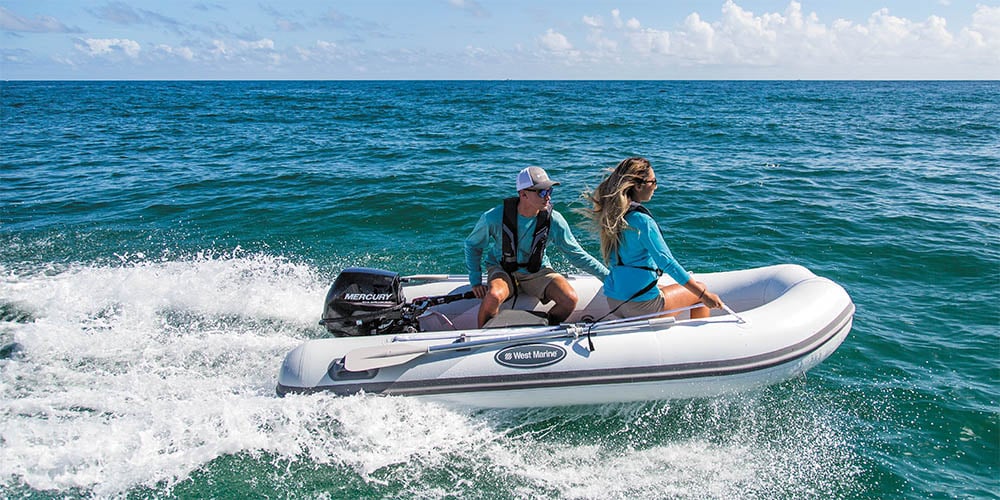
Choosing an Inflatable Dinghy
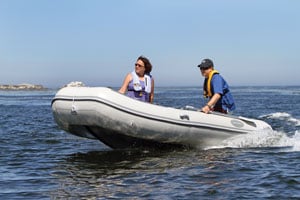
The AL-390 is big and roomy for a dinghy, with a durable aluminum floor. Our customers have given the AL-Series boats great reviews on this site.
By Brian Gordon, West Marine
Our Search for the Perfect Inflatable Boat
West Marine constantly strives to improve our selection of affordable inflatable boats, and we're justifiably proud of our fleet. Our boats combine progressive technical features, rugged durability and great design, so you can be confident of superior value.
West Marine inflatables are created by world-class naval architects like Henning Neumann, who has designed many of our boats since 1990. He's also drawn boats for Avon, Metzeler and several top manufacturers during his career of over 50 years. That depth of experience is reflected in details that matter on the water: tube diameter proportioned for stability without sacrificing handling, transom angles optimized for each hull type, and floor systems engineered to balance rigidity against packability for each boat category.
Choosing the right inflatable comes down to four questions: How do you plan to use it? How important is speed versus portability? Where will you use it — temperate or tropical waters? And how much space do you have to store it? Work through those four questions and the right category becomes clear. This guide explains each boat type, what it does best, and what it gives up, so you can match the right boat to your actual needs rather than buying more — or less — boat than the situation calls for.
Decide if you want a boat that can plane (do you want to go fast?)
Floor Construction and Boat Category
An inflatable's floor construction is the key to the trade-off between portability—ease of assembly and compact storage—and the rigidity needed for best performance. A rigid deep-V hull made from composite plastic, fiberglass or aluminum—a Rigid Inflatable Boat—is an efficient high-performance planing hull, but RIBs often must be stored on a trailer or set of hanging davits. Boats with more flexible fabric floors fold to a light, compact shape, but their flexibility exacts a performance penalty. If you want your boat to plane, allowing you to exceed five miles per hour, a semi-rigid floor is required.
The planing threshold matters more than most buyers realize when they are shopping. A non-planing dinghy is perfectly adequate for short harbor hops in calm conditions — getting from the mothership to the dock, running to the fuel dock, or picking up a mooring in flat water. But if you need to cross a fetch of open water, cover significant distances between anchorages, or handle chop, a planing hull changes the experience dramatically. A sport boat or HP floor boat that gets on plane in chop is a fundamentally different vessel from a roll-up that pushes through it at displacement speed. Know before you buy whether planing performance matters for how you actually intend to use the boat.
Which matters more to you, performance or portability?
Roll-up (RU) Boats
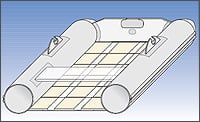
Like dinghies, these boats have floors you don't have to remove when stowing the boat. Roll-ups can be unrolled, inflated and launched in minutes. Floors use wooden slats enclosed in fabric pockets, and you don't need to remove them for storage. Roll-up boats have a transom, so you can use a small outboard motor. Roll-ups excel as tenders. Their flat bottoms and small engines make their performance non-planing, limiting their range to in-harbor, relatively flat-water travel.
The roll-up's greatest strength is its setup time and stowage footprint. A rolled-up dinghy fits in a duffel-sized bag that can be stuffed into a cockpit locker, stern locker, or forward cabin. For coastal cruisers who spend most of their time at marinas with dock access and only occasionally need a tender for a night at anchor, a roll-up is often the most practical choice. Where the roll-up falls short is range and rough water capability: if you are anchoring in exposed conditions or need to cover more than a few hundred yards of open water regularly, the flat bottom and displacement-only performance become real limitations.
Sportboats (SB)
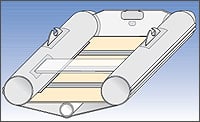
Sport boats are inflatables with a removable rigid floor system made from plywood, composite plastic or aluminum. The floor assembly is made stiffer with the addition of stringers, which run fore and aft to hold the floorboards in alignment, and aluminum extrusions to hold the edges in position. With the floorboards assembled and the port and starboard hull chambers and small tapered keel tube inflated, the boat's floor fabric is stretched taut and takes on a shallow V-shape. This enables the boat to ride through chop and track in turns better than a flat-bottomed boat. The floor also makes sport boats heavier than dinghies, but these boats are fast and lively with outboards from 6–25hp and offer a great performance for the price.
Assembly time is the sport boat's main trade-off against a roll-up or HP floor boat. Installing the stringers, fitting the floorboards, and inflating all chambers takes 15 to 25 minutes depending on experience and boat size — and the same time in reverse at the end of the day. For boaters who use the dinghy daily, this becomes a real consideration. The aluminum-floor sport boat is particularly durable and easy to clean, making it popular with cruising families who use the dinghy as an all-purpose shore boat in all conditions. Aluminum floors are also more resistant to damage from hauling up on rocky beaches, dropping dive tanks, or carrying heavy gear than plywood alternatives.
High Pressure (HP) Inflatable Floor Boats
Take a sportboat and trade the wood floor for a high-pressure inflatable floor, and you have an HP Inflatable Floor boat (sometimes called an Airfloor boat), combining the performance of a sport boat with the light weight and compact stowage of a soft stern dinghy. Its special high-pressure inflatable floor (pumped up to 11psi) is substantially lighter than floorboards and, when deflated, can be rolled up right inside the boat. Inflatable floor boats jump on plane quickly and achieve fine performance using only a small outboard, thanks to their low weight. The boats flex just enough to absorb wakes and waves that would threaten to throw you out of a hard-bottomed boat. HP floor boats are a brilliant combination of benefits, not a compromise. And the setup time is very short!
The HP floor boat has become the category of choice for cruising sailors who live aboard or spend extended time at anchor and need a capable tender that stows compactly. The setup time is genuinely fast — a quality electric pump can bring the floor to operating pressure in under two minutes, and the whole boat is ready to launch in five to eight minutes from a rolled-up state. For passage-making sailors who need the dinghy off the deck and stowed compactly offshore, then deployed quickly at the anchorage, the HP floor boat offers the best combination of performance and packability in the inflatable category. The one area where HP floors give something back versus rigid floors is underfoot feel: the inflatable floor has some flex, which some users find less comfortable standing on for extended periods. For seated day use as a tender it makes no practical difference.
Rigid Inflatable Boats (RIBs) or Rigid Hull Inflatables
RIBs offer the "real boat" performance and strength of a rigid moderate- or deep-vee hull. Their fiberglass hulls carve turns and cut through chop like conventional boats and shrug off abrasion from cruising gear, sand and gravel, dive tanks, etc. But unlike conventional boats, the addition of inflatable tubes to the topsides makes them more stable, more buoyant and less likely to scar the topsides of other vessels when used as a tender.
Their lack of portability is the price you pay for a RIB's performance. The hulls cannot be disassembled, and therefore you can't stow your RIB in a bag in the lazarette. You can deflate the tubes and stow the boat on deck in far less room than the inflated boat, but it still takes up space. Therefore, we generally recommend RIBs for owners who either intend to stow their dinghies inflated on deck, on davits, or deflated and lashed on a weather deck. Their light weight also makes them a cinch to trailer on a light-duty boat trailer.
RIBs are the standard choice for serious offshore cruising powerboats and larger sailing yachts with davit systems, where the dinghy is deployed and retrieved multiple times daily and performance in open water is a genuine requirement. The fiberglass hull handles loading from dive tanks, fuel jugs, outboard motors, and heavy gear without any of the flex or softness that inflatable floors show under heavy loads. For any application where the dinghy is effectively a working boat — ferrying crew, running provisions, covering significant distances in open water — the RIB justifies its storage footprint with performance that soft-floor inflatables cannot match.
Cruisers who are headed for the tropics may be interested in our new aluminum hull RIB. It has the most rugged hull available, so it's perfect for hauling up onto a rocky beach, and it has Hypalon fabric, for UV protection. See our video below.
Compact CR or Folding RIBs
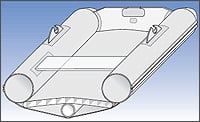
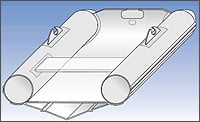
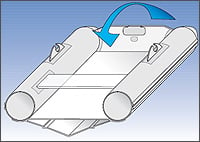
Compact RIBs have a hinged folding transom, which allows the boat to be stored in much less space, and are super portable - we're talking roof rack to water in just 10 minutes! The hull is made from fiberglass and has a shallow V-shape. The transom is a plywood sandwich that is firmly bonded to the inflation tubes. A flexible fabric hinge connects the floor to the transom, allowing the transom to fold flat when stored. A large zippered bag is included for storage, and the stowed boat looks like a giant surfboard in a travel bag. While still large, the Compact RIB will fit on a foredeck or under a boom much more compactly than a normal RIB. It also fits nicely on vehicle roof racks or in the back of a station wagon.
The Compact RIB occupies the sweet spot between a standard RIB and an HP floor boat for boaters who want rigid-hull performance without full RIB storage requirements. The folding transom is the key innovation: with the transom folded flat, the boat's footprint drops dramatically, making it practical to stow on a foredeck or lash to a stern rail in a way that a full RIB cannot manage. On the water, the shallow-V fiberglass hull performs like a proper RIB — tracking well, cutting through chop, and handling a meaningful outboard without the flex or bounce of a soft-floor design. For trailer boaters and powerboaters who want a capable second boat without a dedicated trailer, the Compact RIB is worth serious consideration.
Are you planning to use this boat in the tropics?
Hypalon or PVC Fabric
The location where you intend to use your boat is the key factor in deciding which hull fabric, PVC-coated polyurethane cloth or Hypalon (neoprene-coated nylon). Both fabrics are rugged and dependable, but if you will do most of your boating in tropical conditions, a Hypalon boat will last longer because of its better resistance to UV degradation. Our Hypalon boats are made of Pennel Et FLippo Orca 215 Hypalon fabric. We purchased a multi-year supply of this material, as the new replacement CSM fabric used by other boat manufacturers does not hold up in extended UV tests and will not last as long. This is another reason why purchasing a West Marine boat is a great value.
For boaters in temperate climates who store their inflatables indoors or under covers between uses, a quality PVC boat will give many years of reliable service and represents excellent value for the price. PVC is easier to repair in the field with standard repair kits and is the most common tube material in the inflatable category. For tropical liveaboards and bluewater cruisers spending extended time at anchor in UV-intense conditions, the premium for Hypalon pays for itself in longevity. A well-maintained Hypalon dinghy in tropical conditions will typically outlast a PVC equivalent by three to five years, which more than offsets the initial price difference over the life of the boat.
Keeping your New Inflatable in Great Shape
Talk to most experts and they'll agree; the most common cause of premature inflatable boat failure is exposure to the sun. Fading, discoloration, fabric breakdown and damage to painted and varnished components can all be attributed to UV exposure. There are several strategies for keeping your inflatable looking new:
OK, this is obvious, but put your boat away when it's not in use. We see dozens of inflatables rotting in the sun in our local harbor, and it isn't because they're being used every day. Deflate the boat, clean it and store it.
When inflated, the best protection against damaging exposure is a quality fitted cover. In addition to blocking UV radiation, covers such as our marine polyester Inflatable Boat Covers also protect your boat from accumulated dirt, bird droppings and standing water. Their modest cost is rapidly repaid by extending the life and the increased resale value of your boat.
Specially-formulated inflatable boat cleaners and protectants, like our Two-Part Inflatable Boat Cleaner & Protectant, and comparable products from MDR and Star brite, make it much easier to maintain your boat in "like new" condition by removing dirt and salt and leaving a gloss on the fabric.
Beyond UV protection, the following maintenance practices will significantly extend the life of any inflatable:
- Rinse with fresh water after every saltwater use. Salt crystals left on tube fabric accelerate UV degradation and abrasion between the fabric and any cover or stowage bag. A quick rinse takes two minutes and makes a measurable difference in tube life over a season.
- Store partially inflated, never fully deflated for extended periods. Tubes stored completely deflated for months develop creases at the fold lines that weaken the fabric over time. Store with enough air to hold the tube shape without full pressure, and keep the boat out of direct sunlight.
- Check and treat valves annually. Inflation valves are the most common source of slow leaks in an otherwise sound inflatable. A drop of silicone lubricant on each valve seat at the start of the season keeps the valve seating correctly and prevents the dry-out cracking that causes slow air loss.
- Repair small abrasions before they become tears. The tube fabric on any inflatable is most vulnerable at points of contact with dock lines, anchor chain, oarlocks, and outboard motor clamps. Check these contact points regularly and apply a small patch with an appropriate repair kit before a scuff becomes a hole. Catching a repair early is a five-minute job. Waiting until the fabric has torn through is a much larger project.
How big of a boat will fit your needs, space and budget?
Buy a Reasonably Sized Boat!
There is a good reason we make this recommendation, which may seem self-serving. Bigger inflatables handle dramatically better than smaller ones. The differences between an 8'6" sport boat and a 10' sport boat in handling, carrying capacity and ride, due to the small surface area of the small boat hulls, are greater than you can imagine until you actually try them side-by-side. A sport boat less than 9' long is capable of planing, but tends to be squirrelly on the water, and will fall off a plane easily. 10' boats (and especially 11' boats) have less bow rise when they accelerate and will stay on plane at lower speeds. They are less sensitive to steering inputs so you can relax more while driving them and their larger tubes with slightly greater freeboard will give you a drier ride. Longer boats also have more usable interior volume.
The most common sizing mistake we see is buyers choosing the smallest boat that technically fits their storage space rather than the smallest boat that will genuinely serve their needs on the water. Storage is a real constraint and we take it seriously — but a dinghy that you dread using because it is too small, too wet, and too slow will end up staying aboard unused while you find other ways to get ashore. A boat that is one size larger than your minimum will get used, which is the whole point. If storage is the binding constraint, the HP floor boat category is worth a close look — a 10-foot HP floor boat stows in roughly the same space as an 8-foot sport boat because the inflatable floor eliminates the rigid floorboards that determine stowed volume in sport boats.
Matching Outboard Size to Your Inflatable
Every inflatable has a maximum horsepower rating specified by the manufacturer, based on the transom's structural capacity and the hull's safe operating characteristics. Exceeding this rating is unsafe and will void the warranty. But undersizing the outboard is a more common and equally frustrating mistake. An underpowered inflatable will struggle to get on plane with two adults aboard, run slowly and wetly through chop, and leave you fighting conditions that a properly powered boat would handle easily.
As a practical guide: roll-up dinghies are designed for 2 to 3.5hp outboards and perform well within this range as displacement tenders. Sport boats and HP floor boats in the 9 to 10-foot range perform well with 6 to 9.9hp outboards and can accept up to 15hp depending on the specific model. Eleven-foot and larger sport boats and RIBs typically accept 15 to 25hp and deliver genuinely fast, dry rides at the upper end of that range. Electric outboards have become an increasingly viable option for dinghy use, particularly for roll-ups and HP floor boats used as quiet, emission-free harbor tenders — the Torqeedo 1003 and comparable models provide performance equivalent to a 3hp gasoline outboard with the benefit of zero maintenance, no fuel, and very low noise.
Other Considerations
Outstanding warranties: West Marine boats have a five-year air-holding warranty on hull construction and a one-year warranty on parts and accessories.
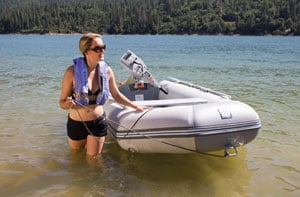
Our PRU-3 is a flat-bottom dinghy that stows compactly without the hassle of removing a floor. Best for around-the-harbor transit, since it doesn't plane. The short-shaft Torqeedo 1003 electric outboard (shown in the picture) is a great companion to this dinghy.
Accessories, valves and hardware: Each of our manufacturers fits excellent accessories like stainless steel towing eyes, strong aluminum oars, reliable inflation valves and heavy-duty pumps to help you inflate your boat quickly with minimal effort.
Inflation pumps: The quality of the pump matters more than most buyers consider at the point of purchase. A low-volume hand pump that takes 20 minutes to inflate a 10-foot sport boat to operating pressure will quickly become the thing you hate most about owning an inflatable. A high-volume double-action hand pump, or better yet a quality electric pump that runs from the boat's 12V system or a portable battery, transforms setup from a chore into a two-minute task. If your boat does not include an electric pump, it is worth adding one to your purchase. The time savings over a season of regular use are significant.
Safety Considerations
Make sure that you carry some basic safety gear aboard your inflatable when you go exploring. We recommend putting the following items in a bag and tying it securely to the dinghy:
Signaling equipment, including a mirror, small flares and a flashlight, and possibly a Personal Locator Beacon, SPOT or Garmin inReach satellite messenger (if you use your boat in offshore conditions)
Communication equipment: Keep a handheld VHF onboard. Models that include a GPS receiver also function as a distress beacon with Digital Selective Calling.
Oars or paddles, engine spares including spark plugs and a spark plug wrench, basic tools, a small anchor and 200' of small line, and of course life jackets for everyone onboard.
One safety consideration specific to inflatables that is worth stating directly: never leave an inflatable dinghy tied astern overnight in open anchorages or conditions where it could be swamped. An inflatable towed or tied at the stern in rough conditions can fill with water, capsize, and place enormous strain on the tow point — and a swamped dinghy is heavy enough to cause serious damage to the mothership's stern or transom. Always bring the dinghy aboard, secure it on deck, or use a painter length that keeps it well clear of the wave action at the stern when conditions deteriorate.