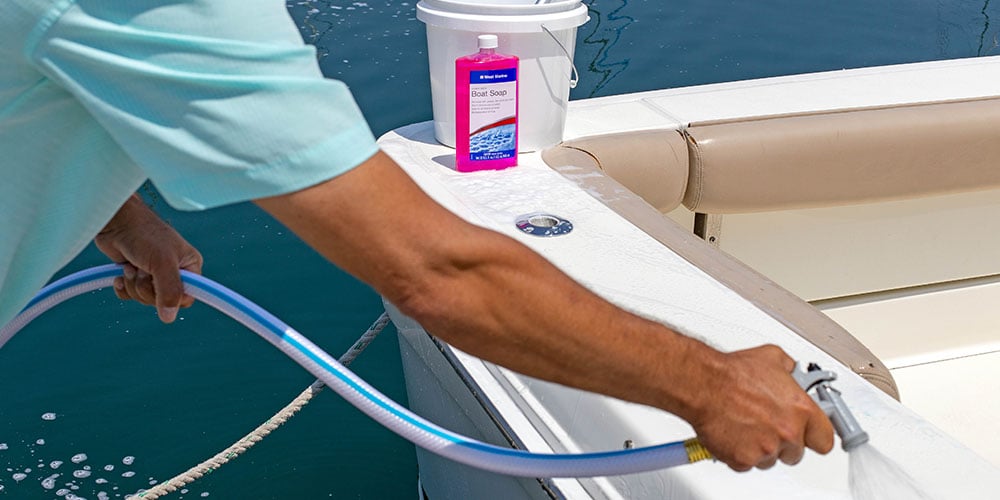
A washdown system helps you clean up the boat after a day on the water.
An onboard washdown system provides a convenient way to hose down the deck after a day of boating. Use it to clean the cockpit after landing a fish, rinse muddy anchor rode as it comes aboard, wash down bait stations, remove sand from swim platforms or rinse the deck after scrubbing.
A good washdown system saves time at the dock and helps keep fish blood, salt, mud and grime from drying on deck. The right setup depends on your boat size, available water source, pump location, hose storage preferences and how much pressure and flow you need.
- Washdown System Components
- Pump Water Pressure
- Pump Installation Options
- Hose Installation Options
- Wiring and Switches
- Washdown System Maintenance
- Washdown System FAQ
Washdown System Components
Washdown systems include a 12V DC pump with an integral pressure switch, a hose and nozzle, an inline filter or strainer, wiring, circuit protection and connectors. Depending on the installation, the system may also include a seacock, thru-hull, tee fitting, quick-connect outlet, bulkhead hose connection, accumulator tank and dedicated on/off switch.
The basic system is simple: seawater or freshwater enters through a seacock or water source, passes through a strainer, reaches the pump and exits through a hose and nozzle. The pump’s pressure switch turns the pump on when the nozzle opens and turns it off when pressure builds after the nozzle closes.
Pump Water Pressure
Pump capacity is rated in gallons per minute, or gpm. A diaphragm pump in the 3.4gpm to 5gpm range meets the needs of most small and medium-sized boats, generally providing pressures in the 35-50psi range, roughly equivalent to 35-50% of city water pressure.
Higher flow is useful for fish boxes, muddy anchor rode and large cockpits, but more is not always better. A pump that is too large may draw more current, require heavier wiring and use more water than needed. A smaller pump may be fine for light rinsing but frustrating when cleaning fish blood, mud or heavy deck grime.
For most recreational boats, choose a washdown pump that balances flow, pressure, amp draw and available space. Check the manufacturer’s recommendations for inlet hose size, outlet hose size, fuse or breaker rating and mounting orientation before installation.
Pump Installation Options
Install your pump in an out-of-the-way but accessible location. Locate the pump above the high-water mark of the bilge, although most of these pumps are designed for use in wet locations. Washdown pumps are often installed in a protected location under a boat’s gunwale or in a cockpit locker.
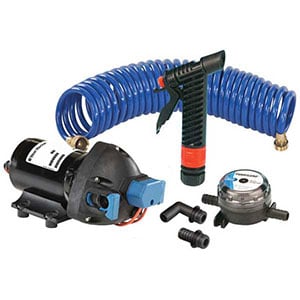
Our 4.0GPM Washdown Pump Kit is great for general washdown of the deck and bait stations and includes the pump, a hose, spray nozzle and quick connect hose fittings.
To supply the pump with seawater, you’ll need to tee into an existing seawater line or install a separate thru-hull and seacock. You will need 1/2" or 3/4" reinforced inlet hose, 1/2" or 3/4" outlet hose with minimum 100psi burst strength, hose clamps and an in-line strainer between the seacock and the pump to keep debris out of the pump.
If you tee into an existing seawater intake, make sure the added demand will not interfere with the original system. Do not compromise engine cooling, livewell function or other critical water systems. A dedicated seacock is often cleaner and safer for new installations, but it requires proper thru-hull installation and sealing.
An optional component is an accumulator tank, which installs downstream from the pump. Accumulator tanks smooth out water delivery and allow the pump to cycle on and off less frequently. They can also reduce pump noise and pressure pulsing when using a spray nozzle.
Hose Installation Options
Once you have installed the pump, you have a variety of options. In the simplest installations, a garden hose with a trigger nozzle is threaded directly to the pump outlet. Energize the pump and use the hose as if it were connected to dock water. To facilitate this type of installation, Jabsco and SHURflo offer washdown pumps with Quick-Connect ports, which permit quick engagement and disengagement of the hose at the pump outlet.
Self-coiling hoses are a popular, lighter and more compact alternative to a heavy garden hose. Some owners plumb the outlet line to a garden-hose-style faucet, which they use to control the flow of water on deck. Check out HoseCoil’s Quick Release System, which includes an outlet fitting that flush mounts to a bulkhead. Used with one of their self-coiling hoses, the system permits quick engagement of the hose for use, and quick disengagement for storage. The slickest installations are self-coiling hose enclosures that plumb directly to the pump. These enclosures neatly store the hose and keep it out of the way but ready for use.
Think carefully about where the hose will be used most often. Fishing boats often benefit from outlets near the cockpit or bait station. Cruising boats may want an outlet near the foredeck for rinsing anchor rode. Center consoles may need enough hose length to reach the bow, stern and swim platform without dragging the hose across sharp edges or electronics.
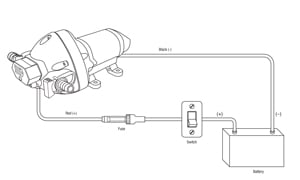
Simple installation with switch and in-line fuse.
Wiring and Switches
If the pump draws less than 10 amps, AWG 14 wire can be used for runs up to 10' from breaker panel to pump with less than a 3% voltage drop. For longer wire runs or pumps with a higher amperage draw, follow the manufacturer’s recommendations.
We suggest you wire the pump to your boat’s electrical distribution panel. If no panel exists, now might be a good time to install one. For convenience, install a waterproof On/Off switch near the pump or near the washdown outlet, depending on how the system will be used.
Use only marine-grade wire and connectors that have been tinned to prevent corrosion. All connections should be crimped using a crimping tool designed for this purpose. To guard against water intrusion and corrosion, all connections should be protected with adhesive-lined shrink wrap tubing. The circuit should be fused or protected with a breaker per the manufacturer’s recommendation.
Label the switch clearly so the pump is not left energized by accident. Although the pressure switch stops the pump when the nozzle is closed, leaving the system powered unnecessarily can shorten pump life if a leak develops or the nozzle is bumped open.
Washdown System Maintenance
Like any seawater system, a washdown system needs occasional inspection. Check the strainer regularly and clean it whenever flow drops or debris is visible. Inspect hose clamps, seacock operation, inlet hose condition, outlet hose condition and electrical connections. If the pump runs but pressure is weak, check for a clogged strainer, air leak on the suction side, kinked hose, low voltage or debris in the nozzle.
If the boat is stored in freezing conditions, winterize the washdown system so trapped water does not damage the pump, hoses or fittings. Flush freshwater through the system after saltwater use when possible, especially if the boat will sit unused for an extended period.
Once you have installed your washdown system and begun to experience the convenience that these systems offer, you’ll wonder how you managed to do without it.
Washdown System FAQ
What size washdown pump do I need?
Most small and medium-sized boats do well with a diaphragm pump in the 3.4gpm to 5gpm range. Larger boats, fishing boats and boats that regularly rinse heavy mud or fish blood may benefit from higher flow, as long as the wiring, hose size and water supply match the pump requirements.
Can I tee a washdown pump into an existing seawater intake?
Yes, but only if doing so does not interfere with the original system. Do not reduce water flow to critical systems such as engine cooling. A dedicated thru-hull and seacock is often the better choice for a permanent installation.
Do I need a strainer for a washdown pump?
Yes. An inline strainer between the seacock and pump helps keep weeds, sand, shells and other debris from damaging the pump or clogging the nozzle.
Should I install an accumulator tank?
An accumulator tank is optional, but it can smooth water flow, reduce pump cycling and make the system feel more consistent when using a trigger nozzle.
Can a washdown system use freshwater?
Some systems can be configured for freshwater, but most deck washdown systems use seawater to avoid draining freshwater tanks. Freshwater may be useful for final rinsing, but seawater is usually the practical choice for heavy deck cleaning.