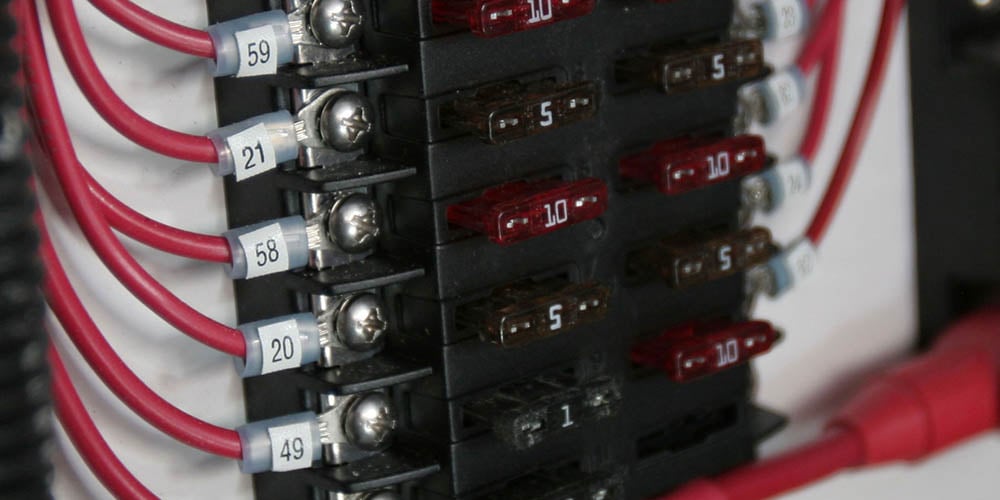
Turning Fear Into Knowledge and Respect
Are you intimidated by your boat’s electrical system? You are not alone. Electrical shocks, short circuits, and fires are potential calamities that should inspire serious respect. Those who don’t understand basic electrical theory often leave onboard electrical work to experts — generally a wise decision.
When your boat is safely in its home port that works fine. But what do you do when you’re anchored in a remote harbor, sailing offshore, or cruising the Intracoastal Waterway with no expert available? Simple repairs may fall to you. This West Advisor covers the basics of circuit protection and the distribution and monitoring of electrical power on your boat. We also recommend Nigel Calder’s Boatowner’s Mechanical and Electrical Manual for anyone who wants to go deeper.
- Circuit Protection Devices
- Styles and Sizes of Fuses
- Circuit Breaker Size Selection
- Distribution Panels
- Selecting the Correct Panel
- ABYC Standards
- Monitors and Control Panels
- FAQs
Circuit Protection Devices
Every wire in an electrical circuit needs protection against short circuits and overloads. A short circuit occurs when electricity travels from the positive to the negative conductor without passing through an electrical load — the device that consumes the energy and creates resistance. Without a load in the path, current spikes far beyond what the wire can safely carry. Heat builds up rapidly, melting insulation, and a fire or electrical system damage can result.
Two types of devices protect wires from short circuits:
Fuses are single-use devices that melt or destruct at a specified current, breaking the circuit. Once they melt, they must be replaced. Fuses are also used to protect specific devices from their own destruction — a reverse-polarity connection on a VHF radio, for example, can melt the radio’s internal components; the fuse blows first to prevent that.
Circuit breakers are mechanical devices that trip and open the circuit without damaging themselves. Because they can be reset rather than replaced, and because they can double as on/off switches, circuit breakers are typically stacked in rows in distribution panels. Like fuses, they are rated by the amperage at which they trip.
Styles and Sizes of Fuses
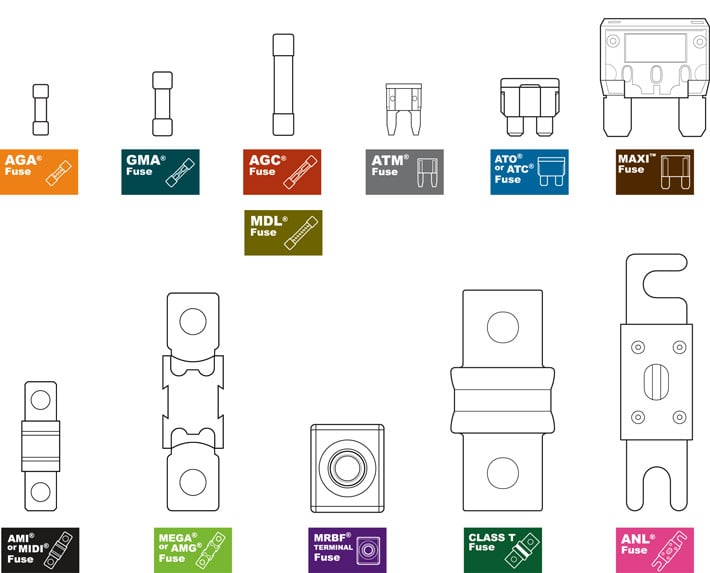
Full-scale fuse comparison (Scale 1:1)
Fuses are available in several configurations for different applications:
- Slow-blow fuses hesitate for a few seconds before blowing, allowing devices with a short-term high amperage draw (motors, compressors) to start up without nuisance blowing.
- AGC fuses are small glass cylinders. You can see whether the fuse element is intact by looking through the glass. Used in basic fuse panels.
- ATC fuses are the automotive-style blade fuses that plug into a two-pronged socket. They are replacing AGC fuses in many applications due to their compact size and ease of replacement.
- Fuse holders install a fuse in the positive conductor of a circuit. Available in waterproof and non-waterproof versions to fit AGC and ATC fuses. Fuses should always be installed as close to the beginning of the positive conductor as possible, to protect the maximum length of wire.
A simplified guide to fuse sizing:
- The amperage of the load largely determines everything else.
- Load amperage plus the distance to the load determines the required wire size (using ABYC wire sizing tables).
- The current-carrying capacity (ampacity) of the selected wire determines the maximum fuse size.
Circuit Breaker Size Selection
Selecting the correct breaker size for a distribution panel is a genuine challenge — every boat’s needs are different, making it impossible to anticipate exactly which breakers will be needed. Blue Sea Systems addresses this with a practical approach: since the majority of circuits on board will have loads under 15A (most electronics, lights, pumps, and small refrigerators), and since most circuit wiring will be at least 14-gauge wire, they supply their panels pre-installed with 15A circuit breakers throughout, for the following reasons:
- If the circuit uses 16-gauge wire (which has an ampacity of 25A), the 15A breaker will protect it before the wire reaches its limit.
- 15A exceeds most individual loads on a recreational boat.
- If smaller protection is needed, a smaller inline fuse can be installed at the load, or a smaller breaker substituted in the panel.
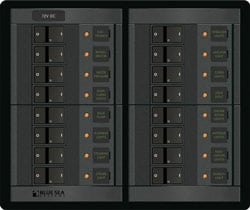
Design your own custom 360 Modular Panel using Blue Sea Systems’ online Panel Wizard.
Distribution Panels
Distribution panels let you selectively turn on and off the circuits that supply electricity to DC loads on board, and provide overcurrent protection to protect wires and devices from damage. Most boats over 20 feet have one or more distribution panels that combine switching and overcurrent protection.
Overcurrent protection means that if a circuit draws more current than it should — from a short circuit, a failing device, or a wire problem — the circuit automatically shuts off. This is done with circuit breakers or fuses, exactly as in home wiring.
Most panels have 4 to 12 circuits, controlling loads like radios, lights, bilge pumps, refrigerators, and electronics. Distribution panels from major vendors come in industry-standard sizes that can be stacked vertically or horizontally as needs grow. Common panel widths are 5-1/4”, with lengths of 3-3/4”, 7-1/2”, 10-1/2”, or 11-1/4”.
AC panels (alternating current / shore power) are similar to DC panels but include a main breaker to disconnect all AC circuits at once — analogous to the main circuit breaker in a house. AC panels also include a reverse polarity indicator light. This light illuminates when the shore power connection is wired with hot and neutral reversed. Many marina pedestals are wired incorrectly. A reverse polarity condition is a serious hazard: it can result in electrocution hazard from energized parts that appear grounded, and severe electrolysis that can destroy underwater metal components.
If the reverse polarity light comes on, disconnect AC shore power immediately and notify the marina. Do not simply reset or ignore it. Do not use any AC outlets until the polarity is confirmed correct. The fix must be made at the marina pedestal or the shore power cord, not at the boat.
Selecting the Correct Panel
Choose a panel based on the current and anticipated number of circuits on the boat, for both AC and DC. Key features to look for in a DC distribution panel:
- Backlit labels: Allows you to read circuit labels at night without a separate light. Far more practical than a lamp shining down on the label area.
- Circuit indicator LEDs: Visual confirmation at a glance of which circuits are on. Essential for managing battery load at anchor.
- Positive and negative bus: Since each circuit requires a pair of wires, a built-in positive and negative bus keeps wiring organized and reduces the risk of miswiring.
- Countersunk flat-head fasteners: The panel aesthetic. Black-painted countersunk hardware that matches the panel gives a professional, finished look.
- Compatible dimensions: Match the panel width and color to existing panels on your boat to maintain a uniform appearance.
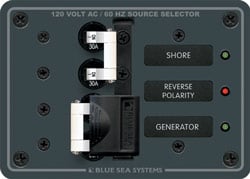
AC Source Selector Breaker Panel
AC panels require a few additional considerations. You must be able to disconnect both the hot and neutral conductors together at the master AC breaker — you cannot break just the hot as you would in a DC circuit. You also may need to select between two or more AC sources: shore power, an inverter, or a generator.
A critical rule: never connect two AC sources to the boat simultaneously. Unlike DC sources (where a battery charger, solar panel, and battery can all be connected at the same time), two AC sources must be perfectly synchronized — perfectly matching in phase — to be combined safely. This synchronization is not achievable without dedicated equipment. This is why AC source selector panels include a mechanical interlock (a slider or key) that physically prevents more than one AC source breaker from being activated at the same time. The Blue Sea Systems panel uses a plastic slider that prevents shore power and inverter from being energized simultaneously.
ABYC Standards
The ABYC (American Boat and Yacht Council) publishes specific standards for wiring distribution panels. Incorrect wiring can cause boat fires and electrocutions. The relevant chapters are:
- Chapter E-8: Standards for AC electrical circuits, including panel construction, wire sizing, and shore power connections.
- Chapter E-9: Standards for DC electrical circuits, including battery connections, wire sizing, and overcurrent protection.
When in doubt about how to wire anything in a marine electrical system, the ABYC standards are the authoritative reference for safe practice. A marine surveyor or ABYC-certified technician can also verify that your system meets current standards.
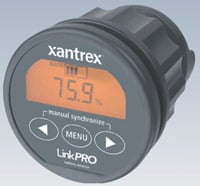
A combination battery monitor displays voltage, amperage, and amp-hours — the three measurements that tell you the complete state of your electrical system.
Monitors and Control Panels
Electrical system monitors make the normally invisible visible. Without them, most boaters have only a rough idea of how much energy their batteries contain, when to charge, and when batteries need replacement. A good electrical monitor eliminates the guesswork.
Electrical system monitors measure three fundamental quantities:
- Voltage shows the approximate state of charge of the battery bank and indicates when charging sources are operating. A fully charged 12V lead-acid battery rests at approximately 12.6–12.7V; a fully charged AGM at approximately 12.8V. Voltage drops as the battery discharges. To be useful, a voltmeter must measure in tenths of a volt.
- Amperage shows how much current is flowing at any moment, measured in amps. A windlass might draw 150A; a GPS 0.05A. Ammeters show both the rate of discharge and the charging current from the alternator, solar, or shore power.
- Amp-hours display how much total energy has been removed from or added to the battery bank. Starting at 0, the counter moves negative as energy is consumed and positive as the battery charges. Amp-hours are the most accurate measure of remaining battery capacity.
A combination monitor measuring all three provides the most complete picture. For boats over 30 feet with significant house loads, a combination amp-hour meter is the right choice. Many current battery monitors also display time remaining until recharge is needed, historical discharge data, charging efficiency, and deepest discharge — useful diagnostics for assessing battery health over time.
Lithium battery systems include a Battery Management System (BMS) as an integral component. The BMS monitors individual cell voltage, temperature, and state of charge, and provides automatic overcharge, over-discharge, and short-circuit protection. If your boat uses lithium house batteries, the BMS provides a level of monitoring and protection not available with lead-acid systems, but it does not replace an external amp-hour meter for understanding overall system state of charge.
Most large inverters can be connected to remote control panels ranging from simple on/off switches to complete monitoring displays. These panels can monitor shore power breaker status, battery state-of-charge, inverter output, and some can automatically start a generator when battery voltage drops or when air conditioning demand requires it.
Frequently Asked Questions
What is the difference between a fuse and a circuit breaker?
Both protect wires from short circuits and overcurrents. A fuse is a single-use device that melts and must be replaced after it blows. A circuit breaker is a mechanical device that trips and can be reset. Circuit breakers can also function as on/off switches, which is why they are used in distribution panels where you want both overcurrent protection and the ability to switch circuits. Fuses are often used at individual loads or in wire runs where the lower cost and compact size are advantages.
What does the reverse polarity light on an AC panel mean?
It means the shore power connection has hot and neutral conductors reversed. This is a serious hazard: it can make normally grounded metal parts live with 120V, risking electrocution, and can cause severe electrolysis damage to underwater metal components. If the reverse polarity light comes on, disconnect shore power immediately and notify the marina. The problem is at the marina pedestal or the shore power cord — it must be corrected there, not at the boat.
How many circuits do I need in a distribution panel?
Count your current loads and add 25–30 percent for future additions. Each independent load (VHF radio, chartplotter, bilge pump, cabin lights, refrigerator, etc.) should ideally have its own dedicated circuit and breaker. Sharing multiple loads on one circuit makes it harder to identify problems and creates a single point of failure for multiple systems. Most boats over 25 feet need at least 8–12 DC circuits; larger boats routinely use 20 or more.
Can I have two AC sources connected at the same time?
No — never connect shore power and an inverter or generator simultaneously. Two AC sources must be perfectly synchronized in phase to be combined, which requires dedicated transfer switch equipment. Running two unsynchronized AC sources in parallel can damage appliances and electrical equipment. AC source selector panels include a mechanical interlock specifically to prevent this from happening accidentally.
What is the best way to monitor my boat’s battery state of charge?
An amp-hour meter (battery monitor) that tracks cumulative energy in and out of the battery bank is the most accurate method. Voltage alone is not reliable — a battery under load shows lower voltage than its actual state of charge, and a battery immediately after charging shows higher voltage that declines once the surface charge dissipates. Amp-hours give a running total of actual energy consumed regardless of instantaneous voltage or load conditions.
Where should fuses be installed in a circuit?
As close to the positive terminal of the battery (or the positive bus) as possible — ideally within 7 inches for the main conductor from the battery, per ABYC standards. The fuse protects the wire between it and the load. The longer the unprotected wire run from the battery to the fuse, the greater the length of wire exposed to a short circuit without protection. Fuses at the load end of a wire protect only the device, not the wire run leading to it.