
Mold, mildew and the odor they create can be a problem even on boats that appear to be clean and well ventilated. This is because, apart from the visible areas in a boat’s cabin, there are many areas that offer the dark, moist environment that these fungi crave. Think under quarter berths, v-berths, settees, hanging lockers, lazarettes, under cockpit seats, chain lockers, and a host of other hidden areas, many of which are barely accessible, if at all. Left unchecked, mold does more than smell bad — it degrades upholstery fabrics, stains fiberglass and gelcoat, attacks wood and adhesives, and can cause respiratory irritation in crew members who spend extended time aboard.
This Advisor discusses tactics, measures and boat maintenance products you can employ in what amounts to a continuous fight. Once you get a handle on it, your cabin will smell a whole lot fresher—and those itchy eyes and that mysterious cough that you may have been experiencing might just go away too.
Written by Brian Gordon, West Marine
- Active vs. Passive Ventilation
- Step One: Remove the Mold
- Step Two: Fumigate
- Step Three: Apply a Mildew Blocker
- Reduce Moisture
- Cabin Heaters and Stoves
Active vs Passive Ventilation
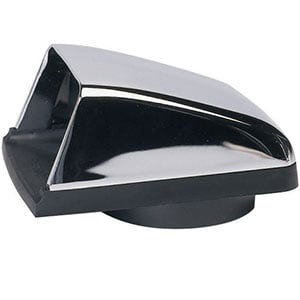
Cowl-style vents help to circulate air below decks.
To prevent mold and mildew, you need to ensure that your boat is well ventilated. This can be as easy as opening hatches or portholes to create cross ventilation. But for times when you are away, you will need to rely on either active or passive ventilators to keep the moisture level down. Passive ventilators, such as cowl vents, clamshell vents, louvered vents, ventilating sails, ports and hatches provide an access path for air to enter or leave the interior of the boat. As long as either the boat or the air itself are moving, they work just fine.
Active ventilators, such as Nicro’s Day/Night Plus Solar Vents incorporate a fan to keep air moving even when the boat or breeze is still. Solar energy or ship’s power is used to power the fan, depending on the ventilator. These vents come with both intake and exhaust fan blades for flexibility in creating your ventilation system.
The most effective ventilation systems create genuine airflow through the boat rather than simply providing an opening. This requires both an intake point and an exhaust point separated by as much of the boat's length as possible. A cowl vent forward facing into the breeze draws air into the forward cabin, which then moves aft and exits through a louvered vent or open companionway. Without an exhaust path, an intake vent simply creates a pocket of slightly less stale air near the vent itself while the rest of the cabin remains stagnant. On boats with complex cabin layouts — multiple berths, enclosed heads, deep cockpit lockers — additional ventilators targeted at specific problem areas are more effective than a single large vent serving the whole interior.
When you are away from your boat, it is a good idea to leave the doors to hanging lockers and other enclosed spaces open to allow air to circulate and reduce moisture. This includes the spaces underneath your boat’s cushions, which can be left turned on their sides with the access covers to hull areas underneath removed. Cushions stored flat on berths trap moisture against the berth surface underneath, creating ideal mold conditions even when the rest of the cabin appears dry. Standing cushions on edge or removing them to a drier environment entirely during extended periods away from the boat is one of the most effective and underutilized mold prevention measures available.
Take a Proactive Approach
Controlling mold is a continuous battle that requires a multi-pronged, proactive approach. I say “control” because you will never entirely eliminate mold and mildew from your boat. This is because their spores are virtually everywhere, and to grow and reproduce, all they need is moisture, the right temperature, and food—which can be virtually any organic substance, meaning any material that contains carbon atoms. This includes running rigging, stored anchor rode, upholstery fabrics, the inner surface of a fiberglass hull—even something as subtle as the oil that your hand leaves on a piece of stainless steel.
Understanding the three conditions mold requires — moisture, temperature, and a food source — tells you where to focus your prevention efforts. Temperature is the one variable you cannot control on an unoccupied boat, so the practical approach is to attack moisture and food sources. Moisture reduction through ventilation and desiccants attacks the primary enabling condition. Regular cleaning removes the organic residues — body oils, food particles, salt residue, and accumulated grime — that serve as food sources. Remove the moisture, and mold cannot grow regardless of how many spores are present. Remove the food sources, and even if moisture is present, mold has nothing to feed on.
Following is a general plan of action for removing existing mold and mildew, and once it is removed, to keep it at bay.
Step One: Remove the Mold
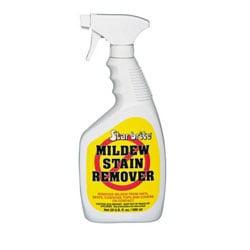
A mold and mildew cleaner like Star brite's Mildew Stain Remover is a great way to tackle mold on your boat.
To remove mold and mildew, try using a solution of bleach, water, TSP (Tri-Sodium Phosphate) and powdered laundry detergent mixed in the following proportions: Four quarts of freshwater, one quart of bleach, 2/3 cup TSP and 1/3 cup of laundry detergent. Alternatively, you can use an off-the-shelf mold and mildew remover product, of which there are two types: those that contain bleach and those that don’t.
Among the best of the bleach-based products is Star brite’s Mildew Stain Remover. Offered in a 22-ounce trigger spray bottle, it gives you the ability to direct the spray into hard-to-reach areas, such as under quarter berths, or up into chain lockers. Among the products that do not contain bleach, Practical Sailor rates Spray Nine Cleaner as, “A top performer with the best price”. It too is offered in a trigger spray bottle and affords the same ease of application as the Star brite product.
In either case, use the boat cleaning product you choose liberally, taking care to spray it into hidden, hard to reach areas. Sop up any runoff from these products with some rags, which you will need to dispose of at the end. Also, when removing mold, the EPA suggests wearing an N95 particulate mask. We would also suggest rubber gloves, coveralls and protective eyewear to keep the spores from harming your body.
A few additional points on effective mold removal that make a meaningful difference in long-term results:
- Allow cleaners adequate dwell time before wiping. Bleach-based and enzyme-based mold removers need contact time to kill spores rather than simply displacing them. Apply the product, wait at least five to ten minutes before wiping, and re-apply to any areas that still show staining. Wiping immediately after application removes the surface mold but leaves viable spores embedded in porous materials like upholstery backing, foam, and wood.
- Pay particular attention to hidden surfaces, not just visible ones. The mold you can see on the surface of a cabin liner or berth base is a fraction of what is present in the structure behind it. Spray cleaning products up into the accessible void spaces behind panels, into the underside of deck surfaces, and behind any interior joinery where moisture can accumulate and air cannot circulate. A trigger spray bottle with an extended nozzle is invaluable for reaching the underside of settees and into chain locker spaces.
- Treat the entire cabin systematically, not just the areas with visible mold. Mold spores from one area of the cabin distribute themselves throughout the interior on air currents. Treating only the visible patches while leaving untreated areas guarantees rapid recolonization of the cleaned surfaces. Work from forward to aft, treating all surfaces including overheads, hull sides, and any exposed foam or fabric.
- Do not use bleach-based products on teak, leather, or colored fabrics without testing first. Bleach is highly effective against mold but can bleach teak to an uneven gray, damage leather finishes, and fade colored upholstery fabrics. For these materials, a non-bleach enzyme-based mold remover is the safer choice. Test any product on an inconspicuous area before applying broadly.
Step Two: Fumigate
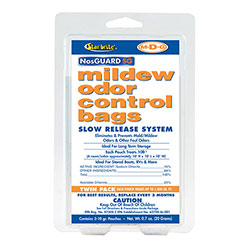
M-D-G Mildew Odor Control Bags eliminate mold with a penetrating vapor.
After removing the mold, follow up with one of the MDG products by Star brite. These products use chlorine dioxide technology to create a penetrating vapor that kills mold along with the odor that it creates. This vapor will penetrate nearly everywhere, including into fabrics and also into areas that you might have missed with the spray. Choices include MDG Fast Release, and MDG Slow Release, which can be used in occupied boats. It works for up to three months and is ideal for continuous treatment of your boat’s cabin during winter layup.
Chlorine dioxide fumigation is effective precisely because it reaches areas that spray cleaners cannot. The vapor penetrates foam cushions, wicks into fabric backing, and disperses into the void spaces behind panels and inside structural cavities where spores survive surface cleaning. For boats with embedded mold odor that persists even after thorough surface cleaning, chlorine dioxide fumigation is often the step that finally eliminates the smell entirely. The odor of mold is produced by the metabolic byproducts of living mold colonies — once the colonies are killed, the odor dissipates. Surface cleaning that removes visible mold but leaves viable spores in foam and fabric leaves the odor-producing colonies partially intact.
When fumigating, close the boat completely to maximize the concentration of vapor and allow it to dwell for the full period recommended by the manufacturer. Open all interior lockers, drawers, and compartments so the vapor reaches every interior space. After the treatment period, ventilate thoroughly before re-occupying the boat. Repeat the treatment every two to three months during storage or in high-humidity conditions to maintain the suppression of mold regrowth.
Step Three: Apply a Mildew Blocker
Although mildew blockers work only temporarily, applying one will give you a temporary leg up in what amount to a continuous battle. According to Practical Sailor, one that works reasonably well is 3M’s Marine Mildew Block. Mildew blockers work by coating surfaces with a biocide that inhibits spore germination. They are most effective on non-porous surfaces — fiberglass, painted surfaces, vinyl — where the coating can remain intact. On porous materials like foam, fabric, and wood, the biocide is absorbed into the material and dissipates more quickly, reducing the effective protection period. Reapplication every two to three months, or at the beginning of each season, is typically required to maintain meaningful protection.
For fabric surfaces like upholstery, berth covers, and canvas, a fabric-specific mildew inhibitor spray formulated for textiles will penetrate the fabric fibers more effectively than a general-purpose blocker and provide better protection without stiffening or discoloring the material. Apply after cleaning and allow to dry completely before replacing cushions or closing lockers.
Reduce Moisture with Calcium Chloride Crystals
Star brite, DampRid and MaryKate all make dehumidifiers that use calcium chloride crystals to remove moisture from the air. In some cases, the moisture gets deposited into a reservoir, as with DampRid’s Easy-Fill Moisture Absorber or the No Damp Ultra Dome by Star brite. These systems are effective, but are prone to spillage unless emptied on time. A better choice for hanging lockers and areas underneath settees and berthing areas are DampRid’s Moisture Absorbing Sachets or MaryKate’s Moisture Control Bag, both of which retain the condensed water in a bag or pouch.
Calcium chloride desiccants work by absorbing water vapor from the surrounding air into the crystals, which gradually dissolve as they absorb moisture. Their effectiveness depends on the volume of air space they are working against and the rate of moisture infiltration from outside. In a tightly sealed boat with modest moisture infiltration, a properly sized desiccant can meaningfully reduce relative humidity over weeks. In a loosely sealed boat in a humid marina environment, desiccants will saturate quickly and require frequent replacement. The most effective approach combines desiccants in targeted locations — hanging lockers, under berths, inside enclosed compartments — with the broader moisture reduction strategies of ventilation and heat described below, rather than relying on desiccants alone to manage the entire cabin.
Placement matters as much as quantity. A single large desiccant unit in the center of the main cabin does relatively little for the moisture trapped in a closed hanging locker four feet away. Place smaller sachets inside every enclosed space — each locker, each berth compartment, the head, the chart table area — rather than relying on one or two large units to serve the whole interior.
Propane and Diesel Cabin Heaters and Stoves

This direct vent mounted propane heater isolates combustion air and produces dry heat.
Many boats are equipped with a propane or diesel cabin heater or stove. Unfortunately, these appliances can increase cabin humidity, because the principal by-products of combustion are carbon monoxide and water, some of which, in the case of most heaters and nearly all stoves ends up in the cabin, where the water will tend to condense against cool interior surfaces— which can result in the formation of mold and mildew.
To prevent this, when using a propane or diesel cabin heater or stove, open your boat’s hatch to let the combustion gasses escape, which is something you should do anyway to limit the possibility of carbon monoxide poisoning. One type of fueled heater that does not present these problems is Sig Marine’s Direct Vent P9000 Propane Heater, with an ABYC-certified design that isolates all combustion air and eliminates the possibility of oxygen depletion, dangerous combustion gas emissions or condensation.
The counterintuitive aspect of combustion heating on boats is that running a non-vented heater to warm and dry the cabin actually increases humidity at the same time it raises temperature. Warm air holds more moisture than cool air, so the cabin may feel less damp while the heater is running, but when the heater is turned off and the temperature drops, that moisture-laden warm air cools and deposits its water content onto every interior surface. The result is condensation on hull liners, portlight frames, and any cold surface in the cabin — precisely the conditions that drive mold growth. A properly vented heater or a direct-vent unit that draws combustion air from outside and exhausts all combustion products overboard raises cabin temperature without adding moisture, which is why vented heating is so significantly better for mold control than unvented heating even when both appear to be providing similar comfort.
Electric Heaters
At the dock, evaporating moisture with an electric cabin heater is a good way to keep surfaces dry. For engine and mechanical spaces there are engine room heaters as well. When you are absent from your boat, low-level heating devices, such as the West Marine Air Dryer and the Goldenrod Dehumidifier are a great way to chase the damp away. Electric heating is the cleanest moisture-management tool available for dockside storage because it adds no combustion byproducts to the cabin air and can run continuously at low power draw without attention. A small electric dehumidifier combined with a low-wattage heater on a thermostat set to maintain 55 to 60 degrees Fahrenheit is one of the most effective mold prevention setups available for boats stored at the dock in damp climates. The ongoing electrical cost is modest, and the benefit to upholstery, wood, and electronics over a wet storage season is significant.
Mold and Mildew FAQs
-
Why is mold and mildew common on boats?
The humid, enclosed environment of boats promotes mold and mildew growth, especially in poorly ventilated areas like cabins and lockers. -
How can I prevent mold and mildew on my boat?
Keep your boat well ventilated, reduce moisture with dehumidifiers or desiccants, and clean surfaces with mold inhibitors. -
What are the best cleaning products for removing mold?
Use marine-specific mold removers or a mixture of water and bleach (10:1 ratio) to kill spores and remove stains effectively. -
How do I prevent mold growth on boat cushions and upholstery?
Store cushions in a dry area, use breathable covers, and treat fabric with an anti-mildew spray. Vacuum-sealed storage bags can also help. -
What role does ventilation play in combating mold?
Adequate airflow reduces moisture buildup, the primary cause of mold. Solar-powered ventilators and fans can help in enclosed spaces. -
Are there natural remedies for controlling mold and mildew?
Vinegar is a natural, eco-friendly mold killer. Wipe affected areas with undiluted vinegar and let it dry to discourage regrowth. -
How do I keep bilge areas mold-free?
Clean the bilge regularly, check for leaks, and use a bilge pump to eliminate standing water. Mold thrives in damp areas. -
Can mold damage my boat?
Yes, unchecked mold can deteriorate fabrics, wood, and fiberglass, and create unpleasant odors, reducing your boat's value and enjoyment.
We're Here to Help!
At West Marine, we’re here to help you make every moment on the water count. With expert advice, premium gear, and over 230 stores ready to serve you, we’ve got more of everything you need for unforgettable boating adventures. Use our store finder to locate a West Marine store near you.
Related Articles: