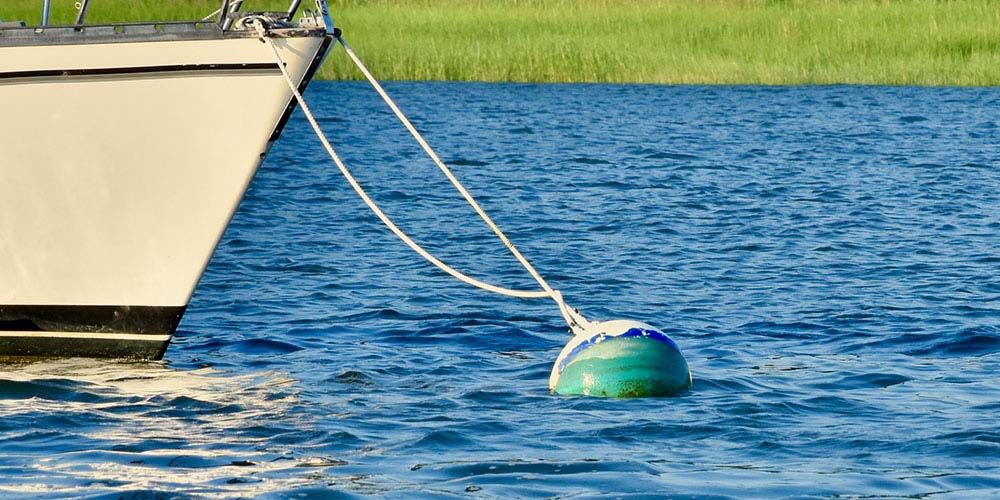
A permanent mooring must remain secure for long periods while unattended, occasionally under adverse conditions. For peace of mind, it should be the right size for the job. The size of your mooring should depend on the conditions under which the boat is moored, such as the amount of fetch for waves to build up and whether your mooring is for light duty, such as overnight use in fair weather, or designed to ride out a hurricane. A mooring system that is adequate for a calm summer anchorage may be entirely inadequate for the same boat in a fall storm — understanding the load your system must handle across the full range of conditions you might encounter is the foundation of a properly designed mooring. Below are the basic anchoring components for installing a mooring.
Written by Brian Gordon, West Marine
- Types of Anchors
- Mooring Chain
- Mooring Buoy
- Mooring Pendant
- Surviving a Storm
- Mooring Anchor Size Requirements
Anchors
Several types of anchors are used when building a mooring, and we'll review them in order of their holding power, from the wimpiest to the most tenacious:
- Concrete Blocks: Many boats use 50-gallon drums filled with cement, concrete blocks, auto engine blocks and other types of dead weight. This type provides the least holding power, working on the principle of sheer weight, but is reliable if pulled out of the bottom. If they drag, they will resist motion with a constant amount of force. Note that in seawater, concrete loses about 42% of its weight when fully submerged, so a mooring anchor designed to weigh 500 pounds on the seabed will actually require about 872 pounds of dry weight concrete. Dead weight moorings are the most common DIY option because the materials are inexpensive and installation requires no specialized equipment, but their holding power per pound is the lowest of any mooring type. For any application beyond a calm, protected location with modest wind exposure, a dead weight mooring should be considered a minimum-viable solution rather than an ideal one.
- Mushroom Anchor: The most common type of mooring anchor is the mushroom, which, under ideal conditions, with the right kind of bottom, can dig in, create suction and develop good holding power. Mushroom anchors work best in a silt or mud bottom, and are not as effective in rocks or coarse sand. If a mushroom gets pulled out of the bottom, it is less likely to reset itself completely, and will merely skip along across the bottom. A weight of 5–10 times boat length is a good rule of thumb, as a bare minimum. The heavier the better, as long as you don't have to move it. The suction that develops as a mushroom settles into a soft bottom over months and years is what gives a well-established mushroom mooring its holding power — a freshly placed mushroom has only its dead weight working for it, and may drag in a moderate storm before it has had time to settle and develop suction. For this reason, new mushroom moorings should be inspected particularly carefully in their first season before being trusted to hold in adverse conditions.
- Pyramid Anchor: The cast-iron Dor-Mor pyramid mooring anchor is a superior alternative to the mushroom. Its smaller size, concentrated weight and pyramid shape allows it to embed itself more rapidly, and its holding power (at a scope of 3:1) is up to about ten times its weight. Recommended by Practical Sailor/Powerboat Reports in 2009. The pyramid's geometry is what gives it its advantage over the mushroom: the shape resists horizontal drag by presenting angled faces to the direction of pull, and the concentrated weight in a small footprint allows it to penetrate and embed in a wider variety of bottom types including firm sand and mixed bottoms where a mushroom would simply sit on the surface. For a given holding requirement, a Dor-Mor pyramid is significantly lighter and easier to handle than an equivalent mushroom, which matters when setting or retrieving the mooring.
- Helical Screw: While the above types rely for holding power on sheer weight or a combination of weight and embedding themselves in the bottom, the helical anchor is screwed into the seabed, usually by a barge-mounted hydraulic device. Helical screws have long, high-tensile steel shafts (8' length is common) with large screw threads (10" to 14" diameter) on the bottom and an attachment eye at the top. These professionally-installed anchors, originating in the offshore oil industry, have gained popularity with recreational boaters since the 1990s, and have the most extreme holding power in relation to their weight. A properly installed helical screw in suitable substrate will hold loads that would drag any comparably sized dead weight or mushroom mooring. Their significant drawbacks are cost — professional installation by a barge and hydraulic equipment is not inexpensive — and the need for suitable substrate, as helical screws cannot be installed in rock or very shallow soft substrate where the shaft cannot achieve adequate depth. In permitted mooring fields where the harbormaster controls what type of mooring anchor may be used, helical screws are increasingly the required standard in many jurisdictions because of their superior holding power and smaller footprint on the seabed.
Mooring Chain
Chapman's recommends two sections of galvanized chain: a heavier, primary chain and a lighter, secondary chain. The primary (ground) chain lies on the bottom. Its length should be 1 1/2 times maximum water depth. The secondary (riding) chain, is connected to the ground chain with a galvanized shackle or swivel. It's usually half the diameter of the ground chain and equal in length to maximum water depth. The heavier chain is not used for the entire run so that the mooring buoy does not have to support an excessive amount of weight. The chain should be as large as practical; make the riding chain at least double the size of the chain on your anchor rode.
Chain inspection and replacement is the most critical and most frequently neglected aspect of mooring maintenance. Galvanized chain in saltwater service degrades continuously through galvanic corrosion, and the rate of degradation accelerates dramatically once the galvanizing is worn through and bare steel is exposed to seawater. A chain that looks adequate above the surface may have significant section loss at or below the mud line, where oxygen depletion and bacterial activity create a particularly aggressive corrosion environment. The ground chain — which lies on the seabed and is perpetually in contact with abrasive bottom material — typically degrades faster than the riding chain and should be the primary focus of any chain inspection.
Best practice for mooring chain management:
- Inspect chain annually, ideally by hauling the entire system for inspection on deck. Visual inspection while the chain is in the water is inadequate for detecting section loss at the mud line or at shackle pins. Haul the mooring at least every two to three years for full out-of-water inspection, and replace any chain showing visible corrosion pitting, link elongation, or section reduction of more than 10 to 15 percent of original diameter.
- Mouse all shackle pins with seizing wire. A shackle pin that works loose over months of constant motion in a mooring system will eventually unscrew and allow the chain to separate. Mouse every shackle pin with stainless steel seizing wire passed through the hole in the pin and twisted tight around the shackle body. This takes two minutes per shackle and is the simplest and most effective insurance against shackle failure.
- Use a swivel between the ground chain and riding chain. A swivel prevents the riding chain from transmitting rotational load to the ground chain as the boat weathervanes around the mooring. Without a swivel, the constant twisting motion of the riding chain gradually works open shackle pins and stresses chain links at the connection point. Galvanized swivels sized appropriately for the chain diameter are inexpensive insurance.
- Consider stainless steel chain for the riding section in high-wear applications. Stainless steel chain costs significantly more than galvanized but degrades more slowly in saltwater, resists abrasion better, and is easier to inspect for section loss because it does not form the scale and rust that obscures galvanized chain damage. For a permanent mooring in a high-exposure location, stainless riding chain with galvanized ground chain is a reasonable long-term investment.
Mooring Buoy
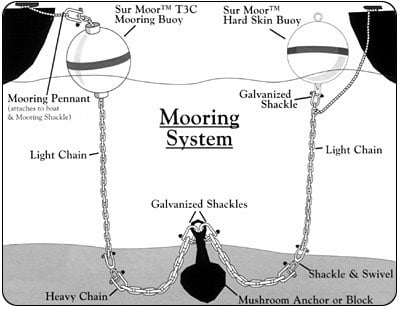
Two styles of Taylor mooring buoys are shown on typical systems with primary and secondary chain.
Your mooring buoy supports the mooring chain and is an essential part of your mooring gear. The two preferred designs for mooring buoys are a traditional buoy with hardware or a buoy with a tube through the center. Both offer reliable flotation and will last for several seasons, depending upon the salinity of the water. Obviously, freshwater applications will extend the useful life of any mooring system.
The buoy must have about twice as much flotation as the suspended chain has weight in order for it to ride high enough in the water to be visible. The Taylor Sur-Moor™ T3C™ Mooring Buoys allow you to pass the chain through the center of the buoy, and attach the pendant on top. Secure the mooring chain at the top using a 4" galvanized O-ring, such as , and add the T3C™ Mooring Collar to protect the buoy from wear by the anchor chain and extend its lifespan.
Buoy condition is a frequently overlooked indicator of overall mooring system health. A buoy that is waterlogged, cracked, or riding low in the water is not simply an aesthetic problem — it is signaling that the chain load it is carrying exceeds its available flotation, which can mean the riding chain is longer than specified, the chain has been replaced with a heavier grade, or the buoy has absorbed water and lost buoyancy. A buoy riding low also reduces the catenary in the riding chain, which increases the angle of pull on the ground tackle and reduces the effective holding power of the mooring anchor. Replace buoys that show cracking, persistent low riding, or visible water absorption rather than continuing to use a marginal buoy in the interest of saving the replacement cost.
Mooring Pendant
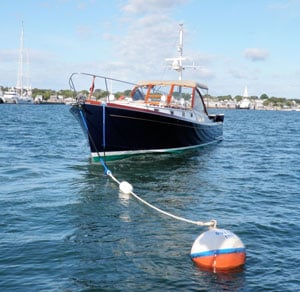
This powerboat is moored through both bow chocks with two of New England Ropes' Cyclone Mooring Pendants. The bottom white section of the pendant is traditional three-strand nylon.
The pendant (pronounced "pennant") attaches the chain to the boat. Large-diameter three-strand nylon line is used because its inherent elasticity (stretching about 10 percent under a load equaling 20 percent of its tensile strength) allows it to act as a shock absorber. Polyester line, Dyneema line or stainless steel wire is preferred by some for better chafe resistance. Length should be about 2 1/2 times the boat's freeboard. Diameter should be as large as is practical—but it must be able to fit through bow chocks and around a bow cleat.
Effective chafe protection is recommended for the point where the pendant passes through a chock. This is critical, as failure caused by chafe at this location is one of the main reasons why boats end up on the beach. A light pick-up buoy at the boat end makes it easy to grab the pendant.
Chafe failure at the bow chock is not a rare or unusual event — it is one of the most consistently documented causes of boats coming off their moorings in storm conditions. The combination of sustained high load, constant motion, and the sharp edge of a chock creates exactly the conditions under which nylon rope fails fastest. A pendant that shows no visible chafe in calm conditions can fail within hours in a sustained blow once the load and motion increase enough to generate heat at the chock contact point. Chafe protection at the chock is not optional equipment on a properly rigged mooring pendant — it is a required component of the system. Leather, heavy-wall rubber hose, chafe tape, or a commercial chafe guard sleeve should be installed at every contact point and replaced at the first sign of wear.
Cyclone Mooring Pendants, made from Endura-12 Dyneema line, were developed by Nantucket Moorings in conjunction with MIT. Traditional pendants are made from three-strand nylon, to absorb shocks by their elastic nature. This stretch, while allowing your boat a comfortable, cushioned ride, allows the line to move across the bow chocks, creating friction and causing chafe.
Cyclone Pendants are attached (using a lunch pail hitch, also called a "cow hitch") to your standard nylon pendant with its floating pickup buoy, and allow use of a low-stretch upper section. Their high tensile strength allows smaller mooring lines to be used, so they fit more easily on boats with smaller cleats and chocks. Very low elongation results in a dramatic reduction in friction, heat and chafing. Also, because the top and bottom sections are just looped together through spliced eyes, you can replace a damaged section without replacing the entire pendant.
Using two pendants rather than one is a practice strongly recommended by experienced mooring professionals for boats left unattended for extended periods or in exposed locations. Two pendants passed through separate bow chocks and secured to separate cleats distributes the load across two contact points rather than one, halves the load on each pendant and its chafe protection, and ensures that even if one pendant fails completely, the boat remains secured by the second. The cost of a second pendant is trivial compared to the cost of recovering a boat that has come off its mooring.
Surviving a Storm
Hurricanes making landfall in locations along the Eastern Seaboard have wrecked hundreds of boats over the past twenty years, many of which were driven ashore with their complete and intact mooring systems still attached. Weather forecasters predict that we are now in a period where we can expect more storms of greater destructive force, storms like Harvey, Irma and Maria that caused tremendous damage in 2017. Just how large does a mooring system need to be if your boat is caught in extreme weather? The following chart gives an estimate of the wind loads (based on the windage of the vessel) and the required size of a pyramid anchor.
The wind load numbers in the table below illustrate why boats on seemingly adequate moorings come off in major storms. A 40-foot powerboat experiencing 100-knot winds generates 12,000 pounds of load on its mooring system. Every component in the system — the anchor, the ground chain, the riding chain, every shackle, the buoy, the pendant, and the chafe protection at the chock — must be capable of sustaining that load continuously for hours. A single undersized shackle pin, a pendant worn through at the chock, or a chain section with undetected corrosion damage is all it takes to lose the boat. Storm preparation for a moored boat means inspecting and upgrading every component of the mooring system to the standard required for the worst conditions the boat might realistically encounter — not the conditions it usually encounters.
If a major storm is forecast and your boat is on a mooring, the most reliable protection is to move the boat to a well-protected marina or hurricane hole if time permits. No mooring system is as reliable as a boat in a properly protected slip with adequate dock lines and fenders. If the boat cannot be moved, double all pendants, add chafe protection at every contact point, remove or furl all sails and covers that add windage, and ensure the mooring system has been recently inspected and is in good condition. A mooring system that has not been hauled and inspected in three or more years should not be trusted to hold in a major storm regardless of its original size and specification.
Minimum Dor-Mor Mooring Anchor Size Requirements
| Boat Length | Beam Sail/Power | Wind Load 64 Knots | Dor-Mor Size | Wind Load 100 Knots | Dor-Mor Size |
|---|---|---|---|---|---|
| 20' | 8'/9' | 1,600lb. | 200lb. | 3,600lb. | 400lb. |
| 25' | 8'/9' | 2,200lb. | 300lb. | 5,000lb. | 500lb. |
| 30' | 9'/11' | 3,200lb. | 400lb. | 7,000lb. | 700lb. |
| 40' | 11'/14' | 5,400lb. | 700lb. | 12,000lb. | 2,000lb. |
| 50' | 13'/16' | 7,300lb. | 1,000lb. | 16,000lb. | 2,000lb. |
| 60' | 15'/18' | 9,100lb. | 1,000lb. | 20,000lb. | 2,000lb. |
| 80' | 19'/22' | 13,000lb. | 2,000lb. | 31,000lb. | 4,000lb. |
Based on wind loading data at min. 3:1 scope, with suitable bottom conditions for anchor to embed. Wind loads based on data from ABYC.
Mooring System Maintenance Schedule
A mooring system that is never inspected is a mooring system that will eventually fail. The following maintenance schedule reflects best practices for recreational boat moorings in saltwater environments. Freshwater moorings can extend these intervals modestly, as the corrosion environment is significantly less aggressive without salt.
- Every season: Inspect the pendant for chafe at all contact points. Replace chafe protection at bow chocks. Check that all shackle pins are moused with seizing wire. Confirm the buoy is riding at the correct height and showing no signs of waterlogging or cracking. Inspect the visible portion of the riding chain for corrosion and section loss.
- Every two to three years: Haul the complete mooring system for out-of-water inspection. Measure chain link diameter at multiple points along both ground and riding chain and compare to original diameter. Replace any chain showing section loss greater than 10 to 15 percent. Inspect the mooring anchor for condition and confirm it is still properly embedded. Replace the mooring buoy if it shows cracking, water absorption, or loss of buoyancy.
- Before any major storm forecast: Double the mooring pendants. Add fresh chafe protection at all contact points. Remove all windage-adding equipment from the boat. Confirm all shackle pins are moused. If the mooring has not been inspected in the past two years, consider moving the boat to a protected marina rather than trusting an uninspected system in extreme conditions.