
What Inverters Do
Inverters change the DC current supplied by a boat’s batteries into AC current to power electronic devices and household appliances on a boat. Whether you want to blend a margarita, charge your laptop, or power a drill, installing an inverter makes all this possible when unplugged from shore power away from the dock.
While this article focuses on how to select an inverter, if you prefer the space-saving convenience of inverter/chargers that combine the functions of a battery charger and a power inverter in one device, our West Advisor article Selecting a Battery Charger for Your Boat can help you choose an inverter/charger that includes a battery charger to meet your needs.
- Inverters versus Gensets
- How Big Should Your Inverter Be?
- What to Look for When Choosing an Inverter
- Modified versus Pure Sine Wave Efficiency
- How Much Battery Capacity Will You Need?
- Installation
- Conclusion
Inverters versus Gensets
Inverters change direct current (DC) into alternating current (AC) to power common household tools, electronic items, and appliances. Generators also produce AC power — so why not use a generator instead?
While both inverters and gensets create AC electricity, inverters are the better choice for variable demand and loads up to 2,000–3,000 watts. Unlike noisy, fossil fuel-driven gensets, inverters are silent and require virtually no maintenance. Their effectiveness is limited by your battery capacity, which is the key trade-off.
Gensets are better for large, continuous loads like air conditioning, heating, and refrigeration. Running air conditioning off an inverter is impractical unless you are cooling a small area for a relatively short time. If your 120V energy requirements exceed 2,000 watt-hours per day, a genset is probably needed.
A practical middle ground is to use an inverter/charger with a genset. The genset runs during meal times and other high-load periods, recharging the house batteries via the inverter’s built-in charger. During off-peak times, the inverter takes over, silently supplying power for smaller loads.
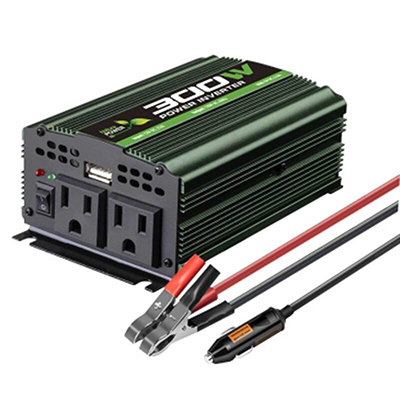 Offered with a choice of 300W, 400W, and 750W of capacity, Nature Power’s small, portable modified sine wave inverters are an inexpensive option for powering small AC loads onboard.
How Big Should Your Inverter Be?
Inverters range from tiny 100W models good for laptops to 4,000W models that can run electric galleys and refrigeration systems. The size you select is governed by the maximum power needed at one time. A computer (200W), TV (200W), and microwave (800W) all running simultaneously will need an inverter delivering more than 1,200W of continuous power. Inverters typically fall into three categories:
Portable inverters generally connect to your DC electrical system via the cigarette lighter socket. These sockets are often problematic due to poor contact or insufficient wire gauge, but portable inverters provide instant use — just plug in and go. They typically deliver up to 300 watts, ideal for laptops, small lights, and tools. AC appliances plug directly into the front of the unit. Portable inverters work equally well in cars and SUVs on family trips.
Permanent-mount inverters (400 watts or more) are hardwired directly to the battery bank. Inverters in this range usually have built-in receptacles but do not integrate with the boat’s existing AC wiring. Some models allow you to wire additional receptacles in remote locations. Top-of-the-line models include built-in transfer switches that enable full integration with existing AC wiring.
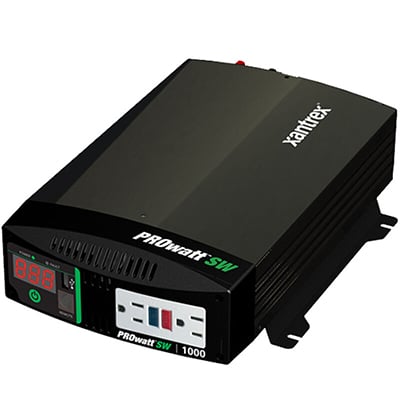 A step up from portable inverters, fixed-mount Xantrex PROwatt SW Pure Sine Wave Inverters are a good choice for powering sensitive electronics. Each includes two front-mount outlets and a USB port for charging mobile devices.
Inverter/chargers have outputs that rival small generators (2,000 to 4,000 watts) and include a powerful battery charger along with battery monitors and remote controls. Inverter/chargers almost always include an automatic transfer switch — when the inverter/charger detects another source of AC power (shore power or a running genset), it shifts from inverting to charging. When the external AC source goes away, it automatically switches back to inverting.
Inverter/chargers should be professionally installed because they draw very high amperage, with the potential for dangerous shorts and electrical fires if wired inadequately. They become an integral part of your boat’s electrical system and can rapidly replenish battery banks in the 400–800Ah range. Many trawler owners are moving away from large diesel generators and instead installing a large inverter/charger for AC loads, complemented by propane ranges and DC refrigeration systems.
What to Look for When Choosing an Inverter
Wave form: Inverters today produce one of two types of AC power: Modified Sine Wave (MSW) or Pure Sine Wave (PSW). Affordable MSW inverters are the most popular type and work well with most common appliances. PSW inverters are more expensive but will run all AC loads and are best for stereos, computers, and other sensitive electronics. Portable tool chargers (especially Makita, according to Magnum Energy), light dimmers, variable speed tools, plasma screens, and home theater sound systems may not perform as well with MSW. MSW inverters are prone to harmonic distortion, which can cause interference in some electronic circuits.
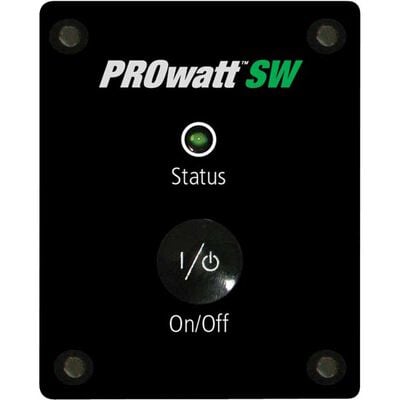 With Xantrex’s PROwatt SW Remote Panel you can turn your PROwatt SW Inverter on or off from a convenient location.
Pure sine wave inverters are extremely sophisticated and can produce AC power at or above the quality of shore power grids. According to Magnum Energy, a pure sine wave inverter can eliminate static lines in televisions and improve sound system quality. A good pure sine wave inverter can have total harmonic distortion (THD) of less than five percent, typically around two percent — compared to MSW inverters which typically run 20–25% THD.
Remote controls: Being able to control, monitor, and program your inverter from inside the cabin is an important consideration, especially when the inverter is mounted in a hard-to-reach location. Remote panels are a must-have for inverter/chargers.
Powerful surge capability: An inverter must be powerful enough to handle the surge or starting requirements of appliances. A 125-watt TV might need 625 watts for a few seconds when starting cold. Without adequate surge capability, the inverter won’t start the appliance.
To quote Don Wilson, the Xantrex Tech Doctor: “My advice? Use common sense here, but always err on the side of the inverter. After all, nobody wants to have to remember to turn off the entertainment center when using the microwave to pop the popcorn! If there is any possibility of the loads running concurrently, include both in your calculations.”
Low electrical interference: High-frequency inverters frequently produce some EMI (electromagnetic interference), which can cause problems with SSB, Ham, and weather fax reception. Many newer designs, especially pure sine wave inverters, meet FCC Class A requirements, which represents a significant improvement. Turning off the inverter when operating the radio is a simple solution if interference occurs.
Modified versus Pure Sine Wave Efficiency
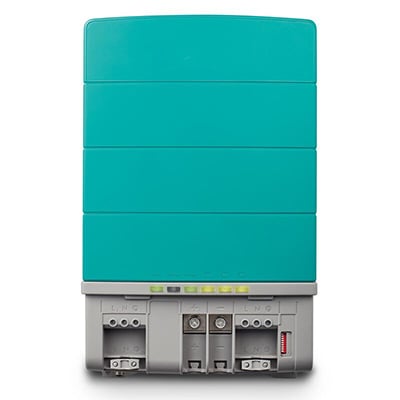 Offering up to 3,000W of pure sine wave AC power with a built-in 160A battery charger, MASTERVOLT’s CombiMaster 12/3000-160 (120V) Inverter/Charger can power heavy AC loads and charge large battery banks with ease.
Inverter efficiency measures how much DC energy gets converted into usable AC power. Efficiency ranges from about 85 to 95 percent, with 90 percent being roughly average.
Efficiency ratings are typically measured using a resistive load (essentially a light bulb or electric heater). When running motors, efficiency splits into two components: the inverter’s conversion efficiency, and the waveform efficiency. Waveform efficiency reflects the fact that most motors and many electronic appliances run better and use less power on a pure sine wave. An electric motor — such as a pump or refrigerator compressor — will typically consume 15 to 20 percent more power on a modified sine wave than on a true sine wave. When choosing an inverter, consider not just the inverter’s efficiency rating but also the type of appliances you’ll most often run.
Power factors and generators: The charger in an inverter/charger presents a large, inductive load for a small generator (under 8kW). Chargers with a high “power factor” are desirable because they are less sensitive to peak voltage and require less AC power to deliver the same charging current. We recommend that a generator be sized at 2.5 times the power draw of the charger.
How Much Battery Capacity Will You Need?
Design rule: To be effective, an inverter should have access to a battery bank that is at least 20 percent as large in amp-hours as the inverter’s size in watts. A 1,000-watt inverter should be supported by at least 200Ah of battery capacity.
The rationale: inverters consume approximately 100Ah of battery capacity per 1,000 watt-hours of AC output. A 1,000-watt inverter running at full capacity for one hour would consume 100Ah — which would discharge a 200Ah battery by 50% from full charge. This is a recommended minimum; more battery capacity is always better.
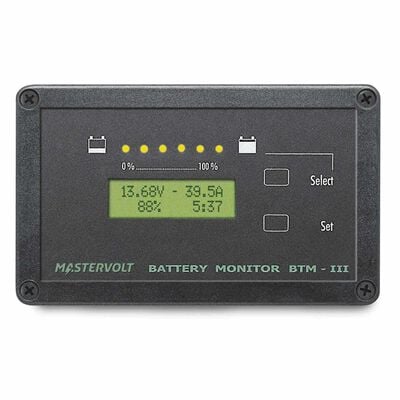 Mastervolt’s Masterlink BTM-III Battery Monitor gives you the ability to monitor up to three battery banks from one convenient display.
Calculating electrical loads: Many appliances show their wattage on a back panel. If only the amp rating is given, use this formula: Volts × Amps = Watts. A 7-amp microwave at 115V requires 805 watts. Multiply each appliance’s wattage by the hours it will run per day, then divide by 10 to find the approximate amp-hours consumed from your batteries.
If an inverter is going to run a 500-watt load, it will draw approximately 50A DC. The math: 500W AC ÷ 85% efficiency ÷ 12.5V = 47A DC. Keep two things in mind: 500W is not a large load — a small cabin heater draws 1,500W and a hair dryer draws 1,000W. And 50A is a substantial DC current draw. Few DC loads on boats under 40 feet draw 50A or more for more than a few minutes. An inverter frequently becomes the largest single DC load on the boat, and installing one may require meaningful increases in battery capacity and wiring upgrades.
Installation
Install a fixed-mount inverter no more than 10 feet from the battery bank to avoid excessive voltage drop or the need for oversized cable. Inverters are not ignition protected and cannot be installed in gasoline engine compartments, but can be mounted in a diesel engine space. Choose a location that is cool, dry, well ventilated, and protected from explosive gases produced by batteries, engines, and fuel systems.
When installing an inverter or inverter/charger, carefully follow the manufacturer’s instructions and ensure the installation complies with applicable American Boat and Yacht Council (ABYC) standards. Inverter/chargers in particular should be professionally installed given the high amperage and fire risk of an inadequate installation.
Conclusion
When considering an inverter, the key trade-off is battery capacity. Compared to a genset, an inverter is a better choice for powering loads up to around 3,000 watts — silently and without maintenance. But your batteries must have enough capacity to back it up. For some boaters, that means increasing battery capacity, supplementing with a genset, or choosing a less powerful inverter that better matches the available battery bank.
Frequently Asked Questions
What size inverter do I need?
Add up the wattage of every AC appliance you might run at the same time — that total is the minimum continuous output you need. Then add at least 20–25% for surge capacity, since motors and compressors draw two to five times their running wattage for a few seconds on startup. For example, a 200W laptop, 200W TV, and 800W microwave running simultaneously requires a minimum 1,200W continuous inverter — but a 1,500W or 2,000W unit gives you headroom for starting surges and future loads.
What is the difference between modified sine wave and pure sine wave inverters?
Modified sine wave (MSW) inverters are less expensive and work adequately for most basic loads — incandescent lights, simple battery chargers, and basic power tools. Pure sine wave (PSW) inverters produce AC power equivalent to or better than shore power and are required for sensitive electronics including laptops, stereos, plasma TVs, variable speed tools, and light dimmers. If in doubt, buy a pure sine wave inverter — it will run any load that an MSW inverter will, plus the sensitive electronics that MSW cannot.
How much battery do I need to run an inverter?
The rule of thumb is 20% of inverter wattage in amp-hours of battery capacity — so a 2,000W inverter needs at least 400Ah of battery capacity. This is a minimum that allows running the inverter at full power for roughly one hour before reaching a 50% discharge. For extended use, larger battery banks (or lithium batteries with greater usable capacity) are needed. Remember that inverter loads are typically the largest single DC draw on the boat and may require upgrading your wiring and battery bank simultaneously.
Can I run air conditioning on an inverter?
Practically speaking, no — not for extended periods. A small window AC unit draws 900–1,500W continuously, which would drain even a large battery bank in a few hours. Whole-boat air conditioning systems are beyond the practical capacity of most inverter installations. A genset is the correct solution for continuous AC loads like air conditioning, large refrigeration systems, or electric cooking. Inverters work best for variable, intermittent loads that can be managed within the battery bank’s capacity.
Where should I install an inverter on my boat?
As close to the battery bank as possible — within 10 feet is the guideline. Longer cable runs between the battery and inverter require heavier cable to limit voltage drop, which adds cost and weight. The location must be cool, dry, and well ventilated. Inverters are not ignition protected and cannot be installed in gasoline engine compartments. A locked battery box or dedicated electrical cabinet is ideal. For inverter/chargers, professional installation is strongly recommended due to the high current and complexity of integrating with the boat’s AC system.