
Before Leaving Home
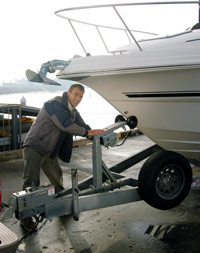
Checking the bow tiedown. Notice that the safety chains are criss-crossed, the Emergency Breakaway Cable is attached to the vehicle, and the trailer jack is retracted.
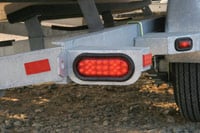
LED lights are a no-brainer upgrade. If you’ve ever troubleshot lighting problems on the road, you know why.
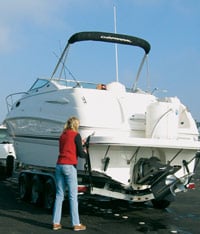
Checking tiedown strap tension after loading. Next step: lower the Bimini top and VHF antenna and remove loose gear from the cockpit.
- Check tires for cold air pressure and general condition. Check lug nuts for tightness. Check wheel bearings or bearing protectors to ensure they’re adequately filled with marine grease. Do not overfill.
- Fasten the hitch coupler securely and lock it with a safety bolt or lock. Confirm the trailer ball size matches the coupler rating. The trailer should ride at a level attitude or very slightly nose-down — if nose-up, use an adjustable-height drawbar to level it. A nose-up trailer promotes trailer sway at highway speeds.
- Attach trailer safety chains in a criss-cross pattern under the tongue and connect the emergency brake breakaway cable to the vehicle. Both must be secure before driving.
- Depending on tongue jack type, either remove the wheel or foot and fully retract the jack, or swing the jack into traveling position along the trailer frame and secure it.
- Plug the trailer wiring connector to the vehicle and verify all lights operate: brake lights, turn signals, running lights, and reverse lights.
- Inspect transom tiedown straps, bow strap, and bow safety chain. All should be secure and in good condition with no fraying or corrosion.
- Install the outboard or sterndrive lower unit support bracket and confirm it is secure for road travel.
- Secure and balance all loose gear inside the boat. If trailering with a cover, make sure it is tightly fastened at all corners.
- Adjust the tow vehicle’s rearview mirrors before pulling onto the road.
Before Launching
- Disconnect trailer lights and secure loose electrical plugs above the waterline before the trailer enters the water.
- Install and double-check the boat’s drain plug. This is the most commonly forgotten step — check it twice.
- Turn the battery switch to the “On” position and remove the outboard or sterndrive support bracket.
- Remove transom tiedown straps and bow safety chain. Leave the bow strap connected until the boat is in the water and ready to float off.
- Attach dock lines and fenders before the boat leaves the trailer.
- Raise antennas (VHF and others), Bimini top, and any towers as equipped.
- On sterndrive and inboard-powered boats, run the blower for a full four minutes before starting the engine. On outboard-powered boats, pump the primer bulb.
Before Trailering Home
- Before pulling the boat out of the water, confirm the sterndrive or outboard is raised.
- Attach and tighten the bow strap, making sure the winch is properly in gear.
- Check that the hull is resting correctly on the trailer bunks or rollers and is properly centered.
- Lower antennas, Bimini top, and towers.
- Secure transom tiedown straps and bow safety chain.
- Attach the sterndrive or outboard support bracket.
- Reconnect all trailer lights and verify operation before leaving the ramp.
- Walk completely around the trailer: inspect tires, bearings, tiedowns, hitch coupler, safety chains, wiring connector, and emergency breakaway cable.
- Secure the boat cover and stow all loose gear (ice chests, life jackets, buckets, and anything else that could blow out at speed).
- Wash the trailer and boat thoroughly with fresh water to remove invasive aquatic species and saltwater contaminants. Many states require this before leaving a boat ramp. Drain all water from live wells, bilge, and coolers as well.
Frequently Asked Questions
Why should I run the blower before starting a sterndrive or inboard engine?
Gasoline vapor is heavier than air and can accumulate in the bilge and engine compartment. A spark from starting the engine can ignite accumulated vapors and cause an explosion. Running the blower for a minimum of four minutes before starting the engine ventilates these compartments and is required by ABYC standards and considered fundamental boating safety. This step is not optional — it is one of the leading causes of preventable boat fires and explosions when skipped.
Why do trailer safety chains need to be criss-crossed?
Criss-crossing the safety chains creates a cradle under the trailer tongue. If the hitch coupler fails and the tongue drops, the crossed chains catch the tongue and prevent it from digging into the road surface — which would cause the trailer to vault and potentially flip the tow vehicle. Chains that are simply looped straight between the trailer and the vehicle frame offer significantly less protection in a coupler failure than properly criss-crossed chains.
Why is the drain plug check so important?
A missing drain plug is the single most common cause of a trailered boat sinking at the launch ramp. The boat floats off the trailer, the driver returns to park the vehicle, and by the time they walk back to the dock the transom is underwater. Check the drain plug before backing down the ramp, not on the ramp. Put it on your checklist and physically touch it every single time.
What are invasive species and why do I need to wash the boat?
Invasive aquatic species such as zebra mussels, quagga mussels, and various aquatic plants can be transported from one body of water to another on boat hulls, trailer bunks, live wells, bilges, and anchor rodes. Once established in a new water body, they can cause catastrophic damage to ecosystems and are virtually impossible to eradicate. Many states require boaters to drain, dry, and/or wash all equipment before leaving a boat ramp. Even where not legally required, it is an important practice for protecting the waterways where we boat and fish.