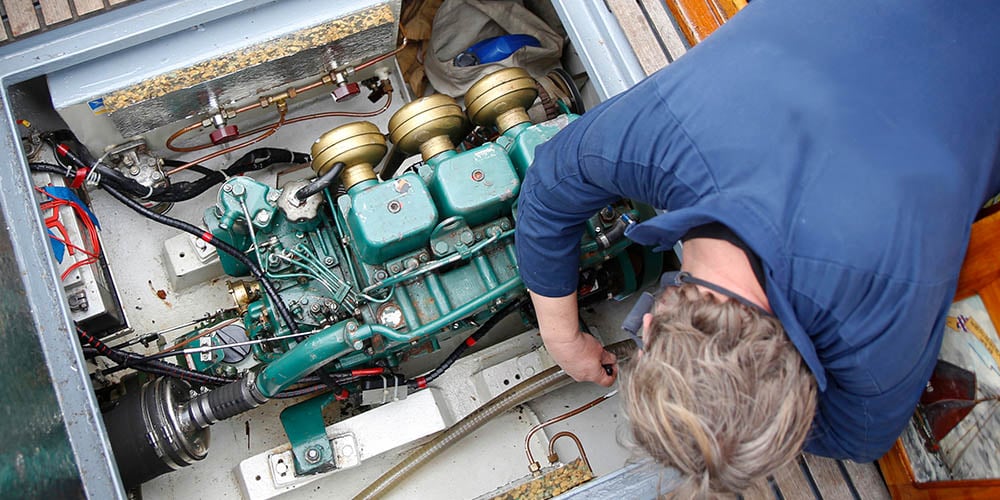
The marine diesel engine that powers your boat is a relatively simple beast. Compared with the gasoline engine in your car, diesels are uncomplicated, and routine maintenance will assure years of reliable service. This article distills the wisdom of the experts down to some basics for you, the owner of a diesel-powered boat, to keep in mind.
- Owner’s Manuals and Hourmeters
- The Big Three: Lubrication, Cooling, and Clean Fuel
- Regular Oil Changes
- Understanding Your Cooling System
- Clean Fuel
- Micron Ratings for Diesel Fuel Filters
- Further Reading
- FAQs
Owner’s Manuals and Hourmeters
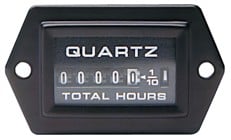
An hourmeter is essential, even if it’s a simple one.
This first topic is a no-brainer. The manufacturers of your engine almost invariably produced an excellent manual containing all the information you need to keep your engine running reliably. You don’t need to read the rest of this article if you just read that document and follow its instructions for recommended maintenance.
Keep track of your maintenance using an hourmeter. If your engine doesn’t have one, buy and install one. Log the maintenance you perform, or have your mechanic log theirs. Find a local mechanic you can trust and establish a regular relationship. If you’ve just bought a used boat, get a diagnostic of the engine and all its systems. Particularly confirm that the alarm system and gauges are working. If the engine overheats or loses oil pressure, working alarms mean a nuisance call for a tow instead of a catastrophic engine replacement.
Your manual will have a Periodic Maintenance table listing all scheduled maintenance for your engine. Below is an example from a three-cylinder Yanmar 3JH4E — typical of what you’ll find for most marine diesels.
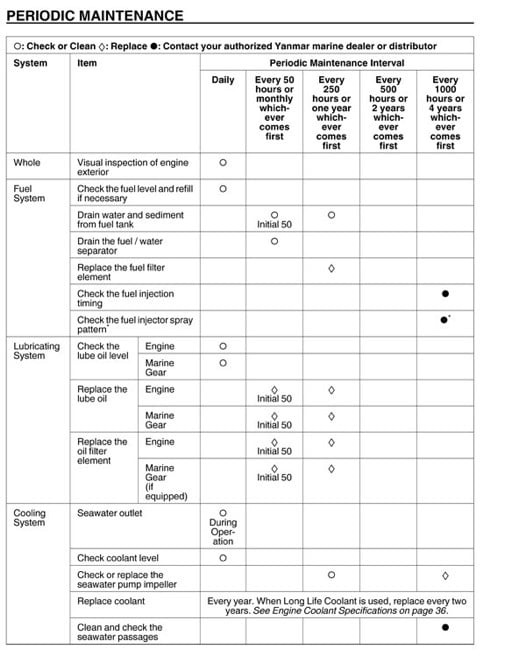
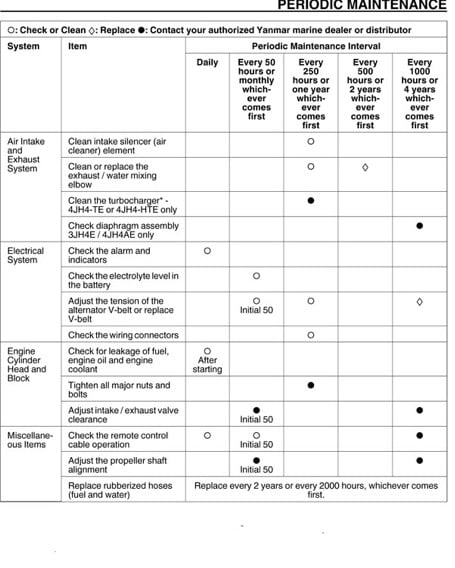
There is a lot in this table. If the frequency and quantity of these tasks overwhelms you, consider this carefully before buying a diesel-powered vessel. But if you follow the recommended schedule, you can ensure your fishing trip or cruising adventure won’t be ruined by engine problems. Below we’ll look at the three most critical maintenance areas: lubrication, cooling, and fuel.
The Big Three: Lubrication, Cooling, and Clean Fuel
Regular Oil Changes
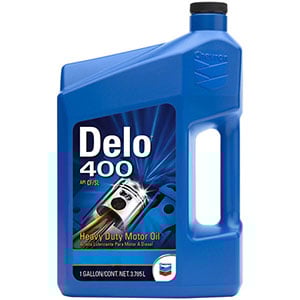
Delo 400 4-stroke oil is suitable for both gasoline and diesel engines.
Most owners understand that frequent oil changes are essential. The typical interval is every 100 hours, but this varies from as few as 50 to as many as 200 hours depending on engine size. Small engines like a 1.6-liter Yanmar take only a small quantity of oil and need more frequent oil changes — every 50 hours in some cases.
Oil in a diesel works harder than in a gasoline engine because diesels run at higher temperatures and under extreme pressure. Diesel fuel also contains traces of sulfur, especially in countries outside the U.S., which converts into sulfuric acid inside the engine. Many boats — particularly small cruising sailboats — run their engines infrequently and for short periods when leaving or entering a slip, or at low RPM for extended periods to charge batteries or freeze a refrigerator holding plate. Both practices are hard on the engine. The engine never reaches full operating temperature, causing moisture to condense inside, forming sulfuric acid and building up carbon deposits on valves and valve stems, which reduces compression. If you do significant motoring at low load or short durations, increase oil change frequency and use top-quality oil with good filters.
Decoding Engine Oil
Oil that is ideal for a gasoline inboard is not always correct for a diesel. Your owner’s manual specifies the API (American Petroleum Institute) and SAE (Society of Automotive Engineers) ratings for your engine. These ratings appear on the oil container.
- API ratings beginning with C (Compression ignition) are formulated for diesel engines. Current diesel service ratings include CK-4, CJ-4, CI-4, CH-4, CG-4, CF-4, CF-2, and CF.
- API ratings beginning with S (Spark ignition) are formulated for gasoline engines.
- The second letter indicates the complexity of the additive package — letters further up the alphabet indicate more complex formulations. Higher-rated oils can generally be used where lower-rated oils are specified. If your manual says “use CD,” an oil rated CE or higher is acceptable.
- Many oils are now dual-rated for both gasoline and diesel use. Chevron’s DELO 400 in 30 and 40 weight is currently rated CJ-4 and SM, making it suitable for both engine types.
Viscosity
The SAE viscosity rating measures an oil’s thickness and ability to flow at different temperatures. Higher numbers indicate thicker oil, which provides better protection at high temperatures but flows less easily when cold.
- Always follow your engine manufacturer’s recommendations first
- If you operate in consistent temperatures, a single-weight oil (e.g. SAE 30) may be appropriate
- If you operate across a wider temperature range, select a multi-viscosity oil (e.g. SAE 10W-30) — these behave like thin oil in cold weather for easier cold cranking, and like heavier oil in high temperatures for better protection
Understanding Your Cooling System
The majority of engine failures are caused by problems in the cooling system. Watch this video from Ed Sherman of the American Boat and Yacht Council (ABYC), who tours the cooling system on a Volvo Penta engine and demonstrates basic maintenance practices.
The most common recreational marine diesel configuration uses a raw water system with a heat exchanger connected to a freshwater loop that cools the engine. Blockages in the raw water side cause the most typical cooling problems — plastic debris, kelp, or barnacles obstructing the raw water inlet, or a disintegrating impeller in the raw water pump.
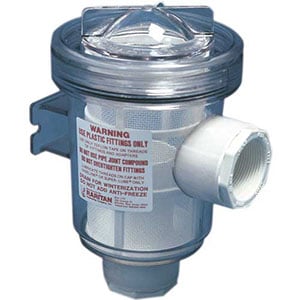
Raw water strainers protect your engine cooling system from debris.
When the impeller fails, a diesel engine overheats very quickly — more seriously than in a gas-powered boat. Diesels run at piston compressions of 350–500 psi, three to four times that of a gasoline engine, and heat builds up rapidly. Within 60 seconds of losing coolant flow, this compression-generated heat can do real damage.
Because the cooling system is so critical, owners of inboard diesels should check their wet exhaust every time they start the engine. If you hear the usual burbling sound of water being expelled, the cooling system is working. If you don’t hear it, or if steam appears instead of water, shut down immediately.
Since the impeller is the component most likely to fail — and typically at the worst possible moment — carry a spare aboard and know how to change it on the water. An impeller puller tool makes the job significantly easier. See our Impeller Replacement 101 West Advisor for the complete procedure.
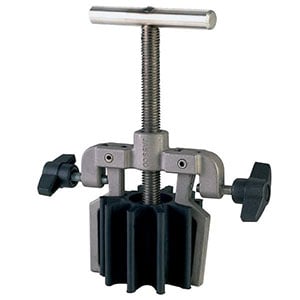
Nigel Calder recommends this impeller puller tool.
Diesel engines have at least three coolers — oil cooler, fuel cooler, and heat exchanger — plus likely a transmission cooler. All require inspection and service at least annually. Raw water side pencil anodes protect these coolers from internal galvanic corrosion. Check them annually and replace as needed or your heat exchanger can be destroyed from the inside out. Regular maintenance is far less costly than replacing a heat exchanger or an engine.
Clean Fuel
Clogged fuel filters will shut your engine down. Lack of fuel won’t damage the engine itself, but losing power at the worst possible moment — entering a harbor, crossing a bar, or in a shipping channel — can put your boat in a dangerous situation.
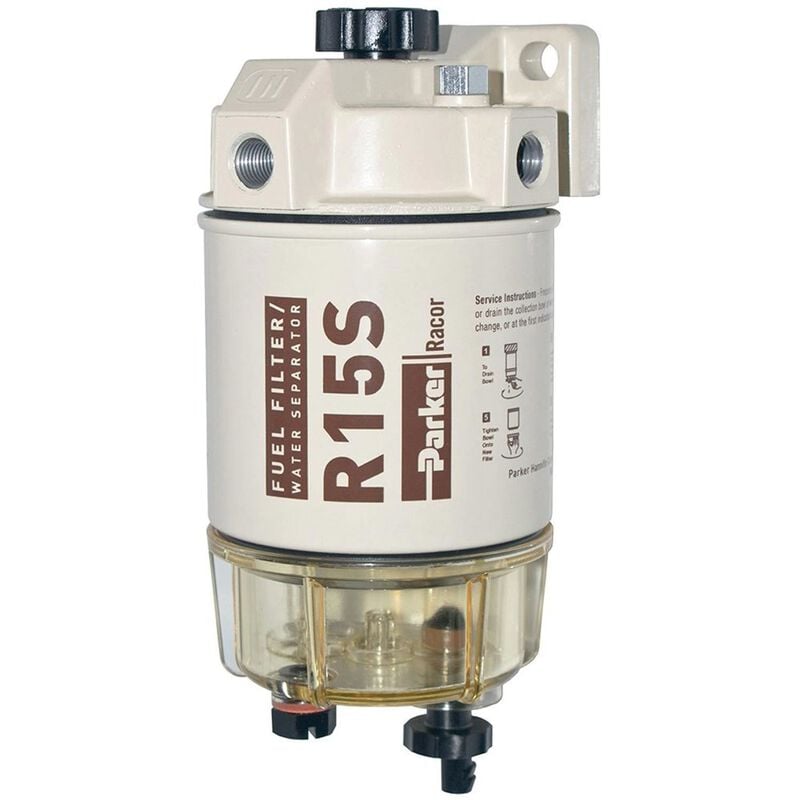
Fuel filter/water separators like this Racor protect your fuel system from water and debris.
Water accumulates in fuel tanks, particularly when the boat sits unused with a tank that is partially or mostly empty. Air that enters through the vent carries humidity, which condenses on the cool tank walls and drops into the fuel. Over time, this water at the bottom of the tank supports microbial growth — often called “diesel bug” — which produces a dark, sludgy contamination that clogs filters rapidly. Stirred up by ocean wave action, this sludge can clog filters in a matter of minutes.
If you acquire a boat that has been sitting neglected, consider a professional fuel polishing service before an offshore delivery or extended passage. A fuel polisher removes all the diesel, pumps it through a series of filters, cleans the tank interior, and replaces the primary and secondary filters. The cost is modest insurance against a filter-clogging episode at sea.
Your boat should have both a primary and a secondary filter. The secondary is usually mounted on the engine itself. Primary filters remove water and larger particles. Primary filters with clear sediment bowls allow a quick visual check — diesel should appear red or amber in color. Water in the bowl settles at the bottom and can be drained easily. Centrifugal primary filters like the Racor Turbine Series use a three-stage process that removes nearly all water and harmful solid particles.
Double-manifold filter systems, such as the Racor MAX Turbine Series, have a valve allowing you to isolate one filter for service while the other keeps operating — eliminating any need to bleed the system after a filter change underway. A vacuum gauge monitors filter condition and alerts you when replacement is needed.
To stay ahead of fuel-related problems: keep spare filter elements aboard, know how to replace them underway, and know how to bleed your engine’s fuel injectors after a filter change. Ed Sherman of the ABYC explains the bleeding procedure:
Adding a fuel biocide such as Biobor JF is good insurance against microbial contamination, particularly if the boat sits unused for extended periods or if you take on fuel in regions with variable fuel quality.
Micron Ratings for Diesel Fuel Filters
Filter elements are rated by the size of particles they remove, measured in microns. Choosing the right rating depends on your filter configuration:
- 30-micron elements are used as a primary filter when a secondary filter remains in place on the engine. A secondary filter is required with 30-micron primary filtration.
- 10-micron elements can be used as either primary or secondary filtration, depending on the engine manufacturer’s recommendation. When used as the sole filter, the existing engine-mounted filter can remain in place for additional protection.
- 2-micron elements remove nearly all water and contaminants and can be used as the only filter in the system. Because they capture so much more material, they clog faster and require more frequent replacement than coarser elements.
Further Reading
Maintaining your diesel is not a mystery. You don’t need to be a mechanic. This article has covered the essentials, but two books by Nigel Calder go much deeper: Boatowner’s Mechanical and Electrical Manual covers the full range of marine systems, and Marine Diesel Engines is a comprehensive reference for diesel-specific maintenance and repair. Both are available through West Marine and most marine chandleries.
With regular care, your diesel will keep chugging along hour after hour, taking you to your next port and safely home again.
Frequently Asked Questions
How often should I change the oil in a marine diesel?
The typical interval is every 100 hours, but this varies from 50 to 200 hours depending on engine size and operating conditions. Smaller engines with less oil capacity generally need more frequent changes. Always follow your engine manufacturer’s recommendation in the owner’s manual. If you run the engine frequently at low RPM or for short durations without reaching full operating temperature, increase your change frequency and use top-quality oil.
What API oil rating should I use in a marine diesel?
Use an oil with an API rating beginning with C (Compression ignition), which designates a diesel-formulated oil. Current ratings include CK-4, CJ-4, CI-4, and CH-4. Many modern oils are dual-rated for both diesel and gasoline use. Your owner’s manual specifies the minimum API rating required — any oil rated at or above that level is acceptable.
How do I know if my raw water impeller has failed?
The most reliable indicator is the wet exhaust check at startup. When you start the engine, you should hear and see water being expelled from the exhaust within 30 seconds. If you don’t hear the normal burbling sound, or if only steam appears, shut the engine down immediately — the impeller has likely failed. A temperature alarm activating is another indicator, but by the time the alarm sounds the engine may already have sustained damage. Check the exhaust at every startup as a habit.
How do I prevent water contamination in my diesel fuel tank?
Keep the tank as full as practical when the boat is not in use — less air in the tank means less humidity condensation. Add a fuel biocide like Biobor JF at each fill-up to prevent microbial growth. Inspect the primary filter bowl regularly for water accumulation and drain it as needed. If the boat has been sitting unused with a partially empty tank for a season or more, consider professional fuel polishing before a major passage.
What are pencil anodes in a marine diesel cooling system?
Pencil anodes (also called zinc pencils) are small sacrificial zinc rods installed in the raw water side of the heat exchanger, oil cooler, and other coolers. They corrode preferentially to protect the more expensive metal components from galvanic corrosion caused by the dissimilar metals in the cooling circuit. Inspect them annually and replace when more than 50% consumed. Neglecting pencil anodes can result in rapid internal corrosion that destroys a heat exchanger from the inside without any external warning signs.