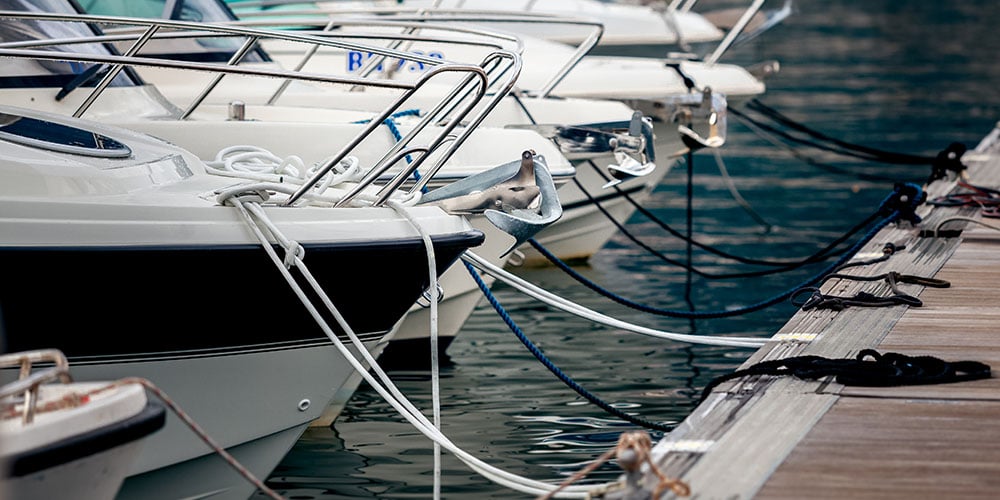
Dock lines secure your boat to a dock, or to another boat when rafting, either temporarily or semi-permanently. These applications demand different types of dock lines. We’ll walk you through what to consider and help you make the right choice.
- Transient or Permanent Dock Lines
- Braided or Three-Strand
- Color
- Diameter
- Length and Line Types
- How Many Dock Lines Do You Need?
- Preventing Chafe
- FAQs
Transient or Permanent Dock Lines
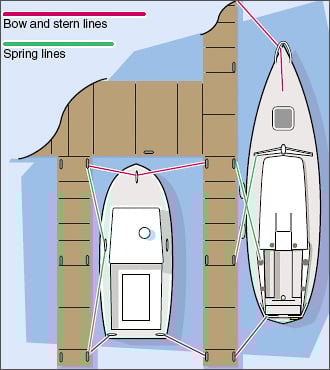
Typical dock line arrangement. The powerboat is using double bow and stern lines to keep the boat away from the dock. The sailboat is using spring lines to prevent fore and aft surging, while the bow and stern lines “locate” the boats.
When your boat is away from its regular slip or mooring, you need designated nylon lines aboard — preferably with spliced eyes — ready to use when you tie up somewhere. These are called transient dock lines. The eye in the end is easily passed around a cleat or piling by someone on the dock while the bitter end is adjusted aboard. There are dozens of combinations of diameters and lengths.
Permanent dock lines are also made of nylon but differ from transient dock lines in several ways. First, they must be protected from chafe — the enemy of all lines in constant use. This calls for leather, rubber, or fabric chafe gear where the line passes through the chocks, and possibly a chafe sleeve on the eye where it loops around the cleat on deck. At the dock, lines should be protected using eye splices and shackles if the dock has rings, or eye splices and short lengths of chain if the dock has cleats. Permanent dock lines should be cut to fit the particular boat in the slip.
Braided or Three-Strand Dock Lines
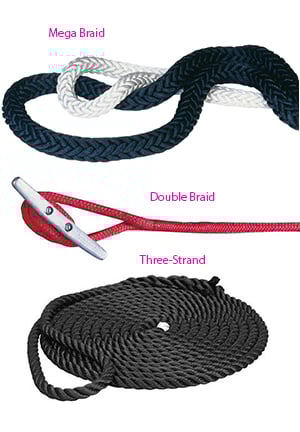
Three types of dock line construction.
Dock lines should be made from nylon, a synthetic fiber with a superior combination of strength and stretch. Nylon is strong (though it shrinks and loses about 10–15% of its strength when wet), durable, and stretchy — three-strand nylon stretches up to 16% of its length when loaded to 15% of its breaking strength, so it absorbs shocks effectively. Low-stretch lines, like worn-out polyester double braid used for running rigging, are less desirable because they transmit shocks from waves, loading up and loosening dock cleats and deck hardware. There are three main types of construction:
- Three-strand line has a knobby finish, is easy to splice, and is the most affordable option. It stretches the most of the three types, making it particularly good at absorbing surge and wave action.
- Double braid is somewhat stronger for a given diameter, has about half the stretch of three-strand, and is available in many colors so you can coordinate with your trim or canvas. The smooth surface handles easily and is less likely to stiffen or harden with age.
- Mega Braid is a single braid construction that is very supple and easy to coil and handle. It is frequently the choice for boats over 70 feet. Mega Braid is harder to splice, so boaters may want to order custom lengths from West Marine Rigging. Available in white or black.
Color
Many boaters want lines that match their canvas, hull stripe, or trim color. Double braided dock lines are available in six colors plus white and white/gold. Three-strand and Mega Braid are typically available in white or natural. If color matching matters to you, double braid gives the most options.
Diameter
We recommend 1/8” of line diameter for every 9 feet of boat length. Larger lines wear longer but stretch less. Use the table below as a starting point, and size up if your boat is on the heavy end for its length or if you moor in an exposed location with significant surge.
| Boat Length | Up to 27’ | 28’–31’ | 32’–36’ | 37’–45’ | 46’–54’ | 55’–63’ | 64’–72’ |
|---|---|---|---|---|---|---|---|
| Dock Line Dia. | 3/8” | 7/16” | 1/2” | 5/8” | 3/4” | 7/8” | 1” |
Length and Line Types
Before selecting lengths, it helps to understand the four basic dock line positions and what each one does:
- Bow line: Runs from the bow cleat forward to the dock. Prevents the bow from swinging away from the dock. Length: approximately 2/3 of the boat’s overall length.
- Stern line: Runs from the stern cleat aft to the dock. Prevents the stern from swinging away. Length: approximately 2/3 of the boat’s overall length.
- Forward spring line: Runs from a midship or forward cleat aft to a dock cleat. Prevents the boat from surging forward. Length: approximately equal to the boat’s overall length.
- Aft spring line: Runs from a midship or aft cleat forward to a dock cleat. Prevents the boat from surging aft. Length: approximately equal to the boat’s overall length.
Spring lines do the critical work of preventing fore-and-aft surging — the motion that causes the most wear on dock hardware and the most noise at the slip. Boats that are stern-to or in a slip may use breast lines (short perpendicular lines from midship cleats to the dock), which are typically 1/4 to 1/3 of boat length.
For transient docking where you carry only a few lines, two lines at 2/3 boat length (bow and stern) plus two lines at full boat length (springs) is the standard minimum kit. In exposed anchorages or with weather coming, doubling up bow and stern lines significantly reduces the chance of failure.
How Many Dock Lines Do You Need?
For a well-equipped boat:
- Minimum transient kit: Four lines — one bow, one stern, two spring lines. This covers most marina situations.
- Full transient kit: Six lines — doubled bow and stern lines plus two springs. Doubles provide redundancy and allow finer position adjustment.
- Permanent slip: Four to six lines cut to fit the slip exactly, with proper chafe protection at each point of contact.
Carry at least one extra line aboard for emergencies — helping another boater tie up, a second anchor line, or a tow line if needed.
Preventing Chafe
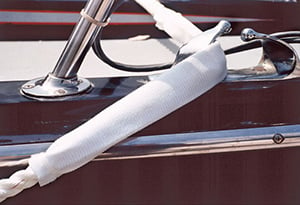
These 18” polyester chafe guards are sold in pairs.
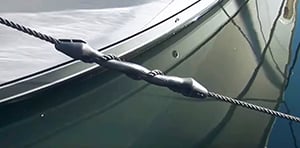
Short lines benefit from elastic dock line snubbers that absorb shock loads and increase effective stretch.
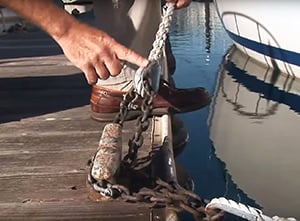
Assembling permanent dock lines to a loop of chain at dock cleats eliminates chafe.
Chafe is the damage caused by a line rubbing against a surface. It is inevitable, but can be reduced by avoiding abrupt changes in line angle and by using abrasion-resistant pads — lengths of leather or hose — called chafing gear. Even smooth, large-radius surfaces will abrade nylon and polyester lines over time.
Chafe guards provide a sacrificial surface that absorbs the damage without reducing the breaking strength of the line itself. The type of hardware on the dock or piling determines the best type of splice and chafe protection to use. Options include:
- Eye splice around a thimble with a galvanized shackle, for connecting to a ring or eyebolt.
- A short loop of chain (about a foot in diameter) through the center of a dock cleat and the thimble, closed with a chain link or shackle. This method completely eliminates chafe at the dock and also prevents dock lines from being stolen by making them difficult to untie quickly.
Dock line snubbers add shock-absorbing stretch to dock lines that are too short to flex effectively on their own. Long dock lines have enough length that their nylon construction provides adequate stretch. Shorter dock lines — particularly stern lines in a tight slip — may not have enough elasticity to absorb surge. A snubber installed inline on a short stern line can eliminate the sharp jerking and snapping that wears on cleats and keeps the crew awake in a swell.
Related: Now that you know what to look for, check out our article Five of Our Best Dock Lines for recommendations.
Frequently Asked Questions
What material should dock lines be made from?
Nylon is the correct material for dock lines. It is strong, durable, UV-resistant, and most importantly, it stretches — up to 16% under load for three-strand nylon. This elasticity absorbs the shock loads from waves, wakes, and surge that would otherwise be transmitted directly to your cleats and dock hardware. Polyester dock lines are sometimes sold but are less desirable because their low stretch transmits shock loads rather than absorbing them.
What is the difference between a spring line and a bow or stern line?
Bow and stern lines run approximately perpendicular from the boat to the dock and control how far the boat sits from the dock. Spring lines run at an angle fore and aft along the dock and prevent the boat from surging forward and backward. In any wave or current, fore-and-aft surge is the primary force acting on a docked boat — spring lines are the lines that resist it. A properly sprung boat barely moves in its slip even in a significant wake or surge.
How long should my dock lines be?
For transient use, bow and stern lines should be approximately 2/3 of the boat’s length. Spring lines should be approximately equal to the boat’s full length. For permanent slip use, cut lines to the exact dimensions of the slip with proper chafe protection. A longer line than needed is not a problem — a shorter one prevents the elasticity the nylon needs to absorb shock loads.
How do I prevent my dock lines from chafing through?
Protect every point where the line contacts a hard surface — chocks, fairleads, cleats, and the dock hardware. Use chafe guards (polyester or leather sleeves that slip over the line) at chock contact points. For permanent dock lines, use an eye splice and thimble at the dock end rather than tying directly to dock hardware. A chain loop around the base of a dock cleat is the most durable permanent solution and also prevents theft.
Should I use three-strand or double braid dock lines?
Both are good choices. Three-strand stretches more and is easier to splice — it is the most practical and affordable option for most boaters, particularly for transient lines. Double braid is slightly stronger for the same diameter, has about half the stretch, handles more smoothly, and is available in colors if you want to match your boat’s canvas. For permanent dock lines where maximum chafe resistance and long service life matter most, double braid is worth the additional cost. For a transient kit carried aboard and used occasionally, three-strand is excellent value.