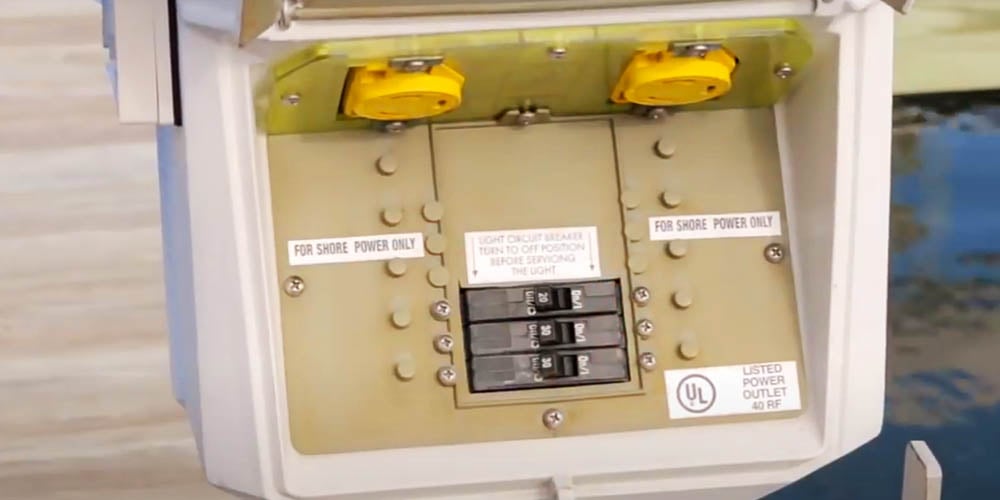
Two types of electrical failure can put people on or around your boat at risk of lethal electric shock. Understanding how Equipment Leakage Circuit Interrupters (ELCIs) and Ground Fault Circuit Interrupters (GFCIs) work, what ABYC standards require, and how to retrofit protection on an existing boat can save lives — including those of swimmers who never set foot on the vessel.
- How Ground Faults Occur
- What Is a GFCI?
- What Is an ELCI?
- ABYC Standards
- Retrofitting Existing Boats
- Testing Your Devices
- Electrical Safety for Swimmers
- FAQs
How Ground Faults Occur
In a properly functioning marine AC electrical system, the same amount of current flows in the hot and neutral wires. When current “leaks” from this intended path to ground, the condition is called a ground fault. A common example is insulation failure in the wiring of an appliance.
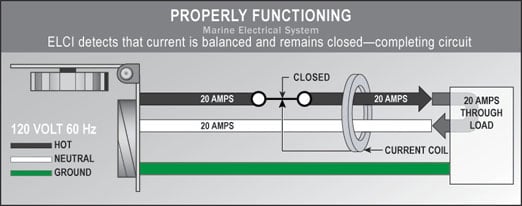
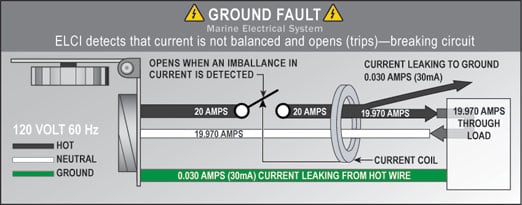
A faulty ground is a separate failure: the grounding path is broken through a loose connection or broken wire. A shore power cord ground wire, for example, can fail due to constant motion and stress from boats rising and falling with tide and wake.
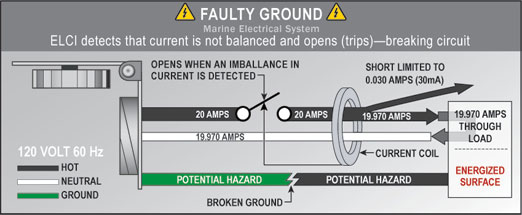
Faulty grounds are often undetectable — a simple continuity test will not necessarily reveal the problem. When a ground fault and a faulty ground occur simultaneously, the results can be fatal. Metal parts on the boat and underwater become energized. People aboard the boat risk receiving a shock from touching energized metal. Swimmers near the boat face a larger and less obvious danger: they can receive a paralyzing dose of electricity from the energized water surrounding the boat and drown from involuntary loss of muscle control — a condition known as Electric Shock Drowning (ESD). A Coast Guard-sponsored study found numerous instances of electrical leakage causing drowning or near-drowning even in cases where the electrical shock was not itself lethal.
What Is a GFCI?
A Ground Fault Circuit Interrupter (GFCI) measures the difference in current between the hot and neutral wires of a branch circuit. If it detects an imbalance of 5 milliamperes (5mA) or more — indicating that current is taking an unintended path to ground — it trips in 1/40th of a second or less, cutting power before a lethal shock can occur.
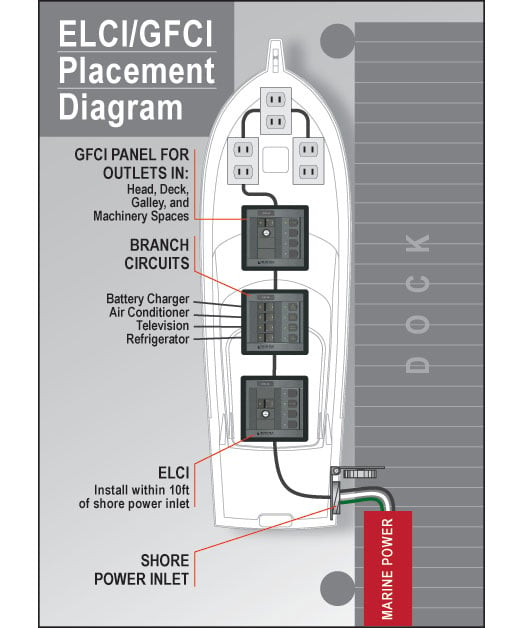
GFCIs are installed at individual receptacles (outlets) in potentially wet environments: the head, galley, machinery space, and weather deck. They appear as standard outlet receptacles with TEST and RESET buttons in the center. They protect against flaws in devices plugged into them.
Important limitation: GFCIs protect branch circuit receptacles but offer no protection against a failing hard-wired appliance such as a water heater, cooktop, or air conditioning system. These permanently wired loads require ELCI protection at the main panel level.
What Is an ELCI?
An Equipment Leakage Circuit Interrupter (ELCI) provides whole-boat ground fault protection at the shore power entry point. Like a GFCI, it measures the difference between current in the hot and neutral wires. If it detects a leakage current of 30mA or more, it trips and disconnects the entire AC shore power system from the boat.
The 30mA threshold is higher than the 5mA GFCI threshold — sensitive enough to protect against dangerous leakage across the entire AC system, while being set above the 3–6mA of normal total leakage current found in a healthy marine electrical system (which would otherwise cause nuisance tripping).
An ELCI that is also a Residual Current Circuit Breaker (ELCI/RCBO) provides both ground fault protection and standard overcurrent (circuit breaker) protection in one device, and can directly replace the main shore power circuit breaker at the panel.
ABYC Standards
ABYC regulation E–13.3.5 states:
If installed in a head, galley, machinery space, or on a weather deck, the receptacle shall be protected by a Type A (nominal 5 milliamperes) Ground Fault Circuit Interrupter (GFCI).
ABYC regulation E–11.11.1 states:
An Equipment Leakage Circuit Interrupter (ELCI) shall be installed with or in addition to the main shore power disconnect circuit breaker(s) or at the additional overcurrent protection as required by E–11.10.2.8.3 whichever is closer to the shore power connection.
In practice, the ELCI must be installed within 10 feet of the shore power inlet. The ELCI and GFCI requirements work together: the ELCI provides whole-system protection at the panel, while GFCIs provide point-of-use protection at individual receptacles in wet locations. Both are required — one does not substitute for the other.
Although ABYC regulations formally apply only to new boat construction and major refits, the hazards and liabilities apply to any boat connected to shore power. Older boats not required to meet current standards are not exempt from the risk.
Retrofitting Existing Boats
Retrofitting ELCI protection to an existing AC system is worthwhile insurance against a genuine life-safety risk. There are two approaches:
- Replace the main shore power circuit breaker: Since an ELCI/RCBO provides both ground fault protection and overcurrent protection, it can directly replace the existing main shore power circuit breaker in the panel. This is the simplest retrofit.
- Add an ELCI upstream of the existing breaker: Install the ELCI between the shore power inlet and the existing main circuit breaker. This approach adds protection without modifying the existing panel breaker.
For GFCI protection, check existing receptacles in the head, galley, machinery space, and weather deck. GFCI receptacles are identifiable by their TEST and RESET buttons. Non-GFCI receptacles in these locations should be replaced. Browse our selection of circuit breaker panels and AC protection devices.
Testing Your Devices
GFCI and ELCI devices must be tested regularly to confirm they are functioning. A device that does not trip when tested provides no protection.
Testing GFCIs: Press the TEST button on each GFCI receptacle monthly. The RESET button should pop out and power to the outlet should cut off. If it does not trip, the GFCI is defective and must be replaced. Press RESET to restore power after testing.
Testing the ELCI: The ELCI has a TEST button on the panel or the device itself. Press the TEST button monthly. The ELCI should trip immediately. Reset it after testing. If the ELCI does not trip when the TEST button is pressed, it must be replaced.
If a GFCI or ELCI trips unexpectedly: Do not simply reset it and continue using the circuit. An unexpected trip indicates a real ground fault or leakage condition in the circuit. Identify and correct the source of the fault before resetting. Common causes include water intrusion into an outlet or appliance, a damaged power cord, a failing appliance with degraded insulation, or a broken ground wire. If you cannot identify the cause, have a marine electrician inspect the system before using shore power again.
Electrical Safety for Swimmers
Do not swim in marinas or around docks equipped with shore power, or around any boat plugged into shore power.
Electric Shock Drowning (ESD) is a genuine and underrecognized hazard. AC current leaking from a boat’s electrical system into the water surrounding the vessel creates voltage gradients in the water. A swimmer entering this area can receive a full-body AC shock that causes muscle paralysis — making it impossible to swim or call for help — without any visible electrical arc, smoke, or warning. The victim drowns from paralysis, not direct electrocution. Bystanders may see nothing unusual and have no idea the water is energized.
ESD incidents most commonly occur:
- In marinas where shore power pedestals supply multiple boats
- Around private docks with shore power connections
- Near boats that are plugged into shore power while being swum around or boarded from the water
The critical difference between ESD and other electrical hazards is that it is invisible. The water looks completely normal. There is no visible sign that it is energized. This is why the swimmer safety rule is absolute: never swim near any shore power connection, regardless of how normal conditions appear.
For more on protecting yourself and your loved ones from electrical shock drowning, visit the BoatUS Electric Shock Drowning Resource Center.
Thanks to Blue Sea Systems for the technical information in this article.
Frequently Asked Questions
What is the difference between a GFCI and an ELCI?
A GFCI (Ground Fault Circuit Interrupter) protects individual branch circuit receptacles in wet locations (head, galley, weather deck) at a 5mA trip threshold. It is installed at the outlet itself and protects against faults in devices plugged into it. An ELCI (Equipment Leakage Circuit Interrupter) protects the entire AC shore power system at the main panel level at a 30mA trip threshold. Both are required — the ELCI does not substitute for GFCIs at individual receptacles, and GFCIs do not provide the system-wide protection that an ELCI provides.
Are ELCI and GFCI protection required on my boat?
ABYC standards requiring both ELCI and GFCI protection apply to new boat construction. Older boats are not legally required to be retrofitted. However, the hazards — electric shock to people aboard and Electric Shock Drowning for nearby swimmers — apply regardless of when the boat was built. Retrofitting ELCI protection to an existing shore power system is straightforward and is strongly recommended for any boat regularly connected to shore power.
What should I do if my ELCI or GFCI trips?
Do not immediately reset and resume use. An unexpected trip means a ground fault or leakage condition is present. Unplug all appliances from the affected circuit and investigate before resetting. Common causes include water in an outlet or appliance, a damaged cord, a failing appliance, or a broken ground wire. If you cannot find the cause, have a marine electrician inspect the system before using shore power again.
What is Electric Shock Drowning (ESD)?
ESD occurs when AC current leaking from a boat or dock electrical system creates voltage gradients in the surrounding water. A swimmer entering this energized water receives a full-body AC shock that causes muscle paralysis, making it impossible to swim or call for help. The victim drowns from paralysis. There is no visible sign that the water is energized — it looks completely normal. ESD most commonly occurs around marinas, private docks with shore power, and near boats plugged into shore power.
How do I test my GFCI and ELCI devices?
Press the TEST button on each GFCI receptacle monthly. The RESET button should pop out and power to the outlet should cut. If it does not trip, the GFCI is defective and must be replaced. Test the ELCI the same way using its TEST button — the entire shore power circuit should trip immediately. Reset after confirming it trips correctly. A device that does not trip when tested is not providing protection.
Can I identify a ground fault before someone is hurt?
The most practical regular check is to test your ELCI and GFCIs monthly. Beyond that, have a qualified marine electrician perform a thorough AC system inspection annually, including testing for current leakage with appropriate meters. Faulty grounds specifically can be undetectable with basic continuity tests — a professional inspection is the only reliable way to identify this failure mode before it becomes dangerous.