Working for a Blue Future
Anything we can do to make boating more environmentally sustainable and to help preserve the places where we boat and fish is a worthwhile effort. If you want to make a difference for cleaner boating, consider these actions.
- Upgrade From a Two-Stroke Outboard
- Electric Outboards
- Pure Electric Inboards
- Hybrid Systems
- Sizing an Electric Drive
- Choosing a Battery
- FAQs
Upgrade From a Two-Stroke Outboard
Four-stroke outboards, like the models by Mercury Marine that we offer, run quieter, are significantly cleaner, and are much more fuel-efficient than two-stroke engines. We also offer propane-powered outboards by Mercury Marine — the Mercury 5hp Propane FourStroke runs on standard propane and eliminates gasoline entirely, with no carburetors to gum and no oil mixing.
Consider an Electric or Hybrid Alternative
If you’re considering a new engine for an older boat or planning new construction of your dream vessel, a hybrid or all-electric option is worth serious consideration. We’ll walk through the options below.
Electric Outboards
Torqeedo Electric Outboards: After testing Torqeedo outboards for years, we are believers in the product. So are our customers, including the owner who posted this review:
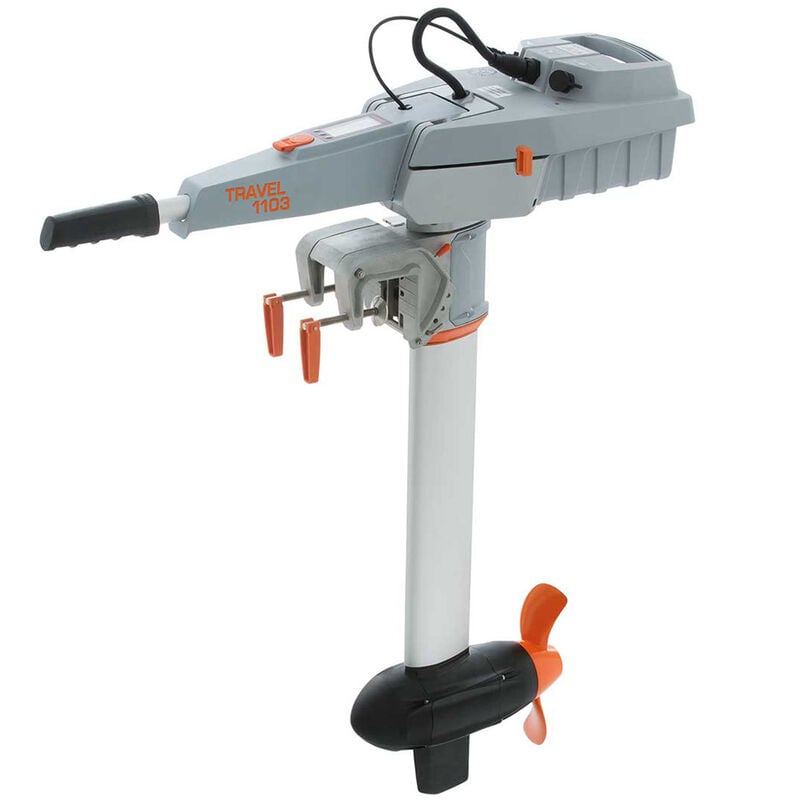
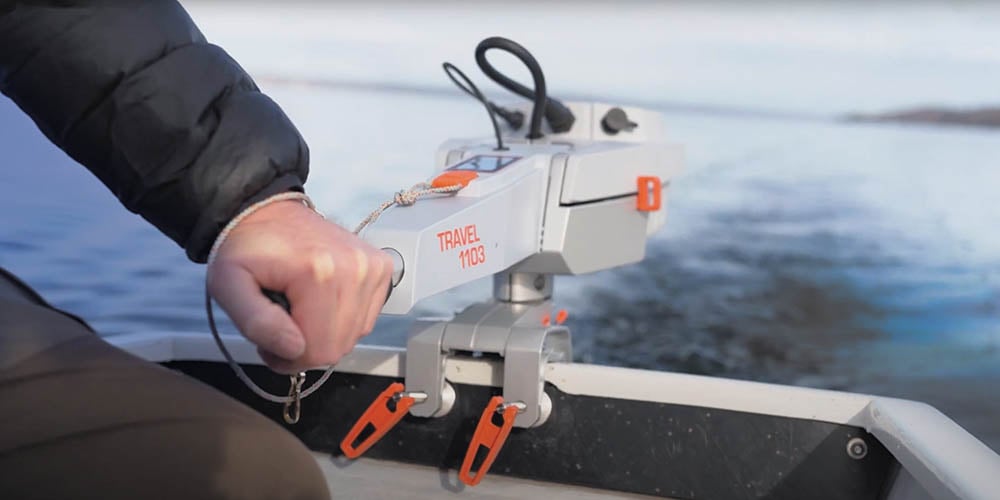
Torqeedo’s 1103 CS Electric Outboard is quiet, easy to handle, and a great choice for dinghy and sailboat owners.
“Fantastic Gas Outboard Alternative! Impressive quality and engineering. I use it on a Watertender 9.9 and my expectations have been exceeded. Range and speed are very good. I replaced a 4hp four-stroke and really like a gas-/oil-free 30lb. motor. I ran it several hours, approx. 2–4 miles and got home with 50% battery remaining. I am planning on adding a solar panel to extend the range and recharge while at the sandbar. Considering its weight at 29.5 lbs. and range of 2–16NM depending on speed, no oil changes, water pump impellers, thermostats, tune-ups, flushing, not having to start and warm-up, not having to reach back to shift F-N-R, only twisting the throttle. This is the perfect outboard for 2–4hp applications. I Love It!”
Torqeedo Travel Outboards feature an integrated lithium-ion battery. The Travel 1103 model can do everything a 3 HP gasoline outboard can, but is lighter, cleaner, quieter, and more convenient. Torqeedo Travel outboards can easily propel tenders, dinghies, and day-sailers up to 1.5 tons. They include an on-board computer with GPS-based range calculation accessible from a smartphone app.
Pure Electric Inboards
The most successful electric propulsion retrofits have happened on inboard boats, with drop-in electric motors that directly replace an old gasoline or diesel engine. Remove the old engine, clean out the toxic residues, remove the fuel tanks, adapt the engine mounts, and install the electric drive using the existing prop shaft and prop. Then add a controller, battery charger, and a substantial bank of marine batteries.
On a 30-foot boat, you typically remove approximately 500 pounds of engine, transmission, and fuel tankage and replace them with a lightweight electric motor and battery banks.

Our RIB 310 inflatable boat on a plane, powered by the Cruise 4.0 electric outboard and a lightweight lithium battery bank.
Above is a video about an electric Alerion Express 33 — a glimpse of why we love e-propulsion for sailboats. This vessel is powered by an inboard DriveMaster Ultra 7.5kW system with two Mastervolt lithium 24/160 batteries providing 320Ah at 48V. The near-silent power comes on instantly, without waiting for a diesel to rev up. We have enjoyed the same experience during years of sailing with our Torqeedo-powered Ultimate 20.
Hybrid Systems
Parallel hybrids (like the HybridMaster, available from Mastervolt) combine an electric motor with a combustion engine. Use silent battery power to leave the harbor, then start the diesel when you need to fight a big current or headwind. Running the combustion engine recharges the batteries using the electric drive. The HybridMaster also offers regenerative charging, feeding power back into the battery bank while you sail. Owners of hybrid cars like the Prius will feel at home with this technology.
Serial hybrids use an electric motor as the full-time propulsion engine, with a gas or diesel generator to replenish the battery banks — the same principle as submarines, diesel-electric locomotives, and many large ships.
Sizing an Electric Drive
Torque compared to combustion engines: With a gasoline or diesel engine, torque increases rapidly as RPM rises. An electric motor has a flat torque curve — full torque is available at even the lowest RPM, which is exactly when you need it most. This means a smaller electric motor can replace a much larger combustion engine. A useful rule of thumb: you need approximately 1,000 watts of electric motor output for every ton of displacement. An e-drive’s shaft horsepower (shp) rating should be about one-third to one-half the brake horsepower (bhp) of the combustion engine it replaces.
Battery sizing for motoring hours: The hours of electric motoring available depend on your battery bank combined with any generation capacity (solar, wind, regenerative charging). According to Mastervolt, for six to eight hours of operation you need 4.6 times the motor’s power output in kWh. Example: 4.6 × 3.5kW = 16.1kWh — that is the battery capacity required for six to eight hours of electric motoring at that power level.
Choosing a Battery
Flooded lead-acid: The most affordable option. 6V deep-cycle batteries (as used in electric golf carts) typically provide 200–250Ah capacity. They are economical and built for deep discharges, but must be mounted upright and require regular addition of distilled water. They emit hydrogen gas during recharging and require ventilation.
AGM batteries: Fully sealed, maintenance-free, handle high recharging current, and can be mounted in any orientation. A strong all-around choice for medium-sized electric propulsion systems.
Gel cells: Sealed, maintenance-free, with a long lifespan and high cycle count. Excellent as a service battery for medium and large systems where longevity is a priority.
Lithium-ion batteries: The highest-performance option, with high energy density ideal for deep cycling. Compared to lead-acid, lithium-ion offers up to 70% savings in volume and weight with three times the cycle life. Torqeedo’s Power 26-104 delivers 104Ah at only 44 lbs. — four times the energy per pound of conventional gel or AGM batteries.
With proper care, a quality battery pack provides five to seven years of reliable service.
Mastervolt offers a wide selection of serial and parallel hybrid and pure electric systems. Contact our Product Advice department at 1-800-BOATING and we can work with Mastervolt to customize a propulsion system for your boat.
Frequently Asked Questions
How do I size an electric motor to replace my diesel or gasoline engine?
A useful rule of thumb is 1,000 watts of electric motor output per ton of boat displacement. For shaft horsepower comparison, an electric drive’s shp rating should be about one-third to one-half the bhp of the combustion engine it replaces — because an electric motor’s flat torque curve delivers full torque at low RPM, where combustion engines produce much less. The key calculation is matching the motor to the displacement, not to the horsepower of the old engine alone.
How many batteries do I need for electric propulsion?
Use the Mastervolt formula: for six to eight hours of operation, you need 4.6 times the motor’s power output in kWh of battery capacity. For a 3.5kW motor: 4.6 × 3.5 = 16.1kWh. Divide by your battery bank voltage to get amp-hours. At 48V, 16.1kWh ÷ 48V = approximately 335Ah. For shorter range requirements, size down proportionally. Lithium-ion batteries deliver the most energy in the least weight and volume, making them the preferred choice for serious electric propulsion builds.
What is the difference between a parallel and serial hybrid marine propulsion system?
A parallel hybrid combines an electric motor and a combustion engine that can each drive the propeller shaft independently or together. You can motor silently on battery power, power up the diesel for heavy conditions, or use both simultaneously. Running the diesel also recharges the batteries, and some parallel hybrids support regenerative charging under sail. A serial hybrid uses an electric motor as the sole propulsion driver, with a generator (gasoline or diesel) to recharge batteries rather than driving the propeller directly — the same arrangement used in diesel-electric submarines and locomotives.
What type of battery is best for electric boat propulsion?
Lithium-ion is the best-performing choice: up to 70% lighter and more compact than lead-acid at equivalent capacity, with three times the cycle life. The higher upfront cost is offset by longevity and weight savings. For budget-conscious builds where weight is less critical, AGM batteries are a reliable middle-ground option. Flooded lead-acid is the most economical but requires ventilation, regular maintenance, and upright mounting — limitations that make it less practical for most propulsion applications.
Can I use a Torqeedo electric outboard as a primary engine on a sailboat?
Yes, for many sailboat applications. The Torqeedo Travel series can replace 2–4hp gasoline outboards and is well-suited for tenders, small day-sailers, and light auxiliary use on sailboats up to approximately 1.5 tons. For larger sailboats requiring more sustained motoring range, the Torqeedo Cruise series electric outboards and inboard systems offer higher power output and larger integrated battery options. The GPS-based range calculator integrated in Torqeedo motors gives real-time range estimation, eliminating the guesswork of knowing how much power remains.