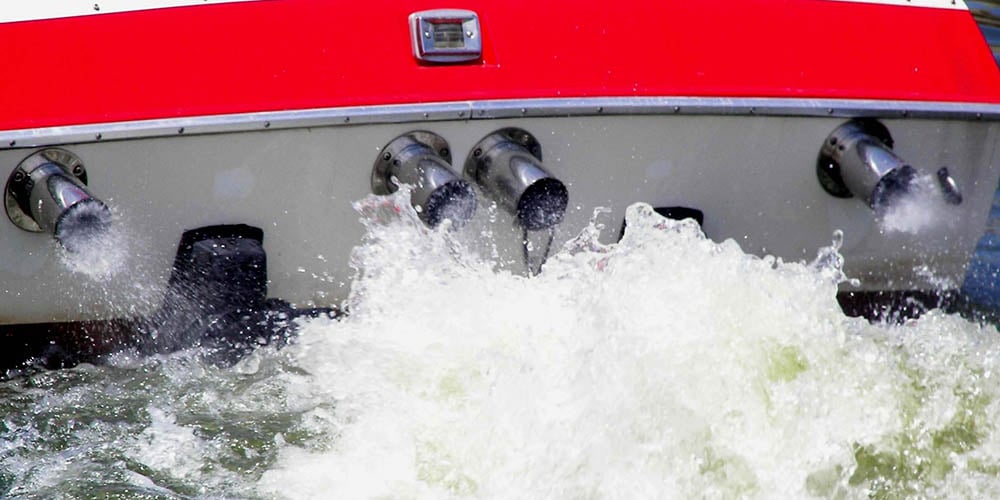
A marine exhaust system does more than route combustion gases overboard — it cools those gases, silences engine noise, and prevents seawater from back-flooding the engine. Understanding how each component works helps you choose the right replacement parts, spot problems before they become failures, and install or inspect the system correctly.
- Wet vs. Dry Exhaust Systems
- Mufflers and Lift Mufflers
- The Anti-Siphon Loop
- Additional System Components
- Exhaust Hose and Tubing
- Inspection and Maintenance
- FAQs
Wet vs. Dry Exhaust Systems
Water-cooled inboard engines inject cooling water into the exhaust pipe, which cools the exhaust gases and muffles engine noise. The exhaust then pushes the water out the exhaust outlet. This is known as a wet exhaust system. Wet exhaust systems use the heat-absorbing and sound-dampening qualities of water to cool and quiet the exhaust — an elegant design that eliminates the need for expensive high-temperature exhaust components downstream of the mixing point.
Air-cooled, or dry exhaust, systems are uncommon except in performance powerboats or large work boats where excessive heat buildup and noise are tolerable, or in precisely engineered trawler and passagemaker exhaust systems that insulate the hot exhaust pipe with forced air. Dry exhaust components must be rated for significantly higher temperatures and typically require more complex routing and insulation.
Mufflers and Lift Mufflers
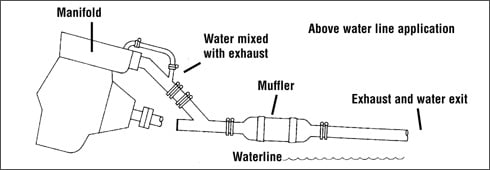
Above- and below-waterline applications require distinctly different products to muffle engine noise.
Powerboats with above-waterline exhaust outlets use marine mufflers, commonly made from non-metallic materials, to contain engine noise and cool the exhaust. Mufflers are always mounted above the waterline and usually have a check valve in-line to prevent backward water flow that could damage the engine.
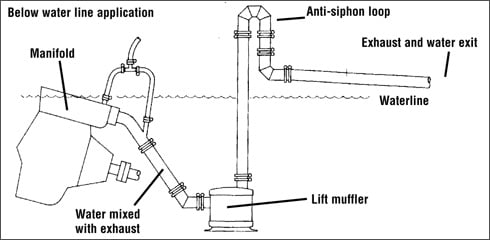
Lift mufflers like Centek Vernalifts are used by both powerboats and sailboats with below-waterline or transom-level exhaust outlets. They are vertical mufflers mounted below the waterline with an outlet line coming off the top of the chamber. Exhaust gas and expended cooling water mix shortly after the exhaust manifold and travel together into the muffler’s chamber, where the cooling water collects before exhaust gas pressure pushes it out the remainder of the exhaust hose. The chamber also provides a reservoir for seawater that may enter from following seas when the boat is under sail. For greater noise reduction, an inline muffler can be installed downstream of a lift muffler.
Sizing a water lift muffler: The muffler’s internal water-holding capacity must be sufficient to contain all the cooling water that could accumulate while the engine is being started — if the chamber is too small, water can back up into the exhaust manifold before exhaust pressure builds enough to push it clear. Most muffler manufacturers provide sizing guidelines based on engine horsepower and cooling water flow rate. Match the muffler to the engine’s raw water pump output, not just to the exhaust hose diameter.
The Anti-Siphon Loop
One of the most critical — and most commonly overlooked — components in a wet exhaust system is the anti-siphon loop, shown in the second diagram above. When the engine stops, the raw water pump stops pumping, but the exhaust hose still contains a column of water. If the exhaust outlet is below the waterline or the hose dips below the waterline at any point, a siphon can form that allows seawater to flow backward through the exhaust system and into the engine cylinders. This is called back-siphoning and it is a leading cause of hydrolocked engines — a catastrophic and expensive failure mode.
The anti-siphon loop prevents this by creating a high point in the raw water supply line that is above the waterline. A vented loop fitting at the top of this high point admits air and breaks the siphon when the pump stops. The loop must be located at least 12” above the waterline at all angles of heel and trim to be effective. On sailboats, the angle of maximum heel must be factored into this measurement — a loop that is above the waterline while the boat is upright may be submerged at 30 degrees of heel.
Inspect the vented loop fitting annually and replace it every three to five years. The small rubber membrane or disc inside that admits air can harden or fail, turning a functional anti-siphon loop into a false sense of security.
Additional System Components
For vessels with through-the-transom exhaust, flapper valves prevent following seas from running back up the exhaust system and flooding the engine. They clamp around the outside diameter of the exhaust pipe to form a check valve. Inspect flapper valves annually — the rubber flap can stiffen with age and no longer seal properly, allowing water entry when the engine is off.
Exhaust Hose and Tubing
Exhaust hose connects the exhaust manifold to the muffler and runs from the muffler to the overboard outlet. It must withstand heat, oil, acids, pressure, water weight, and vibration without failure — no other hose on the boat operates under as many simultaneous stresses.
As a rule of thumb, hose runs that are longer than four times the inside diameter of the hose should use wire-reinforced exhaust hose or fiberglass exhaust tubing. Shorter lengths can use non-reinforced hose. All hose connections should be made to rigid surfaces such as tubing, pipe, or the muffler itself — hose-to-hose connections are never recommended because they lack the rigidity to hold a reliable seal under the constant vibration of a running engine.
Exhaust hose runs must also avoid any low points where water can pool. A low point in the hose run creates a water trap that the exhaust cannot push clear, causing a restriction and potential back-flooding. Route exhaust hose with a continuous rise to the muffler inlet and a continuous rise from the muffler outlet to the overboard fitting wherever possible.
Inspection and Maintenance
The wet exhaust system should be inspected at the start of each season and any time exhaust odor, unusual smoke color, or reduced water flow from the exhaust outlet is noticed. Work through the system from the engine to the overboard outlet:
- Exhaust hose: Squeeze the hose along its full length. Any section that feels spongy, brittle, cracked, or swollen should be replaced. Exhaust hose does not give obvious outward warning before failure — the interior surface degrades faster than the exterior. Hose that is more than 5–7 years old should be proactively replaced regardless of appearance.
- Hose clamps: Check for corrosion and confirm all clamps are tight. All connections at the exhaust manifold and muffler should have two stainless steel clamps per connection.
- Muffler: Inspect the muffler body for cracks, discoloration from heat, or soft spots that indicate the material is breaking down. Check that the muffler is securely mounted and not vibrating against any structure.
- Anti-siphon loop: The vented loop valve should be clean and free of salt buildup. Disassemble and inspect the internal valve annually. Replace every 3–5 years.
- Transom flapper valve: The rubber flap should flex freely and seat against the fitting face when pushed closed. If it has stiffened or is not sealing, replace it.
- Water flow confirmation: After starting the engine, confirm that cooling water is exiting the exhaust outlet within 30 seconds. No water or reduced flow indicates a blocked raw water intake, failed impeller, or obstruction in the exhaust system.
Frequently Asked Questions
What does it mean if my exhaust is smoking black or white?
Black smoke typically indicates incomplete combustion — an overly rich fuel mixture or air intake restriction. White smoke (or steam) in a wet exhaust system can be normal on cold startup but persistent white smoke may indicate coolant entering the combustion chamber, which is a sign of a failing head gasket or heat exchanger. Any unusual change in exhaust color or smell warrants immediate investigation before further operation.
What does it mean if water is not coming out the exhaust?
No cooling water exiting the exhaust outlet within 30–60 seconds of engine startup is a serious warning. Immediately shut down the engine and check: the raw water sea cock is open, the raw water intake strainer is not clogged, and the raw water impeller has not failed. Running a wet exhaust engine without cooling water flow will cause rapid overheating and expensive damage to the exhaust manifold, riser, and engine.
How long does marine exhaust hose last?
Exhaust hose typically has a service life of 5–10 years, but this varies significantly with engine use, water temperature, and whether the system runs hot. The interior surface of exhaust hose degrades from heat and acids in the exhaust gases and is not visible during a surface inspection. Proactive replacement every 5–7 years is standard practice, regardless of outward appearance. Any hose showing cracks, swelling, or softness should be replaced immediately.
What is a water lift muffler and do I need one?
A water lift muffler (such as a Centek Vernalift) is required when the exhaust outlet is at or below the waterline — common on sailboats and low-freeboard powerboats. The muffler’s internal chamber collects cooling water that would otherwise drain back toward the engine when the engine stops, and the chamber volume must be sufficient to hold all this water safely while the engine builds exhaust pressure on startup. If your exhaust outlet is well above the waterline, a conventional inline muffler may be sufficient.
What is back-siphoning and how do I prevent it?
Back-siphoning occurs when seawater siphons backward through the raw water cooling circuit and into the engine after shutdown, potentially flooding the cylinders and causing a hydrolocked engine. It is prevented by installing a vented loop (anti-siphon loop) at a high point in the raw water supply line, at least 12 inches above the waterline at any angle of heel or trim. The vented loop fitting must be inspected annually and replaced every 3–5 years — a failed valve provides no protection.