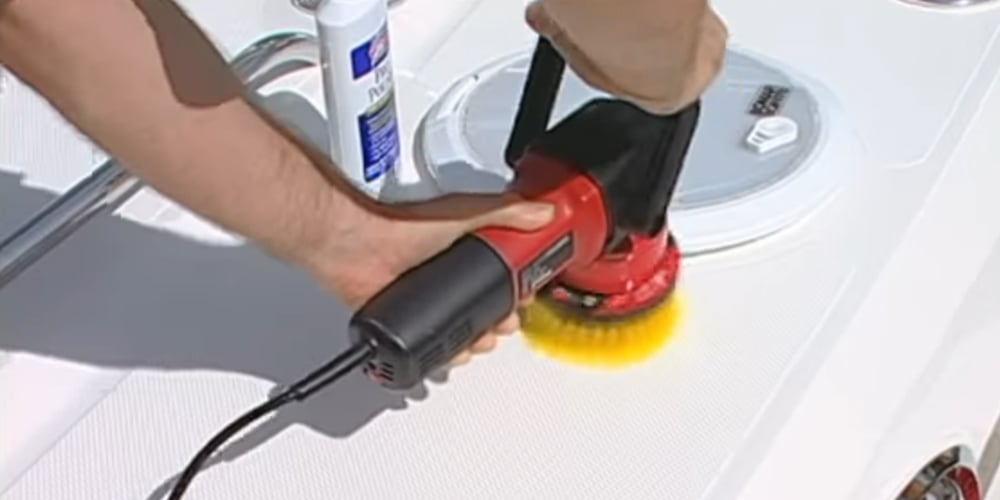
Owner apathy and dull, tired gelcoat go hand in hand. In the opinion of some owners, bright, shiny boats don’t sail any better or catch more fish, so why bother with maintenance? But keep in mind that maintaining your boat’s gelcoat will help you “catch” more customers should you ever want to sell.
How to Protect a New Boat’s Gelcoat
If you own a brand-new boat, you are in luck. All you need to do is wash your boat and apply a quality wax. Waxing now will protect that like-new look and head off a time-consuming restoration project down the line. We’ll walk you through everything you need to know to keep your boat looking great for years to come.
- About Gelcoat
- Four Steps to Gelcoat Restoration
- One-Step Formulations
- Polishing Machines
- Polishing Techniques
- Required Tools and Supplies
- FAQs
About Gelcoat
Gelcoat is the coating sprayed against a highly polished mold at the beginning of the fiberglass layup process, producing the smooth, mirror-like finish of a new boat. With time, unprotected gelcoat oxidizes and takes on a chalky appearance. As it oxidizes it becomes porous — and the more porous it becomes, the more readily it stains. This process continues until the boat becomes one of the dilapidated wallflowers we have all seen at the dock. The good news is that nearly all gelcoat can be restored, provided it is not completely worn through.
Four Steps to Gelcoat Restoration
Step One — Wash It
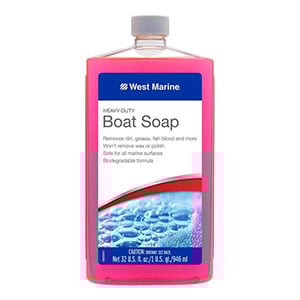
Marine boat soaps are low-sudsing formulas that are better for the marine environment than household dish soap.
Wash the hull and topsides with marine boat soap diluted in water to remove all surface dirt. Marine boat soaps rinse residue-free and are better for the environment than popular dishwashing liquids, most of which are high in sulfonates and should be avoided around the water.
Molded-in non-skid areas can be difficult to clean. Try a chelating non-skid cleaner — these formulations break the bond between dirt and deck without heavy scrubbing.
After removing surface dirt, inspect for damage. Look for stress cracks around stanchions or other areas that may indicate an underlying structural problem. For surface scrapes or gouges that need repair, see our West Advisor Do-It-Yourself: Gelcoat Repairs, which covers gelcoat restoration, scratch repair, and polishing and waxing techniques.
Step Two — Remove Stains
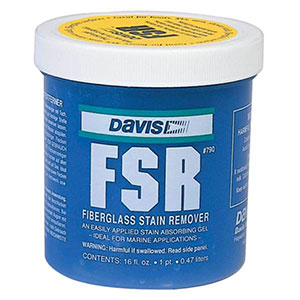
This acid-based stain remover in gel form holds well to vertical surfaces and works chemically with minimal scrubbing.
Nearly all boats have some degree of gelcoat staining that soap and water alone won’t remove — stains exist at a deeper level within the porous gelcoat surface. There are two types: mineral stains (rust, black streaks) and organic stains (bird droppings, coffee, wine, leaves).
Acid-based stain removers are effective for most mineral and organic stains. Gel formulations are the easiest to use because they hold to vertical surfaces and work chemically with little or no scrubbing. When using an acid-based stain remover, wear rubber gloves and eye protection, and keep the product off paint, varnish, or galvanized surfaces.
Due to air pollution, many boats are stained over their entire surface even when they appear clean. To check: swab gel stain remover across an area that looks fine, leave for 20 minutes, then rinse. If the color changes — whites whiten, colors brighten — you have general staining. Apply the stain remover over the entire topsides and hull to restore the original color.
Specialty formulations target specific stains: black streak removers, rust stain removers, exhaust stain removers, mold stain removers, and bird and spider dropping removers. If a general stain remover doesn’t do the job, try a formulation specific to your stain type.
Step Three — Polish It
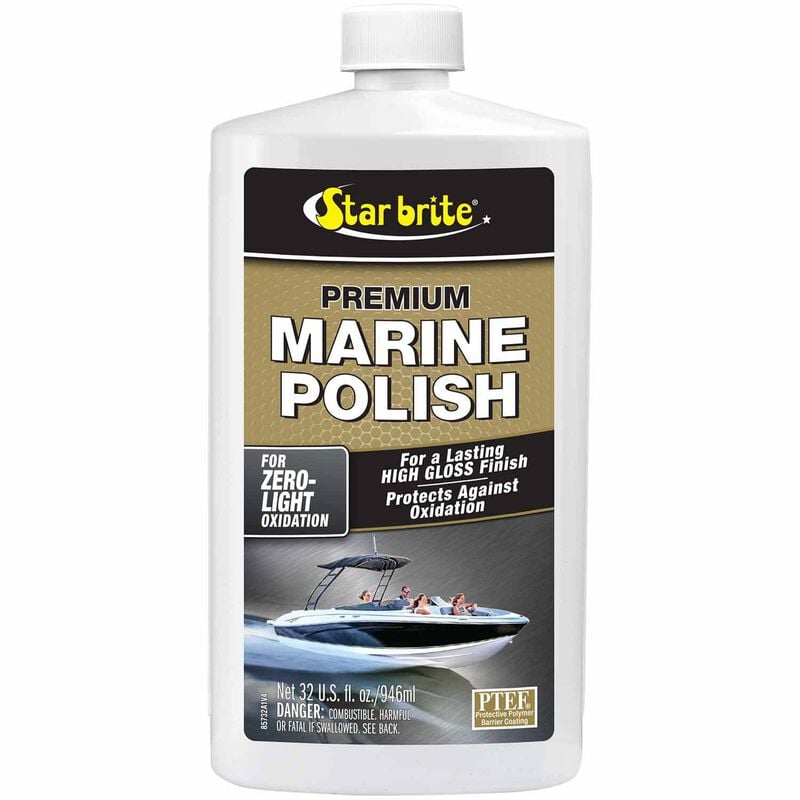
Star Brite’s premium marine boat polish is effective for light oxidation with no hard rubbing required.
Unless your boat is very new, it will have some oxidation. Light oxidation appears as a slight dulling of the gelcoat. Moderate to heavy oxidation shows as a chalk-like powder at the surface.
Polishes and their more aggressive cousins, rubbing compounds, use abrasives to smooth the pitted surface of porous gelcoat and restore the shine. For heavily oxidized gelcoat, start with rubbing compound and follow with successively finer grades of polish. Each application removes a small amount of gelcoat — always use the least aggressive product that will get the job done. Do not polish in direct sunlight; the product will dry too fast and become difficult to remove.
Step Four — Wax It
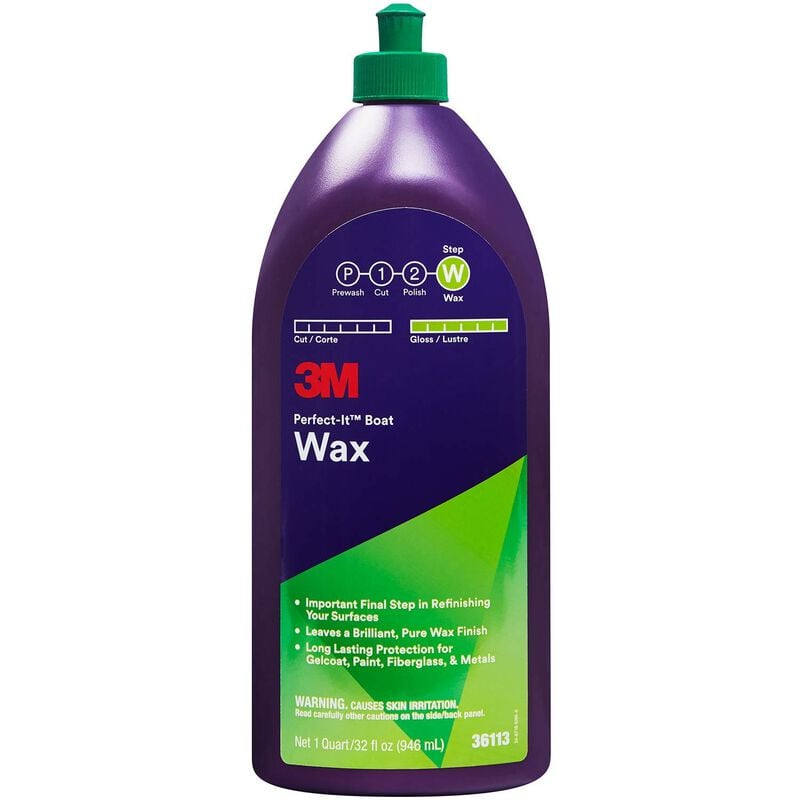
3M’s Perfect-It™ boat wax is a gel formulation that holds well to vertical surfaces.
Once polished, protect the surface with a wax. Wax seals out oxygen, which prevents oxidation, and most waxes contain UV inhibitors that protect gelcoat from sun damage. Wax choices include pure carnauba, carnauba/polymer blends, and polymer-only formulations:
- Pure carnauba wax provides a deep, warm shine and is the traditional choice for boats. It requires more frequent reapplication (typically every few months in strong sun) but is easy to apply and buff.
- Carnauba/polymer blends combine the shine of carnauba with the longer-lasting protection of polymers — a good all-around choice for most boaters.
- Polymer-only formulations provide the longest-lasting protection and are the most durable option for boats that sit in the sun year-round. They tend to produce a crisper, harder shine than carnauba.
Wax can be applied by machine or by hand. Do not apply wax under direct sunlight — the wax will dry too quickly and become difficult to buff off cleanly.
Molded-In Non-Skid
Most boaters limit non-skid care to washing and stain removal, believing that polishing and waxing will make it slippery. For old, worn non-skid this may be true. But Shurhold Industries has demonstrated that non-skid in good condition can be polished and protected without loss of traction. See the video below for a demonstration.
One-Step Formulations
Conventional wisdom says polishing and waxing should always be separate operations. While the four-step procedure above produces the best results, one-step products combining polish with wax make perfect sense for light to moderate oxidation. If the oxidation is light and you want to finish in half the time, a one-step product is a practical choice.
Polishing Machines
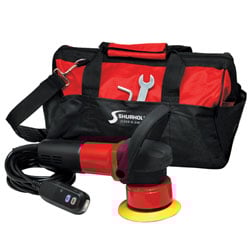
Shurhold’s Dual-Action polisher bridges the gap between heavy-duty circular polishers and common automotive buffers — effective but safer for inexperienced users.
Two types of machines are available. Variable-speed circular polishers cover ground quickly in experienced hands but can burn through and mar gelcoat when used by a novice. For most boaters, a random orbital polisher is the safer choice. These are available as battery-powered units and AC plug-in units. If using an AC machine with the boat in the water, ensure it is GFCI-protected — water and electricity are a dangerous combination.
Polishing Technique
Whether polishing or waxing by hand or machine, work in small sections using a circular motion and finish each section completely before moving on. For a detailed polishing walkthrough, see our West Advisor Do-It-Yourself: Gelcoat Repairs, which covers gelcoat restoration, scratch repair, and polishing and waxing techniques.
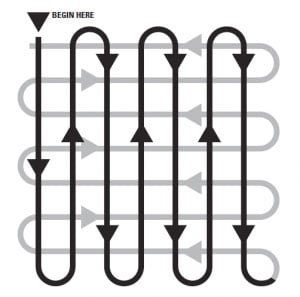
For even, consistent results, follow this overlapping pattern when buffing or polishing with a machine.
Summary
Once you have completed the restoration, maintain the result with regular washdowns and a fresh coat of wax every season — or more frequently for boats kept in strong sun. Now kick back and enjoy the compliments.
Required Tools and Supplies
- Medium or coarse deck brush
- Soft-bristled handheld brush
- Chamois
- Cotton rags
- Goggles
- Kneepads
- Bucket
- Hose with nozzle
- Boat soap
- Polish
- Wax
Optional:
- Random orbital polisher or circular polisher (AC units must be GFCI-protected)
- Polishing and buffing pads
Waxing Non-Skid
The video below demonstrates how to wax and protect gelcoat non-skid against the damaging effects of weather and sun.
Frequently Asked Questions
How often should I wax my boat?
As a general rule, wax your boat at least once per season — ideally at the beginning of the season to protect against the coming months of UV exposure. Boats stored outdoors year-round in strong sun (Florida, Southern California, the Caribbean) may benefit from waxing twice per year. A simple test: if water no longer beads and sheets off the hull, it’s time to wax. Polymer-only waxes last significantly longer than pure carnauba; if longevity between applications matters to you, a polymer formulation is worth the trade-off in shine quality.
What is the difference between rubbing compound, polish, and wax?
Rubbing compound is the most aggressive abrasive — it removes significant oxidation and surface damage but also removes more gelcoat. Polish is a finer abrasive used after compound to refine the surface and restore gloss. Wax contains no abrasive — it seals and protects the polished surface and provides UV protection. The correct sequence is compound (if needed) → polish → wax. Never apply wax over oxidized or stained gelcoat; the wax will seal the damage in rather than protecting clean gelcoat.
Can I use a random orbital polisher on my boat?
Yes, and for most recreational boaters it is the recommended choice over a circular polisher. A random orbital (also called a dual-action) polisher moves the pad in an elliptical pattern that greatly reduces the risk of burning through gelcoat — the primary hazard with circular polishers in inexperienced hands. Use the appropriate pad for the product: foam cutting pads for compound, foam finishing pads for polish, and soft foam or microfiber pads for wax. Work in small sections and keep the machine moving.
What is the difference between carnauba and polymer boat wax?
Carnauba is a natural wax from a Brazilian palm that provides a warm, deep shine. It is easier to apply and buff, but is less durable than synthetic polymers and requires more frequent reapplication. Polymer waxes are synthetic and provide longer-lasting protection with a harder, glossier finish. Carnauba/polymer blends offer a middle ground. For a boat that sits in the sun year-round and you want to wax less often, choose a polymer or blend. For classic appearance and the traditional look on a wooden or traditional vessel, carnauba is the premium choice.