By Tom Burden, West Marine Technical Editor
Buying too little paint means an extra trip to the store mid-project — and if the store is out of stock or the batch code differs, you risk a color mismatch. Buying too much wastes money on paint you can't return once opened. This guide gives you two ways to estimate how much boat paint you need, explains what affects coverage in the real world, and walks through a worked example so you can apply the formula to your specific boat.
- Quick Reference Table by Boat Type
- Calculate by Hull Surface Area
- Worked Example
- What Affects How Much Paint You Use
- Understanding the Paint Categories
- Painting Guides with Color Charts
- FAQs
Quick Reference Table by Boat Type
The following quantities are approximate estimates for two coats of paint on a typical boat of that type and length. Your actual usage may vary based on hull shape, surface condition, paint type, and application method.
| Boat Type | Bottom Paint | Topside | Topside Polyurethane | Enamel | Waterline | Deck |
|---|---|---|---|---|---|---|
| 10’ Dinghy | 1 qt. | 1 qt. | 1 qt. | |||
| 14’ Outboard | 1–2 qt. | 1 qt. | 1 qt. | 1 pt. | ||
| 18’ Runabout | 2 qt. | 1 qt. | 2 qt. | 1 pt. | 1 qt. | |
| 20’ Sailboat | 3 qt. | 2 qt. | 2 qt. | 1 pt. | 1 qt. | |
| 24’ Runabout | 3–4 qt. | 2 qt. | 2 qt. | 1 pt. | 1 qt. | |
| 30’ Sailboat | 1.5 gal. | 3 qt. | 1 gal. | 1 pt. | 2 qt. | 2 qt. |
| 32’ Cruiser | 1.5–2 gal. | 3 qt. | 1 gal. | 1 pt. | 2 qt. | 2 qt. |
| 36’ Auxiliary | 2 gal. | 5 qt. | 2 gal. | 1 pt. | 1 gal. | 3 qt. |
| 40’ Cruiser | 2.5 gal. | 6 qt. | 2.5 gal. | 2 pt. | 1.5 gal. | 1 gal. |
| 45’ Sailboat | 3–3.5 gal. | 8 qt. | 3 gal. | 3 pt. | 2 gal. | 1 gal. |
| 50’ Sportfisher | 4+ gal. | 8 qt. | 3 gal. | 4 pt. | 2.5 gal. | 1 gal. |
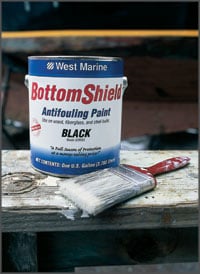
Bottom Shield is designed for easy application and clean up, making it a great bottom paint for DIYers.
Calculate by Hull Surface Area
The table is a useful starting point, but boats of the same length can vary significantly in hull shape and underwater area. The formula below gives you a more accurate estimate based on your specific boat’s dimensions. All you need is your boat’s length (bow to stern at the waterline) and beam (widest point):
Length × Beam × 0.75 = Approximate Underwater Surface Area in Sq. Ft.
Once you have the surface area, find the coverage rate on the paint can label — this is the theoretical coverage per gallon for one coat. Divide your surface area by that number to get gallons per coat, then multiply by the number of coats you plan to apply. Most bottom paint manufacturers recommend a minimum of two coats, with extra coats on the waterline stripe, leading edges, and keel where wear is heaviest.
The formula for total paint needed:
(Surface Area ÷ Coverage Rate) × Number of Coats = Gallons Needed
Then add 10–15% for waste, drips, brush-out, and touch-up.
Worked Example
Say you have a 28’ cruising sailboat with a 10’ beam, and you want to apply two coats of bottom paint rated at 400 sq. ft. per gallon (theoretical coverage).
Step 1 — Calculate underwater surface area: 28 × 10 × 0.75 = 210 sq. ft.
Step 2 — Gallons per coat: 210 ÷ 400 = 0.525 gallons (roughly a quart and a half)
Step 3 — Two coats: 0.525 × 2 = 1.05 gallons
Step 4 — Add 15% buffer: 1.05 × 1.15 = 1.21 gallons
In this case, buying two quarts would leave you short. Two gallons would be generous. The practical answer is to buy one gallon and one quart, which gives you 1.25 gallons — enough for two solid coats plus a buffer for touch-up and extra coverage on the keel and waterline.
Note that this formula gives the underwater surface area only. The topsides, waterline stripe, and deck are separate surfaces that need to be estimated independently, which is why the quick reference table breaks them out by area.
What Affects How Much Paint You Actually Use
The coverage rate on the label is a theoretical maximum under ideal conditions. Real-world usage is almost always higher. The main factors:
- Surface condition: A rough or porous surface from years of accumulated bottom paint absorbs significantly more paint than a smooth, previously painted hull. If you’re painting over a badly oxidized or rough surface, plan for 20–30% more paint than the formula suggests. If you are stripping the hull back to bare fiberglass and applying barrier coat, the bare surface will absorb the first coat heavily — budget for an extra coat over what you would normally apply.
- Application method: Brush application typically uses less paint than roller because a brush lays a more controlled coat. Roller application is faster but tends to apply a slightly thicker coat and wastes more in the nap. Spray application on large hulls is efficient but requires more paint to achieve the same dry film thickness due to overspray.
- Temperature and humidity: Hot, dry conditions cause solvent to flash off quickly, which can result in thinner coats than intended. Working in the ideal temperature range (typically 50–90°F for most bottom paints, check the label) gives you better control over coat thickness and coverage.
- Paint type: Ablative (self-polishing) bottom paints are designed to wear gradually and typically go on at a thinner wet film thickness than hard bottom paints. Hard paints applied at the recommended thickness tend to use more paint per coat but build up protection faster. Check the label for the specific wet mil thickness and coverage rate.
- Hull shape: The 0.75 multiplier in the formula is an average that works well for most monohull powerboats and cruising sailboats. Full-keel sailboats, multihulls, and boats with complex underbody shapes may have a larger actual surface area than the formula predicts. When in doubt, err on the side of buying an extra quart.
- Number of previous coats: If your boat already has many layers of old bottom paint, you may be painting over an irregular surface that uses more paint than a smooth substrate. If the old paint is in good condition, you can paint over it. If it’s peeling or flaking, those areas need to be addressed before painting, which will increase the prep work and may increase paint usage.
Understanding the Paint Categories in the Table
The table columns represent distinct products with different uses — you are not expected to buy every column. Here is what each means:
- Bottom Paint: Antifouling paint applied below the waterline to prevent growth of barnacles, algae, and other marine organisms. Applied to the hull bottom and keel, from the waterline down. Required on any boat stored in the water; not used on trailered boats that are out of the water between uses.
- Topside (one-part): One-part alkyd or acrylic paint applied to the hull above the waterline. Easier to apply than two-part polyurethane and more forgiving of imperfect surface preparation. Does not achieve the same gloss or durability as two-part, but is a practical choice for do-it-yourselfers and boats that are repainted regularly.
- Topside Polyurethane (two-part): Two-component polyurethane applied above the waterline. Cures to a hard, high-gloss, extremely durable finish that closely resembles gelcoat in appearance. Requires careful surface preparation, accurate mixing ratios, and good application technique. Lasts significantly longer than one-part topside but is more demanding to apply.
- Enamel: Typically refers to the paint applied to the non-skid deck areas, or in some applications to a below-waterline coating. Enamel is more flexible and impact-resistant than standard topside paints, making it suitable for areas that receive foot traffic and regular wear.
- Waterline: The narrow stripe of paint at the waterline, sometimes called the boot stripe, which covers the area where the hull transitions from the topsides to the bottom. This area is particularly prone to scum and staining and benefits from dedicated waterline paint or boot top stripe paint. The surface area is small but this strip often requires more coats than the rest of the topsides because of its exposure.
- Deck: Non-skid deck paint formulated to provide traction underfoot while resisting UV, salt water, and foot traffic. Deck paint is typically thicker than topside paint and contains grit or texture additives.
Painting Guides with Color Charts

Frequently Asked Questions
How do I calculate how much bottom paint I need for my specific boat?
Measure your waterline length and maximum beam. Multiply: Length × Beam × 0.75 = underwater surface area in square feet. Divide by the coverage rate on the paint can (square feet per gallon per coat), multiply by the number of coats (usually two), and add 15%. This gives you a practical purchase quantity for your specific hull. See the worked example above for a step-by-step calculation.
Do the quantities in the table cover one coat or two?
Two coats. All values in the table assume two coats of paint, which is the minimum recommended by most manufacturers. If you are applying to bare fiberglass or a particularly rough or porous surface, plan on an extra coat and add proportionally to the estimate.
What is the difference between topside paint and topside polyurethane?
Topside paint is a one-part formulation — easier to apply, more forgiving, and suitable for most DIY applications. Topside polyurethane is a two-part system that cures to a much harder, higher-gloss finish that lasts significantly longer. The tradeoff is that two-part polyurethane requires careful surface preparation, accurate mixing, and more skill to apply without runs or sags. For a boat repainted every two or three years, one-part topside is practical. For a show-quality finish intended to last five or more years, two-part polyurethane is the appropriate choice.
Why does the table show more bottom paint than topside paint for the same boat?
The underwater hull surface is typically larger than the visible topsides above the waterline, especially on sailboats where the keel and full underbody add significant surface area. A 30’ sailboat might have 250–300 square feet of underwater surface but only 100–150 square feet of topsides above the waterline — which is why bottom paint quantities in the table are consistently higher.
Can I store leftover bottom paint for next season?
Yes, if stored correctly. Seal the can tightly, store it upside down to prevent a skin from forming on the surface, and keep it in a cool, dry location out of direct sunlight and away from freezing temperatures. Most bottom paints remain usable for one to two years when stored properly. Before using stored paint, stir it thoroughly and check that the consistency has not changed significantly. Ablative paints that have separated significantly or bottom paints that have thickened substantially should not be used.
Should I buy exactly the amount shown in the table?
Use the table as a starting point, then add a buffer of at least one quart beyond the estimated amount. Running out of paint mid-coat means stopping work, making a store run, and risking a slightly different batch code that can cause minor color variation even within the same color. For small boats, buying one extra quart is cheap insurance. For larger boats where a gallon is more relevant, buy the next gallon size up rather than cutting it close.