
What to Consider When Choosing a Trolling Motor
Bow-Mount Motors
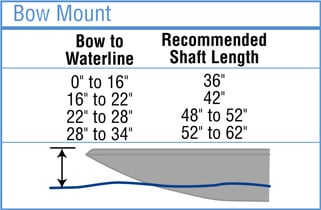
Note: Add 8" to your bow to waterline measurement if large waves are often present where you fish.
Bow-mounted trolling motors are best for anglers who want precise boat control from the front casting deck. Because the motor pulls the boat instead of pushing it from the stern, it is easier to hold a shoreline, work a weed edge, correct for crosswind or stay positioned near docks, bridge pilings, reefs and other fish-holding structure. This setup is common on bass boats, bay boats, flats boats and other fishing boats where hands-free control and accurate positioning matter.
Many modern bow-mount motors include foot-pedal control, wireless remotes, GPS anchoring, route recording and fishfinder integration. These features help anglers spend less time correcting boat position and more time fishing. To prevent damage from groundings or submerged obstacles, a spring-loaded mount like Minn Kota’s BowGuard 360 allows the motor to swing away on impact. On very small craft or on a light sailboat, the trolling motor often doubles as an auxiliary engine and is mounted on the transom where it is operated by a tiller.
Transom-Mount Motors
Transom-mount trolling motors are a practical choice for smaller boats, jon boats, inflatables, dinghies, canoes, kayaks and sailboats that need simple electric propulsion. They are usually easier to install, remove and store than bow-mounted systems, which makes them a good fit for boaters who want reliable slow-speed control without a permanent deck-mounted setup. Transom-mount trolling motors have brackets that adjust to different angles and heights so the motor’s shaft is immersed to the proper depth.
Because a transom-mounted motor pushes the boat from behind, it does not offer the same steering precision as a bow-mounted motor when fishing into wind or current. However, it works very well for trolling, slow maneuvering, auxiliary propulsion and small-boat fishing. For kayak and canoe users, a lightweight transom motor paired with the right battery can extend range without adding unnecessary complexity.
Fresh vs. Saltwater
Choose a trolling motor that matches the water where you fish. Saltwater motors are built with corrosion-resistant materials, sealed electrical components, stronger coatings and hardware designed to withstand harsh marine environments. This matters in coastal bays, tidal rivers, estuaries and offshore areas where salt exposure can quickly damage unprotected electrical and mechanical parts.
Freshwater trolling motors are not recommended for saltwater use because they lack the same level of corrosion protection and sealing. Even occasional saltwater exposure can shorten the life of a freshwater motor if salt remains around the prop shaft, connectors, steering components or mounting hardware. If you fish in both freshwater and saltwater, choose a saltwater-rated trolling motor and rinse it thoroughly with fresh water after each trip.
Shaft Length
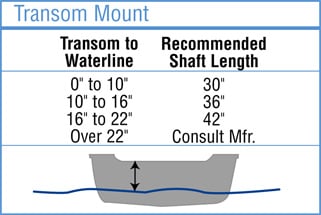
The standard shaft length is 42". To determine the right length for your boat, measure the distance from where the shaft is mounted on the deck or the transom to the water. Then add 16" (for MotorGuide) or 20" (for Minn Kota) and select the next closest measurement. We recommend longer shafts for operation in rough water so the prop stays about 6" below the surface when the boat pitches and rolls. If you frequently fish in rough water, add 8" to your bow to waterline measurement and choose the shaft length accordingly. If your measurement falls within the overlapping ranges, select the longer shaft length. Fine-tune the motor’s vertical position with the adjustment on the mount.
Shaft length is one of the most common setup mistakes anglers make. A shaft that is too short can allow the propeller to break the surface in chop, which causes cavitation, loss of thrust and inconsistent boat control. A slightly longer shaft is often the better choice for boats with high bows, pontoons, center consoles or fishing platforms that regularly see wind, wake or open-water conditions.
Thrust
Trolling motors are rated in pounds of thrust. As a rule of thumb 72 to 75lb. of thrust roughly equals one horsepower or 746W of electrical power. A typical 12V motor that draws 60A consumes approximately 720W. The equation for power is easy: the higher the voltage, the higher the thrust. Trolling motors are offered in 12V, 12/24V, 24V and 36V versions, with the most powerful ones offering more than 100lb. of thrust, powerful enough to move heavy vessels such as pontoon boats. Maximum thrusts at different voltages are approximately 12V/55lb. and 24V/80lb.
Thrust should be selected based on total boat weight, not just boat length. Passengers, fuel, batteries, coolers, fishing gear, livewells and wind exposure all affect how hard the trolling motor has to work. A motor that feels adequate on a calm morning may struggle later in the day when wind, current or tide increases. Choosing a stronger motor often improves control because the motor can run at lower settings instead of constantly operating near maximum output.
The Right Size
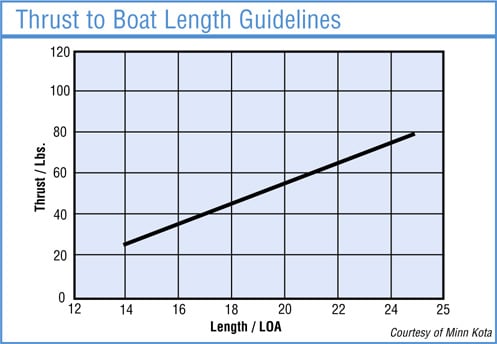
Bigger is usually better when it comes to trolling motor sizing, but the best choice depends on how and where the boat is used. Larger boats, heavier fishing loads, pontoons, bay boats and boats with high sides need more thrust because they catch more wind and require more power to hold position. We recommend 5lb. of thrust for every 200lb. of a vessel’s gross weight as a starting point, then adjusting upward for wind, current, rough water or all-day fishing.
Small kayaks, canoes and jon boats may only need a compact 12V motor, while bass boats and larger fishing boats often benefit from 24V or 36V systems. If you regularly fish docks, bridges, grass lines, reefs, wrecks or other structure where boat position is critical, choose enough thrust to maintain control without draining batteries too quickly. Undersizing the motor can lead to shorter runtime, poor steering response and frustration in anything other than calm conditions.
Power Consumption
Think about the size of your boat, how much battery capacity you can safely install to satisfy the energy demands of a trolling motor, and whether or not you will be able to charge the batteries when underway. Check the amp draw of the models you have in mind. A 24V model with 54lb. of thrust may only draw 28A, while a 12V model with 44lb. of thrust can draw 36A. The rule of thumb is that larger motors require more battery capacity, and if you fish from dawn to dark with a boat of 16' or longer, you’ll probably want 24V. Serious anglers who spend a lot of time on the water will appreciate a 36V motor.
Runtime depends on battery capacity, motor speed, wind, current, hull weight and how often the motor is used for heavy corrections. Running a trolling motor at full power drains batteries much faster than making slow adjustments at lower settings. Lithium marine batteries are becoming more popular for trolling motor systems because they reduce weight, provide more usable capacity and maintain steadier voltage throughout the discharge cycle. Before upgrading to lithium, confirm that your onboard charger and trolling motor system are compatible with lithium battery requirements.
Advanced Features
Many trolling motors now feature autopilot and route storage capabilities to guide you through your most productive routes. With Bluetooth connectivity, you can control these features from your phone or from an included remote control. Some Minn Kota motors feature Humminbird's MEGA Down Imaging and are compatible with select fishfinders.
GPS anchoring is one of the most useful modern trolling motor features. Systems like Spot-Lock can hold a boat in place over structure without a traditional anchor, which is especially helpful when fishing reefs, wrecks, brush piles, docks, bridge pilings or windblown shorelines. Route recording, heading lock, contour following and wireless controls also help anglers repeat productive passes and maintain better boat control throughout the day.
Brushless motor technology is another feature worth considering on premium models. Brushless trolling motors are typically quieter, more efficient and require less maintenance than traditional brushed motors. For anglers who fish frequently, spend long days on the water or rely on GPS positioning in wind and current, advanced features can be more than conveniences; they can directly improve fishing efficiency.
Trolling Motor FAQ
How do I maintain my trolling motor to ensure longevity?
Rinse the motor with fresh water after each trip, especially after saltwater use. Check for fishing line, weeds or debris around the propeller and prop shaft, inspect electrical connections for corrosion, and make sure mounting hardware remains tight. Keep batteries charged and follow the manufacturer’s service recommendations for lubrication, storage and inspection.
Can I use a freshwater trolling motor in saltwater?
It’s not recommended. Freshwater motors do not have the same corrosion protection, seals and hardware used on saltwater-rated models. If a freshwater motor is used in saltwater, rinse it thoroughly after each use, but understand that corrosion and electrical damage can still occur over time. For regular coastal or offshore use, choose a saltwater-specific motor.
What is the difference between a tiller handle and a foot pedal for controlling a trolling motor?
A tiller handle is simple, direct and easy to use from the stern or cockpit, making it common on transom-mount motors and smaller boats. A foot pedal allows hands-free steering from the casting deck, which is helpful when fishing because you can control the boat while continuing to cast, retrieve or work a lure. Wireless remotes and app-based controls are also common on advanced GPS trolling motors.
Can I use a trolling motor on a kayak or canoe?
Yes, many trolling motors are suitable for kayaks, canoes and other small watercraft. Choose a lightweight motor with the right thrust rating and shaft length for the craft, and make sure the battery does not overload the boat or affect stability. Many kayak anglers prefer compact 12V systems or lightweight lithium battery setups to reduce total weight.
How do I calculate battery life for my trolling motor?
To estimate battery life, divide the battery’s amp-hour rating by the motor's amp draw. For example, if your motor draws 20A and your battery is rated at 100Ah, it may run for approximately 5 hours under steady conditions. Real-world runtime varies because wind, current, boat weight, speed setting, battery age and GPS anchoring all affect power consumption.
Can I use a solar panel to charge my trolling motor’s battery?
Yes, solar panels can help charge trolling motor batteries, but the results depend on panel output, battery size, sun exposure and the type of charge controller used. Solar charging is often best for maintaining batteries or extending charge between trips rather than rapidly recharging a heavily depleted trolling motor bank. Always use a marine-rated charge controller that matches your battery type.
What is the best way to store a trolling motor during the off-season?
Clean and dry the motor before storage, inspect the propeller and shaft, and store the unit in a cool, dry place when possible. Disconnect batteries, clean terminals and keep batteries properly charged according to the battery manufacturer’s recommendations. For saltwater motors, pay extra attention to rinsing and drying areas around the mount, prop shaft and electrical connections.
Can I use a trolling motor in heavy vegetation or weedy areas?
Yes, but heavy vegetation requires care. Weedless prop designs can help reduce tangles, but anglers should still check the prop regularly for weeds, fishing line or debris. Running the motor while the prop is wrapped can reduce efficiency, increase heat and potentially damage the motor.
What safety precautions should I take when using a trolling motor?
Make sure the motor is securely mounted, the shaft is set to the correct depth and all wiring is properly protected with the correct fuse or circuit breaker. Keep loose lines, anchor rope and fishing gear away from the propeller. Carry basic tools, spare fuses and a backup paddle or propulsion option when using a trolling motor on small craft.
Can I retrofit my current boat with a trolling motor if it wasn’t designed for one?
Yes, many boats can be retrofitted with a trolling motor, but the installation should account for mounting location, deck strength, wiring, battery storage, charger compatibility and safe weight distribution. Bow-mount motors may require a reinforced mounting surface, while transom motors need adequate clearance and proper shaft depth. If you are adding a higher-voltage system, confirm that the boat has enough space for the required batteries and wiring.
We're Here to Help!
With over 230 stores and a vast online selection, West Marine has trolling motors, batteries, chargers, mounts, wiring, marine electronics and accessories to help you build the right system for your boat. Whether you need a simple transom-mount motor for a small craft, a GPS-enabled bow-mount motor for fishing structure, or a complete battery and charging setup for long days on the water, our team can help you choose equipment that fits your boat, fishing style and operating conditions. Click on our store locator to find a West Marine store near you.
Related: