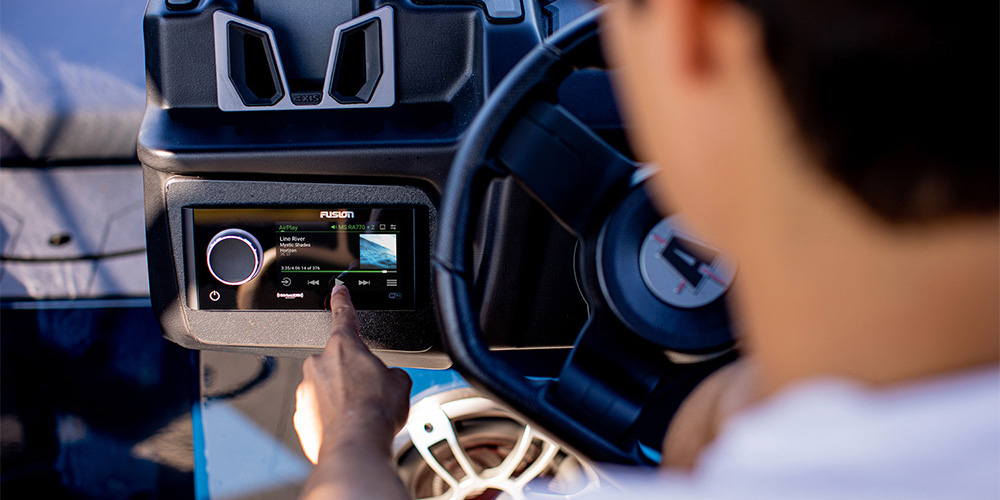
Music streaming has transformed onboard entertainment. Where boaters once needed CD changers, satellite radio receivers, or an iPod dock to fill the cockpit with sound, a phone and a marine stereo now give access to 100 million songs on demand. But the quality of that experience varies enormously depending on the wireless technology being used, the streaming platform’s bitrate, the audio codec handling the transmission, and the capability of the marine audio hardware receiving the signal.
Marine environments create challenges that land-based audio systems rarely face: fluctuating connectivity offshore, Bluetooth range limitations across an open cockpit, engine noise competing with audio at lower frequencies, and the acoustics of an open-air listening environment that bleeds sound energy in every direction. Building a great onboard streaming experience requires understanding how these factors interact.
This guide explains everything a boater needs to know about streaming music on the water — from how Bluetooth codecs actually work to which streaming platforms offer the highest audio quality, to what the marine audio system in your boat needs to support to get the most out of it.
- How Music Streaming Works
- Why Marine Audio Streaming Is Different
- Bit Rate and Audio Quality
- Wi-Fi vs. Bluetooth Streaming
- Bluetooth Codecs: SBC, AAC, aptX, and LDAC
- Lossy vs. Lossless Audio
- Streaming Platform Comparison
- Marine Audio Systems Built for Streaming
- How to Improve Streaming Quality on Your Boat
- Offline Playback for Offshore Use
- FAQs
How Music Streaming Works
Music streaming services store enormous audio libraries on remote cloud servers and transmit audio data continuously over an internet connection to your playback device. Rather than downloading a complete file before playback starts, streaming sends small sequential packets of audio data so playback begins almost immediately. A small buffer — typically 10–30 seconds of audio loaded ahead of the current position — allows continuous playback even if the connection briefly fluctuates.
The key variables that determine streaming audio quality are the bit rate (how much audio data per second), the codec (how that data is compressed and encoded), and the transmission method (Bluetooth or Wi-Fi) that carries the audio from your phone or tablet to your marine stereo. All three interact, and all three matter for what you actually hear through your speakers.
Why Marine Audio Streaming Is Different
A home audio system sits in a controlled acoustic environment with stable Wi-Fi, a fixed listening position, and no competing noise sources. A boat is none of those things. Marine streaming audio faces several compounding challenges:
- Open-air acoustics: Sound energy dissipates rapidly outdoors. An audio system that sounds full and rich in an enclosed room will sound thin and quiet on an open flybridge. Marine audio systems compensate with higher amplifier power and speaker efficiency, but they also expose weaknesses in low-quality compressed audio that a home system might mask.
- Engine and wind noise: Engine noise on a planing powerboat at speed sits in the 250–500 Hz range, right where male vocals, bass guitar, and a significant portion of musical midrange live. At cruising speed, you lose a significant portion of the music’s midrange detail to engine noise masking. This actually reduces the perceptible quality difference between a 128 Kbps stream and a 320 Kbps stream at cruising speed — but at anchor or at idle, the difference becomes clearly audible on a quality marine system.
- Varying connectivity: Cellular signal strength drops progressively as you move offshore. At 5–10 miles offshore on most coastal routes, LTE becomes intermittent. At 20+ miles offshore, it may be absent entirely. Marina Wi-Fi networks are notoriously overloaded — dozens of boats sharing a single access point produces connection quality worse than a weak cellular signal.
- Bluetooth range limitations: Standard Bluetooth has an effective range of approximately 30–33 feet (10 meters). On a larger boat, your phone in the cabin may be at the edge of reliable range from a cockpit head unit, causing dropouts. Some marine head units support Bluetooth 5.0, which extends range and improves connection stability.
- Electrical noise: Alternators, electric motors, and switching power supplies all generate electrical noise that can introduce interference in audio systems. Marine-grade audio equipment is built with shielding and filtering specifically to reject this noise — consumer-grade equipment is not.
Bit Rate and Audio Quality
Bit rate is the amount of audio data transmitted per second, measured in kilobits per second (Kbps). Higher bit rate means more data, which means either less compression (better quality) or lossless transmission (no quality reduction from compression at all).
| Bit Rate | Quality Level | Typical Use |
|---|---|---|
| 128 Kbps | Standard compressed | Background music, low-bandwidth connections |
| 256 Kbps | High-quality compressed | Apple Music standard (AAC) |
| 320 Kbps | High-quality compressed | Spotify Premium, standard Bluetooth ceiling |
| 1,411 Kbps | CD-quality lossless | TIDAL HiFi, Apple Music Lossless (ALAC) |
| 2,000–9,216 Kbps | Hi-Res Lossless | TIDAL Max, Apple Music Hi-Res Lossless |
The practical point: standard Bluetooth (SBC codec) is limited to approximately 328 Kbps total throughput, which is enough for 320 Kbps compressed audio but cannot carry CD-quality lossless or hi-res audio. If you have a TIDAL HiFi subscription or Apple Music Lossless enabled but are sending audio over standard Bluetooth, the platform delivers the high-quality file to your phone but the Bluetooth connection then recompresses it for transmission — you are paying for lossless and receiving compressed. Wi-Fi-based transmission eliminates this bottleneck entirely.
Wi-Fi vs. Bluetooth Streaming
The most consequential choice in onboard streaming quality is the transmission method between your source device and the marine stereo.
Bluetooth is simple, universal, and the default for most marine stereo connections. Every smartphone pairs with every Bluetooth-capable head unit without any network configuration. The limitation is bandwidth: even the best Bluetooth codec (LDAC) is capped at approximately 990 Kbps, and the most common codec (SBC) at approximately 328 Kbps. This is sufficient for high-quality compressed audio but cannot carry lossless or hi-res audio without recompressing it.
Wi-Fi streaming — through Apple AirPlay® 2, a networked streaming receiver, or a Wi-Fi-capable marine stereo like the Fusion® Apollo — has essentially no meaningful bandwidth ceiling for audio. Wi-Fi 5 can carry 1.3+ Gbps; even a full uncompressed 24-bit/192kHz hi-res audio stream requires only about 9.2 Mbps. Wi-Fi audio is not better because it is faster in a general sense: it is better because it removes the bandwidth constraint that forces Bluetooth to recompress already-compressed streaming audio.
Apple AirPlay 2 is the most practical implementation of Wi-Fi audio for iPhone users with a compatible marine stereo. AirPlay 2 transmits audio over the local Wi-Fi network at Apple Lossless (ALAC) quality — up to 24-bit/48kHz — with no Bluetooth recompression. It also supports multi-room audio synchronization, which is relevant on larger boats where cockpit, cabin, and flybridge zones are on the same system.
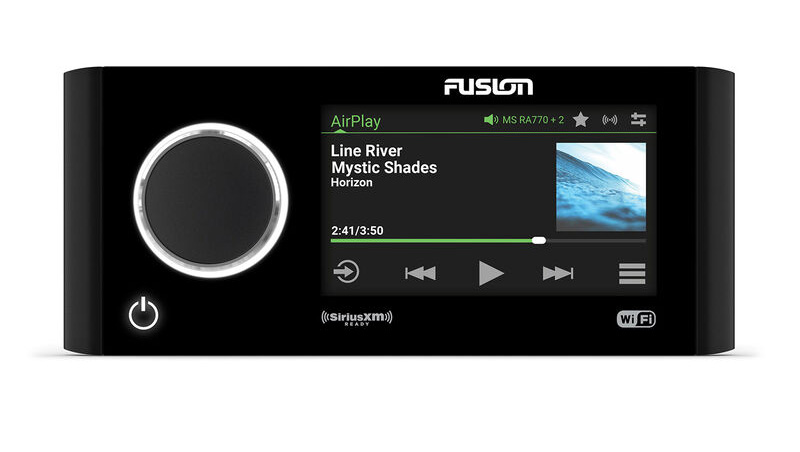
The Fusion® Apollo series supports Wi-Fi®, BLUETOOTH®, Apple AirPlay® 2, DSP technology and advanced high-fidelity marine streaming capabilities.
Practical guidance: For casual recreational boating where you are streaming Spotify or Pandora from a phone via Bluetooth at 320 Kbps, the quality difference between Bluetooth and Wi-Fi is not perceptible on most marine systems. Where Wi-Fi matters is if you are using Apple Music, TIDAL, or Amazon Music Unlimited at their lossless quality tiers and want to actually hear the difference that subscription is paying for.
Bluetooth Codecs: SBC, AAC, aptX, and LDAC
Not all Bluetooth audio connections are equal. The codec negotiated between your phone and the head unit determines the maximum audio quality that Bluetooth can deliver. Both devices must support the same codec — the connection defaults to the highest quality codec both devices have in common.
- SBC (Subband Codec): The baseline Bluetooth audio codec that every Bluetooth device supports. Maximum throughput approximately 328 Kbps. At 320 Kbps source material (Spotify Premium), SBC is at its ceiling and quality is good. At lower source quality it is fine. SBC is the default fallback when no higher codec is available on both devices.
- AAC (Advanced Audio Coding): Supported natively by Apple devices (iPhone, iPad). At up to approximately 250 Kbps, AAC is more efficient than SBC and sounds noticeably better at comparable bit rates because the codec itself is more perceptually efficient. If you use an iPhone with a head unit that supports AAC Bluetooth, you are already getting significantly better audio than SBC without doing anything else. Most newer Fusion, JL Audio, and other premium marine head units support AAC.
- aptX / aptX HD: Qualcomm’s codec family, common on Android devices. Standard aptX reaches approximately 352 Kbps at lower latency than SBC, with improved sound quality. aptX HD extends this to approximately 576 Kbps at 24-bit depth, providing audible improvement over SBC on complex musical passages. Requires both the phone (most Samsung, Google Pixel, and other Android flagships) and the head unit to support it.
- LDAC: Sony’s high-quality Bluetooth codec, capable of up to 990 Kbps at 24-bit/96kHz. The closest Bluetooth gets to Wi-Fi audio quality. LDAC is supported on Sony Xperia devices and many Android phones running Android 8.0 and above. It is less commonly supported in marine head units, though some premium models have added support. At its highest quality setting, LDAC can carry a lossless FLAC file over Bluetooth without recompressing to SBC quality — the compression loss is minimal and often inaudible on typical marine systems.
The practical takeaway: if you have an iPhone, prioritize a marine head unit that supports AAC Bluetooth. If you have an Android, look for aptX HD or LDAC support. If your head unit only supports SBC, upgrading to one that supports AAC or aptX HD is the single most effective way to improve Bluetooth streaming quality without changing any other part of the system.
Lossy vs. Lossless Audio
Lossy compression (MP3, AAC, OGG Vorbis) reduces file size by permanently removing portions of the audio that psychoacoustic models predict are least perceptible — very high frequencies, sounds masked by louder simultaneous sounds, brief transient details. At high bit rates (256–320 Kbps), modern lossy codecs are transparent to most listeners on most systems. At lower bit rates (128 Kbps or below), the artifacts become audible as harshness on cymbals, smearing on complex musical textures, and reduced stereo width.
Lossless compression (FLAC, ALAC) compresses audio without discarding any information, like a ZIP file for audio. The decompressed result is bit-for-bit identical to the original recording. CD quality is 16-bit/44.1kHz at approximately 1,411 Kbps. Hi-res lossless is typically 24-bit/96kHz or 24-bit/192kHz at 2,000–9,200 Kbps.
Whether you can hear the difference between a 320 Kbps AAC stream and a CD-quality lossless stream through your boat’s audio system depends on the quality of the marine speakers and amplifiers, background noise levels, and how critical a listener you are. On a premium marine system at anchor in quiet conditions, many people can hear a meaningful difference. At cruise speed with engine noise present, almost nobody can. The most important step for most boaters is getting to 256–320 Kbps quality — the difference between lossless and 320 Kbps high-quality AAC is much smaller than the difference between 128 Kbps and 320 Kbps.
Streaming Platform Comparison
Not all streaming services offer the same maximum audio quality. Here is a practical comparison for boaters:
| Platform | Max Quality (Standard) | Lossless Option | Max Bit Rate | Codec |
|---|---|---|---|---|
| Spotify Premium | Very High | No (lossless planned but not available) | 320 Kbps | OGG Vorbis |
| Apple Music | High (256 Kbps AAC) | Yes (Lossless & Hi-Res Lossless included) | Up to 9,216 Kbps | AAC / ALAC |
| TIDAL HiFi Plus | HiFi (FLAC) | Yes (Max: MQA/FLAC) | Up to 9,216 Kbps | FLAC / MQA |
| Amazon Music Unlimited | HD (FLAC) | Yes (Ultra HD included) | Up to 3,730 Kbps | FLAC |
| Pandora | Standard | No | 192 Kbps (Plus) / 64 Kbps (free) | AAC |
| YouTube Music Premium | High | No | 256 Kbps | AAC |
| SoundCloud | Standard | No | 128 Kbps (free) / 256 Kbps (Go+) | MP3 / AAC |
Practical guidance by use case:
- Best for casual, connected boating (Bluetooth): Spotify Premium at 320 Kbps OGG Vorbis is arguably the best Bluetooth streaming experience because the 320 Kbps ceiling matches standard Bluetooth capability and the catalog and playlist ecosystem are excellent. You are not leaving quality on the table because Bluetooth can carry everything Spotify sends.
- Best for lossless quality via AirPlay 2 (iPhone users): Apple Music with Lossless enabled, streamed via AirPlay 2 to a compatible marine stereo like the Fusion Apollo. The entire lossless library is included at no extra cost in the standard Apple Music subscription. This is the most practical way to get genuine lossless audio through a boat stereo without complex network setup.
- Best for audiophile-level streaming: TIDAL HiFi Plus for its combination of CD-quality FLAC and MQA hi-res content. Requires a Wi-Fi-capable marine stereo or streaming via a network-connected device to avoid Bluetooth recompression.
- Best for offline/offshore use: Any platform with offline download capability. Spotify, Apple Music, TIDAL, and Amazon Music Unlimited all support downloading playlists and albums for offline playback. Download at the highest available quality setting before leaving the marina.
Marine Audio Systems Built for Streaming
Consumer audio equipment is not appropriate for marine installation. Marine-grade components are built with UV-resistant materials, sealed or conformal-coated circuit boards, stainless or marine-alloy hardware, and corrosion-resistant speaker cones and surrounds. The electrical environment on a boat also introduces alternator whine, switching power supply noise, and ground loop potential that marine-grade audio equipment is designed to reject.
Beyond the environmental requirements, modern premium marine head units are built specifically around the streaming ecosystem:
- Fusion Apollo RA670/770/870: The benchmark for streaming-capable marine audio. Apollo series head units support Wi-Fi networking, Bluetooth 5.0, Apple AirPlay 2, Spotify Connect (allowing the Spotify app to stream directly to the stereo over Wi-Fi rather than routing through the phone’s Bluetooth), and NMEA 2000 integration for boat network control. The Apollo also incorporates DSP (Digital Signal Processing) that allows tuning EQ, time alignment, and speaker output for specific acoustic environments — cockpit, cabin, and flybridge zones can each be optimized independently. Spotify Connect is particularly useful on boats because it maintains the stream even when you walk away from the helm with your phone; the stereo plays directly from the internet rather than acting as a Bluetooth speaker for your phone.
- JL Audio MediaMaster series: Premium marine source units with advanced DSP and wide codec support including Bluetooth aptX. JL Audio’s marine amplifiers are among the best available for low-noise performance in demanding electrical environments. Pairing a JL Audio source unit with JL Audio M series marine amplifiers and speakers gives a high-output, low-distortion system that takes full advantage of high-quality streaming sources.
- Rockford Fosgate marine audio: Rockford’s marine series is designed for high-output outdoor use with excellent power handling. Suited to larger pontoons, offshore powerboats, and wake boats where volume and bass output in an open environment are the primary requirements.
DSP (Digital Signal Processing) deserves specific attention in the context of streaming quality. A high-quality streaming source that is sent through a poorly tuned EQ with excessive bass boost sounds worse than a mediocre source properly tuned. Marine DSP allows you to compensate for the acoustic environment — reduce resonant frequencies from the hull, compensate for speaker placement compromises, time-align multiple speaker zones so audio from forward and aft speakers arrives simultaneously rather than creating an echo effect. Good DSP tuning makes a larger practical difference to what you actually hear than the difference between 320 Kbps and lossless audio on most marine systems.
How to Improve Streaming Quality on Your Boat
- Enable the highest quality setting in your streaming app. Spotify: Settings → Audio Quality → set Streaming and Download to “Very High” (320 Kbps). Apple Music: Settings → Music → Audio Quality → enable Lossless Audio. TIDAL: Settings → Streaming Quality → select “Max” for HiFi Plus subscribers. Many apps default to a lower quality setting to conserve data — you will never hear the difference you paid for if you don’t enable it.
- Check which Bluetooth codec your head unit supports. Look in the head unit’s specifications for supported codecs. If it only lists SBC, consider whether upgrading to a unit with AAC or aptX HD support is worth the improvement. iPhone users specifically benefit from AAC Bluetooth support; Android users from aptX HD or LDAC.
- Use AirPlay 2 if you have an iPhone and a compatible stereo. Set up your boat’s onboard Wi-Fi network (even a simple router or a hotspot from a cellular router like Pepwave or Cradlepoint), connect the marine stereo to it, and connect your iPhone. AirPlay removes the Bluetooth recompression bottleneck entirely for Apple ecosystem users.
- Enable Spotify Connect on compatible marine stereos. This routes the stream directly from Spotify’s servers to the stereo over Wi-Fi rather than from your phone over Bluetooth. The phone becomes a remote control, not an audio source. The result is a more stable, uninterrupted connection even when the phone moves around the boat.
- Get DSP tuning done properly. If your marine stereo has DSP, use it. Even basic adjustments — pulling back excessive bass to prevent speaker distortion at volume, adding a slight midrange boost to compensate for engine noise masking, time-aligning cockpit and cabin speakers — dramatically improve what you actually hear regardless of source quality.
- Install speakers in properly sized and sealed locations. A premium speaker installed in a poorly sealed, undersized enclosure sounds significantly worse than a mid-grade speaker properly installed. Marine speaker placement is often constrained, but using properly sized mounting rings and backing plates to create an adequate baffle makes a real difference.
Offline Playback for Offshore Use
When you move beyond reliable cellular coverage — typically 5–15 miles offshore on most U.S. coastal routes depending on terrain and carrier — streaming from the internet is no longer an option. The solution is pre-loading content before departure.
All four major lossless-capable platforms (Apple Music, TIDAL, Amazon Music Unlimited, and Spotify) support offline downloads for paid subscribers. The critical detail: download at the highest available quality setting, not the default. Most apps default to a lower download quality to conserve storage. In Apple Music, enable Lossless in settings and the downloads will be ALAC. In TIDAL, set download quality to “Max” for FLAC downloads. In Spotify, the maximum download quality is 320 Kbps OGG Vorbis (the same as online streaming at Very High quality).
Practical approach for an offshore trip: the night before departing, connect to shore Wi-Fi and download all the playlists and albums you plan to play. A full day’s worth of music at 320 Kbps requires roughly 1–2 GB of storage. At lossless quality, plan for 3–6 GB for a comparable amount of content. Once downloaded, the app plays back from local storage and needs no internet connection. Turn off cellular data streaming to prevent the app from switching to streaming when you have a marginal connection and then dropping out entirely.
Marine Audio Streaming FAQ
Yes, depending on the codec. Standard Bluetooth SBC is capped at approximately 328 Kbps, which is enough for Spotify Premium at 320 Kbps but cannot carry lossless audio from Apple Music or TIDAL without recompressing it. Upgrading to a head unit that supports AAC Bluetooth (for iPhone users) or aptX HD/LDAC (for Android users) significantly improves Bluetooth streaming quality. For true lossless audio, use Apple AirPlay 2 or a Wi-Fi-capable marine stereo that avoids the Bluetooth bandwidth constraint entirely.
For casual Bluetooth streaming, Spotify Premium at 320 Kbps is excellent because the bitrate matches what Bluetooth can deliver. For lossless quality via AirPlay 2 on an iPhone, Apple Music includes lossless at no extra cost. For the highest fidelity with hi-res content, TIDAL HiFi Plus offers FLAC and MQA up to hi-res resolution. For offline-first boaters who frequently go offshore, all four lossless platforms support high-quality downloads. The most important step regardless of platform is enabling the highest quality setting in your app — most default to lower quality to save data.
Spotify Connect allows a compatible marine stereo (like the Fusion Apollo) to stream directly from Spotify’s servers over Wi-Fi rather than receiving audio through your phone’s Bluetooth connection. Your phone becomes a remote control, not an audio source. The benefit on a boat is that you can walk away from the helm with your phone, move below deck, or hand your phone to someone else without interrupting playback. The connection is also more stable than Bluetooth across larger boats where range can be a factor.
Download your playlists and albums for offline playback before leaving the marina while connected to shore Wi-Fi. Spotify, Apple Music, TIDAL, and Amazon Music Unlimited all support offline downloads for paid subscribers. Download at the highest available quality setting — most apps default to a lower quality. A full day of music at 320 Kbps requires roughly 1–2 GB of storage. Once downloaded, disable cellular data streaming so the app plays from local storage rather than switching to a marginal cellular connection that may drop mid-song.
Not recommended. Consumer audio equipment is not designed for saltwater exposure, UV degradation, vibration, or the electrical environment of a boat. Consumer speaker cones and surrounds degrade rapidly in marine conditions. Circuit boards without conformal coating corrode. Most importantly, consumer amplifiers and head units lack the electrical noise rejection that marine equipment is designed with — alternator whine and switching power supply noise will be clearly audible in the audio output. Marine-grade audio equipment from Fusion, JL Audio, Rockford Fosgate, and others is specifically engineered for the marine environment.