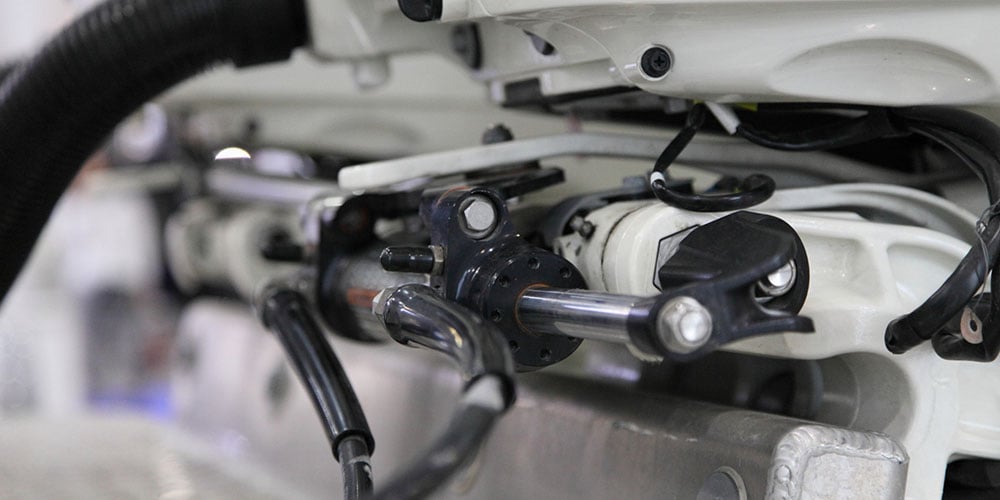
Hydraulic boat steering transforms how a boat handles — particularly with high-torque outboards, twin-engine setups, or any application where mechanical steering becomes heavy, imprecise, or fatiguing at speed. Unlike mechanical cable steering, a hydraulic system physically isolates the helm from propeller torque and engine vibration, so the wheel turns only when you intend it to, holds a course without constant correction, and remains consistent whether you're trolling at 5 knots or running at 60mph. West Marine stocks complete hydraulic steering packages — most include a helm pump, hydraulic cylinder, and steering fluid — as well as individual components, hoses, fittings, and upgrade parts to fit virtually any vessel type from a single-engine runabout to a twin-engine cruiser to 70-foot workboats.
- Types of Hydraulic Steering Systems
- Parts of a Hydraulic Steering System
- Hydraulic Cylinders
- Baystar and Seastar Outboard System
- Seastar, Capilano and Hynautic Sterndrive Systems
- Seastar, Capilano and Hynautic Inboard Systems
Types of Hydraulic Steering Systems
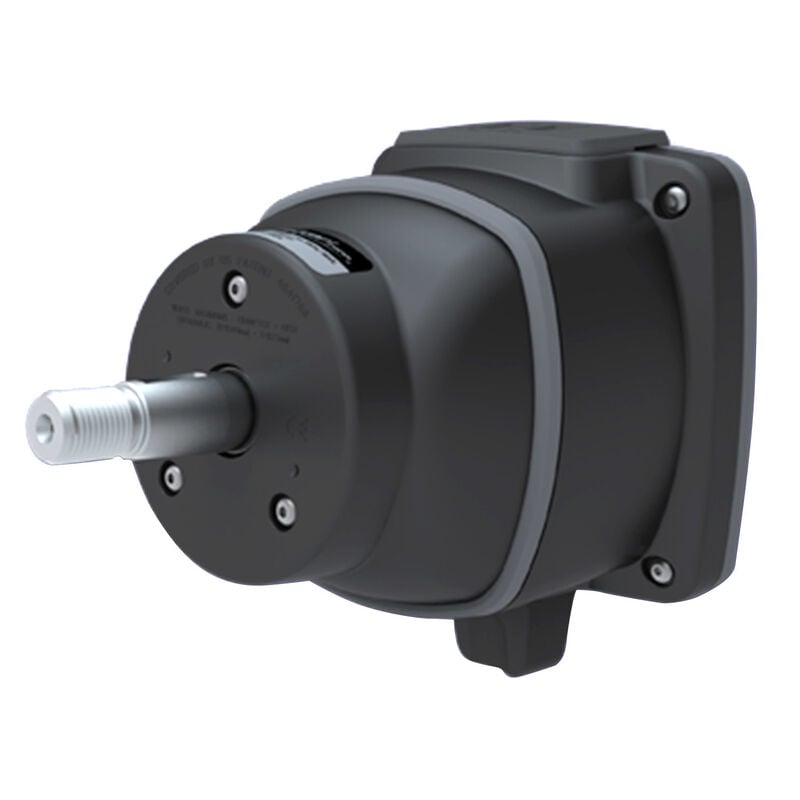
The SeaStar classic tilt helm is adjustable to five wheel positions to find the most comfortable steering position and is a popular pick for hydraulic boat steering systems.
Understanding which hydraulic steering system is right for your boat starts with understanding the four fundamental architectures and what each is designed to do.
Two-line manual systems are the most common configuration for recreational boats. When you turn the steering wheel, the helm pump displaces hydraulic fluid into one of two lines running to the cylinder — a clockwise turn sends fluid into the starboard line, which pressurizes one side of the cylinder's internal piston. That piston moves a rod connected directly to the engine's steering arm or a rudder, turning the boat. As the rod extends on one side, it retracts on the other, and the displaced fluid from the opposite end of the cylinder returns to the helm via the port line. The entire system is self-contained and requires no external power source. For the majority of single and twin-engine recreational boats from 20 to 50 feet, a two-line manual system is the correct choice.
Three-line manual systems (Hynautic) operate on a pressurized circuit with a separate remote reservoir and pressure-relief valve — a meaningfully different architecture from two-line systems. Because the fluid reservoir and relief valve live remotely rather than at the helm, the helm itself is simpler and more compact. Fluid fill and pressure checks happen at the reservoir rather than at the wheel. Three-line systems use soft copper refrigerant-type tubing rather than nylon hose, which is standard installation practice on commercial and work vessels. These systems are rated for boats up to 70 feet and are frequently specified where multiple steering stations, higher fluid volumes, or commercial-grade durability are required.
Power assist systems address the limitations of manual hydraulics at the extremes of recreational performance — outboards above 150hp, bass boats, pontoon boats, power catamarans, and inboard cruisers without engine-driven assist. Rather than relying on helm-pump pressure alone, a power assist system adds an electronically-controlled on-demand hydraulic pump that supplements steering force. The result is a steering effort comparable to a modern automobile regardless of engine size, speed, or number of engines. Power assist systems activate only when needed, drawing minimal power at rest and delivering additional hydraulic pressure the moment you begin a turn.
Full power steering systems are the correct specification for larger vessels where rudder loads exceed what a manual or power-assist circuit can handle effectively. These systems operate two distinct circuits simultaneously:
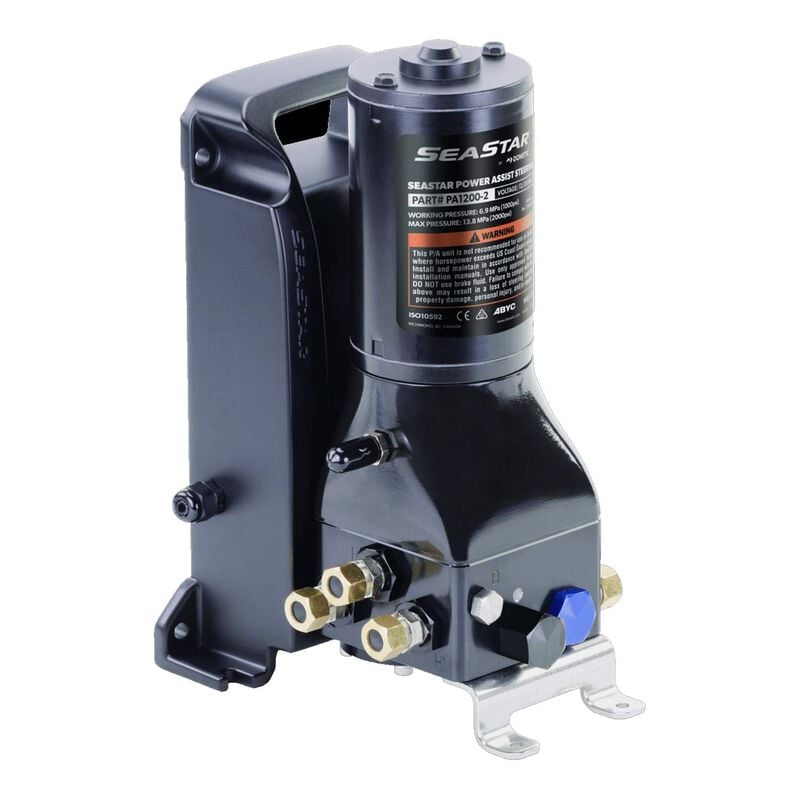
SeaStar power assist is a hydraulic steering part upgrade for existing hydraulic steering and boosts the pressure to make steering easier and more responsive.
- A "manually-operated" hydraulic system of a standard SeaStar helm pump and hydraulic cylinder (fitted with an integral servo cylinder and power steering valve), and
- A "power" steering system of either an engine-driven pump (conventional) or an electrically-operated power assist pump.
The manual circuit handles precision control — it's what the helmsman actually operates. The power circuit handles the physical work of moving the rudder under load. The two circuits are linked through the servo cylinder so that control inputs from the helm are amplified, not replaced. The Optimus 360 system, which is NMEA 2000 compatible and uses a joystick control, represents the current evolution of this architecture for twin-outboard performance applications.
Parts of a Hydraulic Steering System
Every hydraulic steering system — from the simplest BayStar kit to a full Hynautic three-line installation — is built from the same two fundamental components: the helm and the cylinder. Knowing what each does and how they interact is essential for selecting the right system and for troubleshooting when something isn't right.
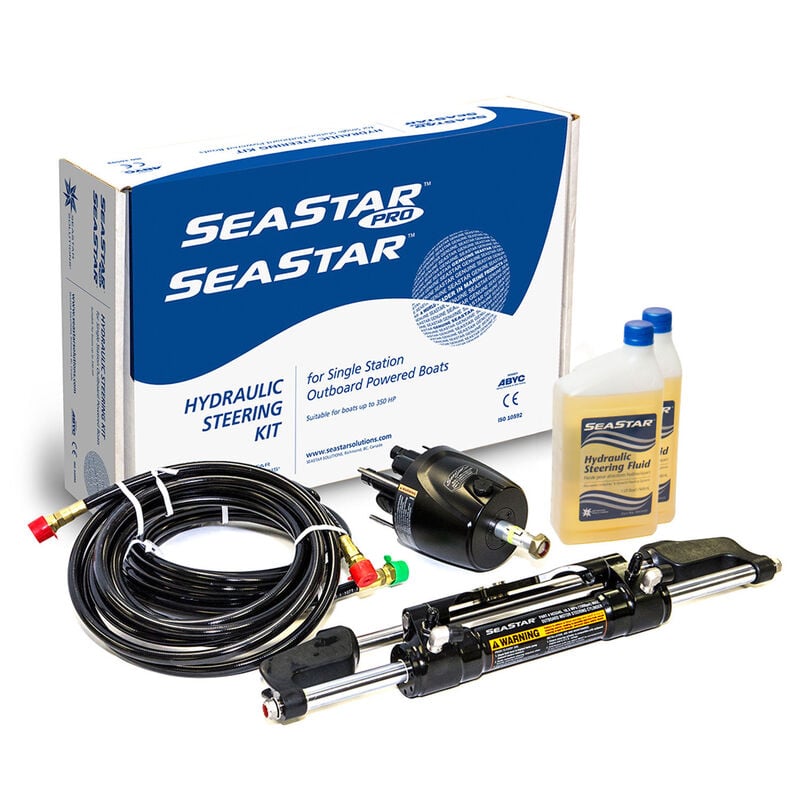
Full marine steering systems kits, like this one from SeaStar, include the helm, cylinder and optional hoses all in one box.
The helm is a hydraulic pump integrated with a precision valve assembly. When you turn the steering wheel, the shaft rotates a swashplate inside the helm body, which sequentially actuates a ring of small piston pumps. This multi-piston design is what gives SeaStar and similar helms their characteristic smooth, consistent feel — each piston displaces a small, precise volume of fluid, unlike a single large piston whose output would be uneven through the stroke. The integral check valve assembly prevents fluid from flowing backward through the pump, which is the mechanism that eliminates kickback to the wheel even when propeller torque or wave action loads the cylinder. In popular helms like the SeaStar and SeaStar PRO, the helm body also incorporates the fluid reservoir and a pressure-relief valve, which limits maximum system pressure to prevent component damage if the cylinder reaches full travel. Some installations — particularly Hynautic three-line systems — separate these functions into distinct remote components.
In operation: a clockwise turn at the wheel pressurizes the starboard hydraulic line, driving fluid into the cylinder and extending or retracting the rod, which steers the engine or rudder. Return fluid from the opposite end of the cylinder travels back to the helm via the port line. The system is closed — no fluid is consumed under normal operation, which means a properly maintained hydraulic system should require no fluid additions between scheduled service intervals. If you're adding fluid, there is a leak in the system that needs to be found and corrected before it becomes a steering failure.
Choosing a Helm
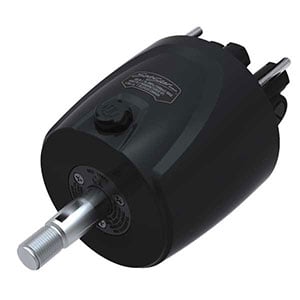
Dometic's SeaStar PRO 2.0 helm HH5770 includes unique check valves to counteract torque from large outboards (similar in function to No FeedBack mechanical steering).
Helm selection comes down to three variables: boat length, engine horsepower, and top speed. The SeaStar 1.7 helm covers the broadest range of recreational applications — boats to 40 feet, outboards with up to a V-6 engine, and speeds to 50mph. It's the correct choice for the majority of center console, walkaround, and cruiser applications in this range. Step up to the SeaStar PRO for boats running larger outboards up to 300hp and speeds above 60mph. The PRO operates at pressures up to 1,500psi and incorporates enhanced check valve engineering that actively counteracts propeller torque — the equivalent of mechanical No-Feedback steering but in a hydraulic package. Its increased 2.0 cubic inch displacement delivers faster steering response at the cost of slightly higher helm effort, a tradeoff performance boaters consistently prefer. The SeaStar regular helm is also available in 2.0 and 2.4 cubic inch displacements for boats with larger cylinders or twin-station applications that require additional fluid volume per lock-to-lock cycle.
Bezel and back plate kits reduce helm protrusion from the dash and allow SeaStar front-mount helms to be retrofitted into dash openings previously occupied by mechanical steering or older SeaStar units — useful for upgrades where cutting a new dash hole is not practical.
Tilt steering is available as an option for BayStar, SeaStar, and SeaStar PRO, providing five adjustable wheel positions for helm comfort across different operator heights and seating positions. Tilt is not available for Capilano or Hynautic systems.
Hydraulic Cylinders
The cylinder is the actuator — the component that converts hydraulic pressure into physical movement of the engine or rudder. It consists of a bored aluminum or stainless cylinder body, an internal piston sealed with hydraulic-rated O-rings, a chrome or stainless external rod, and attachment hardware appropriate to the installation type. The cylinder receives pressurized fluid from the helm, and the piston's movement extends or retracts the rod, which connects directly to the engine's steering arm or the vessel's rudder linkage.
Current-generation outboard-mounted cylinders mount directly to the engine's tilt tube and connect to the engine's integral steering attachment point — meaning the cylinder exerts its force entirely between two points on the outboard itself, without loading the hull, transom, or deck. This is a significant design advantage over older transom-mount configurations, which required the hull to absorb steering reaction forces.
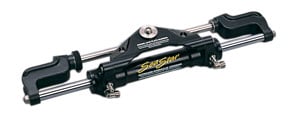
Front-mount pivoting outboard cylinder HC5345 is the most popular model for SeaStar and SeaStar PRO systems.
The distinction between balanced and unbalanced cylinders matters most when autopilot integration is a requirement. A balanced cylinder uses the same volume of hydraulic fluid to move the rod an equal distance in either direction — port deflection and starboard deflection are hydraulically symmetrical. This symmetry is what autopilot pumps require to make accurate, repeatable course corrections. An unbalanced cylinder moves the rod the same physical distance in both directions, but the fluid volumes are different because the rod occupies space inside the cylinder on one side. Autopilot systems cannot compensate for this asymmetry, which is why unbalanced cylinders — including those in older BayStar kits HK4200 and HK4230 — are incompatible with autopilot installations. If autopilot is on your list, confirm a balanced cylinder is part of the system before purchasing.
For inboard and sterndrive applications, cylinder selection requires matching the specific drive brand, model year, and engine configuration. SeaStar Solutions (formerly Teleflex) maintains a detailed online selection guide at www.seastarsolutions.com that walks through this process step by step. For applications outside the guide, or where multiple cylinders and helm displacements need to be compared, contact our technical staff for application-specific guidance.
Multiple helm displacements and cylinder combinations are available — except for SeaStar PRO — allowing you to adjust the number of lock-to-lock steering wheel turns to match your preferred handling feel. A lower lock-to-lock count gives quicker, more responsive steering; a higher count gives lighter, more gradual response. The right choice depends on your boat's hull type, speed range, and how you prefer to drive.
Steering hose carries hydraulic fluid between the helm and cylinder. For outboard applications, hoses are factory-manufactured to specific lengths with swaged fittings — field modification is not recommended and can compromise pressure ratings, potentially causing steering failure. Inboard and some I/O applications may use copper tubing rather than hose, particularly in Hynautic three-line systems.
Tie bar kits mechanically synchronize two or three engines so that a single steering input turns all engines in unison. Depending on the system, synchronization uses a mechanical tie bar, a drag link connected to fixed-mount cylinders, or a hydraulic (liquid) tie bar. The correct tie bar configuration depends on engine spacing, cylinder type, and whether independent engine tilt is required.
Autopilot integration requires a hydraulic pump teed into the existing steering circuit, and some systems require a third hydraulic line — a compensating line — to allow the autopilot pump to operate without back-pressure from the helm. SeaStar's Add-A-Station Autopilot Fitting Kit (HF5501 for outboards, HF5502 for sterndrive and inboard) contains the hardware for this. Some autopilot installations also require a rudder position sensor to give the autopilot closed-loop feedback on actual rudder angle.
BayStar and SeaStar Outboard Systems
BayStar™ Outboard
- Single-engine boats up to max. 150hp including runabouts and inflatables. Standard engine tilt tubes. Balanced cylinder.
- Compact helm with 5" footprint, needs 3" dash hole. 4.5 turns lock-to-lock
- Optional 5-position tilt helm, BayStar PLUS helm for quicker response
Not recommended for use with high performance, 150HP engines (such as Mercury Optimax 150HP engines) or single engine, high-speed boats (such as bass boats). Not for smaller HP outboard engines that use wing nut type transom mount clamping screws.
SeaStar Outboard (Front Mount)
- General purpose system. Typical applications include center console fishing boats and cruisers.
- Single and multiple engine capability. Independent engine tilt for twin engine installations. Total power to 700hp.
- Five turns lock-to-lock steering response.
SeaStar Outboard (Side Mount)
- Typical applications include center console fishing boats and cruisers
- All engines with threaded tilt (steering) tubes. Cylinder attaches to the engine tilt tube. Single and multiple outboard engine installations. Total power to 600hp in counter rotating application. (see the SeaStar Solutions web site). Suitable for installation in shallow splashwells and on engines fitted with power steering.
- Unbalanced cylinder with 4.8/5.7 turns lock to lock.
SeaStar Outboard (Splashwell Mount)
- Light duty alternative to front or side mount cylinders. Transom or hull mounted cylinder typically attaches to an anchor point on or near the inside of the boat's transom. Single and multiple engine capability. Fits engines with/without support (steering) tube.
- Total power to 600hp in counter-rotating application. Speeds to 60mph maximum.
- Unbalanced cylinder with 5.5/6.5 turns lock to lock
SeaStar PRO Outboard
- High speed, single-engine outboard boats, like bass, flats, combo race/ski and other performance orientated boats capable of speeds in excess of 65mph, up to 300hp. For use with high-performance propellers and jackplates.
- Compact helm has only a 4 7/16" footprint. Needs 3" dash hole (Tilt requires larger hole). Patented steering lock valves. 4.25 turns from lock-to-lock. Factory swaged hoses are Kevlar reinforced.
- Optional PRO Cylinders with longer shaft bushings and larger pivot bushings for an even more solid feel
SeaStar Tournament Series
- Extreme heavy duty cylinders and tiebars designed for high performance multiple-engine applications (also available for single engine applications)
- Application-specific cylinders and tie bars
- For use with SeaStar helms and hoses
SeaStar Cat/Pontoon Steering
- For outboard-powered catamarans and pontoon boats. Dual non-power-assisted outboards up to 450hp (600 combined horsepower for counter-rotating twin engines) with standard tilt tubes. Speeds up to 75mph and dual-station helms.
- Compact helm has only a 4 7/16" footprint. Patented steering lock valves. Independent engine tilt
Optimus 360 Joystick Control System
- Replaces the traditional hydraulic steering system with a joystick steering/shift/throttle control system, engineered for powerboats with twin mechanically-controlled outboards. The Optimus EST system replaces the boat's conventional outboard engine controls and cables. Optimus 360 is the culmination of the three sub systems which are interconnected and synchronized to provide intuitive joystick docking of the vessel with true fingertip control. Garmin and Raymarine each have introduced new CANbus autopilots (the GHP 20 and Evolution EV-DBW Drive-By-Wire) that work with this system.
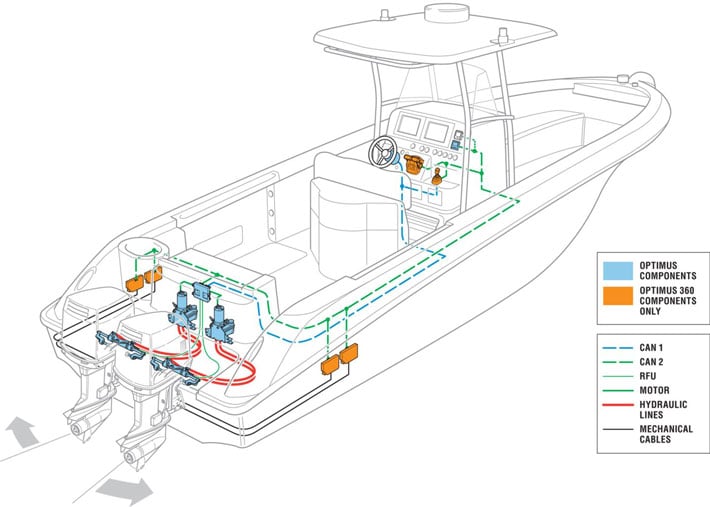
Optimus 360, the new SeaStar Solutions power steering system uses "smart" hydraulic cylinders and an electronic steering wheelhub. The components communicate via CANbus. It controls twin engines independently to make docking much simpler.
SeaStar, Capilano and Hynautic Sterndrive Systems
SeaStar Stern Drive Steering
- For non-power-assisted sterndrives and any stern drive system with an autopilot. Cylinders are specific to drive brands and models.
SeaStar/Capilano/Hynautic Heavy-Duty Sterndrive Steering
- For sterndrive, outboard and inboard boats that require external cylinders of substantial size and strength. K-5 cylinders are nickel-plated for aesthetics and protection. System components sold separately. Required wing plates and hardware not available from SeaStar Solutions. Available Capilano 2-line and Hynautic 3-line systems.
SeaStar, Capilano and Hynautic Inboard Systems
SeaStar Inboard (2-line system)
- Pleasure and workboat applications up to 50' with some exceptions. Most inboard-powered boats with single/twin engines. Single engine planing/displacement hulls 26' to 44'. Dual engine planing hulls 26' to 50'. Dual engine displacement hulls and sailboats from 26' to 44'.
- Dual station steering with optional hardware
Capilano Inboard (2-line system)
- Most inboard-powered boats with single/dual engines including planing or displacement hulls from 30' to 55'
Hynautic Inboard (3-line system)
- Heavy-duty 3-line system for boats to 70' with a wide range of helm displacements and cylinder configurations.
SeaStar Inboard Power Steering
- Boats up to 120'. Cylinders determined based on vessel size and hull type. Engine type determines which power steering pump is used.
Frequently Asked Questions: Hydraulic Boat Steering
What is the difference between hydraulic steering and mechanical steering on a boat?
Mechanical steering uses a cable or rack system that physically connects the steering wheel to the engine or rudder. At higher engine horsepower or speed, propeller torque feeds back through the cable and makes the wheel heavy or unpredictable. Hydraulic steering replaces the cable with a closed fluid circuit — the helm pump and cylinder are hydraulically linked, but there is no mechanical connection that can transmit torque back to the wheel. The result is consistent, effort-free steering at any speed or engine size, with no kickback and no correction needed to hold a straight course.
How do I know which hydraulic steering system fits my boat?
The three key variables are engine horsepower, boat length, and top speed. For a single-engine boat to 40 feet with a V-6 outboard and speeds to 50mph, the SeaStar 1.7 helm with a front-mount cylinder is the standard choice. For high-performance single-engine boats above 65mph or outboards to 300hp, specify the SeaStar PRO. For boats above 50 feet, twin-engine workboat applications, or vessels requiring a pressurized three-line circuit, move to the Capilano or Hynautic systems. For sterndrive and inboard applications, cylinder selection also depends on the specific drive brand and model year — the SeaStar Solutions selection guide at seastarsolutions.com covers these combinations in detail.
Can I add an autopilot to my existing hydraulic steering system?
Yes, but with one important prerequisite: your cylinder must be a balanced type. Balanced cylinders displace equal fluid volumes for equal rod travel in both directions, which autopilot pumps require to make accurate course corrections. Unbalanced cylinders — including those in older BayStar kits HK4200 and HK4230 — are not compatible with autopilot integration. Assuming you have a balanced cylinder, autopilot is added by teeing an autopilot pump into the hydraulic circuit using SeaStar's Add-A-Station Autopilot Fitting Kit (HF5501 for outboards, HF5502 for sterndrive and inboard). Some installations also require a compensating line and a rudder position sensor.
Why does my hydraulic steering feel spongy or require more turns than it used to?
Sponginess and increased lock-to-lock turns almost always indicate air in the hydraulic system. Air is compressible, so any air pocket in the circuit absorbs helm pump displacement that should be going to the cylinder, making steering feel vague and increasing the number of turns needed to achieve full deflection. The fix is a full system bleed — removing air from the circuit by cycling the helm while topping up fluid at the reservoir. A hydraulic steering system is a closed circuit and should never require fluid additions under normal use; if you are adding fluid, locate and repair the leak before bleeding, or the air will return.
What hydraulic steering fluid should I use?
Use only fluid specified for your system — SeaStar and BayStar systems require SeaStar hydraulic steering fluid (HA5430 or equivalent). Do not substitute automotive power steering fluid, brake fluid, or generic hydraulic oil. Marine hydraulic steering systems use specific O-ring compounds and seal materials that are compatible with their designated fluid but can be damaged by automotive alternatives, leading to seal failure and steering loss. Always check your helm's fluid specification label before topping up or performing a full system flush.