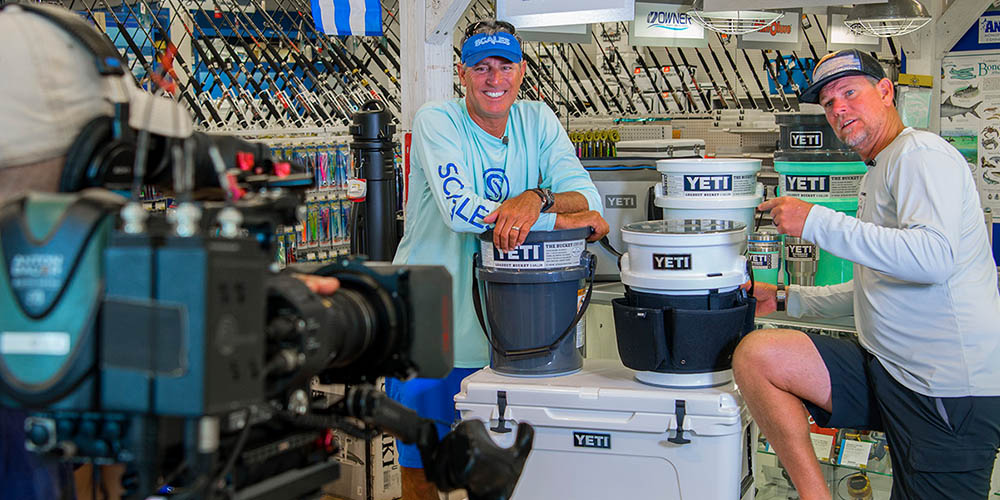
Steve Rodger and Scott Walker are the co-hosts of Into the Blue, one of the most respected offshore fishing series on television. Steve is a Florida Keys captain who holds the Key West record for dolphin fish and has spent decades guiding anglers to yellowfin tuna, swordfish, and billfish in the waters around the Keys. Scott is a charter captain and tournament angler based in Marathon who has fished competitively across the Caribbean, Mid-Atlantic, and internationally — including a 1,000 lb bluefin tuna catch-and-release in Nova Scotia.
West Marine associate Sharon Halcomb sat down with Steve and Scott to talk about their techniques, fish stocks, tackle preferences, and what it takes to catch and responsibly release big game fish. Below you’ll find key takeaways from their conversation, followed by the full interview.
- Kite Fishing: What It Is and Why It Works
- Tuna Techniques: Live Bait Over Jigging
- How to Release Big Game Fish Correctly
- Fish Stocks in the Florida Keys: A First-Hand Account
- Full Interview
Kite Fishing: What It Is and Why It Works
Kite fishing is the dominant technique for targeting sailfish, dolphin, and tuna in the Florida Keys — and according to Scott Walker, who has been fishing the Keys for over 35 years, it consistently outperforms conventional trolling. The core principle is deception through invisibility.
A fishing kite is flown from the boat like a recreational kite, but with a release clip on the line that holds the fishing line. The live bait is attached below the clip, suspended so that it struggles at the very surface of the water. Because the leader and hook are held above the surface by the kite, nothing below the surface is visible to the fish. A pelagic species — sailfish, tuna, or mahi-mahi — approaching from below sees only a struggling baitfish with no line, no terminal tackle, and no boat shadow near the bait.
The result, in Scott’s words: “It’s a dinner bell that rings as loud as any bell you have ever heard rung.”
The setup is also accessible to recreational anglers. Electric kite reels are affordable and straightforward to use. A fishing kite costs around $100. The full system — kite, reel, clips, and rigging — can be assembled for under $500, and the technique applies to any boat large enough to run bait offshore.
Key points from Scott on kite fishing:
- The leader and hook are never in the water during the presentation — the fish sees only the bait.
- Live bait is rigged to struggle at the surface, which triggers aggressive strikes from pelagic species feeding below.
- Electric kite reels make the technique manageable for recreational anglers without a professional crew.
- Kite fishing requires practice to master, but the learning curve pays off quickly in increased hookups on pressured fish.
Tuna Techniques: Live Bait and Chunking Over Trolling
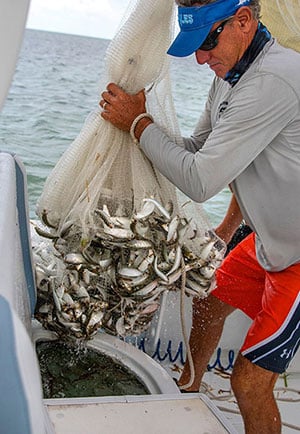
First things first. Fishing doesn’t really begin until after Steve and Scott catch a load of bait.
Both Steve and Scott are emphatic that for tuna, live bait and chunking outperform trolling in most conditions. Steve’s approach is to spend the first part of the morning catching a baitwell full of live bait before making a single offshore run — sometimes three to four hours of bait catching that puzzles clients who have paid for fishing time. The payoff: once offshore with live bait, the session becomes significantly more productive than running with lures from the dock.
The chunking technique Scott describes from Nova Scotia is the same principle applied at anchor: positioning the boat over or near a concentration of fish, deploying chum or cut bait continuously into the current, and fishing live or fresh-cut bait in the resulting slick. The fish feed up-current and become increasingly aggressive as the chum trail builds. Scott’s description: “Before an hour is up you’ve got like 800 pound tuna eating out of your hand.”
Steve’s most exciting variation: topwater lures on tuna feeding on the surface near working shrimp boats. Tuna that have been following a shrimp boat’s by-catch will hit almost anything thrown at them — including flies and improvised lures — providing visual, sight-cast fishing that’s rarely associated with offshore tuna.
How to Release Big Game Fish Correctly
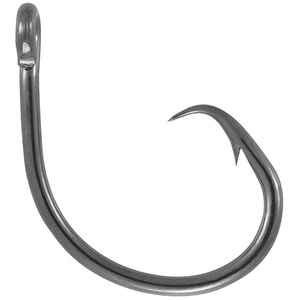
Usage of circle hooks greatly increases the chance that released fish will survive.
Steve and Scott have released thousands of billfish and large pelagics over their careers and have developed clear, science-backed practices for maximizing survival after release. Their approach:
Fight the fish as hard as your tackle allows. The longer a fish is fought, the more exhausted it becomes and the lower its post-release survival probability. Use tackle matched to the fish — not the lightest possible for the challenge of the fight. Scott is explicit: “The longer you fight the fish, the more exhausted it’s going to be. Catch ’em quick and use the appropriate tackle.”
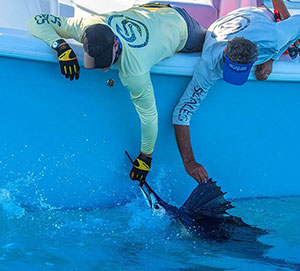
Keep billfish in the water. For billfish specifically, Steve and Scott never bring the fish onto the boat for a photo. The fish is brought alongside, the hook removed or the leader cut, and the fish released boatside. The additional stress and physical damage of boating a billfish significantly reduces its survival probability compared to a waterside release.
Run water through the gills before releasing. A fish that has been fought hard is oxygen-depleted. Steve’s technique: hold the fish facing into the current or drag it slowly behind the boat at idle speed for several minutes before release. This passes oxygenated water through the gills and allows the fish to recover aerobically before being on its own. “Some people are a little bit quick to turn the fish loose,” Steve notes. If the fish shows visible signs of exhaustion — lying on its side, slow to right itself — it needs more recovery time.
Use circle hooks. Circle hooks reduce deep hooking dramatically, resulting in far more lip-hooked fish that can be released with minimal injury. Scott credits the widespread adoption of circle hooks with the recovery of sailfish populations in the Florida Keys over the past two decades.
Fish Stocks in the Florida Keys: A First-Hand Account
Scott Walker has been working on the docks in the Florida Keys for 30 years. His account of species population changes during that period is detailed and largely optimistic about the effectiveness of management measures:
- Swordfish: After a longline ban in the Florida Keys, swordfish populations have recovered dramatically. “15 years ago, swordfish were extinct in our eyes, and now we can catch them almost any day we want to.” The Keys is now considered one of the premier swordfish fisheries in the world.
- Sailfish: Circle hook adoption combined with strong catch-and-release culture has kept sailfish populations stable or improving. Scott considers Florida Keys sailfishing as good today as it has ever been in his 35 years.
- Red and black grouper: After significant population declines, both species have recovered to what Scott calls “fair, I would almost say good” numbers under strict per-person limits.
- Nassau grouper: The one species Scott considers a genuine loss in the Keys. Nassau grouper have essentially disappeared from the fishery despite protections.
- Red snapper: Annual catch limit regulations have produced a remarkable recovery. Steve describes going from sparse populations in his childhood to current conditions where “you can’t get away from them.”
- Mahi-mahi: The one species both Steve and Scott flag as under pressure, attributed to longline pressure in the Carolinas intercepting fish before they migrate south.
- Yellowtail snapper: Stable across the full 30 years Scott has been observing the stock, despite consistent commercial and recreational harvest.
The broader picture: both Steve and Scott attribute the generally positive trend to increasingly effective management through annual catch limits, gear restrictions (longline bans, circle hook requirements), and improved compliance monitoring. Neither endorses a view that the fishery is unmanaged or in crisis.
Full Interview: Sharon Halcomb with Steve Rodger and Scott Walker
West Marine associate Sharon Halcomb interviews Steve Rodger and Scott Walker, co-hosts of the TV series Into the Blue.
Sharon: How has the success of the show affected your lives?
Steve: With the great success of the show it seems like I get more days when I can go out and actually go fishing with my friends and my family.
Sharon: Can you give us a brief overview of your lives and how you got started in fishing?
Scott: I started with my aunt and uncle out of Ocean City and was on the water every day starting at age 13. I’m a little anal about preparation, but it has paid off for me. Into the Blue has been a great stepping stone for me to get back into competitive fishing.
Sharon: Who gave you guidance when you were younger and starting out in your fishing career?
Scott: I would say it was my father. We fished out of Ocean City, Maryland. We’d tease the fish for miles into shallow water.
Sharon: What kind of fishing really excites you?
Scott: Trolling for white marlin. Been doing it my whole life. I’ve done it in Venezuela, all over the Caribbean, Cancun, Isla Mujeres and the Mid Atlantic from North Carolina, Virginia, to Ocean City, Jersey. I will do it until the day I die. I’ve been doing it since I was 16 years old. I remember my first bite and my last bite and I’m thinking about my next bite.
Steve: Sight casting. Live bait. Artificial bait. Love catching permit. Love sight casting big dolphin that are surfing the waves. Sight casting with live bait or artificial. Love throwing bait to tailing billfish. It could be cobia, it could be barracuda on the flat. Love stalking the fish and presenting the bait and the opportunity, not sitting and waiting to get lucky.
Sharon: Scott, when you go for those big marlin, do you ever use a fighting chair?
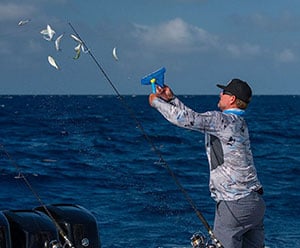
Hors d’oeuvres for the big brutes.
Scott: I’m all about stand up. I’ve been in a fighting chair and as a mate for a long time. I know how to work a fighting chair, know how to train someone and how to use one myself. Last year I finally got to catch a 1000 pound bluefin up in Nova Scotia and got to use a chair which is exactly what they are for, conquering a big fish. We do a lot of sight fishing. It’s standup with spinning tackle. We can use conventional, but given our choice, with the great new innovations from Shimano, standup with a spinning rod is about as good as it gets.
Steve: No rail fishing on the East Coast. I’ve never seen anyone rail fish. That seems to be a West Coast thing only.
Sharon: Scott, what is the biggest fish you ever landed?
Scott: Me and my aunt and uncle fought a grand or bigger bluefin for 10 hours. Marlin up to 857, mako shark up to just under 800, some tiger sharks pushing a thousand.
Sharon: Bluefin? You say you got a 1000 pound bluefin? Is that what you said? Up in Nova Scotia?
Scott: Yea, catch and release.
Sharon: How about you, Steve?
Steve: (Takes a sip from his drink) Ummmm, so all my memorable ones … I caught a 204 pound yellow fin here in Key West. I speared one with my spear gun, 198 pounds. I have the Key West record dolphin at 72.4 pounds. It was six and one-half feet long.
Sharon: What’s the longest it took you to catch any of those big fish?
Steve: Some of those tunas? Too long! (laughter) As I get older, I’ve learned you gotta pop ’em or stop ’em and put it to ’em. I had a client catch one that was like 190. I think we spent like six hours on that fish. On 50 pound test — and the water was only like 200 feet that we hooked ’em in. But no rail, short standup rod with a belt on and just — they’re not prepared, I’m not prepared, plus me being scared not to lose ’em — I didn’t want to put the pressure, that’s the mistake! I didn’t want to let the drag go up far enough.
Steve: (Back to previous question) The biggest swordfish I ever caught was 330. So that was a pretty neat fish. Still waiting to get a 500 pounder.
Sharon: You ever have a shark try to take your fish?
Scott: Yep, they’re a nuisance.
Steve: All the time. We have a major problem with sharks. They’re becoming very trained to where they’re following the boat. They’re learning. They’re smart animals. We battle sharks daily. We run from sharks all the time.
Sharon: How did you get your start as fishing celebrities?
Steve: Throughout my career, multiple celebrities would come down to the Keys. I did numerous shows with a lot of celebrities and Jose Wehebe was a good friend of mine. I did maybe a dozen shows with Jose. Great guy, always had time for the people. So Jose and I, we did a lot of fishin’… and through that we masterminded a show called the “Mad Fin” Shark Series which was aired on ESPN. Through that I was approached by Tom Roland and Scott to do a show with them.
Scott: I started out at Hawks Key Resort. I was the big dog on the dock.
Sharon: What advice do you have for anglers that want to get into professional fishing?
Steve: I would never discourage it. I would say follow your dreams. I would tell somebody if their passion is to be on the water it’s a great place, it’s very peaceful, it’s soothing, it’s exciting, it’s ever changing, it’s always mesmerizing, so my advice would be if that is your dream and your passion, to go for it.
Scott: (Chimes in) One hundred percent and make it (the dream) happen.
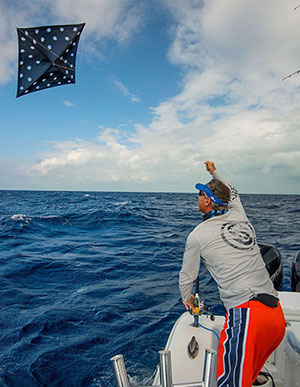
The “dinner bell” is about to ring!
Sharon: Is there a species of fish that you would like to catch, or a place in the world that you would like to fish but never had the opportunity?
Steve: The Ascension Islands. I’ve seen some videos of 100 pound yellowfin eating out of people’s hands. That seems pretty amazing. Beautiful clear water, I think I would really enjoy seeing big animals like that up close.
Sharon: How about you Scott?
Scott: I just have one fish left. And that’s a black marlin. I’m either going to get it in Panama or somewhere, but probably Panama in the near future. Other than that, Africa or the Azores, chasing the blue marlins around.
Sharon: What’s your preferred tackle and technique for fishing say tuna?
Scott: Live bait.
Steve: We spend the morning catching a load of bait. My day doesn’t begin until we have a load of bait in the well. Sometimes we’ll spend three or four hours, with people staring at me thinking, “we’re paying money for this?” But the point is that once we have the bait then we go offshore and we own it. The fun for me is to throw top water lures at tuna that are bustin’ on freebies. That’s my absolute most exciting way to do it.
Steve: (continuing) I took Scott out to a shrimp boat that trawls all night and in the morning throws the by-catch over. There can be 100 to 400 tuna following that boat. We’ll pull up to them, and pretty much you can handline ’em, catch ’em on a piece of tee shirt, catch ’em on a fly rod. You can do anything you want with them, because they have spent a month behind that boat just eating. That’s always a neat fishery to take people to — very visual.
Scott: Chunking the shrimp boats is kinda the same technique as when I was up in Nova Scotia. The more bait you can throw over — you’re anchored, you’re not trolling. Before an hour is up you’ve got like 800 pound tuna eating out of your hand. It’s pretty amazing. Definitely the live bait and the chunking versus trolling for tunas.
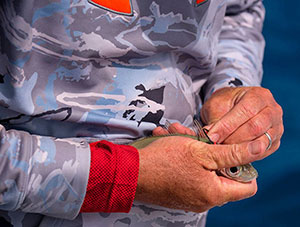
Baiting up.
Sharon: How about yo-yo jigs? Do you ever do that? Dropping it to the bottom and reeling up as fast as you can?
Steve: Is that like a metal jig, like a butterfly jig? Like a “Flat Fall” jig?
Sharon: Yes.
Steve: We do. It’s exciting. Believe me, we go yo-yo jigging as soon as we don’t catch the bait!
Sharon: How about rock fishing?
Scott: We have snappers. Red snappers. Mutton snappers and grouper.
Sharon: Do you have a preferred tackle or technique for bottom fish?
Scott: We both fish for the same fish and we both do it differently. I do it with a drifting boat and live bait on the bottom at 200 feet. We hit the spot over and over and keep resetting. Steve sets up with an anchor and chums.
Sharon: For our customers who have never done it, can you describe kite fishing? How you rig for kite fishing and the concept behind it?
Scott: Kite fishing in the Keys is the preferred way to fish verses the traditional way to fish. The kite suspends the bait at the surface of the water with nothing for the pelagic to see. The sailfish, dolphin or tuna can’t see the leader or even the hook because they are at the top of the fish. The leader system is not even in the water. You have a fish struggling at the surface. It’s a dinner bell that rings as loud as any bell you have ever heard rung!
Sharon: Is kite fishing just for professional fishermen or can the average person with a 24’ boat do it?
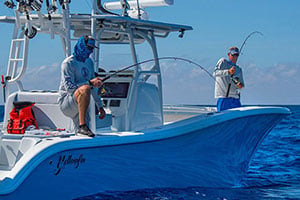
Dual hook-ups on spinning tackle.
Scott: Electric reels are affordable and easy to use and set up with a minimum of knowledge. Kites are about $100. You can do the whole system for under 500 bucks and it will make you a better fisherman. The more you use a kite, the more techniques you can learn.
Sharon: Transitioning to fish stocks. Where you fish the most, have you noticed an increase or decrease in any particular species?
Steve: I think fisheries are something that is always evolving and they are trying to figure it out. The South Atlantic Council has set up an ACL, which is the annual catch limit for commercial and recreational. It has worked really well with red snapper. A lot of people complain about not having the opportunity to fish for them as often as they would like, but from when I was a kid, we went from just a few red snapper to places where you can’t get away from them. People are running from them. (Talking about fish stocks) It is definitely something that can take a hit and bounce back. Mud snapper limits have been bumped down from 10 to 5 fish, which we feel is reasonable. Some things (fish stocks) have taken a lick. The mahi-mahi have taken a lick. There are some long line guys up in South and North Carolina that are getting them before they make their way down our way. But with technology and the way everybody sees what is going on, I think we have a better handle on it. We are definitely moving in the right direction.
Sharon: Anything to add Scott?
Scott: With the advent of circle hook fishing, fishing for sailfish in the Florida Keys in the 35 years I have been here is as good today if not better. As a charter boat captain who has been on the docks for 25 years, the yellowtail snapper have always been here, and even with commercial fishing and the ten fish limit, I have never seen that stock of fish go up or down. Groupers disappeared, but they are back. The regulations of one per person are strong. The Nassau grouper has pretty much disappeared from the Florida Keys. But red grouper and black grouper are back in fair, I would almost say good numbers. Swordfishing. After a long line ban in the Florida Keys, 20 years later now we have one of the top fisheries in the world. 15 years ago, swordfish were extinct in our eyes, and now we can catch them almost any day we want to. I’d say regulations are working and in the 30 years I have been working in the Keys fisheries, I’ve seen a wonderful balance of everything.
Sharon: Do you have any tips on how to best handle a fish to ensure its survival when you release it?
Scott: Don’t take ’em out of the water. The science is there. I understand both sides of the case. Light tackle records are great, but the longer you fight the fish, the more exhausted it’s going to be. Catch ’em quick and use the appropriate tackle for the size fish you are after. And if it’s a billfish, get ’em alongside and hang over them rather than taking them out of the water. Scott and I don’t take them out of the water for Into the Blue. I would never condemn anybody for popping them out of the water quickly, ’cause in the 70s and 80s I caught tens of thousands of ’em and the ones I released where I wrote, “probably died” on the certificate were caught two or three years later. They’re tougher than you think.
Steve: Take your time releasing them. Definitely run a lot of water through the fish. Make sure he is ready. You want to make sure the fish has had a chance to get some oxygen back in ’em. Some people are a little bit quick to turn the fish loose. If you notice the fish is really run down and beat up, you want to help ’em along and maybe drag ’em behind the boat for a while to make sure he gets that oxygen through the gills.
Sharon: What’s your favorite fish to eat and favorite way to cook it? Or I should say prepare, since you don’t always have to cook them.
Steve: So raw, my favorite sashimi is cero mackerel. I do like hamachi, which is your yellowtail.
Sharon: What kind of mackerel is that?
Steve: Cero mackerel, c-e-r-o. That is the one I like here. It is the best sashimi in my mind that there is. The second would be the hamachi, which is your west coast fish, the yellowtail. Those two are my favorite raw fish. When it comes to something I really enjoy, it’s some pan fried grouper. Yellow edge grouper, some scamp grouper, black grouper. Just a little bit of olive oil, maybe some panko, just in the pan; not deep fried. Have that with some rice and beans and the family is pretty happy!
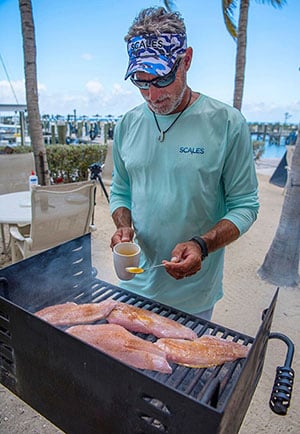
At the end of the day, the fillets go skin down on the grill. Brushed with a little butter and garlic, they are sooooooo good. Yea buddy!
Scott: Raw first. My favorite would be wahoo, of course the tunas. Mangrove or yellowtail snapper, mud snapper cooked on the grill. Skin down, brushed with butter or garlic. Serve it hot. I blanket a lot of fish as well, but my go-to is grilled fish with a little butter and garlic.
Sharon: It’s lunchtime here and you are making me hungry!
Sharon: Do you shop at West Marine?
Steve: Yep, that’s where we shop. That’s the place to walk in and get exactly what you need. It’s all there. It’s a one-stop-shop. (talking about the store where he shops.) When maintenance day comes around, you can’t be ordering stuff you don’t have online, and West Marine is going to have it. Whether it’s a screw, a bolt, a nut, oils, rope, line, anchors, electronics.
Sharon: Which store do you normally go to? Which location?
Steve: We’ll usually use the Stock Island one — just because it’s closer to the marina. But we also use the one downtown as well.
Sharon: Do the people who work in the Stock Island store seem knowledgeable?
Steve: Yep, they do. But I don’t rely on anybody to tell me anything. I just need you to tell me where it’s at.
Sharon: How about you Scott? Where do you go?
Scott: We only have one. It’s in Marathon by Seven Mile Bridge. I’m a Port Supply (West Marine Pro) card holder. So I get great prices. They always have what I need. They have had many of the same employees for 10 years. There is a new face every now and then, but there is always a familiar face, and that is the important thing.