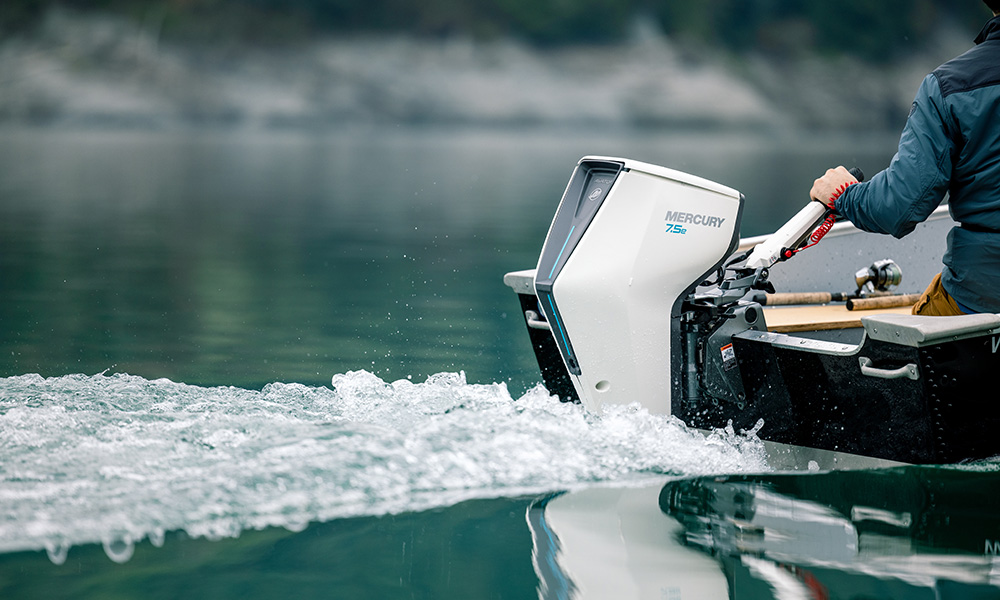
Electric mobility is changing boating more than most people expected, and faster. What started as a niche category — a handful of small, specialty units for kayaks and dinghies — has grown into a serious product segment. Mercury Marine, the world’s largest outboard manufacturer, has committed to electrification with its Avator lineup, which has expanded from the original 7.5e to include the 20e, 35e, 75e, and 110e. Torqeedo — long the category leader in marine electrification — was acquired by Yamaha Motors in 2024, signaling major OEM investment in the space. ePropulsion has established itself as a credible third option with competitive products at multiple price points. The electric outboard market is projected to grow from $910 million in 2024 to $1.64 billion by 2034.
But market growth does not answer the question that matters most to you: is an electric outboard right for your specific boating situation? The honest answer is that electric outboards are genuinely excellent for a defined set of applications, and genuinely the wrong choice for others. This guide will help you make that determination clearly.
The electric outboards we carry include the Mercury Avator 7.5e. The features and specifications discussed below focus on that model, but the decision framework applies to electric outboards generally.
What Electric Outboards Are Good At
Before getting into specific features, it helps to understand where electric outboards genuinely outperform gasoline engines — not just match them.
Noise. This is the most significant real-world advantage. The Mercury Avator 7.5e is documented as four times quieter than a comparable 3.5hp four-stroke at full throttle. In practice, this means a near-silent boating experience that transforms activities like wildlife watching, fishing in sensitive areas, and simply being on the water. Gasoline outboards — even modern, well-tuned four-strokes — produce a constant exhaust and mechanical note that shapes the entire on-water experience. Electric propulsion removes it entirely.
Instant, linear torque. Electric motors produce full torque from zero RPM. Unlike a gasoline engine that needs to rev into its power band, an electric outboard responds instantly and linearly to throttle input. Mercury’s Avator 7.5e produces immediate, full-power response that delivers acceleration comparable to or faster than a gasoline engine of nominally similar horsepower. The Avator 7.5e produces 750W of continuous power at the prop shaft and is rated for speed and acceleration comparable to a 3.5hp four-stroke.
Maintenance simplicity. No oil changes, no gear lube, no fuel system, no spark plugs, no winterization, no ethanol-related fuel degradation. A gasoline outboard has hundreds of components subject to wear and corrosion; an electric outboard’s drivetrain has a small fraction of that. Mercury recommends charging the Avator battery before storage and recharging every six months in long-term storage. That is essentially the maintenance program. The integrated Battery Management System monitors cell health and charge state to protect the battery automatically.
Emissions and access. Zero direct emissions at the point of use. This matters increasingly as water quality regulations expand. Numerous lakes and reservoirs across the United States — particularly in California and the Northeast — restrict or prohibit internal combustion engines entirely to protect water quality. In those locations, an electric outboard is not a preference but a prerequisite for motorized boating.
Advantages of Avator Electric Outboards
Minimal Maintenance
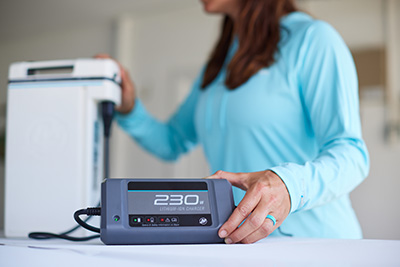
No oil changes, no gear lube, no winterization. The Avator 7.5e outboard is a breeze to maintain. Most of your care will be focused on battery charging and storage, and that’s not complicated either. Mercury recommends you charge the battery before storage and charge every six months if in long-term storage. The Avator system includes an advanced Battery Management System that monitors the battery to help keep it performing at its peak.
Easy to Use
Using the Avator outboard is just as simple as maintaining it. The tiller model clamps in place, with no extra cables or wires to connect. Then when it’s time to go boating, all you need to do is slide in the battery and push a button. No pull-starts, no priming, no warm-up period before loading the engine.
Easy to Transport
Most portable outboards are easy to haul around, but with electric, you get the advantage of having no fuel or fumes, meaning you could transport the outboard in your car to get to the water. Mercury enhanced this feature with the Avator 7.5e tiller outboard’s quick-release bracket system. The clamp bracket can remain on the boat, while the outboard itself is lifted off for carrying. The tiller also folds down to become a convenient carrying handle. As an alternative, there’s a carrying bag with rolling wheels that fits the 7.5e tiller model with 15-inch shaft.
Connected Technology
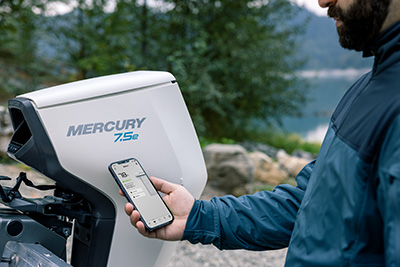
Engine-connected apps are not new from Mercury. Its VesselView Mobile® system is available for combustion outboards ranging from 25 to 600hp. With its electrification program, however, Mercury incorporated a series of new helpful tools into an Avator-specific app, like visualized range estimates to help you see how far you can go. The app is available for the 7.5e outboard with the addition of a Mercury SmartCraft® Connect module.
Digital Display and Throttle
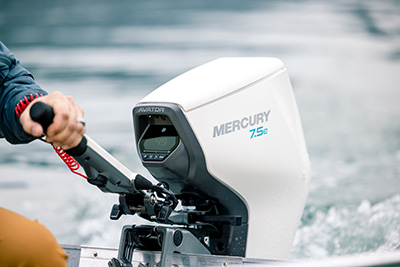
Mercury lets you manage and monitor the Avator propulsion system from the digital display, which is integrated into the outboard on tiller models. Throttle controls are also digital for smooth, responsive performance. The display shows state of charge and runtime remaining — replacing the analog gauges and cable throttle of a conventional outboard with a simpler, cleaner interface.
Exceptionally Quiet
This is one of the more attractive features of electric propulsion. The transverse flux motor technology Mercury uses in its Avator 7.5e outboard is whisper-quiet and ultra-efficient. Whether you’re into wildlife watching or simply want to immerse in nature — or in conversation — there’s no need to do it over the noise of an engine. The 7.5e outboard is four times quieter to the operator than a 3.5hp four-stroke outboard at full throttle.
The Torque Advantage
When considering an electric outboard and how much power you need, it helps to understand a few aspects of the technology. Electric motors spool up nearly instantly, delivering immediate power rather than requiring engine RPM to build into a power band. They also generate high torque across a broad range of speeds rather than only at peak RPM. Combined, these traits allow the Avator 7.5e to produce speed and acceleration that rivals internal combustion engines with a nominally higher power rating.
The Avator 7.5e generates a full 750W of power at the prop shaft and is capable of speed and acceleration performance comparable to a 3.5hp four-stroke outboard. Mercury reports 52% quicker acceleration than a comparable electric competitor at the time of launch. In practice, this means the power-to-performance ratio of an electric outboard is more favorable than the watt-to-horsepower conversion number suggests.
Where Electric Outboards Work Best
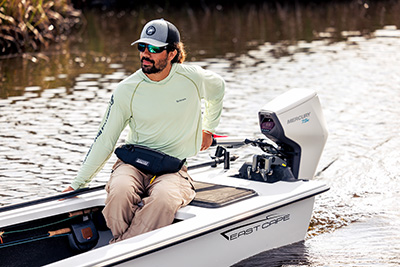
The right question when evaluating an electric outboard is not "is this as powerful as a gas engine" but "does it match what I actually want to do?" Electric outboards at the Avator 7.5e power level are not appropriate for offshore work, large boat powering, or any application requiring sustained high-speed operation over long distances. They are excellent — sometimes superior to gasoline alternatives — for the applications below.
Small Boats on Protected Waters
Small aluminum V-hull boats, jon boats, canoe-boat hybrids, dinghies, rigid inflatables, micro skiffs, and square-stern canoes are all natural fits. If you already own one of these, an Avator 7.5e gives you the ability to motor without hauling fuel, dealing with a pull-start, or smelling exhaust on a summer day. Many lakefront property owners maintain small boats for occasional outings — for that use case, an electric outboard with its internal battery requires no external fuel system and minimal setup time.
Secondary Sail Power
Electric outboards are a practical choice for secondary propulsion on sailboats or for sailboat tenders. The absence of a fuel system means no fuel storage or venting concerns aboard, and the quiet operation makes motoring into an anchorage or marina far less intrusive.
Electric-Only and Restricted Waters
Numerous lakes and reservoirs restrict or prohibit internal combustion engines entirely to protect water quality and aquatic ecosystems. Lake Tahoe, multiple East Bay and Santa Clara Valley water district reservoirs in California, and many other bodies of water across the country fall into this category. For boaters in these areas, an electric outboard is the only motorized option. Even where combustion engines are not prohibited outright, noise restrictions and slow-speed regulations on sensitive waterways make electric propulsion the practically superior choice.
Fishing in Sensitive or Shallow Environments
Anglers in shallow flats, backwater creeks, and sensitive ecological areas benefit significantly from electric propulsion’s near-silent operation. Fish are sensitive to sound and vibration transmitted through water; an electric motor produces no combustion noise and substantially less underwater vibration than a gasoline engine. This is separate from and in addition to the trolling motor category — a portable electric outboard like the Avator can both move the boat efficiently between locations and provide precise, quiet positioning in fishing spots.
One Complete Kit
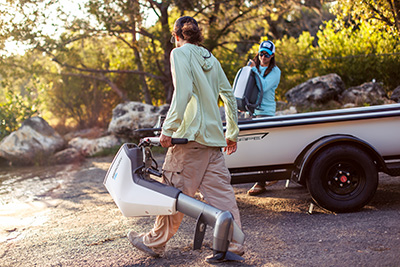
The Avator 7.5e tiller outboard comes with everything you need to get started in one complete kit: the outboard with integrated digital display, the quick-release transom bracket, a quick-connect lithium-ion battery, a charger, and prop. Clamp the bracket in place on the transom, slide in the battery, and you are ready. There is no need to source an external battery or a separately optimized charging system — though additional batteries and a faster charger are available for the Avator platform if you want to extend runtime or reduce recharge time.
What to Know Before Buying: Honest Considerations
Upfront cost is higher than a comparable gasoline engine. A new Mercury 3.5hp four-stroke outboard — which has comparable speed and acceleration to the Avator 7.5e — costs significantly less than the Avator kit. The premium reflects the battery system, digital controls, and connectivity features. Long-term maintenance costs are lower for the electric option, but the payback period depends heavily on how much you use it.
Range is fixed by battery capacity. A gasoline engine can be refueled in minutes at any marina. An electric outboard’s range is determined by battery capacity and throttle level — the Avator 7.5e on a Veer V13 boat runs 60 minutes or 5 miles at constant full throttle on one fully charged 1 kWh battery, or up to 19 hours and 34 miles at constant 25% throttle. In practice, most recreational outings fall between these extremes. The digital display and app provide real-time range estimates, so you are not guessing. Adding a second battery extends range proportionally. Plan your trips within the battery’s capacity, and the range is not a limitation — exceed it, and you have a problem. This requires honest assessment of how you actually use a boat.
Charging takes time, not seconds. The included 110-watt charger recharges a fully depleted 1 kWh battery in approximately nine hours from a standard household outlet. The optional 230-watt charger reduces this to approximately four hours. There is no marina-equivalent rapid fueling available. Plan charging around your outing schedule, not the other way around.
Battery temperature sensitivity. Lithium-ion batteries — including the Avator system — perform less efficiently in cold temperatures. Cold-weather paddling and boating will reduce available range compared to warm-weather conditions. Mercury’s Battery Management System manages cell-level protection, but boaters in cold climates should plan for reduced range in early spring and late fall conditions.
Electrification FAQ
How far can I go on one battery?
Range depends on throttle level, boat load, water conditions, and hull efficiency. According to Mercury, the Avator 7.5e on a Veer V13 boat runs for 60 minutes or 5 miles at constant full throttle on a fully charged 1 kWh battery, and up to 19 hours or 34 miles at constant 25% throttle. Real-world trips at mixed throttle settings will fall between these numbers — most recreational outings on small lakes or protected waterways easily fit within the available range. The digital display and companion app provide real-time state-of-charge and estimated remaining range so you can manage your trip accordingly. Additional batteries can be added to extend range.
How long does it take to charge?
The included Avator 110-watt charger recharges a fully depleted 1 kWh battery in approximately nine hours from a standard household outlet. The available 230-watt charger completes the same charge in approximately four hours, also from a standard outlet. Neither requires a special high-voltage charging circuit. The practical approach for most boaters is to charge overnight before a day on the water, the same way you charge a phone or tablet.
Will an electric outboard work on waters where combustion engines are prohibited?
Yes. Electric outboards produce zero direct emissions and no combustion products, making them compatible with electric-only lakes, reservoirs with internal combustion restrictions, and sensitive ecological areas where gasoline or diesel engines are prohibited. If your primary boating area has engine restrictions, verify the specific rules — most electric-only designations apply to gasoline and diesel combustion engines specifically, and electric propulsion is explicitly permitted or required.
How does the Avator compare to other electric outboards like Torqeedo or ePropulsion?
West Marine carries the Mercury Avator lineup. The broader electric outboard market also includes Torqeedo — a German manufacturer with a long track record in marine electrification, now owned by Yamaha following a 2024 acquisition — and ePropulsion, which offers competitive products at generally lower price points. All three compete in the small portable electric outboard category with broadly similar performance at the 1 kWh battery capacity level. Key differences are in battery integration approach (internal vs. external), app connectivity, weight, and specific features. If you want to compare specific models side by side, our store associates can walk you through the options we carry.
Is an electric outboard a good choice for a first-time boater?
Often yes, for the right application. The Avator system’s push-button start, digital throttle, integrated display, and elimination of fuel handling remove several of the operational complexities that trip up new boaters with gasoline outboards. For someone starting on a small lake with a modest boat, an electric outboard is genuinely simpler to operate safely than a gasoline equivalent. The range limitation is less of a concern for a new boater than for an experienced one trying to replicate long-distance gas-engine trips.
Electric Offers Options or an Alternative Based on Your Needs
For some people, electric propulsion offers an easy entry into boating that’s perfect for getting started. Even if you’re in love with your current Mercury outboard, you don’t need to give up the thrill of high-horsepower performance to also enjoy the electric experience. A small Avator electric outboard-powered boat might have a place in your personal fleet right next to your current rig for days when you want to enjoy the immersive, easy-boating experience that electric provides.