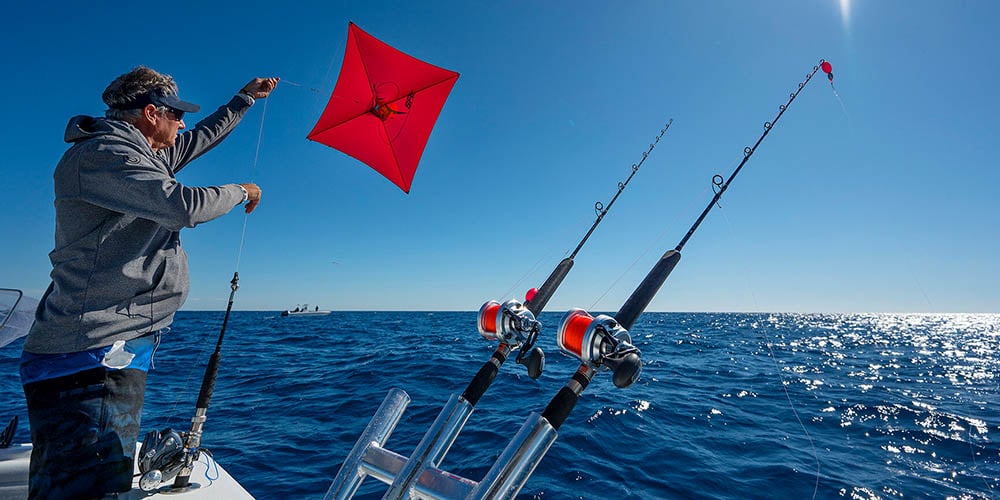
Is it hang gliding for baits, kite-sailing for greenies? Nope, it’s kite fishing, and it’s one of the most effective ways to present live baits to tuna, marlin, sailfish, kingfish and other surface-feeding game fish. A fishing kite lets anglers suspend live baits at the surface while keeping the leader and terminal tackle mostly out of the water, creating a natural, frantic presentation that can trigger aggressive strikes from wary predators.
Kite fishing has a long history. Early forms were practiced in China, New Guinea and other Pacific Islands, where shore anglers used kites to carry baits beyond the surf. In modern offshore fishing, the technique became especially popular in South Florida after fishing icon Bob Lewis helped introduce it to billfish anglers. The advantage is simple: a live bait can swim and splash just below the surface while the heavier leader line hangs vertically from above instead of trailing through the water where it may spook fish.
Experienced anglers often increase coverage by flying multiple kites. A common offshore spread may use up to three kites, with as many as three baits suspended beneath each kite, allowing nine live baits to fish different positions around the boat. The setup looks complicated at first, but each part has a job: the kite holds the line in the air, the release clips control bait position, the markers show where each bait is swimming and the fishing rods fight the fish when a bait is eaten.
- Kite Fishing Equipment
- Kite Rods and Reels
- Sea Anchors
- Kite Fishing Drift Technique
- Kite Fishing FAQ
Kite Fishing Equipment
Fishing kites are square and typically have a carbon-graphite frame across which is stretched rip-stop nylon fabric. Anglers fly kites with 50-, 80- or 100-pound Spectra or Dacron line connected to a stubby rod and a powerful reel. Electric reels are often employed, since reeling in a kite producing 15-20 pounds pressure can be tiresome. Kites vary in size and weight to accommodate light to heavy winds.
Carry an assortment of kites to accommodate different wind speeds. A light-wind kite may not have enough control in a stiff breeze, while a heavy-wind kite may not stay up when conditions go calm. Having backups also matters because kite line can break, a kite can crash or a kite can become difficult to retrieve once it hits the water. Some captains attach a small party balloon to the back side of the kite to help keep it afloat if it falls, saving valuable time during a tournament or hot bite. Helium balloons can also be used in light wind to help support the kite.
Each kite’s line has one or more release clips, like those used on outriggers, strung at intervals along the kite line; and each clip is assigned to a rod and reel. As many as three baits are suspended below each kite. When multiple kites are flown, anglers place small weights on the edge of each kite to control the direction they want to fly and prevent them from crossing over each other. The diagrams below depict what this looks like.
Mono-filament or fluorocarbon are attached to a fishing reel’s main line with a neon-colored Styrofoam marker about the diameter of your forefinger, with a snap swivel. These markers hover in the air above each of your baits and indicate their location. A dual or three-way rod holder on the transom holds your kite rod and one or two additional rods.
The marker system is important because kite baits are often spread away from the boat and can be difficult to track in glare, chop or low light. A bright marker lets the crew see when the bait is swimming correctly, when it has pulled too far from the surface and when a fish is approaching. Good communication between the kite operator and anglers on the bait rods helps keep the spread organized.
Kites can also be used from shore anywhere you have the wind at your back, allowing boat-less anglers with a little creativity to present baits way beyond normal casting range. With the right gear, kite fishing is easier than it looks.
Kite Rods and Reels
In addition to your preferred rods and reels for billfishing, for each kite that you fly, you will need a dedicated kite rod and reel.
Low-speed conventional reels like the Penn Senator 114H2 make a great choice for a kite reel. Power assist electric reels are recommended for even greater convenience, but at a substantially higher price. We stock a range of Daiwa electric reels that connect to a deep cycle battery with alligator clips, plug into a waterproof receptacle, or use a Lithium battery pack.
Kite rods are short and heavy, often with just one ring guide at the tip, about 3' in length. Their singular job is to hold the kite line. Your other rods hold your baits.
The bait rods should be matched to the species being targeted. Sailfish and kingfish setups may use lighter tackle than tuna, marlin or other large pelagic species. The goal is to keep the bait swimming naturally at the surface while maintaining enough drag and line capacity to fight the fish once it releases from the kite clip.
Sea Anchors
Kite fishing is often done while drifting as slowly as possible the bow to the wind or with the boat perpendicular to the wind. To do this, a sea anchor or drogue is attached to the boat's bow or to an a cleat amidships.
A sea anchor helps control drift speed and boat angle so the kite spread fishes properly. Without drift control, the boat may slide too quickly, causing baits to drag, kite lines to sag or the spread to collapse toward the boat. Slowing the drift also helps keep live baits in the strike zone longer, especially around current edges, color changes, reefs and offshore structure.
Kite Fishing Drift Technique
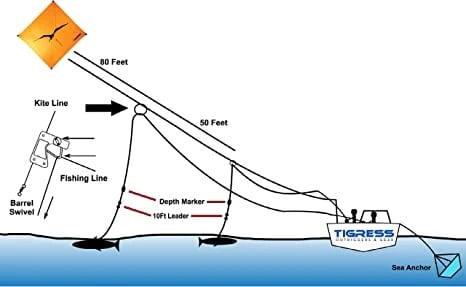
Drifting is the most popular approach to kite fishing, punctuated by surface strikes from aggressive game fish. Using two kites weighted to fly to the left and right with multiple baits off each kite line helps achieve maximum surface coverage. Flat lines used on the upwind side of the boat provide even more coverage. Using a sea anchor to slow the boat's drift can help the kite fly better.
Once the kite is flying, set the first bait closest to the boat and then work additional baits farther away. Keep each bait just at or below the surface so it splashes naturally without being dragged. If the bait is constantly pulled out of the water, lower it slightly. If the bait swims too deep or disappears from view, raise it by adjusting the kite line or release clip position.
When a fish eats, the line should pop free from the release clip so the angler is connected directly to the fish. Keep the boat organized during the strike. Clear unused lines as needed, maintain pressure on the hooked fish and watch the remaining baits because multiple strikes are common when predators push bait to the surface.
Kite Fishing FAQ
What species can you catch kite fishing?
Kite fishing is commonly used for sailfish, tuna, marlin, kingfish, mahi, wahoo and other predatory game fish that feed near the surface. The technique is especially effective when fish are wary of leaders or when live baits need to be presented naturally on top.
Why use a kite instead of flat lines?
A kite keeps most of the leader and line out of the water, allowing the bait to swim and splash at the surface with a cleaner presentation. This can help draw strikes from fish that might avoid a bait dragging behind heavy leader or visible terminal tackle.
How many baits can you fish from one kite?
Many offshore anglers fish up to three baits from one kite line using separate release clips. The exact number depends on crew experience, wind, sea state, available rod holders and how much spread control the crew can manage safely.
Do you need an electric reel for kite fishing?
You do not need an electric reel, but it makes kite fishing easier. A kite can pull hard in stronger wind, and retrieving it by hand or with a manual reel can become tiring. Electric reels are common on boats that kite fish often.
Can you kite fish from shore?
Yes. Kite fishing can be done from shore when the wind is blowing offshore or at a useful angle behind the angler. Shore-based kite fishing allows baits to be carried much farther than normal casting distance, but it requires open space, steady wind and careful line control.