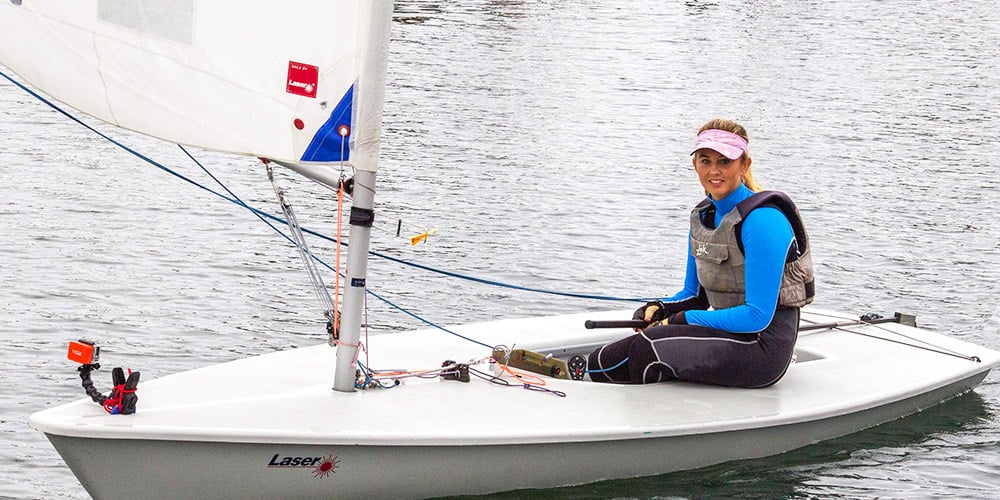
The Laser sailboat is one of the most competitive one-design racing classes in the world. Raced in more than 120 countries and featured in Olympic competition, the Laser rewards sailors who master boat handling, fitness, strategy and consistency.
With three rig sizes available, the Laser platform allows sailors of different ages, sizes and experience levels to compete in highly competitive fleets. Whether you're just getting started in dinghy racing or pursuing national and international competition, learning from accomplished Laser sailors can help accelerate your progress.
One such sailor is Hanne Weaver, a former U.S. Sailing Junior Women's Singlehanded Champion and top Laser Radial competitor. In this interview series, Hanne shares insights into Laser sailing, training, race preparation, physical conditioning and the skills required to compete at a high level.
- About the Laser Class
- Laser Rig Options
- Training for Laser Racing
- Fitness for Laser Sailors
- Race Strategy and Boat Handling
- Watch the Interview Series
About the Laser Class
The International Laser Class is widely recognized as one of the most competitive singlehanded dinghy classes in sailing. The simplicity of the boat places the focus on sailor skill rather than equipment, creating close racing where tactics, fitness and boat handling determine results.
Laser sailors compete at every level, from local club races to world championships and the Olympic Games. The class also supports one of the largest Masters racing programs in sailing, attracting hundreds of competitors from around the world.
Laser Rig Options
The Laser platform offers three sail configurations designed to accommodate different sailor sizes and experience levels.
| Rig | Sail Area | Common Users |
|---|---|---|
| Laser Standard | 80 sq. ft. (7.06 m²) | Adult and Olympic-level sailors |
| Laser Radial | 62 sq. ft. (5.76 m²) | Women, youth and lighter sailors |
| Laser 4.7 | 51 sq. ft. (4.7 m²) | Junior and developing sailors |
The Laser Radial has become one of the most successful pathways for sailors advancing from youth sailing into national and international competition.
Training for Laser Racing
Success in Laser sailing requires much more than time on the water. Top sailors spend significant time developing technical skills, refining maneuvers and improving race management.
Training often focuses on:
- Starts and acceleration techniques
- Upwind boat speed
- Downwind sail trim and balance
- Tacking and gybing efficiency
- Wind shift recognition
- Racecourse strategy and decision making
- Mental preparation and focus
Because the Laser is highly responsive, small improvements in technique can have a significant impact on performance over the course of a race.
Fitness for Laser Sailors
Physical conditioning plays a major role in competitive Laser sailing. Sailors spend long periods hiking out to keep the boat flat and balanced, which places significant demands on the legs, core and cardiovascular system.
Many competitive sailors incorporate:
- Core strength training
- Leg endurance exercises
- Cardiovascular conditioning
- Flexibility and mobility work
- Balance and coordination drills
Improved fitness helps sailors maintain proper body position throughout long regattas and make better decisions when fatigue becomes a factor.
Race Strategy and Boat Handling
At the highest levels of Laser competition, physical ability and boat speed are only part of the equation. Successful sailors combine strong technical skills with race strategy, tactical awareness and mental discipline.
Key areas of focus include:
- Starting line positioning
- Reading wind shifts and pressure
- Fleet management
- Mark rounding efficiency
- Risk versus reward decision making
- Maintaining focus during long races
These skills become increasingly important as competition levels rise and performance differences between sailors become smaller.
Laser Sailing with Hanne Weaver
In this two-part interview series, Hanne Weaver discusses her experience competing in the Laser Radial class and shares insights into training, racing and preparation for high-level competition.
Laser Sailing with Hanne Weaver – Part I
Laser Sailing with Hanne Weaver – Part II
Frequently Asked Questions About Laser Sailing
What is a Laser sailboat?
A Laser is a singlehanded sailing dinghy designed for one sailor. It is one of the world's most popular racing sailboats and is sailed recreationally, competitively and at the Olympic level.
What is the difference between a Laser Standard and Laser Radial?
The primary difference is sail size. The Laser Standard uses a larger sail for heavier sailors, while the Laser Radial uses a smaller sail that is easier for lighter sailors to handle in a wide range of conditions.
Is Laser sailing physically demanding?
Yes. Competitive Laser sailing requires strong leg, core and cardiovascular fitness because sailors spend significant time hiking out to keep the boat balanced and performing efficiently.
Can beginners learn to sail in a Laser?
Yes. Many sailors learn in a Laser because of its simple design. However, beginners should expect a learning curve, particularly in stronger winds where balance and boat handling become more challenging.
Why is the Laser class so popular?
The Laser's simple design, worldwide participation, affordable competition and emphasis on sailor skill have made it one of the most successful one-design racing classes in sailing history.
Need More Help?
Whether you're just getting started in dinghy sailing or preparing for your next regatta, West Marine offers the gear, apparel and equipment you need to spend more time on the water. Visit your local store and talk with our knowledgeable crew for help selecting the right sailing equipment. Find your store here.