“The strongest chain is only as reliable as its weakest link.”
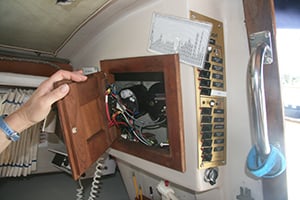
Behind these gold-colored switch panels lurked a 40-year-old tangle of do-it-yourself wiring projects. The amazing thing is that all of the systems still worked. Does your boat have a similar legacy of bad electrical work?
That same truism applies to your boat’s DC electrical system. Put it in a corrosive environment where wiring and electrical components are subjected to more concentrated daily abuse than your family car will experience in five years, and it’s easy to see how small electrical problems get out of hand very quickly.
Safety onboard begins with a reliable DC electrical system, properly installed with quality wiring, connections, and components. Don’t take shortcuts when wiring your boat — you may compromise the safety of your boat and crew. According to BoatUS Marine Insurance, problems with DC electrical systems are responsible for 37 percent of onboard fires, more than any other single category.
In several decades of owning and working on boats, I have personally seen more examples of scary do-it-yourself DC electrical projects than any other type of boat equipment failure. Something about 12-volt DC power encourages people to try their hand using household-grade wire and terminals. The amazing thing is how many of these rat’s nests of wiring actually work — for the moment.
If you’re not familiar with basic electrical practices and theory, hire someone who is. With that said, there are excellent resources available — Don Casey’s Sailboat Electrical Systems: Improvement, Wiring, and Repair, John C. Payne’s Marine Electrical Bible, and Edgar J. Beyn’s The 12-Volt Doctor’s Practical Handbook — so you really can learn to complete simple electrical projects on your own. This stuff is not rocket science.
This West Advisor covers basic standards and practices of DC marine wiring, starting with the most frequently asked question: which wire to use.
- Can I Use Regular Wire on My Boat?
- Primary Wire Color Standards
- What Size Wire Should I Use?
- Making Secure Connections
- The Pull Test
- Terminal Types and Uses
- More ABYC Wiring Standards
- Heat Shrink Tubing Sizes
- DC Circuit Wizard
- FAQs
Can I Use “Regular Wire” on My Boat?
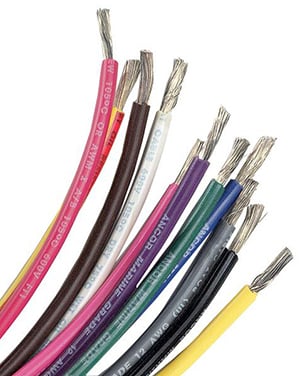
Ancor marine-grade wire products exceed UL 1426, ABYC, and US Coast Guard Charter boat (CFR Title 46) standards. Notice the silver color of the conductors — the wire is tinned copper.
The answer is a qualified yes, if the wire is SAE (Society of Automotive Engineering) J378, J1127, or J1128. These wires are designed for surface vehicles, not for the marine environment, but meet minimum standards for boats in limited circumstances.
ABYC standards impose important restrictions on SAE wire: it should not be run in bilge spaces or areas subject to moisture from spray or dripping (ABYC E-11.14.4.1.5 requires that conductors in bilge areas have watertight connections). It should not be run in engine spaces unless marked “oil resistant” and “75°C.” It should not be used in applications subject to vibration or frequent flexing. It must never be used for 110-volt applications. Only use wire marked with its size and type.
Most importantly, SAE wire is up to 12 percent smaller than American Wire Gauge (AWG) Boat Cable, which means larger gauge wire must often be used to stay within recommended voltage drop limits. Wire charts in Chapman’s Piloting and other publications are written for AWG wire, not SAE. All wiring on boats should be stranded, not solid copper wire used in household applications — solid wire cannot withstand the vibration found onboard.
Given all these limitations, why not just use real marine-grade wire?
Primary Wire Color Standards
The ABYC Standards & Technical Information Reports for Small Craft recommends the following color standards for marine wiring of boat engines and accessories:

What Size Wire Should I Use?
Wire sizing requires balancing four key variables: ampacity, temperature, cable bundling, and voltage drop. Installing wire that is too large is expensive and adds weight; installing wire that is too small is a safety risk. Here is how each variable affects your selection.
Ampacity
Ampacity is the current-carrying capacity of a conductor — the maximum amps it can safely carry. Some loads, such as LED lights, draw a constant amount of current and are easy to calculate from the device specs. Others, such as power inverters or any motor-driven device, will spike significantly at startup. Size your circuit to handle the maximum amperage of all devices in it. An anchor windlass that typically draws 80 amps but may draw 300 amps when breaking out a stuck anchor needs wiring sized for the spike, not the average.
Temperature
Higher ambient temperature reduces the amount of current a cable can safely carry. ABYC standards assume engine room temperature is 122°F (50°C). A #6 AWG wire can safely carry 80 amps outside the engine room but only 46.4 amps inside it. In general, maximum current is 15 percent less in engine spaces, which are assumed to be 20°C hotter than non-engine spaces.
Cable Bundling
Cables bundled together generate cumulative heat and have more difficulty dissipating it than wires run individually. The relevant ABYC standard technically applies to wiring carrying 50 volts or more (so it primarily affects AC circuits), but the principle applies to tightly bundled DC wiring as well. General reduction factors: three conductors bundled together, reduce maximum ampacity by 30 percent; four to six conductors bundled, reduce by 40 percent; seven to 24 conductors bundled, reduce by 50 percent.
Voltage Drop
Each wire has a predictable level of internal resistance, so in a DC circuit, some energy is lost as heat. The longer the wire run, the greater the voltage drop. This matters practically — electric motors run more slowly at 11.5 volts, and sensitive electronics may malfunction at reduced voltage.
The solution is larger diameter wire, which has lower internal resistance. ABYC provides two voltage drop tables:
- 3% maximum voltage drop: Required for panelboard feeders, bilge blowers, electronic equipment, navigation lights, and other circuits where voltage drop must be kept to a minimum.
- 10% maximum voltage drop: Permitted for general lighting and circuits where voltage drop is not critical.
Nigel Calder, in Boatowner’s Mechanical and Electrical Manual, recommends always using the 3% table: “Given the harshness of the marine environment, it just does not pay to start out by trying to cut calculations as fine as possible.” We agree. If you size all your wiring for 3% voltage drop, the wire will easily meet ampacity requirements as well. See our West Advisor Marine Wire Size and Ampacity for both voltage drop tables.
Making Secure Connections
Crimping vs. Soldering
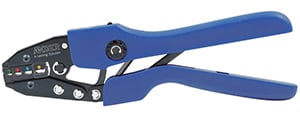
Ancor Double Crimp Ratcheting Wire Terminal Crimper
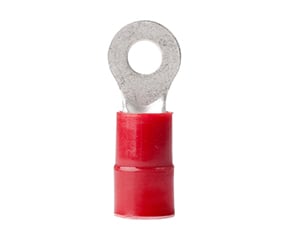
Nylon 8 AWG Red Ring Terminal
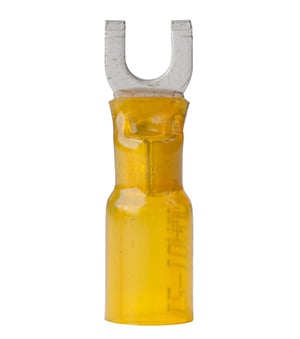
12-10 #10 Heat Shrink Spade Terminal
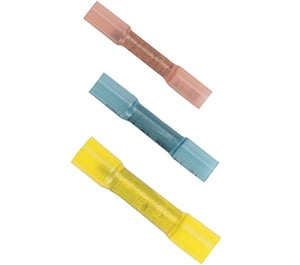
Heat Shrink Butt Connectors, 22-18 gauge red, 16-14 gauge blue, 12-10 gauge yellow
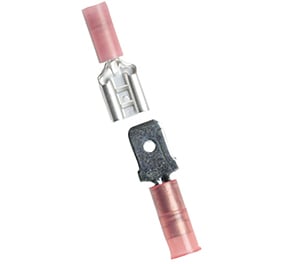
Red male and female nylon disconnects, 22-18 gauge

Red Heat Shrink Snap Plugs, 22-18 gauge
Most wire problems happen at the connections, and experts are in agreement on this point. Connections must be mechanically connected, not just soldered. Per ABYC E-11.16.3.7: “Solder shall not be the sole means of mechanical connection in any circuit.” Crimping provides a solid mechanical connection that resists cold joint failures under fatigue and removes strain from the connection point.
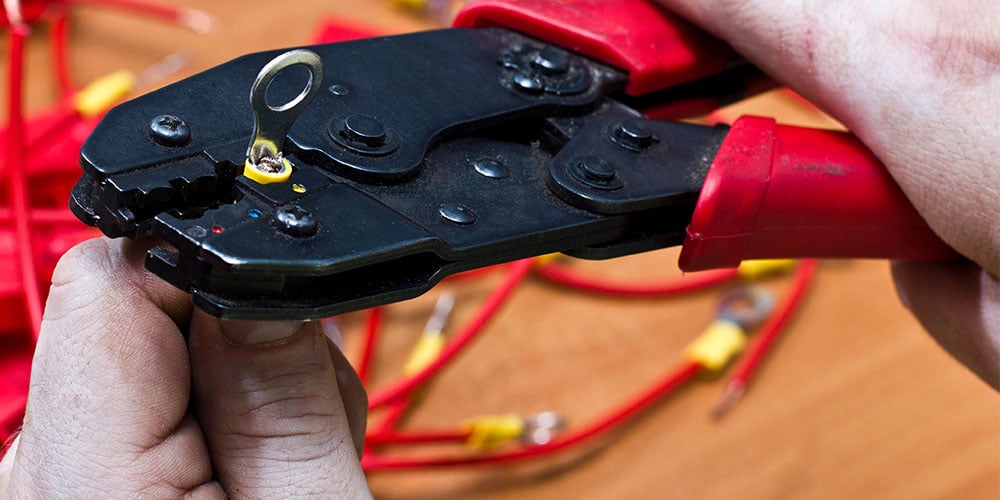
Never twist wires together, use household wire nuts, or wrap a bare wire around a terminal screw. A proper crimp connection is essential for safety and reliable current-carrying ability. Use a quality crimper such as the Ancor Double Crimp Ratcheting Wire Terminal Crimper. ABYC E-11.14.3.8 specifies that “Solderless crimp-on connectors shall be attached with the type of crimping tools designed for the connector used.” This means using a crimper matched to the terminal manufacturer — barrel and insulation thicknesses vary between brands, and the wrong crimper produces a substandard connection even on a correctly sized terminal.
The Pull Test
Place the terminal in the correct die in the crimper, insert the wire, and squeeze until the jaws grip the terminal lightly without distortion. After crimping, verify the connection by giving the wire a firm tug. ABYC pull-test ratings by gauge: 16 AWG connectors must withstand 15 pounds of pull; 10 AWG terminals must withstand 40 pounds; 00 battery cable terminals must withstand 150 pounds. Finish every connection with adhesive-lined heat shrink tubing.
Terminals are color-coded by wire gauge: red for 22–18 gauge, blue for 16–14 gauge, yellow for 12–10 gauge.
Terminal Types and Uses
Ring Terminals
For permanent, secure termination. Ring terminals cannot pull off and are preferred over spade terminals for this reason. Per ABYC E-11.14.4.1.11: “Ring and captive spade type terminal connectors shall be the same nominal size as the stud.”
Flanged Spade Terminals
For permanent termination when the terminal screw is captive. ABYC E-11.16.3.4 recommends terminal connectors be of the ring or captive spade type.
Butt Connectors
For connecting two wire leads of the same gauge. Step-down butt connectors join conductors of different sizes or combine two conductors to one.
Disconnects and Snap Plugs
Quick-disconnect connectors are appropriate for electronic and digital equipment. ABYC recommends their use for circuits not exceeding 20 amps, with voltage drop less than 50 mV at 20 amps, and a pull-out resistance of at least six pounds.
Wire Support
ABYC recommends that wires be supported every 18” along their path to prevent repeated flexing from the boat’s motion or engine vibration. Cable ties and clamps are both approved methods.
More ABYC Wiring Standards
Extra Wire at Junction Boxes and Distribution Panels
ABYC E-11.14.4.1.12: “Conductors terminating at panelboards in junction boxes or fixtures shall be arranged to provide a length of conductor to relieve tension, to allow for repairs and to permit multiple conductors to be fanned at terminal studs.”
Chafe Protection
ABYC E-11.14.4.1.7: “Conductors that may be exposed to physical damage shall be protected by self-draining loom, conduit, tape, raceways, or other equivalent protection. Conductors passing through bulkheads or structural members shall be protected to minimize insulation damage such as chafing or pressure displacement. Conductors shall also be routed clear of sources of chafing such as steering cable and linkages, engine shafts, and control connections.”
Maximum Four Terminals per Stud
ABYC E-11.14.4.1.10: “No more than four terminals shall be secured to any one terminal stud. If additional connections are necessary, two or more terminal studs shall be connected together by means of jumpers or copper straps.” Multiple conductors may also be swaged into one terminal, provided the combined cross-sectional area of the conductors does not exceed the terminal’s capacity, and the connection passes the pull test per E-11.14.3.3.
Highest Ampacity Terminal First
Per ABYC E-11.14.4.1.10.1, when installing more than one ring terminal on a stud, the largest (highest ampacity) terminal should be installed first, with successively smaller terminals installed above it.
Avoiding Magnetic Interference with the Compass
ABYC E-11.14.4.2.1: “Wiring shall be installed in a manner that will avoid magnetic loops in the area of the compass and magnetically sensitive devices. Wires that may create magnetic fields in this area shall run in twisted pairs.”
Heat Shrink Tubing Sizes
ABYC E-11.16.3.9 recommends: “The shanks of terminals shall be protected against accidental shorting by the use of insulation barriers or sleeves, except for those used in grounding systems.” Adhesive-lined heat shrink tubing creates a water, oil, and acid-resistant seal that prevents corrosion at the connection. It shrinks to one-third of its original diameter (3:1 shrink ratio).
| Size | Shrinks To | Wire Range (AWG) |
|---|---|---|
| 1/8” | 1/32” | <18 |
| 3/16” | 1/16” | 20–12 |
| 1/4” | 5/64” | 16–10 |
| 1/2” | 1/8” | 12–8 |
| 3/4” | 5/32” | 8–4 |
| 3/4” | 1/4” | 6–2/0 |
DC Circuit Wizard
Blue Sea Systems’ DC Circuit Wizard performs calculations and recommends appropriate circuit protection options — fuse or circuit breaker — and wire size for virtually any DC application. It is a useful tool for checking your wire sizing calculations.
Design rule: A change of six gauge numbers represents a fourfold increase in wire size. When the wire size goes down two numbers (from 14 to 12 AWG), the amount of copper in the wire increases by 59 percent.
Frequently Asked Questions
Why can’t I use household wire on my boat?
Household wire is solid copper, which work-hardens and cracks under the constant vibration found on a boat. Marine-grade wire uses finely stranded copper that remains flexible under vibration. Household wire is also not tinned — marine-grade wire uses tinned copper conductors that resist the corrosion that occurs when bare copper is exposed to salt air and moisture. The insulation on household wire is not rated for the UV exposure, fuel resistance, or temperature extremes of the marine environment.
Should I solder or crimp my marine electrical connections?
Crimp, not solder alone. ABYC E-11.16.3.7 explicitly states that solder shall not be the sole means of mechanical connection. Soldered connections are susceptible to cold joint failures from vibration fatigue and can wick solder up the wire strands, making the wire rigid at the connection point where it needs flexibility. A proper crimp with adhesive-lined heat shrink provides a mechanically secure, corrosion-resistant connection that meets ABYC standards.
What is the maximum voltage drop allowed in marine DC wiring?
ABYC specifies two limits: 3% maximum for navigation lights, bilge blowers, electronic equipment, and panelboard feeders; 10% maximum for general lighting and non-critical circuits. However, Nigel Calder and most experienced marine electricians recommend always designing to the 3% limit — if you size wire for 3% drop, it will also easily meet ampacity requirements, simplifying the calculation.
What does “tinned” mean on marine wire?
Tinned means each copper strand is coated with a thin layer of tin before the wire is assembled. Tin does not corrode in the presence of salt air and moisture the way bare copper does. On a boat, wiring exposed to the marine environment over years will corrode from the outside in on bare copper wire — the tin coating on marine-grade wire dramatically slows this process and extends the service life of connections and conductors.
How often should I support wiring runs on my boat?
ABYC recommends supporting wiring every 18 inches along its run. This prevents the repeated flexing that leads to conductor fatigue and insulation chafing from the boat’s motion and engine vibration. Use cable ties or clamps rated for the marine environment — avoid plain nylon cable ties in engine spaces or areas exposed to sunlight, as they become brittle with UV exposure and heat.