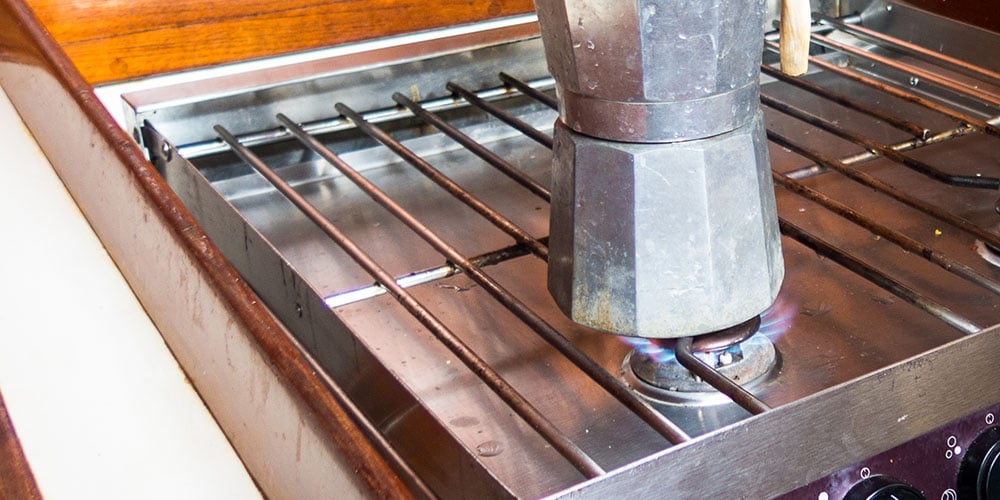
Once you experience the ease of cooking on a propane stove, you’ll never go back to kerosene or alcohol. Propane stoves light instantly and are as easy to use as a home gas range. The flame burns clean without the odor of kerosene and burns significantly hotter than alcohol.
The Potential Problem with Propane
Propane gas is heavier than air and will collect in bilge areas if a leak exists, creating a potentially explosive situation. However, with proper installation, basic safety precautions, and common sense, the possibility of a propane explosion can be effectively eliminated. A correctly installed marine propane system — with a vented locker, solenoid shutoff, pressure gauge, and properly rated hose — is safe to operate. The danger comes from shortcuts, deferred maintenance, and improper components.
- Regulators & Pressure Gauges
- Propane Lockers
- Solenoid Control Valves
- Supply Hoses
- How to Test for Leaks
- If You Smell Gas
- Common Propane Installation Mistakes
- FAQs
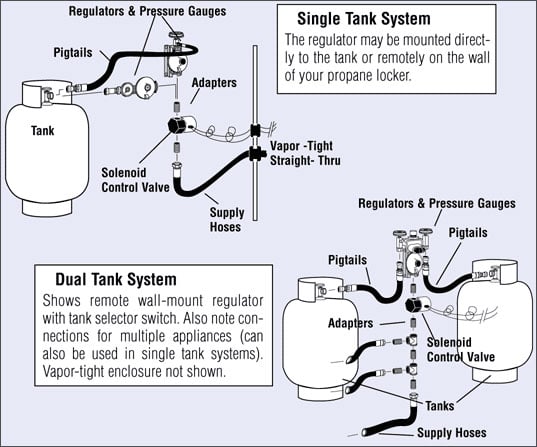
Diagram of a properly installed marine propane system showing tank, regulator, solenoid valve, supply hose routing, and appliance connection.
Regulators & Pressure Gauges
A pressure gauge must be installed immediately after the main tank valve. It is used to detect leaks in the propane system — not as a fuel gauge. It cannot give a precise measurement of remaining fuel because pressure in a propane system remains relatively constant until the fuel runs out. To measure remaining fuel, you need to weigh the tank.
Regulators reduce the propane’s pressure from approximately 150 psi at the tank to 0.5 psi, the pressure at which appliances are designed to operate. There are two methods of connecting a regulator to the tank:
- Direct mount: A single-stage regulator with gauge screws directly onto the tank at the POL fitting. Simple and compact.
- Remote mount: Use a single-stage or two-stage wall-mount regulator when you need to locate the regulator away from the tank. Remote regulators have 1/4” inlets to accept a pigtail with a 1/4” male flare on one end and a POL fitting on the other.
A two-stage regulator provides more consistent pressure delivery over a wider range of ambient temperatures and tank fill levels, and is preferred for installations with multiple appliances or longer supply runs.
Propane Lockers
All connections between the propane tank, regulator, and solenoid valve must be made in a vapor-tight compartment that is either completely separated from the interior of the boat, or outside the boat in a location where leaking gas cannot drain into the interior. This is the most critical structural requirement of a marine propane installation.
The locker must have a vent line from its lowest point that drains directly overboard above the waterline — any leaking gas flows down and out of the boat rather than accumulating inside. If your boat does not have a built-in propane locker, purpose-built ready-made propane lockers are available.
Key propane locker requirements:
- Vapor-tight construction — no passages to the boat’s interior
- Drain vent from the lowest point, exiting overboard above the waterline
- No low pockets in the vent line where gas can collect
- Tanks firmly secured so they cannot tip, rattle, or become damaged in a seaway
- Nothing else stored in the locker — the tank and its connections only
Periodically remove the tank, pour water into the locker, and verify that it drains directly downward with no pooling. Check lid gaskets for proper fit and sealing annually.
Solenoid Control Valves
A solenoid is an electrically-controlled valve that allows you to shut off the gas supply from a remote location without going to the propane locker. The switch is typically located on a small panel in the galley, with a red indicator light showing when the solenoid is open (gas flowing). Flip the switch off and the valve closes. For safety, solenoids are designed to close in the event of a power failure — they are “normally closed” valves that require electricity to stay open.
We offer solenoid valves with either 1/4” or 3/8” NPT ports. For installations with multiple appliances, the Full-Flow 3/8” Solenoid Valve provides greater flow capacity and prevents “gas starvation” when multiple burners are operating simultaneously. To connect the 3/8” solenoid directly to the regulator, use a 3/8” brass pipe nipple. All pipe thread connections must be sealed with approved thread sealing compound or Teflon tape.
Supply Hoses
Use LPG-rated supply hose of the correct length to carry gas from the regulator to the stove or heater. Although supply hoses carry only 0.5 psi, they are rated to 350 psi working pressure — far stronger than required. What matters is that the hose is rated for LPG service; automotive, air, and gasoline hoses are not acceptable substitutes regardless of appearance.
Each supply hose must run continuously from inside the propane tank enclosure to the appliance without intermediate fittings or splices. You cannot chain fittings together because the hose is too short. If the run is too short, replace the hose — do not add fittings in the middle of a run. Use a Vapor-Tight Straight-Thru fitting where the hose exits the propane locker. Supply hoses connect to the appliance using a 3/8” female flare swivel and to the solenoid using a 3/8” male NPT adapter.
Inspect supply hoses annually for cracking, stiffening, swelling, or abrasion. Replace hose that shows any of these signs regardless of age. Manufacturers typically rate hose life at 10–20 years, but UV exposure, heat, and ozone can cause earlier failure. When in doubt, replace it — hose is inexpensive compared to the consequences of a failure.
How to Test for Leaks
Leak testing is the most important regular maintenance task for any marine propane system. Test after every repair, after any significant grounding or collision (which can loosen fittings), after the start of each season, and whenever you smell gas.
Soap solution leak test (always use this method):
- Open the tank valve and turn on the solenoid. Do not light any burners.
- Mix a solution of dish soap and water, or use a commercial leak detection solution. Do not use detergents containing ammonia — ammonia can attack brass fittings.
- Apply the soap solution liberally to every fitting, connection, and joint in the system — the POL fitting at the tank, the regulator connections, the solenoid inlet and outlet, all hose connections, and the appliance connection.
- Watch for bubbles. Bubbles forming at any point indicate a leak. Even slow bubbling indicates a leak that must be repaired before using the system.
- Close the tank valve and observe the pressure gauge. A properly sealed system will hold pressure with no drop over several minutes. A pressure drop with the tank valve closed confirms a leak somewhere in the system downstream of the gauge.
Never test for leaks with a flame. If a fitting is leaking and you cannot stop it by hand-tightening (using the correct technique for the fitting type), replace the fitting or hose — do not operate the system until the leak is eliminated.
If You Smell Propane Gas
Propane has a distinctive sulfur (rotten egg) odor added specifically so leaks can be detected. If you smell gas aboard:
- Do not operate any electrical switches — do not turn on or off lights, fans, bilge blowers, or any other electrical device. A spark from a switch can ignite accumulated propane.
- Do not start the engine.
- Close the tank valve at the propane locker immediately.
- Open all hatches and ports to ventilate the boat. If safe to do so, run the bilge blower manually (using a switch you have already verified is in a safe location).
- Do not use the boat until the source of the leak is found and repaired and the system has passed a soap solution leak test.
- If the smell is strong or persists, get all crew off the boat and call for assistance from a safe distance.
Common Propane Installation Mistakes
The following problems are those most frequently found by marine surveyors when inspecting propane systems. Check your boat for all of these:
Plugged vent in propane locker: Without a way for leaking gas to escape, propane accumulates to dangerous concentrations in the locker. Verify the vent drains freely by removing the tank and pouring water in the locker — it should drain directly downward with no pooling. Check lid gaskets for proper fit and sealing.
Wiring attached to gas lines: Electrical wire tied to a propane line is dangerous. A short circuit can heat the wire enough to melt through the hose. Route wiring and gas lines separately.
Storing objects in the propane locker: The propane tank and its connected components are the only things that belong in the propane locker. Anchors, tools, and other objects can scratch the tank, damage the regulator, or cut the hose. One surveyor found an anchor that had worn through the paint on a tank and caused corrosion.
One gas line supplying multiple appliances with interior junctions: Gas lines for each appliance should originate individually at the tank. Interior junctions create additional leak points inside the boat. Fewer connections mean fewer opportunities for failure.
No working propane detector: While not required by ABYC specifications, propane detectors are inexpensive, easy to install, and can save your life. If you have one, verify the date of manufacture — they typically have a reliable service life of five years. Test the sensor periodically by releasing a small amount of fuel from a butane lighter near the sensor.
No chafe protection on gas lines at bulkheads: Wherever hoses pass through bulkheads, they must have chafe protection. Constant vibration on a boat causes hoses to wear against hard surfaces and eventually leak. Support hoses every 18 inches and use proper non-chafe grommets or bushings at every penetration.
Rusted tanks, regulators, and solenoids: Replace rusted components immediately. Even if the certification date is still valid, a visibly corroded tank or regulator can fail without warning.
No operating instructions posted: A guest or new crew member unfamiliar with the boat may not know to close the solenoid after use, or how to properly light the burner. Post simple operating instructions in the galley.
Manual shutoff valve behind the stove: Reaching over a burning burner to close a manual valve is dangerous, especially during a gas-related emergency. A remote electric solenoid shutoff mounted at the tank, controlled from a galley panel switch, is dramatically safer.
Missing or inoperable pressure gauge: Without a functioning pressure gauge, you cannot test the system for leaks. A pressure gauge is essential safety equipment, not optional.
Weathered, cracked, or improper fuel hoses: Replace hose that shows any cracking, stiffening, or UV damage regardless of age. Never substitute gasoline hose, air hose, or any non-LPG-rated hose for propane service.
Spare cylinders stored inside the boat: Any spare propane cylinder, including small cylinders for portable appliances or camping stoves, must be stored the same way as the primary tank — in a vented locker or on deck. Never store propane cylinders below decks.
In the words of one experienced surveyor: “It is well worth an extraordinary inspection effort when you have a propane system.”
Frequently Asked Questions
How do I know if my propane system has a leak?
Use a soap solution: apply a mixture of dish soap and water to every fitting, connection, and joint in the system with the tank valve open and the solenoid energized. Any bubbles indicate a leak. Also observe the pressure gauge with the tank valve closed — a pressure drop over several minutes confirms a leak downstream. Never test with a flame. Test after every repair, at the start of each season, and whenever you smell gas.
What should I do if I smell propane on my boat?
Do not operate any electrical switch. Do not start the engine. Close the tank valve immediately. Open all hatches and ports to ventilate. Do not use the boat until the source of the leak has been identified and repaired and the system has passed a soap solution leak test. If the smell is strong or persistent, get all crew off the boat before investigating.
Does my propane system need a solenoid shutoff valve?
ABYC strongly recommends a solenoid shutoff and most marine surveyors consider it essential. A solenoid allows you to remotely cut gas flow from the galley without going to the propane locker, and it closes automatically in the event of a power failure. A manual shutoff valve behind the stove is significantly less safe and more dangerous to operate during an emergency.
How often should I replace propane supply hose?
Inspect annually and replace at any sign of cracking, stiffening, swelling, or abrasion. Manufacturers typically rate LPG hose life at 10–20 years, but UV exposure and heat can cause earlier failure. When in doubt, replace it — hose is inexpensive and a hose failure is catastrophic. Never use non-LPG-rated hose as a substitute.
Can I store spare propane cylinders below decks?
No. Any propane cylinder — including small canisters for portable stoves — must be stored in a vented deck locker or on deck. Storing any propane cylinder below decks violates basic safety standards and creates an explosive risk if the cylinder leaks.
How do I measure remaining propane fuel?
Weigh the tank. The pressure gauge is for leak detection, not fuel level — pressure in a propane system remains relatively constant until the tank is nearly empty. Tare weight (empty tank weight) is stamped on most cylinders. Subtract tare weight from current weight to determine remaining fuel. A postal or luggage scale works for smaller cylinders.