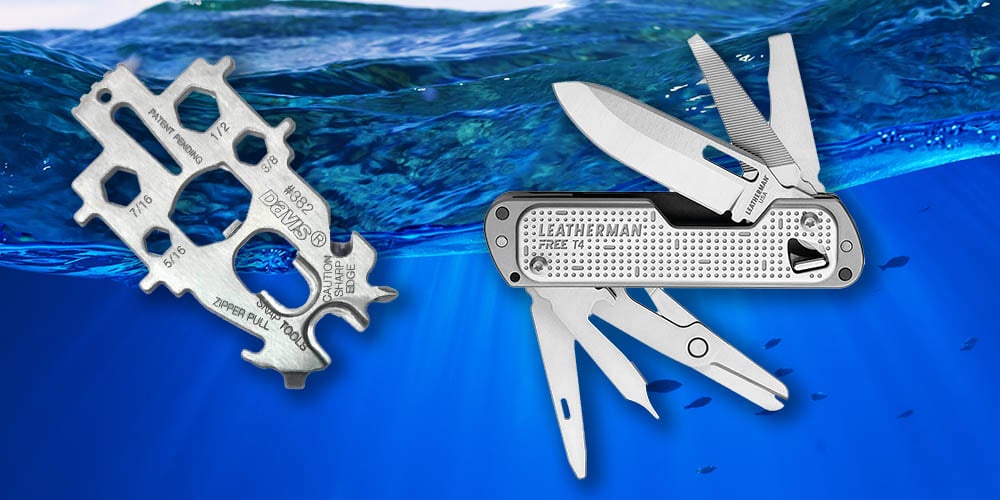
A multi-tool on your hip is fundamentally different from a toolbox below. It’s the tool you reach for when you’re in the cockpit, on the dock, or halfway up the mast and can’t conveniently go get anything else. Choosing the right one means understanding what the major brands do differently — and which of those differences actually matter in a marine environment.
- What Makes a Multi-Tool Marine-Ready
- Brand Comparison: Leatherman, Gerber, SOG, Victorinox
- Which Tools Do You Actually Need?
- The Magnetic Compass Problem
- How to Carry It
- Care and Maintenance
- FAQs
What Makes a Multi-Tool Marine-Ready
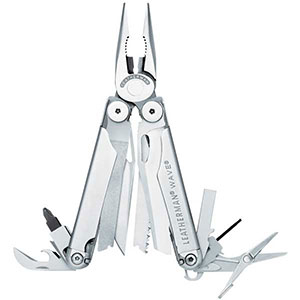
The Wave® is Leatherman’s most popular multi-tool, with 17 tools and four bits.
Before comparing brands, understand the specific demands of the marine environment — they differ meaningfully from land use.
Corrosion resistance is the overriding concern. Most multi-tools are made from AISI 400-series stainless steel. Despite the “stainless” label, 400-series steel has high iron and carbon content and relatively low corrosion resistance — sufficient for general outdoor use but vulnerable in continuous salt air and spray exposure. The blade steel grade matters as much as the handle material: 420HC is the most common and is serviceable; 154CM holds an edge three times longer and resists corrosion better; S30V is premium but rare in multi-tools and difficult to sharpen in the field. Titanium nitride coatings on handles and components add meaningful corrosion protection. Some brands use 17-4 precipation-hardened stainless in specialty products, which outperforms 400-series significantly in salt environments.
One-hand deployment matters on a boat. When you’re on a moving vessel, one hand is often on a line, a rail, or the helm. A multi-tool that requires two hands to open blades or access tools is genuinely less useful than one that allows one-hand access to the tools you use most. This is a real differentiator between brands.
Blade locking is a safety requirement, not a preference. Wet hands on a boat mean a blade that folds back under pressure is a serious injury risk. Every blade on every tool you consider should lock open positively. Liner locks and frame locks are both reliable; spring-back tools are not acceptable in a marine environment.
Plier quality is the primary use case. On a boat, you reach for pliers more than any other tool — for hose clamps, wire terminals, cotter pins, and split rings. Evaluate jaw fit (no slop at the tip), jaw material (hardened vs. softer steel), and whether the jaws include a hard-wire cutter, which matters for rigging and electrical work.
Brand Comparison: Leatherman, Gerber, SOG, Victorinox
Leatherman
Leatherman invented the modern plier-based multi-tool in 1983 and remains the benchmark against which everything else is measured. Their flagship lines — the Wave+, Charge TTi, and Surge — set the standard for component quality, locking mechanisms, and warranty support. The 25-year warranty is the best in the industry and is actually honored.
What Leatherman does best: Outside-accessible blades on the Wave+ and Charge lines are the defining feature — the knife blade deploys directly from the closed tool with one hand, without unfolding the handles. Replaceable wire cutter inserts (on Wave+, Charge, and Surge) are a practical advantage for heavy electrical use. Tool variety and quality at price point is unmatched.
Where Leatherman falls short: The screwdriver axis on most models is off-center, which makes sustained screwdriving less comfortable and efficient than a dedicated driver. Plier opening requires two hands on most models.
Marine recommendation: The Wave+ is the right starting point for most boaters. The Charge TTi upgrades to 154CM blade steel for meaningfully better edge retention and corrosion performance — worth the price premium in a saltwater environment. The Surge is the heavy-duty choice for liveaboards and cruisers who use their multi-tool daily and need the larger jaw size.
Gerber
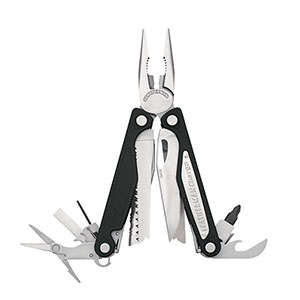
The Charge® AL has 17 tools, eight bits, and a 154CM premium steel blade.
Gerber builds its multi-tools around a dominant function rather than balanced versatility. The Center-Drive is their most distinctive product — its screwdriver is on the true centerline of the tool, which means it drives fasteners with the same feel as a full-size driver, something no other multi-tool achieves. The pliers on the Center-Drive deploy by sliding forward out of the handle rather than unfolding, which is faster and works with one hand.
What Gerber does best: The Center-Drive’s screwdriver is genuinely the best on any multi-tool — if your most common task is driving fasteners, nothing else compares. Gerber’s lifetime warranty matches or exceeds competitors. The MP600 and similar models offer exceptionally smooth one-hand plier deployment. Price-to-feature ratio on mid-range models is strong.
Where Gerber falls short: Blade steel on most Gerber models is 420 stainless — adequate but not exceptional for edge retention or corrosion resistance. Component quality on lower-end models is inconsistent. The Center-Drive’s blade is not outside-accessible.
Marine recommendation: The Center-Drive for powerboaters who spend significant time on electrical and mechanical maintenance — the centerline screwdriver is a meaningful real-world advantage over a 30-minute job tightening hose clamps. Less compelling for sailors who prioritize blade access and plier use over screwdriving.
SOG
SOG’s signature contribution to multi-tool design is their compound leverage plier system, used across their PowerAssist and PowerLock lines. Gears in the handle multiply the force applied at the jaw — SOG claims 18% more cutting force than conventional pliers at the same hand pressure. Their spring-assisted blade opening (on the PowerAssist) allows one-thumb blade deployment faster than any other multi-tool on the market.
What SOG does best: Raw plier and cutting power — the compound leverage system is genuinely noticeable when cutting wire or crimping terminals under load. Spring-assisted blade deployment is the fastest one-hand opening available. Build quality on the PowerAssist and PowerLock is excellent.
Where SOG falls short: The gear system adds weight and bulk. SOG’s warranty and service reputation is good but does not match Leatherman’s 25-year standard. Blade steel is 8Cr13MoV on most models — functional but corrosion-prone compared to Leatherman’s 420HC or 154CM.
Marine recommendation: The PowerAssist for anglers and powerboaters who regularly cut heavy line, wire, or cable and want maximum jaw force. The spring-assisted blade is the best option for anyone who regularly needs a blade deployed with one hand in a hurry. Less ideal for sailors who prioritize a refined feel and tool variety over raw mechanical advantage.
Victorinox
Victorinox brings the Swiss Army Knife philosophy to a full-size plier-based multi-tool in the SwissTool Spirit line. The result is the most refined, precisely fitted multi-tool available — components open and close with a quality of engagement that most competitors don’t match. The Spirit X offers 26 tools, the highest count of any major multi-tool.
What Victorinox does best: Fit and finish quality is best in class — tolerances are tighter, surfaces are more polished, and components snap into position more precisely than any competing brand. The scissors on the SwissTool are exceptional — better than any other multi-tool scissors, which matters for sail repair, rope work, and cutting braid. Metal and wood saws are included and actually work. Corrosion resistance of Victorinox steel is above average for the category.
Where Victorinox falls short: The Spirit line is more expensive than comparable Leatherman or Gerber models. It is not as heavy-duty as the Leatherman Surge for demanding mechanical use. Blades are not outside-accessible — you must unfold the handles to reach the knife. Bit driver system is less comprehensive than Leatherman’s.
Marine recommendation: The SwissTool Spirit X for sailors who do sail and canvas work, cut a lot of line, and value precision over brute force. The scissors alone justify the price premium for a cruising sailor. Also the most aesthetically refined option for boaters who care about the feel of the tool in hand.
Which Tools Do You Actually Need?
The right component list depends on your boat and your role aboard. Here is how to think through it by boating type:
| Boating Style | Priority Tools | Brand to Consider |
|---|---|---|
| Offshore powerboat / sportfisher | Needlenose pliers, hard-wire cutter, wire stripper, braid scissors, hook file, blade | Leatherman Wave+ or Surge |
| Inshore / bay fishing | Pliers (for hook removal), braid scissors, blade, split ring tool | Leatherman Wave+, SOG PowerAssist |
| Cruising sailboat | Marlinspike, quality scissors, blade, wire cutter, screwdrivers, rigging knife | Victorinox SwissTool Spirit X, Leatherman Surge |
| Day sailor / racer | Marlinspike, blade, screwdrivers, pliers | Leatherman Wave+, Victorinox SwissTool Spirit |
| Powerboat maintenance-focused | Centerline screwdriver, pliers, wire stripper, hard-wire cutter | Gerber Center-Drive |
| PWC / day boater | Blade, pliers, screwdrivers — compact is more important than comprehensive | Leatherman Skeletool, Gerber Suspension NXT |
Components worth having on any marine multi-tool regardless of boating style: needlenose pliers with hard-wire cutter, a locking straight blade, Phillips and flathead screwdrivers, and scissors capable of cutting braid. Everything else is specific to your use case.
Components that sound useful but rarely get used: can opener, bottle opener (unless you’re cruising), nail file, mini screwdriver. Don’t let impressive component counts drive your decision — a 21-tool multi-tool you use 4 of is worse than a 12-tool multi-tool you use 9 of.
The Magnetic Compass Problem
All 400-series stainless steel multi-tools are ferromagnetic to some degree — their high iron content can induce deviation errors in a magnetic compass if stored nearby. At 12 inches, the effect is small but measurable. At 6 inches, it can be significant. Do not store any multi-tool near your binnacle compass, chart table compass, or handheld compass. In an offshore navigation scenario where you lose electronics and revert to compass navigation, compass deviation from a nearby multi-tool on your hip could put you meaningfully off course over several miles.
Practical rule: keep your multi-tool at least 18 inches from any compass when taking a bearing or steering by compass. Stow it below or in a cockpit locker before conducting a compass check.
How to Carry It
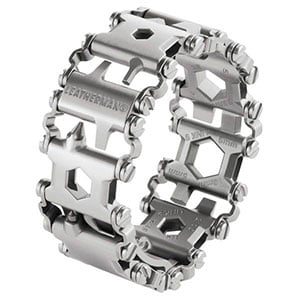
Leatherman’s Tread™ puts 29 tools in a wearable bracelet of 17-4 stainless steel links.
A multi-tool stored below in a toolbox defeats its purpose. The value is immediate access — on your body, not in a drawer.
Belt sheath: The standard carry method. Most quality multi-tools include a sheath. Look for positive retention (snap or strap) so the tool doesn’t fall overboard when you lean over the rail. On a sailboat, position the sheath where it won’t snag on running rigging, winch handles, or lifelines — a sheath that catches a sheet at the wrong moment is dangerous.
Pocket clip: Some compact models (Leatherman Skeletool, Gerber Suspension NXT) include a wire clip for pocket carry. Lighter and less bulky than a sheathed tool for day boating where you don’t want a full sheath on your belt.
Wearable: The Leatherman Tread is a 17-4 stainless steel bracelet with Allen wrenches, screwdrivers, and box wrenches built into each link. The 17-4 alloy has significantly better corrosion resistance than 400-series steel, making it better suited to continuous salt exposure than a conventionally carried tool. It never leaves your wrist, which means it’s always accessible. The trade-off is that it provides a different and more limited toolset than a conventional multi-tool.
Care and Maintenance
Multi-tool maintenance in a marine environment is simple but must be consistent. Skipping it for a season produces rust in pivot points that is difficult to reverse.
- After every saltwater day: Rinse thoroughly with fresh water. Open all blades and tools fully to allow water to drain from pivot points — salt water that wicks into a closed tool and dries is the primary corrosion pathway. Dry with a cloth.
- After drying: Apply a light machine oil or corrosion inhibitor (Boeshield T-9, WD-40, or 3-IN-ONE) to all pivot points and blade edges. Work each component open and closed to distribute the oil. Close and store dry.
- Blade maintenance: A ceramic rod or diamond-coated file handles field sharpening for 420HC and 154CM steels. Leatherman and Victorinox both offer factory sharpening services for more advanced edge restoration.
- Check blade locks periodically: Liner locks wear over time. If a blade no longer locks open solidly — if it can be pushed closed with thumb pressure during normal use — the tool needs service or replacement. An unlocked blade on a boat with wet hands is a genuine injury risk.
Frequently Asked Questions
Leatherman vs. Gerber vs. SOG: which brand is best for boating?
For most boaters, Leatherman’s Wave+ or Charge TTi is the best all-around choice — outside-accessible blades, replaceable wire cutters, excellent build quality, and the best warranty in the industry. Gerber’s Center-Drive is the right call if your primary use is driving fasteners. SOG’s PowerAssist is best if you regularly need maximum cutting force or the fastest one-hand blade access. Victorinox’s SwissTool Spirit X is the premium choice for cruising sailors who prioritize fit, finish, and exceptional scissors. The honest answer is that all four brands make tools that will serve you well — the differences are real but not dramatic at the flagship model level.
Is a more expensive multi-tool actually better for marine use?
Yes, with diminishing returns above the mid-range. The jump from a $40 budget multi-tool to a $100–130 flagship model (Leatherman Wave+, Gerber Center-Drive) buys meaningfully better steel, better locking mechanisms, better corrosion resistance, and a real warranty. The jump from $130 to $200+ (Leatherman Charge TTi, Victorinox SwissTool Spirit X) buys better blade steel and refinement, which matters for frequent users in demanding environments. Beyond $200, you’re paying for premium materials and customization rather than fundamental performance improvements. Don’t buy a cheap multi-tool for marine use — the salt environment will expose the quality difference quickly.
What’s the difference between 420HC and 154CM blade steel?
420HC is the standard stainless steel used in most mid-range multi-tools (Leatherman Wave+, most Gerber models). It’s corrosion resistant, easy to sharpen, and holds an adequate edge for most tasks. 154CM is a premium tool steel used in the Leatherman Charge TTi and Charge AL — it holds its edge roughly three times longer than 420HC and has better corrosion resistance. For occasional use, 420HC is fine. For daily use on a working boat, 154CM is worth the upgrade.
Do I need a marlinspike on my multi-tool?
If you sail, yes. A marlinspike is the tool for opening shackles, working knots under tension, and splicing rope — tasks that come up regularly on a sailboat and are impossible to do well with a screwdriver blade. Most Leatherman Surge and some Victorinox models include a dedicated marlinspike. For powerboaters, a marlinspike is less critical but occasionally useful for shackle work and freeing jammed knots.
Should I be worried about rust on my multi-tool?
Yes, if you use it in saltwater environments and don’t maintain it. 400-series stainless steel rusts in continuous salt exposure, particularly in pivot points and inside the handles where water collects. Fresh water rinse and oil after every saltwater day prevents this reliably. Neglect it for a full season and you’ll have rust in the pivots that requires disassembly to address. Titanium nitride coatings (golden color) and 17-4 stainless steel (used in Leatherman Tread) both offer better corrosion resistance, but no finish eliminates the need for basic maintenance.