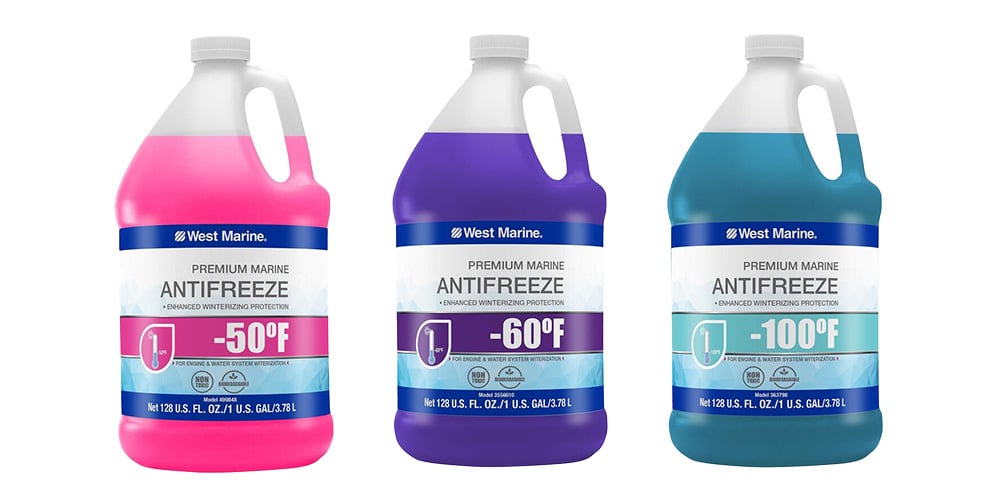

West Marine offers propylene glycol antifreeze in -50°F, -60°F, and -100°F burst ratings to meet the needs of any climate.
Propylene Glycol Is the Safer Choice for Marine Use
The chemical in antifreeze that resists freezing is either ethylene glycol (EG) or propylene glycol (PG). Ethylene glycol makes an effective antifreeze and coolant, but it is a poison that is deadly to pets and wildlife and makes disposal problematic. Propylene glycol is odorless, tasteless, biodegradable, and non-toxic. While it is slightly more expensive to produce, its combination of safety and effectiveness makes it the superior choice for marine use — particularly anywhere it may contact potable water systems or bilge water that discharges overboard.
- Antifreeze Applications
- Freeze Point vs. Burst Point
- Dilution and Value
- Can You Mix Antifreeze Brands?
- Conclusion
- West Marine and Star brite Antifreeze Selection Chart
- FAQs
Antifreeze Applications
The main applications for antifreeze on a boat include winterization of potable water systems, sanitation systems, engine raw water cooling systems, non-running engines, and air conditioners. Selecting the right product requires knowing which system you are protecting — not all marine antifreezes are interchangeable across applications.
- Engine and water system antifreeze (non-toxic propylene glycol): West Marine Engine and Water System Antifreeze is ideal for winterizing potable water systems, raw water cooling circuits, sanitation systems, and non-running engines during layup. Available in -50°F, -60°F, and -100°F burst ratings. Because this product does not contain the corrosion inhibitor additive package required for engine coolant service, it should not be used in running engines as a coolant. It is, however, safe for any system where it may come in contact with drinking water.
- Engine antifreeze and coolant: West Marine Engine Antifreeze and Coolant contains an additive package that prevents corrosion and antifreeze degradation at high operating temperatures, enabling it to serve as both freeze protection during winter layup and as engine coolant during the boating season. Due to its additives, it should not be used to winterize potable water systems. Available in the engine products section.
Freeze Point vs. Burst Point
This is the most important distinction to understand when reading antifreeze ratings — and the most commonly misunderstood.
The burst point (shown as -50°F, -60°F, -100°F, etc.) is the temperature at which a sealed copper pipe filled with the undiluted product will burst from ice expansion. Burst points are a standard created by the plumbing industry in the 1930s to indicate the structural protection strength of an antifreeze product. This is the rating printed prominently on the label.
The freeze point is the temperature at which ice crystals (slush) begin to form in the undiluted product. At the freeze point, the liquid begins to solidify into slush but does not expand with enough force to burst pipes or damage plumbing. Slushing is not harmful to engine or potable water systems.
The practical implication: a product rated to a -50°F burst point may have a freeze point of only +12°F to +16°F. If your winters regularly drop to 0°F, a -50°F burst-rated product still protects your plumbing because the freeze point is irrelevant — what matters is whether the ice expansion can burst pipes, and a -50°F burst rating means it cannot until that extreme temperature is reached. See the selection chart below for freeze and burst points by product.
For a more detailed discussion of freeze points vs. burst points and expanded antifreeze guidance, download the Antifreeze 101 Reference Guide  .
.
Dilution and Value
When buying antifreeze, you are mostly paying for the concentration of ethylene or propylene glycol — which can range from 25 to 95 percent of the product. This is why lower temperature-rated products are more expensive: they contain a higher glycol concentration.
The important thing to compare when shopping is protection per dollar after dilution, not sticker price. Some products advertised at a -50°F burst rating require use at full strength to achieve that rating. Other products can be diluted with water at a 3:1 ratio (three parts antifreeze to one part water) and still provide -50°F burst protection. A product that costs 25% more but can be diluted 3:1 may actually cost significantly less per gallon of coverage than a cheaper product that must be used full strength.
Always read the label for the manufacturer’s dilution instructions before purchasing, and calculate the cost per gallon of mixed product rather than the cost per gallon of the concentrate. Never dilute antifreeze beyond the manufacturer’s stated ratio — adding too much water reduces protection proportionally.
Can You Mix Antifreeze Brands or Formulas?
Mixing antifreeze products in the same system is generally not recommended. Different formulas may have different additive packages that interact unpredictably, reducing corrosion protection or causing the additives to drop out of solution. For potable water system winterization with non-toxic propylene glycol products, the risk is lower because these products have minimal additive content — but it is still best practice to flush the system thoroughly before switching products.
For engine coolant applications, never mix ethylene glycol and propylene glycol products, and never mix different additive packages (conventional green, OAT, HOAT) without flushing the cooling system completely first.
Conclusion
For marine use, propylene glycol antifreeze is the right choice — non-toxic, biodegradable, and safe for any system on the boat. Select the burst rating appropriate for the coldest temperatures in your climate: the -50°F product covers most of the continental United States, the -60°F product is suitable for colder northern climates, and the -100°F product is appropriate for extremely cold storage conditions or as an extra safety margin.
Follow the manufacturer’s dilution instructions carefully, compare products on the basis of cost per gallon of mixed solution rather than concentrate price, and use engine-and-water antifreeze (without corrosion inhibitors) for potable water systems and raw water circuits, and engine coolant antifreeze (with inhibitors) for running engine applications.
West Marine and Star brite Antifreeze Selection Chart
| Antifreeze | Burst Rating | Freeze Rating |
|---|---|---|
| Star brite Wintersafe -50 | -50°F | +14° to +18°F |
| West Marine -50 | -50°F | +12° to +16°F |
| West Marine -60 | -60°F | +7° to +10°F |
| West Marine -100 | -100°F | -48° to -50°F |
| Star brite -200 | -200°F | -98° to -103°F |
Frequently Asked Questions
What is the difference between ethylene glycol and propylene glycol antifreeze?
Both are effective antifreezes, but ethylene glycol is toxic to pets and wildlife and is difficult to dispose of safely. Propylene glycol is non-toxic, biodegradable, and odorless, making it the appropriate choice for marine applications — especially anywhere it may contact potable water or discharge into the water via the bilge.
What does the burst rating on marine antifreeze mean?
The burst rating (-50°F, -60°F, etc.) is the temperature at which a sealed pipe filled with undiluted product will burst from ice expansion. It is not the freeze point, which is the much higher temperature at which the liquid begins to slush. A -50°F burst-rated product may have a freeze point of only +12°F — but slushing at that temperature will not damage plumbing. The burst point is the relevant protection threshold.
Which antifreeze rating do I need for my climate?
The -50°F burst rating covers most of the continental United States adequately. The -60°F rating is appropriate for colder northern states and Canada. The -100°F and -200°F ratings are for extreme cold climates or for boaters who want a significant safety margin above the coldest expected temperature. When in doubt, use the rating one step colder than your expected minimum winter temperature.
Can I use the same antifreeze for my engine cooling system and my drinking water system?
No — these require different products. Engine antifreeze and coolant contains corrosion inhibitors that are not safe for potable water systems. Engine and water system antifreeze (non-toxic propylene glycol without inhibitors) is safe for drinking water systems, raw water cooling circuits, and sanitation systems during layup, but should not be used as a running engine coolant because it lacks the inhibitor package that prevents corrosion in a running engine.
How do I dispose of used marine antifreeze?
Propylene glycol antifreeze is biodegradable and non-toxic, but should still be disposed of responsibly rather than poured into storm drains or waterways. Many marinas and boatyards accept used antifreeze for recycling or disposal. Check with your local marina or waste management authority for approved disposal options in your area. Never dispose of ethylene glycol antifreeze on the ground or in storm drains — it is toxic to wildlife and should be treated as hazardous waste.