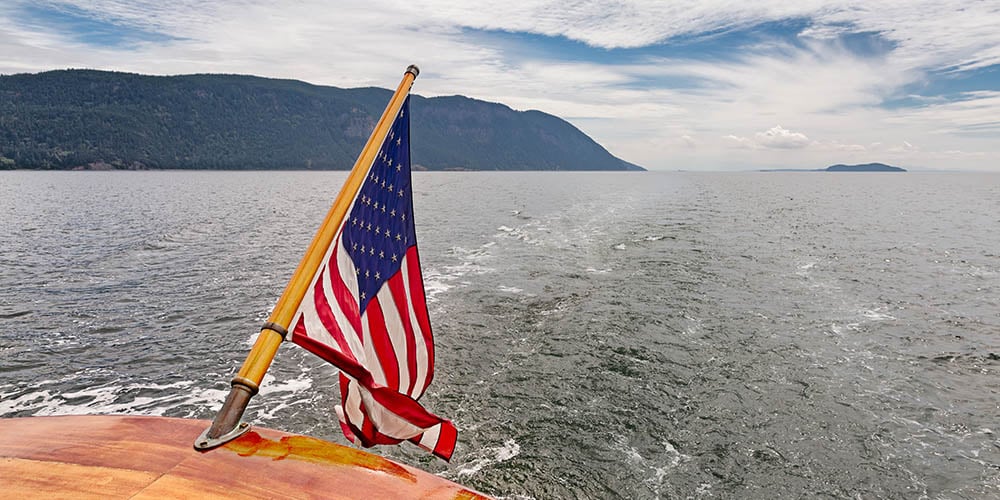
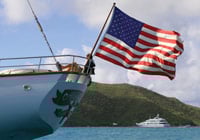
This large U.S. flag looks fine on a shorter-than-recommended staff.
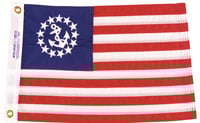
U.S. Yacht Ensign
- The Ensign
- Everyday Flag Etiquette
- Flag Size
- Half-Staff
- Courtesy Flags
- Flag Placement
- Burgees
- How to Order
- FAQs
The Ensign
For most boaters, flag etiquette begins and ends with the question of which ensign — or national flag — to fly and where to fly it. United States citizens who sail or boat may choose between two flags: the 50-star national flag (commonly called “Old Glory”), or the U.S. Yacht Ensign, which depicts a fouled anchor on a field of 13 stars in place of the 50 stars representing the states.
The story of these two ensigns is an interesting one. In the early to mid-19th century, most yachts looked like fishing boats and other commercial vessels. Ports charged local duty to visiting commercial craft, and customs officials collected fees from all entering vessels — including yachts, despite the protests of their owners. Under pressure from yachtsmen, the American and British governments independently approved special national flags to be flown only from pleasure boats. In the United States, the yacht ensign was designed by the officers of the New York Yacht Club in 1848. It remains a legal national flag for pleasure craft in U.S. waters.
International waters: Boats in international waters should fly the 50-star U.S. flag, not the Yacht Ensign, in the traditional stern location. The Yacht Ensign is a domestic flag recognized only within U.S. waters. Foreign customs authorities and vessels will recognize the 50-star flag as the correct national ensign; the Yacht Ensign may cause confusion or not be recognized as a national flag.
Everyday Flag Etiquette
All boats operating in U.S. inland waters may fly either the 50-star U.S. flag or the U.S. Yacht Ensign. Flags are traditionally flown from 8:00 a.m. to sunset. Fly the ensign from the appropriate position based on boat type:
- Powerboats: From the stern staff when underway or at anchor.
- Sailboats: On the aftermost sail, 2/3 of the length of the leach above the clew when under sail; from the stern staff when under power or at anchor.
- Sportfishermen: On a halyard just behind the tuna tower.
Lower the ensign at sunset or when you leave the boat. A flag flying overnight or when the boat is unattended is contrary to etiquette.
Flag Size
We recommend a flag that is 1 inch long for every 1 foot of boat length, with a staff that is twice the length of the flag’s vertical (hoist) edge. For example, a 33-foot boat should fly a 24” × 36” Yacht Ensign nautical flag on a 48” flag staff. A shorter staff may be used if space is limited — the priority is that the flag is visible and clear of obstructions.
Half-Staff on a Boat
When a national day of mourning or presidential proclamation calls for flags to be flown at half-staff, the correct practice on a boat is to fly the ensign at half-mast on the stern staff. The flag is first hoisted to the top of the staff, then lowered to the halfway position. When the period of mourning ends, the flag is again hoisted to the top before being lowered for the day at sunset.
On sailboats without a stern staff, the ensign is typically flown from the backstay or leach of the aftermost sail. In this case, the flag may be flown a few feet below the peak of the sail to indicate half-staff. The spirit of the tradition — a visible acknowledgment of mourning — is more important than achieving an exact geometric half-staff position.
Courtesy Flags
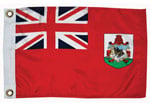
British Virgin Islands courtesy flag

Yacht club burgee (Santa Cruz Yacht Club).
Show respect when you enter the waters of another nation by flying their flag as a courtesy flag. This is both a matter of etiquette and, in many countries, a practical signal to customs authorities that you have arrived as a foreign vessel. The courtesy flag should be flown as soon as you enter the foreign country’s waters — ideally before you reach the customs dock — and kept flying for the duration of your stay.
The Q flag (solid yellow) is flown below the courtesy flag to signal that your vessel has not yet been cleared by customs. It should be lowered once clearance is obtained.
Where to Fly Your Courtesy Flag
- Mastless boats: At the bow.
- Boats with a spreader: From the starboard spreader.
- Multiple-masted boats: From the starboard spreader of the forward mast.
The starboard spreader position is the position of honor for a guest flag, and flying the courtesy flag there is a signal of respect to the host country. Never fly a courtesy flag from the port spreader — the port spreader is traditionally reserved for signals and other flags.
Burgees
Yacht club burgees are triangular or swallow-tail pennants that identify membership in a yacht club or sailing organization. They are flown from the masthead, the bow pulpit, or from under the starboard spreader — below any courtesy flags. When a courtesy flag is flying from the starboard spreader, the burgee moves to the bow pulpit or masthead.
Ordering Flags
Order courtesy flags sized to fit your boat. We stock courtesy flags for common cruising destinations in 12” × 18” and 24” × 36” sizes. We can also order 3’ × 5’, 4’ × 6’, and 5’ × 8’ flags shipped directly from our supplier for less common destinations or larger vessels.
Frequently Asked Questions
Do I have to fly a flag on my boat?
There is no U.S. federal law requiring recreational boats to fly a national ensign in domestic waters, but it is considered proper etiquette to do so when underway or at anchor. In foreign waters, flying your national ensign is both an etiquette requirement and in some countries a legal one — customs authorities expect to see a national flag on any foreign-flagged vessel. The courtesy flag of the host country is also expected when entering foreign waters.
What is the difference between the U.S. 50-star flag and the Yacht Ensign?
Both are legal national flags for U.S. pleasure craft in U.S. waters. The 50-star flag is the standard U.S. national flag. The U.S. Yacht Ensign, designed by the New York Yacht Club in 1848, depicts a fouled anchor on a field of 13 stars and was created specifically for pleasure boats to distinguish them from commercial vessels for customs purposes. The Yacht Ensign should not be flown in international waters — use the 50-star flag there, as foreign authorities may not recognize the Yacht Ensign as a national flag.
When should I fly a courtesy flag?
Fly the courtesy flag of any country whose waters you enter, as soon as you enter those waters. This applies to international travel — the Bahamas, Mexico, Canada, the Caribbean — and is a sign of respect to the host country. The flag should stay up for the duration of your stay. If you have not yet cleared customs, fly the Q flag (solid yellow) below the courtesy flag until clearance is obtained.
Where on the boat do I fly the national ensign?
On most powerboats: from the stern staff. On sailboats under sail: 2/3 of the leach length above the clew on the aftermost sail; under power or at anchor, from the stern staff. Flags are traditionally flown from 8:00 a.m. to sunset and should be lowered when you leave the boat.
What size flag do I need for my boat?
Use the rule of 1 inch of flag length per 1 foot of boat length. A 33-foot boat flies a 24” × 36” flag on a 48” staff (the staff should be twice the hoist — vertical edge — of the flag). Courtesy flags can be smaller than the ensign; 12” × 18” is appropriate for most recreational boats up to about 40 feet.