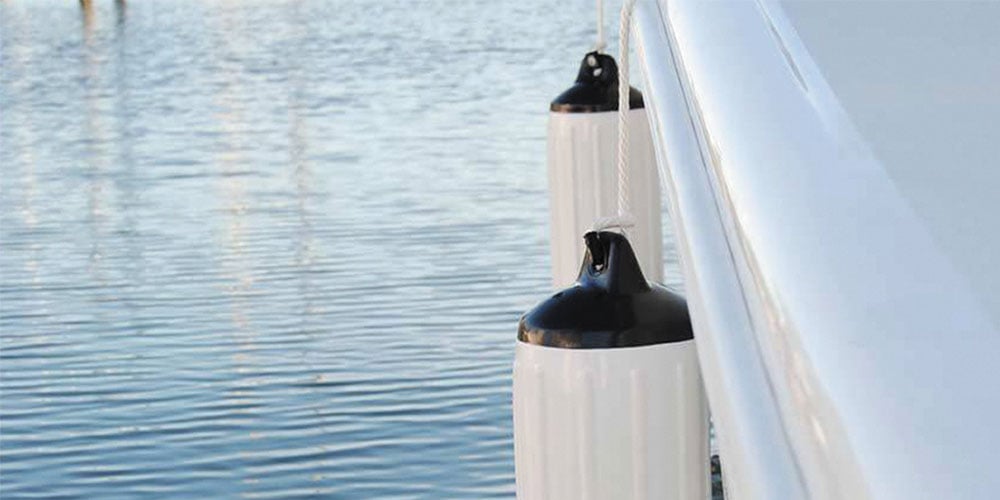
The right fenders in the right size and quantity can mean the difference between a clean gelcoat and a costly repair. This guide gives you a sizing chart by boat length, a simple formula for how many fenders you need, placement recommendations, and a breakdown of every fender type — so you leave with a clear answer, not just general advice.
- How Boat Fenders Work
- How to Choose the Right Size Boat Fender
- How Many Fenders do You Need?
- Where Should You Place Your Fenders?
- Vertical vs. Horizontal Hanging Boat Fenders
- Boat Fender Types
- Matching Fender Colors to Your Boat
- Boat Fender Accessories
How Boat Fenders Work
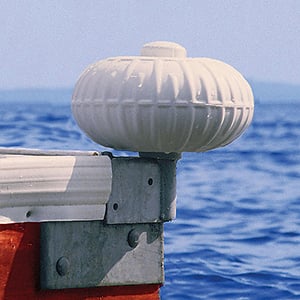
Corner dock wheels help you get into your slip when crosswinds or currents are a challenge.
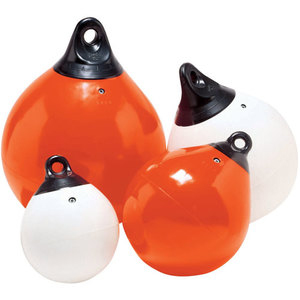
Tuff End™ round fenders are great for raft-ups, and are often used by commercial anglers, as mooring buoys or starting line markers for sailing races.
Whether inflated or soft foam, cylindrical, spherical or flat-fenders absorb the shock of vessels bumping into docks or other vessels. They insulate the boat from damage and decelerate it as it surges and rolls about. Boats that tie up to floating docks usually set fenders just above the waterline to maintain a buffer zone between dock and boat. Boats that raft together place the fenders at the point of contact—generally where the beam is the widest. Docking next to pilings presents a special challenge; the pilings tend to push the fenders aside, with damaging consequences. A solution is to use a fender board that spans the distance between pilings. With the fenders and board, a boat can ride reasonably comfortably against a wharf.
All the Comforts of Home
Boats with permanent slips often customize their space, installing dock guards, dock wheels or cushions so that the dock carries the protection, not the boat. Since these forms of padding can be placed right at the point of contact, they won’t swing out of the way. Dock cushions can prevent damage when fenders are not lined up precisely. There are so many types of padding configurations that, with a little creativity, you can defend any style of boat from any kind of docking damage.
Sizing Fenders by Boat Length
We like roughly 1" of diameter for cylindrical fenders or 2" of diameter for spherical fenders for every four-to-five feet of boat length. This is not a firm recommendation because fender size also depends on location, boat weight and conditions. Boats in unprotected end ties on Lake Erie, San Francisco Bay or other locations with nasty chop or tidal surge will need more protection than a vessel docked in a calm lake. We suggest using proper lines or fender whips to suspend the fenders at the correct height.
We recommend large diameter fenders because they provide the best protection. After all, it is only the width of the fender that separates the boat from the dock. Here are some general sizing recommendations:
Choosing the Right Size Boat Fender
| Boat Length In Feet | Cylindrical Fender Diameter | Round Fender Diameter | Flat Fender Size |
|---|---|---|---|
| Under 10' | 3" | NR | Small |
| 10'–15' | 3"–4" | 9" | Small |
| 15'–20' | 5"–5.5" | 12" | Small |
| 20'–25' | 6"–6.5" | 15" | Medium |
| 25'–35' | 8"–8.5" | 18" | Medium |
| 35'–50' | 10.5"–12" | 21" | Large |
| 50'–60' | 12" | 27" | Large |
| 60'–72' | 15"–24" | 27" | Large |
How Many Fenders Do You Need?
The general rule of thumb is:
One fender for every 10 feet of boat length, plus one additional fender.
Breakdown:
- Small Boats (up to 20 feet): 3 fenders (2 based on length + 1 additional)
- Medium Boats (20-30 feet): 4 fenders (3 based on length + 1 additional)
- Larger Boats (30-40 feet): 5 fenders (4 based on length + 1 additional)
Example:
For a Sea Ray 300 Sundancer (which is 30 feet long), you would typically need 4 fenders (3 for the 30-foot length + 1 additional).
This rule of thumb provides a good starting point, but the actual number may vary depending on specific docking conditions, the type of dock, and how the boat will be tied up.
Where Should You Place Your Fenders?
Using the Sea Ray 300 Sundancer again as an example:
- Bow: Place one fender near the bow to protect the forward section.
- Midship: Position one or two fenders along the midship area, where the boat is likely to make the most contact with the dock.
- Stern: Place one fender near the stern to protect the aft section.
Vertical vs. Horizontal Hanging Boat Fenders
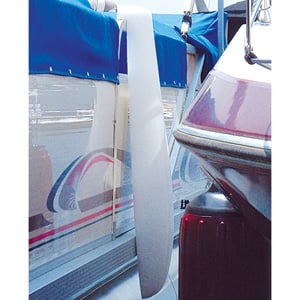
Specialty fenders are made to protect specific parts of your boat, like this fence saver made specifically for pontoon boats.
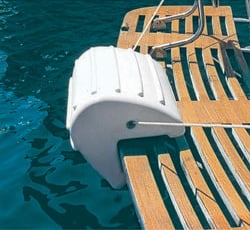
We offer many specialized fenders to protect your boat, like this transom fender used on a swimstep.
Center rope tube fenders (Big B fenders) allow you to hang the fender either horizontally or vertically using one line running through the centerline. A figure eight knot in the end of the line, or two figure eights at both ends of the fender are used to keep the fender from sliding.
Flat fenders are either modular or articulating and vinyl-covered. String together the modular style to create a custom-fitted system. Hinged vinyl-covered flat fenders wrap vertically around small boat gunwales, and are great for boats with tumblehome (topsides that slant inward at the gunwale).
Boat Fender Types
Round fenders are popular for larger powerboats with concave bows and larger commercial vessels (especially commercial fishing boats). Orange round fenders are also used as low-tech mooring buoys.
- Best for: larger powerboats with concave bows, raft-ups, commercial use
Two eye cylindrical fenders have a molded-in fairlead or tab at each end. Tie a line to one end only and hang the fender vertically or tie both ends for horizontal deployment.
- Best for: most recreational boats, versatile vertical or horizontal use
Transom mounted fenders protect a boat’s transom or swim step when docking stern-to (Mediterranean style) in a marina.
- Best for: Mediterranean-style stern-to docking
Rafting Cushions are designed for rafting boats together, and can be tied to pilings using the two rows of center holes. Large surface area, six independent molded tubes, versatile mounting options, and they won’t roll or ride up.
Low freeboard fenders sit high on the hull and hang inward over the gunwale. The smaller size protects boats that sit low in the water, like bass, fishing and ski boats. The larger size prevents bigger boats from riding up under high docks when the tide rises.
- Best for: bass boats, ski boats, fishing boats that sit low in the water
Tuff End fenders: rugged large diameter heavy-duty fender with good protection for flared, deep-V hulls. They’re popular for large boats and commercial applications. Trivalve can be inflated easily with any kind of pump.
V-shaped Freedom Fenders with a self-centering shape will stay on a piling regardless of boat movement. They’re sized for everything from small boats to mega yachts.
- Best for: piling docks where standard fenders slide off
Pontoon fenders, such as the Fence Saver II, Pontoon Curve Protector and Pontoon Protector 90, are available in specialized shapes. They protect the delicate aluminum fencing and unusual corners on pontoon boats.
- Best for: pontoon boats only — protects aluminum fencing and corners
| Boat Length | Cylindrical Diameter | Round Diameter | Flat Size | Recommended Qty |
|---|---|---|---|---|
| Under 10' | 3" | NR | Small | 2 |
| 10'–15' | 3"–4" | 9" | Small | 3 |
| 15'–20' | 5"–5.5" | 12" | Small | 3 |
| 20'–25' | 6"–6.5" | 15" | Medium | 4 |
| 25'–35' | 8"–8.5" | 18" | Medium | 4 |
| 35'–50' | 10.5"–12" | 21" | Large | 5 |
| 50'–60' | 12" | 27" | Large | 6 |
| 60'–72' | 15"–24" | 27" | Large | 7 |
NR = Not recommended. Quantities are minimums — add extra fenders for exposed docks, tidal surge, or rough conditions.
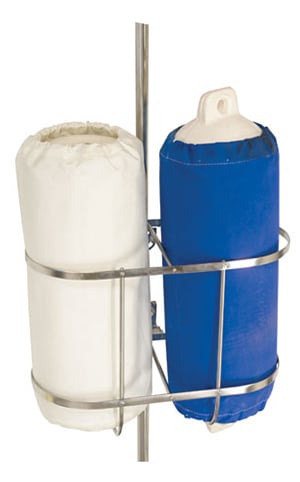
Attach our fender rack to a stanchion.
Matching Fender Colors to Your Boat
Do you want to dress up your boat with fenders that match or complement the gelcoat? We have a wide variety of colors that will go with your boat’s color scheme, in a variety of different fender styles.
Boat Fender Accessories
It is sort of a tribute to Yankee ingenuity that we have so many fender accessories, but there is a use for all of them on somebody’s boat:
Fender covers keep your fenders from getting dirty. Some boats have theirs embroidered with the boat’s name for a very posh accent.
Fender racks allow you to store one or two fenders on the lifeline stanchion’s 7/8" or 1" tubing, so they’re ready for deployment.
Hand-operated fender pumps can keep your inflatable fenders at optimum pressue, And when necessary, fill your inflatable raft and NFL-approved football.
Last, but not least, we have an incredible assortment of fender accessories: hangers, lifeline clips, fender adjusters, fender straps, fender cleats, locks, hooks and suction cup straps. We also have a cleaner to remove grease, oil and grime.
Frequently Asked Questions
What size fender do I need for my boat?
Use roughly 1 inch of diameter for every 4–5 feet of boat length for cylindrical fenders, or 2 inches of diameter for spherical fenders. A 25-foot boat typically needs a 6–6.5 inch cylindrical fender or a 15-inch round fender.
How many fenders do I need?
The general rule is one fender per 10 feet of boat length, plus one extra. A 30-foot boat needs 4 fenders. A 20-foot boat needs 3.
Where should fenders be placed?
One near the bow, one or two amidships where most contact occurs, and one near the stern. For piling docks, use a fender board spanning the pilings to prevent fenders from being pushed aside.
Should fenders hang vertically or horizontally?
Vertically for most dock situations — it gives a wider buffer zone. Horizontally when docking against a high dock or in rough conditions where the boat rises and falls significantly.
What is a fender board and when do I need one?
A fender board is a plank that spans two or more pilings, with fenders behind it against the boat. It's essential when docking alongside a piling dock, where individual fenders tend to get pushed aside by the pilings.
What's the difference between inflatable and foam fenders?
Inflatable fenders are adjustable for firmness and can be deflated for compact storage. Foam fenders require no maintenance and can't go flat, making them more reliable in situations where you can't monitor inflation levels.