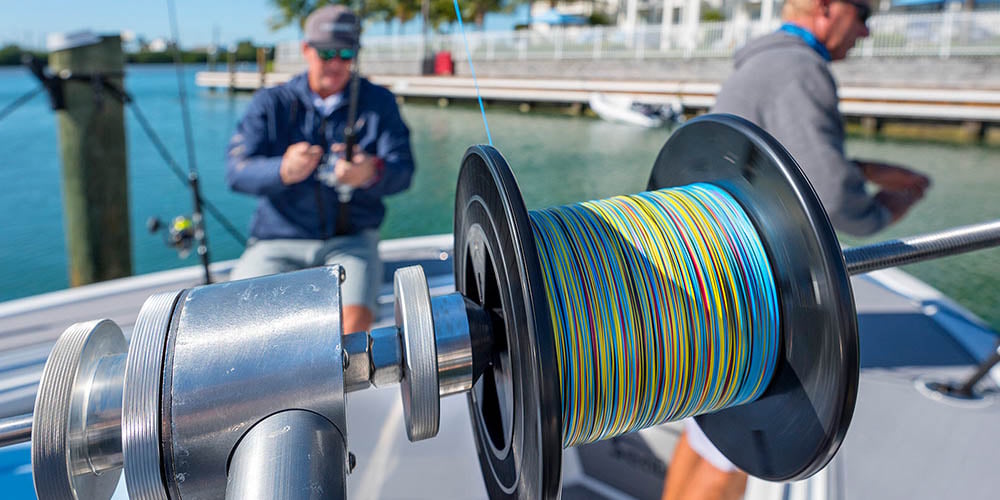
The fishing line you choose affects everything — how far you cast, whether you feel the bite, and whether you land the fish or lose it. The three main types — monofilament, fluorocarbon, and braid — each have real advantages and real trade-offs depending on your target species, technique, and conditions. This guide breaks down what matters so you can pick the right line before you hit the water.
- Monofilament vs. Thermal vs. Braided Line
- Line Strength
- Nylon, Dacron, Spectra, or Dyneema Line
- Castability
- Line Stretch
- Line Memory
- Fluorocarbon Line
- Examples for Selecting Fishing Line
- Useful Tips
- Conclusion
What to Look for When Choosing Fishing Line
Monofilament vs. Thermal Filament vs. Braided
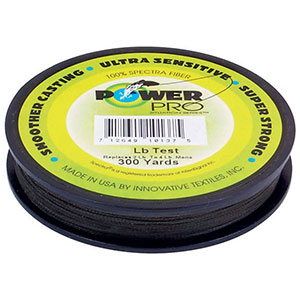
Spectra braided fishing line, like this line from Power Pro, is light, strong, and slippery, for less line noise and lower friction.
Fishing line that is extruded in a single continuous filament and left untwisted is called monofilament. It’s smooth and clear and offers moderate amounts of stretch. Monofilament is also available in special colors to improve visibility above the water while keeping it invisible to the fish. High-performance line produced by thermal bonding of small fibers is called thermal filament and has a smaller diameter per pound test than monofilament. Braided lines are a bit thicker and more common for fishing larger species — for example, fishing for large blue- and yellowfin tuna offshore.
Line Strength
The strength of fishing line is called test and is measured in pounds. It should roughly match the weight of the species you are fishing for — for example, use 30-pound test for tuna in the 30-pound range. A typical line to cast for trout would be 4-pound test.
Consider braided line of 30-pound test or more if you go after large game fish. A rule of thumb is to fish with the lightest gear possible so you don’t tire and have more fun. In competition when test is specified, anglers must use light line to land heavy fish — but that requires experience, a zest for a long fight, and above all, solid technique. Another difference: while normal fishing line is guaranteed to break above its rating, tournament line must break before the rating or the records will not be recognized.
Nylon, Dacron, Spectra, Dyneema
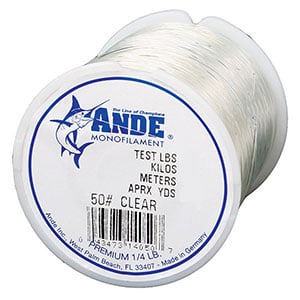
Monofilament nylon fishing line, like this Ande Premium Monofilament, is inexpensive and widely used.
Nylon, the oldest and most common synthetic fiber for fishing line, is made from linear polyamides and offers a good compromise between strength, stretch, and abrasion resistance. Dacron, developed by DuPont in the late 1950s, is based on a long-chain polyester and represents a step up from nylon in strength, flexibility, and low stretch.
Spectra and Dyneema are two modern brand names for ultra-strong polyethylene fiber used in high-tech fishing line. It is many times stronger than steel, more durable than polyester, and so light it floats. We recommend Spectra/Dyneema for higher tensile strength at smaller diameters, which reduces tackle weight and increases the amount of line that fits onto the spool. For example, 130-pound Spectra test has the same diameter as conventional 30-pound test nylon line. Spectra/Dyneema also offers better abrasion resistance, which prevents loss of bait or lure when fishing near obstacles or near the bottom where line snags or chafes against sharp objects.
Castability
When it comes to active styles of fishing that require frequent casting, we recommend smooth, light lines because they come off the spool easier, enabling more accurate casts over longer distances.
Line Stretch
Less stretch in fishing line results in more sensitivity to feel the fish, which is what most anglers want. However, in certain situations some stretch is desirable — for example when trolling — because it acts like a shock absorber and can mean the difference between setting the hook in a soft-mouthed fish such as salmon or ripping it out.
Line Memory
Unlike in humans and computers, less memory is better when it comes to fishing lines. Memory refers to a line’s tendency to retain its shape after being wound on a spool. A line with a lot of memory “remembers” the loops it formed on the spool and springs into coils when it comes off. Lines with low or no memory stay straight off the spool, which reduces friction on guides and reels and enables longer, smoother casts.
Fluorocarbon Line
Fluorocarbon (PVDF) has become the preferred choice for leader material and finesse fishing applications. Key characteristics:
- Nearly invisible underwater: Its refractive index is close to water, making it the least visible line type to fish.
- Stiffer than monofilament with less stretch: Provides better sensitivity and hook-setting power.
- Denser than water: Sinks faster than mono, making it ideal for bottom fishing and deep presentations.
- More abrasion resistant than monofilament.
- More expensive than mono but less than most braid.
Best for: clear water fishing, leader material, finesse applications, drop-shot rigs, bottom fishing.
Not ideal for: topwater lures (it sinks) or long-distance casting (stiffer than mono).
Note: Line strength ratings are guidelines. Size up 25–30% to account for knot strength loss and shock loads.
Examples for Selecting Fishing Line
| Test | Type | Venue | Technique | Target Species |
|---|---|---|---|---|
| 2–4 lb | Mono / Fluoro | Freshwater | Spinning, casting | Trout, panfish, bass (finesse) |
| 6–10 lb | Mono / Fluoro | Inshore | Spinning, casting | Bass, walleye, redfish, flounder |
| 12–20 lb | Mono / Braid | Near shore | Trolling, casting | Stripers, snook, salmon, mahi-mahi |
| 30–80 lb | Braid + leader | Offshore | Trolling, jigging | Tuna, marlin, grouper, sharks |
Useful Tips
Line loses up to a third of its strength at the knot, so we recommend that you size fishing line generously, even though actual breaking strength typically exceeds its rating by approximately 50 percent. Use proper fishing knots to attach leaders and terminal tackle to minimize strength loss at the connection point. A line’s shock resistance withstands breakage when fish hit at high speeds, especially during trolling. If you are not sure what you are going to encounter, err on the strong side or you risk losing your catch.
For example, if you fish for fast-swimming Dorado in the 20-pound range, use 30-pound test so your line has enough strength and shock resistance (approximately 45 pounds) if the fish hits at full throttle and takes off with the bait. For a well-balanced tackle that is functional and comfortable to use, match the line class to rod and reel. Too light a line may be difficult to cast or may be broken by an excessive load. Too heavy a line can break the rod.
Frequently Asked Questions
What is the best fishing line for beginners?
Monofilament is the best starting point. It’s affordable, forgiving, easy to knot, and available everywhere. 8–12 lb monofilament handles most inshore and freshwater situations a beginner will encounter.
What is the difference between monofilament and fluorocarbon?
Both are single-strand lines, but fluorocarbon sinks, has less stretch, and is nearly invisible underwater. Monofilament floats, stretches more, and is more forgiving — making it better for topwater lures and beginners. Fluorocarbon is preferred for leader material and clear-water finesse fishing.
When should I use braided line?
Braid is best when you need maximum sensitivity, thin diameter for more line on the spool, or are fishing in heavy cover or deep water where abrasion resistance matters. It has virtually no stretch, so you feel every bite. Most offshore anglers use braid with a fluorocarbon or mono leader.
Does fishing line expire?
Yes. Monofilament and fluorocarbon degrade with UV exposure and should be replaced at least once per season, or more frequently if you fish heavily. Braid lasts longer but should be inspected regularly for fraying or abrasion damage — particularly the last several feet closest to the terminal tackle.
What pound test should I use?
Match your line strength to the average size of the fish you’re targeting. As a general rule, use line rated close to the expected fish weight, then size up 25–30% to account for shock loads, knot strength loss, and abrasion. When in doubt, go heavier — you can always adjust down once you have a feel for the fishery.
Conclusion
Make sure the line’s test matches the average weight of the targeted species, is capable of absorbing shock loads when the fish hits, and has enough strength in the knot areas.
- Bait-casting on a lake requires lighter and more sensitive line than saltwater game fishing because it is a more active style of fishing and the targeted species are smaller.
- Common monofilament has more stretch than braided high-tech line and takes up more room on the spool.
- Performance lines such as Spectra are priced higher than nylon or Dacron, but offer more sensitivity, abrasion resistance, and knot strength, with low stretch and minimal memory — we consider them a good value for serious fishing applications.
- Line with moderate stretch is good for trolling because it may be the difference between hooking the fish or ripping the hook right out of its mouth.
- Good advice when buying line is to buy plenty of it because you will find that you lose more than you expect.
View & Shop Fishing Line
Related: