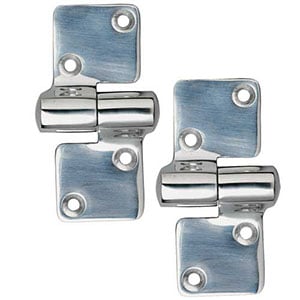
Take-apart hinges are ideal for engine covers and lift-off hatches because they can quickly be separated without tools.
Marine cabinet hardware includes the hinges, latches, catches, handles, pulls, locks and brackets used to build, repair or upgrade boat cabinetry. While these parts may look similar to household hardware, marine versions are typically smaller, more compact and made from corrosion-resistant materials such as brass, chrome-plated brass, bronze or stainless steel.
Choosing the right hardware matters because boats move, vibrate and flex. Cabinet doors, hatches and drawers must stay secure underway, resist corrosion in damp cabin environments and remain easy to operate in tight spaces.
- Marine Hardware Materials
- Padlocks and Marine Locks
- Hinges
- Catches, Hasps and Door Hooks
- Door Latches and Lock Sets
- Barrel Bolts, Braces and Table Brackets
- Handles and Pulls
- How to Choose Cabinet Hardware
- Marine Cabinet Hardware FAQ
Marine Hardware Materials
Marine cabinet hardware is exposed to humidity, salt air, vibration and frequent use. Material choice affects appearance, strength and long-term durability.
- Stainless steel: Strong, corrosion resistant and well suited for exposed or high-use areas.
- Brass: Traditional marine appearance with good corrosion resistance, especially in interior applications.
- Chrome-plated brass: Offers a polished finish while retaining brass construction underneath.
- Bronze: Durable and corrosion resistant, often used where strength and traditional styling matter.
- Zinc or plated hardware: Suitable for some light-duty interior uses but less ideal in damp or salt-exposed areas.
For exterior lockers, cockpit compartments and damp cabin areas, choose the most corrosion-resistant material available. For interior cabinets, finish, size and operating style may be equally important.
Padlocks and Marine Locks
Marine locks are similar to land-based locks but are generally made from corrosion-resistant materials such as brass or bronze. They are commonly used on cockpit lockers, dock boxes, companionway boards and storage compartments.
A common option is to use keyed-alike locks so cockpit lockers, dock boxes and companionways can all be opened with the same key. This simplifies access, but remember that some common marine locks may use similar key patterns, so they should not be treated as high-security protection.
Door hardware with built-in locks can include a knob and catch and may be surface mounted or mortised into the door. Chrome-plated brass lock sets are popular because they look appropriate aboard and resist corrosion better than ordinary household hardware.
Hinges
There are many hinges to choose from. The best hinge depends on the door, hatch, table or panel it supports.
- Piano hinges: Long, continuous hinges that distribute loads across a wide area. They work well for tables, hatches, dock boxes and long cabinet doors.
- Take-apart hinges: Feature a removable or spring-loaded pin so the two sides can be separated easily. They are useful for companionway ladders, lift-off hatches, removable panels and engine covers.
- Offset hinges: Have one leaf offset from the other, allowing a door or panel to open wider without binding.
- Butt hinges: A standard hinge style used for many small cabinet doors and interior applications.
- Strap hinges: Longer decorative or structural hinges that can spread loads across larger surfaces.
When selecting hinges, consider door weight, opening angle, screw size, mounting surface, corrosion exposure and whether the door must be removed without tools.
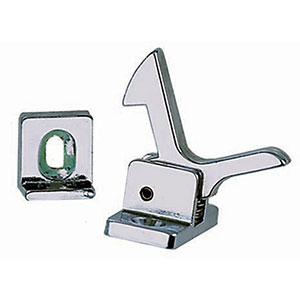
Zinc Elbow Catch
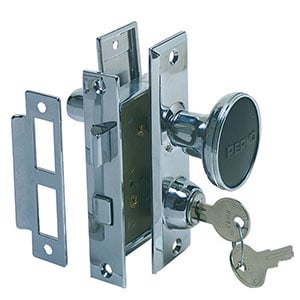
Mortise Latch Set with inside deadbolt lock.
Catches, Hasps and Door Hooks
Catches are used to secure cupboard or locker doors. They consist of two parts: a latch or pin on the door and a receptacle or socket on the doorframe. Their snap-in and snap-out design makes them convenient, but they are generally less secure than latches, bolts or hooks.
Hasps have a hinged plate with a slot that fits over a raised eye. When folded over the eye, the hasp can accept a padlock to secure a hatch, door or locker.
Door hooks consist of a hook and an eye. They are used to hold doors closed or to keep an open door from swinging and banging while underway.
For cabinet doors that may open while the boat heels, pitches or hits wakes, choose a closure that provides enough holding power for the application. Light catches may be fine for small interior cabinets, while heavier doors or lockers may need a latch, bolt or hasp.
Door Latches and Lock Sets
Door latches include a knob and catch that help keep cabin doors secure. Several common latch styles are used aboard boats:
- Rim latch/lock sets: Mounted on the surface of the door.
- Mortise latch/lock sets: Installed into a pocket cut into the door.
- Strike plates: Installed on the doorjamb to accept the latch when extended. Box strikes mount on the surface of the doorframe, while flush strikes are inset.
- Case: The housing for the lock and/or latch mechanism.
- Escutcheon: The decorative plate mounted on the exterior side of the door.
Mortise latch sets create a clean, traditional appearance but require more careful installation. Rim latch sets are easier to install and can be a better option when door thickness or construction does not allow mortising.
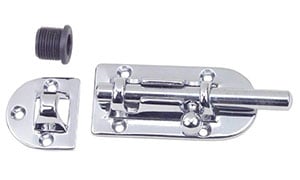
This barrel bolt has a friction pad for smooth operation and to reduce rattling.
Barrel Bolts, Braces and Table Brackets
Barrel bolts consist of two parts: a sliding bar mounted to the door and a receptacle mounted to the doorframe. When the bolt slides into the receptacle, it creates a secure closure because the bar is held captive and cannot slide out accidentally.
Corner braces are the nautical equivalent of L-brackets. They are used to support tables, counters, shelves and platforms at a right angle to the mounting surface.
Table brackets are similar to corner braces but usually consist of two pieces so the table or platform can be removed when necessary. They are useful aboard boats where furniture must be secure underway but removable to save space.
Handles and Pulls
Depending on the application, some handles and pulls will work better than others. In tight cabin spaces, low-profile or flush-mount hardware helps prevent snagging clothing, lines, bags or foul weather gear.
Doorknobs are through-bolted or screwed into doors and drawers to help open them. They are easy to use but can protrude into narrow walkways.
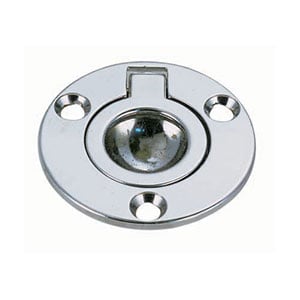
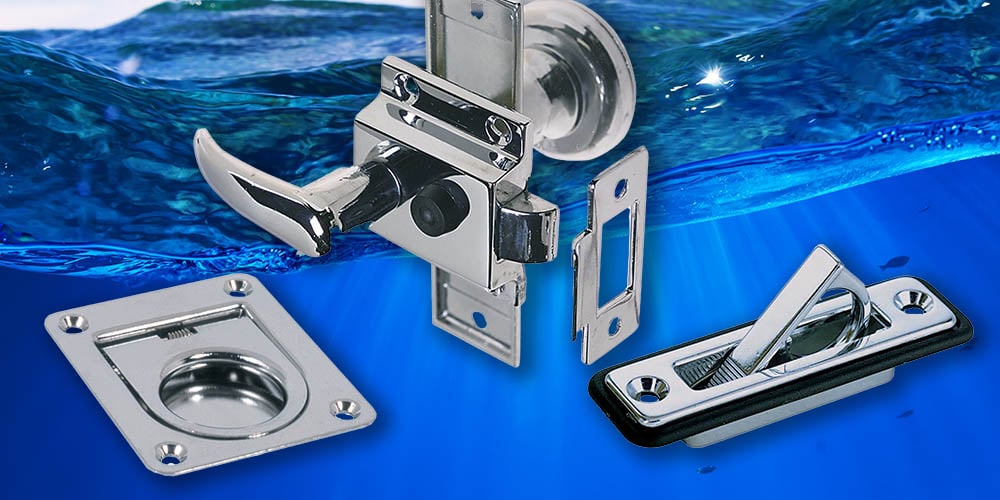
Many ring pulls mount flush with the surface of the cabinet to reduce snagging and can be opened with one finger.
Flush handles have a hinged handle that folds into a recessed base when not in use. This keeps the surface flush and reduces the chance of snagging gear or clothing.
Ring pulls are similar to flush handles but use a smaller hinged ring instead of a larger handle. They are typically used for small compartments, floorboards, access panels and lightweight doors.
Grab handles may look similar to cabinet handles but are designed for handholds. Do not assume a cabinet pull can serve as a load-bearing grab handle unless it is specifically rated and installed for that purpose.
How to Choose Marine Cabinet Hardware
Before replacing or adding cabinet hardware, consider the hardware’s job, mounting location and expected load.
- Match the material to the environment: Use stainless steel, bronze or chrome-plated brass in damp or exposed areas.
- Choose the right duty rating: Small catches and pulls are for light-duty interior use, not heavy lockers or exterior security.
- Measure carefully: Check door thickness, screw spacing, cutout dimensions and swing clearance before buying.
- Plan for motion: Boats heel, roll and vibrate, so cabinet closures should prevent doors from opening underway.
- Avoid snag points: Flush pulls and low-profile hardware are better in tight companionways and narrow cabins.
- Use proper fasteners: Select corrosion-resistant fasteners compatible with the hardware material.
Most items in this category are considered light-duty closures and are suitable for securing interior doors, cabinets and drawers. Most, with the possible exception of hasps and some grab handles, should not be used for external doors where security or structural loads are a concern. Do not overestimate the capacity of these fastenings.
Marine Cabinet Hardware FAQ
What makes marine cabinet hardware different from household hardware?
Marine cabinet hardware is typically smaller, more compact and made from corrosion-resistant materials such as stainless steel, brass, bronze or chrome-plated brass. It is also designed for tight spaces and the vibration common aboard boats.
What type of hinge is best for removable hatches?
Take-apart hinges are ideal for removable hatches, engine covers and companionway ladders because they allow the hinged component to separate without tools.
Are catches secure enough for boat cabinets?
Catches are useful for light-duty cabinet doors, but they are less secure than latches, hasps, hooks or barrel bolts. Use stronger hardware for heavier doors or lockers that must stay closed underway.
When should I use flush pulls?
Flush pulls are best in tight spaces where protruding handles could snag clothing, gear or lines. They are commonly used on lockers, floorboards and small access panels.
Can cabinet handles be used as grab handles?
Only if they are designed and installed for that purpose. Most cabinet pulls are light-duty hardware and should not be relied on as safety handholds.