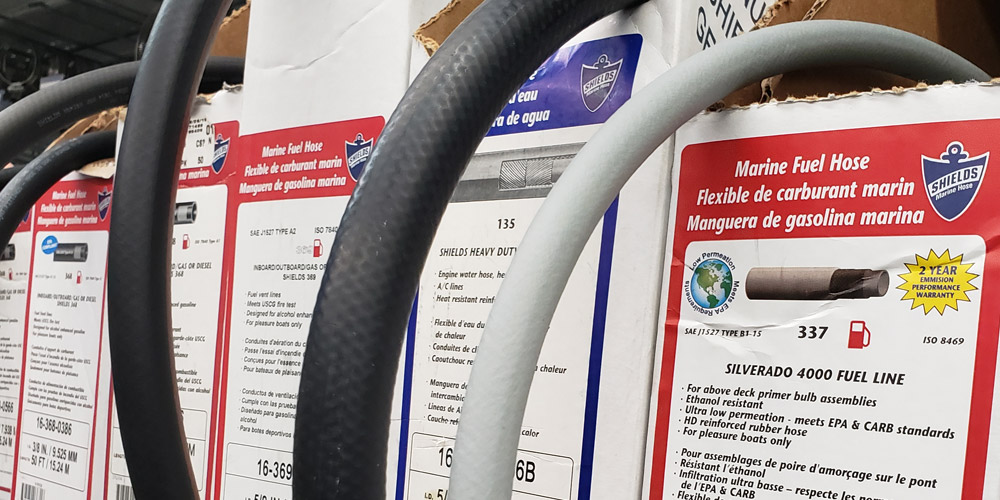
By Tom Burden, West Marine Technical Editor
Mind the Hose!
Consider what can happen when a hose bursts. If you are lucky, you will only have nuisance repairs to electronics, engine, or interior. If fate has it in for you, a defective hose can cause a serious odor problem if it’s the discharge of the head, start a fire if it’s part of a fuel line, or even sink your boat if it’s connected to a through-hull fitting. Hose failure is one of the leading causes of onboard fires and sinkings in recreational boats. That’s why we recommend spending a little more on high-quality marine hose that offers more durability and better performance in critical applications, and why you should inspect your hoses frequently for signs of deterioration.
- Selection Questions
- What to Look For When Choosing Marine Hose
- Installation Tips
- Marine Hose Application Guide
- Fresh Water System
- Sanitation System
- Engine Hose
- Wet Exhaust System
- Fuel System
- Bilge/Livewell
Selection Questions
What fluid or application do you need the hose for?
Your application determines what kind of hose to purchase. The following is a guide to match hose and application. Our selection of hoses encompasses most applications and is available in any length from a foot up.
Raw Water Hoses
Raw water intake hoses ingest water from outside a boat to cool an engine, flush a toilet, cool an air conditioner, or provide a fresh supply of water for fish in bait tanks. Use only hose recommended for “below waterline” connections. Depending on the application, raw water intake hose will have fabric, PVC, or stainless steel spiral reinforcement that resists kinking and prevents the hose from collapsing when, for example, an engine pulls a vacuum due to a clogged water intake screen. For engine raw water intake, we recommend Shields Series 250 or Series 252 hose, both of which are reinforced with a metal wire helix to prevent collapse. For engine coolant circulation, Shields Series 135 hose (reinforced with polyester yarn spirals) can be a good choice — however, care must be taken not to exceed the minimum bend radius and the temperature rating of the hose. For an overview of hose applications, see the hose application tables below.
Drain Hoses
Drainage hose for cockpit, sink, or shower needs to be flexible with strong walls and resistance against kinks and abrasions, but since these hoses are under positive pressure, they generally do not require helical wire reinforcement.
Freshwater Supply Hoses
Potable water hoses must be made of FDA-approved, non-toxic materials so they won’t cause bad taste in drinking water supplies. Pressurized freshwater systems must use reinforced hose to withstand pump pressure (approximately 40–60 PSI). For fill and vent hoses in water tanks, extra-heavy-duty sanitation/water hose should be used, while reinforced rubber hose is the best choice for hot water up to 140°F.
Alternatively, you may use a reinforced vinyl hose with nylon braid. Examples include: Series 162 (polyester-reinforced clear PVC hose, FDA-approved); Series 140 VAC Standard (steel wire-reinforced PVC hose); and Series 148 Multi-Purpose (vinyl helix hose, FDA-approved, ideal for critical drain and fill applications).
Bilge Pump Hoses
Bilge pump hoses typically use corrugated polyethylene with molded cuffs because it is flexible, economical, and resists oil, solvents, and other waste that collects in the bilge. For better flow, choose a hose with a smooth bore, abrasion-resistant cover, and good anti-kink flexibility. Examples include: Series 148 Multi-Purpose (smooth-walled vinyl helix hose, FDA-approved, ideal for critical drain and fill applications) and Shields Multiflex Hose (Series 141). Of the corrugated hoses, the best choices are Shields VAC Standard (Series 140) and Bilgeflex (Series 120).
Sanitation System Hoses
Sanitation hose must be tough, flexible, and resistant to odors and toilet chemicals. Choose hose with a smooth bore, heavy wall, and specifically labeled for marine sanitation use. We recommend only smooth interior wall hose because corrugated types trap waste and restrict flow. There are two primary choices: white vinyl hose and sanitation-specific hose. Both will eventually transmit some odor over time. Rigid PVC does not pass odors but is stiffer, more difficult to route, and does not connect directly to pumps and through-hulls. It is possible to plumb part of the system with rigid PVC and switch to flexible hose where necessary.
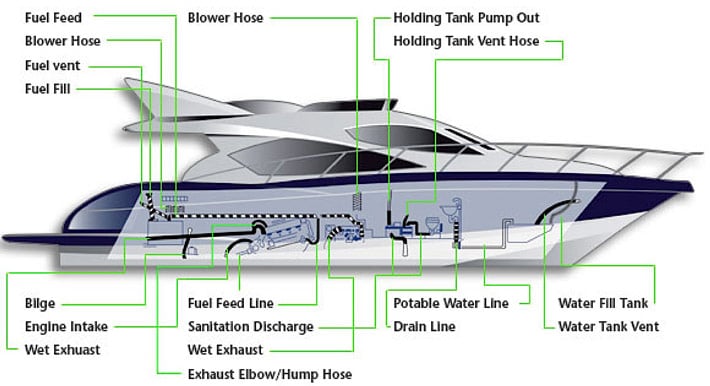
What to Look For When Choosing Marine Hose
Reinforcement: Many hoses have reinforcement in the walls for strength and rigidity, and to prevent collapse or expansion under pressure. Reinforcements can be wire, yarn spiral, or PVC/vinyl helix. Below-waterline hoses and engine intake hoses should always have wire helix reinforcement to prevent collapse under suction.
Burst strength: Hose used for discharge lines must resist pressure. This burst strength, measured in pounds per square inch (PSI), depends on product design and diameter. Small-diameter hoses have greater burst strengths. Hoses with multiple plies or helical reinforcement have greater pressure limits, which is important for pressurized water or exhaust applications.
Vacuum rating: Hose on the intake side must withstand suction, measured as a vacuum rating. Intake hose should have a vacuum rating of 20 or higher to resist collapse when the pump draws a vacuum through it.
Temperature range: Primarily critical for engine cooling hose, but also important for pressurized hot water systems. Never use hose rated below the maximum operating temperature of the system it serves.
FDA approval: Hose used in potable (drinking) water systems must be constructed from safe, non-toxic, FDA-approved materials that are contamination-free.
Bend radius: A hose should not be bent more than the minimum bend radius recommended by the manufacturer to avoid kinks, stress, and eventual breakage. Particularly important for sewage lines and bilge pump applications where routing requires turns.
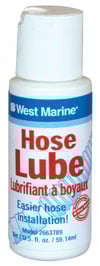
Sometimes a lubricant is needed to install a hose onto a fitting. Hot water and liquid soap are practical alternatives if dedicated hose lube is not available.
Choosing the Right Hose Diameter
Hoses are sized by their inside diameter (ID). Hose fittings are labeled based upon the ID of the hose they fit — in other words, the outside diameter of a 1/2” barbed elbow will measure slightly greater than 1/2”, but it will fit 1/2” ID hose correctly. Smooth bore hose is recommended for all applications, since corrugated hose can reduce flow by as much as 30%. Hose must be matched to the fittings on pump, through-hull, deck fill, tank, and so on. Some common diameters by application:
- Bilge pumps: 3/4”, 1 1/8”, 1 1/2”, or 2”
- Deck fill/discharge: 1 1/2”
- Gasoline feed: 1/4” to 3/8” depending on engine size
Choosing Hose Clamps
Marine hose clamps are stainless steel bands that compress hose around barbed fittings. Quality marine clamps are all stainless steel, including the screw, band, and housing — not just the band. T-bolt hose clamps have a 360° clamping surface and are significantly stronger than worm-gear clamps. They are required in applications with high pressure, heat, or vibration, such as exhaust systems. Two clamps are recommended for all below-waterline connections. Through-hulls, hose lube, and sealant may be necessary to complete your marine plumbing installation.
Installation Tips
- Most boats use flexible vinyl or rubber hose and barbed fittings secured by hose clamps. You may find it easier to install hoses over barbed fittings if you place the hose end in hot water first and use liquid soap as a lubricant.
- Threaded fittings should be wrapped with PTFE (Teflon) tape or sealed with thread sealant prior to assembly to seal tiny gaps in the threaded connection.
- In household applications, plastic pipe and fittings are solvent-welded with PVC cement. This technique is not recommended on boats because vibration and pounding can cause fatigue and failure at these joints over time.
- Use double hose clamps on all hose-to-pipe connections below the waterline for extra security. Make sure to use hose barbs long enough to give both clamps sufficient gripping surface.
- Connect fittings of the same material within a system — thread styles and inter-thread distances will match. Bronze fittings have been known to split weaker plastic fittings when overtightened.
- Normal green color on an aging bronze fitting is surface oxidation and is not a problem. A pink or red color, however, indicates dezincification (galvanic corrosion of the zinc component in brass or bronze) and the fitting should be replaced.
Marine Hose Application Guide
| ••• Excellent |
| •• Good service in normal applications |
| • Good service with proper installation. May not be suitable in all applications |
| NR — Not recommended |
| NA — Not available in size range |
| 1 — Can easily be bent into tight radius |
| 2 — Can be bent into gradual radius |
| 3 — May kink in applications requiring bend radius |
Fresh Water System
| Series | Name | Non-Pressurized Supply | Pressurized Hot | Pressurized Cold | Water Tank Fill | Drain Line Below Waterline | Drain Line to Sump or Above Waterline | Water Tank Vent | Flexibility |
|---|---|---|---|---|---|---|---|---|---|
| Series 162 | Polyester Reinforced / Clear PVC Tubing | ••• | ••• | ••• | •• | ••• | ••• | ••• | 2 |
| Series 150 | Clear PVC Tubing | •• | NR | NR | • | NR | •• | •• | 2 |
| Series 148 | Multi-Purpose Vinyl Hose | NA | NR | NR | ••• | ••• | ••• | ••• | 2 |
| Series 141 | Multiflex Hose | • | NR | NR | ••• | NR | ••• | • | 1 |
Sanitation System
| Series | Name | Toilet To Holding Tank | Holding Tank Pumpout | Holding Tank To Overboard Discharge | Toilet Water Inlet | Holding Tank Vent | Flexibility |
|---|---|---|---|---|---|---|---|
| Series 105 | Poly X Sanitation Hose | ••• | ••• | ••• | NA | NA | 1 |
| Series 101 | No-Odor Super Head Hose | ••• | ••• | ••• | NA | NA | 1 |
| OdorSafe + | OdorSafe™ Plus Hose | ••• | ••• | ••• | NA | NA | 1 |
| Series 148 | Multi-Purpose Vinyl Hose | •• / ••• | ••• | ••• | ••• | ••• | 2 |
| Series 162 | Polyester Reinforced Clear PVC Tubing | NA | NA | NA | ••• | NA | 2 |
Engine Hose
| Series | Name | Engine Intake | Generator Intake | Exhaust Coolant Hose/Limited Bend | Exhaust Coolant Hose/Severe Bend | Exhaust Water Injection | Flexibility |
|---|---|---|---|---|---|---|---|
| Series 262 | Corrugated Nautaflex Silicone Exhaust Hose | ••• | ••• | ••• | ••• | ••• | 1 |
| Series 202V | Hi-Temp Silicone Exhaust & Water Hose | NR | NR | ••• | NR | • | 3 |
| Series 250 | Shieldsflex II Marine Water/Exhaust Hose | ••• | ••• | ••• | ••• | ••• | 1 |
| Series 200 | Exhaust/Water Hose | NR | • | ••• | NR | •• | 3 |
| Series 130 | Heater Hose | NR | NR | •• | NR | NR | 3 |
| Series 135 | Heavy-Duty Water Hose | NR | • | •• | NR | •• | 3 |
| Series 160 | Water Hose | NR | •• | ••• | NR | •• | 2 |
Wet Exhaust System
| Series | Name | Straight Pipe Connector less than 4 x hose ID | Straight Pipe Connector more than 4 x hose ID | Moderate Bend | Severe Bend | Flexibility |
|---|---|---|---|---|---|---|
| Series 262 | Corrugated Nautaflex Silicone Exhaust Hose | ••• | ••• | ••• | ••• | 1 |
| Series 202V | Hi-Temp Silicone Exhaust & Water Hose | ••• | • | NR | NR | 3 |
| Series 200 | Exhaust/Water Hose | ••• | • | NR | NR | 3 |
| Series 250 | Shieldsflex II Marine Water/Exhaust Hose | ••• | ••• | ••• | • | 2 |
| Series 252 | Shieldsaust-C | ••• | ••• | ••• | ••• | 1 |
Fuel System
| Series | Name | Oil Tank Fill | Fuel Tank Fill | Fuel Feed Inboard/IO | Fuel Feed Outboard | Fuel Tank Vent Inboard | Fuel Tank Vent Outboard | Flexibility |
|---|---|---|---|---|---|---|---|---|
| Series 331 | Silverado 3000 | N/A | N/A | N/R | ••• | N/A | N/A | 2 |
| Series 350 | Type A2 Fuel Fill Hose | ••• | ••• | N/A | N/A | N/A | N/A | 1 |
| Series 355 | Type A2 Fuel Fill Hose | ••• | ••• | N/A | N/A | N/A | N/A | 1 |
| Series 315 | Silverado 2000 Outboard Fuel Hose | N/A | N/A | N/R | ••• | • | ••• | 2 |
| Series 368 | Low Permeation Marine Fuel Hose | N/A | N/A | ••• | ••• | N/A | N/A | 1 |
| Series 369 | Type A2 Fuel Vent Hose | N/A | N/A | N/R | N/R | ••• | ••• | 1 |
Bilge/Livewell
| Series | Name | Submersible Bilge Pump | Remote Bilge Pump | Hand Bilge Pump | Livewell Inlet | Livewell Drain Above Waterline | Livewell Drain Below Waterline | Flexibility |
|---|---|---|---|---|---|---|---|---|
| Series 148 | Multi-Purpose Vinyl Hose | ••• | ••• | ••• | ••• | ••• | ••• | 2 |
| Series 141 | Multiflex Hose | ••• | •• | ••• | N/R | •• | N/R | 1 |
| Series 140 | VAC Standard | ••• | ••• | ••• | •• | •• | • | 1 |
| Series 120 | Bilgeflex Hose | •• | N/R | • | N/R | N/R | N/R | 1 |
Marine Hose FAQs
What types of hoses are used on boats?
Marine boats use several distinct hose categories, each engineered for its specific application. Raw water intake hoses bring seawater aboard for engine cooling, toilet flushing, and air conditioning. Sanitation hoses connect toilets to holding tanks and handle pumpout. Fuel hoses connect fuel tanks to engines and must meet ABYC and Coast Guard standards for fire resistance and permeation resistance. Exhaust hoses carry hot exhaust gas mixed with cooling water from the engine to the transom. Bilge hoses route bilge pump discharge overboard. Freshwater supply hoses carry potable water through pressurized systems. Each type has specific construction requirements and should never be substituted with a different hose type.
What makes marine hoses different from standard hoses?
Marine hoses are engineered for the specific demands of a boat environment that standard plumbing, automotive, or garden hose cannot meet. They must resist saltwater and UV degradation, withstand vibration without fatigue cracking, and in the case of fuel hoses, resist fuel permeation to prevent fire hazard. Below-waterline hoses must have wire reinforcement to resist collapse under suction without which they can flatten and block flow. FDA-approved construction is required for potable water hoses. Using non-marine hose in a critical application — especially fuel or below-waterline connections — is a safety risk that can result in fire or sinking.
How do I choose the correct hose diameter?
Measure the outside diameter of the barbed fitting the hose will attach to, which equals the ID of the hose you need. Hoses are sized by inside diameter (ID) — a 3/4” hose has a 3/4” inside bore. Do not guess at the size; an undersized hose forced onto a fitting will strain the connection and fail prematurely, while an oversized hose will not seal reliably. Always match the hose ID to the fitting barb diameter exactly, and use the correct hose clamp size for the outside diameter of the hose.
What is the significance of hose reinforcement?
Reinforcement serves different functions depending on its type. Wire helix reinforcement prevents a hose from collapsing under suction (vacuum), which is critical for all below-waterline intake hoses — without it, a hose can flatten shut when the pump draws a vacuum, completely stopping water flow. This is particularly dangerous for engine cooling water intake. Braid or spiral reinforcement resists expansion under pressure, which is essential for fuel lines and pressurized water systems. A hose without the correct reinforcement type for its application may fail suddenly and without warning.
How do I ensure a secure hose connection?
Use all-stainless marine hose clamps — confirm the screw and housing are stainless, not just the band. Install the clamp over the barb, not at the end of the hose. For below-waterline connections, use two clamps per fitting, positioned close together but each making full contact with the barb. Tighten clamps firmly but not so hard that you cut into the hose wall. Re-check clamp tightness after the first season and annually thereafter, as hose and clamp can relax slightly with use and temperature cycling. T-bolt clamps provide superior clamping force for exhaust and high-pressure applications where worm-gear clamps are inadequate.
What are the signs a marine hose needs replacing?
Inspect hoses at least once a season, squeezing and bending each one to check for flexibility. Signs requiring immediate replacement: visible cracks or surface checking (particularly at the ends near clamps), bulging or softening anywhere along the run, unusual stiffness or brittleness, a spongy feel indicating the wall has delaminated internally, or any fuel smell near fuel hoses. Sanitation hoses that have developed a persistent odor even after cleaning may have saturated walls and should be replaced. Any hose older than 7–10 years should be proactively replaced regardless of appearance, particularly fuel and below-waterline connections.
How do I maintain marine hoses?
Marine hoses require inspection, not active maintenance. Squeeze each hose along its full length to check for soft spots, stiff sections, or cracks. Check clamps for corrosion and confirm they are tight. Look for swelling, discoloration, or external cracking that indicates UV or chemical degradation. For sanitation hoses, occasional flushing with fresh water helps prevent odor buildup. Fuel hoses should be kept free of external contamination. Never paint over hoses — paint hides deterioration and makes future inspection unreliable.
We’re Here to Help!
At West Marine, we’re here to help you make every moment on the water count. With knowledgeable associates, a comprehensive selection of marine hoses and fittings, and over 230 stores, we have what you need for any plumbing repair or upgrade. Use our store finder to locate a West Marine store near you.