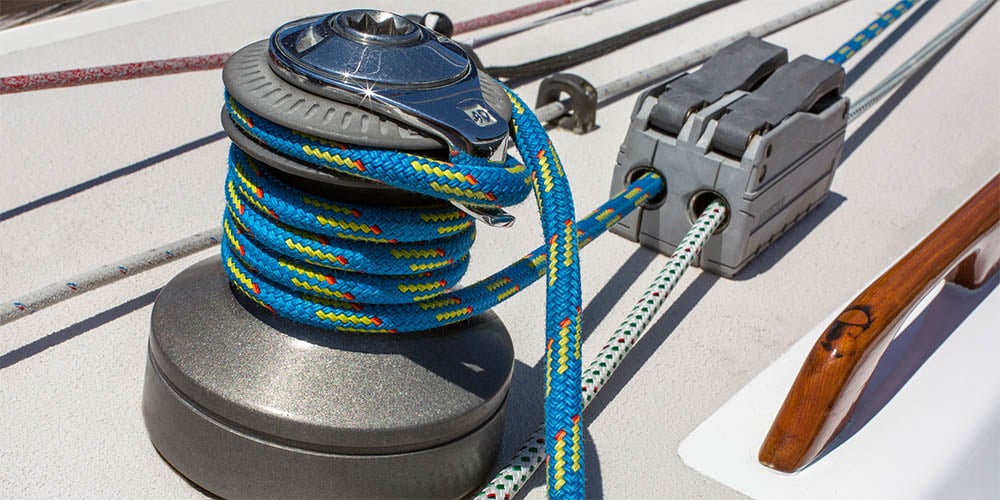

A Harken Classic #48 winch with a 10” handle is a good fit for the 155% genoa on this Cal 40.
The modern sailboat winch dates from the 1960s, when two San Francisco Bay sailors who owned big racing boats named Baruna and Orient founded the Barient Winch Company. The basic design has evolved little over 50 years, but the major manufacturers — Lewmar, Harken, Andersen, and Antal — have all introduced new product lines that are simpler to service, cleverly engineered for better grip, and easily converted to electric operation. Here is what to consider when choosing winches for your sailboat.
- How Winches Work
- Self-Tailing vs. Non-Self-Tailing
- Power Ratio and Sizing
- How Many Gears Do You Need?
- Winch Handles
- Winch Materials
- Electric and Hydraulic Winches
- FAQs
How Sailing Winches Work
Winches multiply your strength by combining two mechanisms: leverage (a long handle turning a smaller-diameter drum) and gear reduction (the number of handle revolutions per drum revolution). Ratchets prevent the drum from turning backward. Winches with two, three, or four gears let you tame sails that would otherwise be too hard to control by a single crew member.
With routine maintenance, winches last a very long time — which is why many boats built in the 1970s still carry their original Barient winches. Sooner or later replacement becomes necessary, and modern winch engineering makes the upgrade worthwhile.
Self-Tailing vs. Non-Self-Tailing Winches
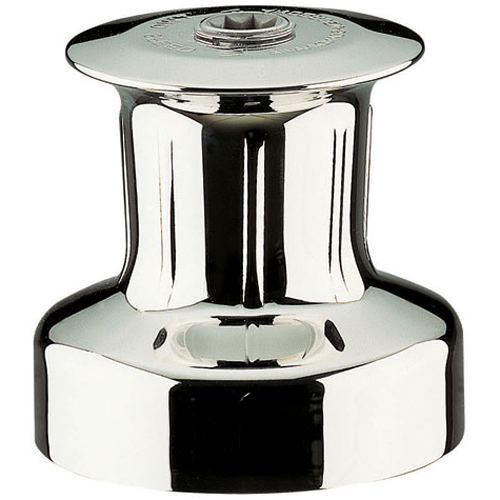
Andersen #10 single-speed non-self-tailing winch. Andersen winches have stainless drums with their Power Grip Rib surface — horizontal friction on the drum while allowing the line to move up and down easily.
Non-self-tailing winches are less common today and best suited to sportboats in applications requiring constant trimming. On an Antrim 27, for example, a non-self-tailing winch works well for trimming an asymmetric spinnaker where the sheet is in constant motion and the winch is only used in heavy air. A dedicated tailer handles the line while the grinder works the handle.
Self-tailing winches are recommended for most applications, and essential when sailing shorthanded. The self-tailer grips the line automatically, freeing the trimmer to grind with both hands. Mount the stripping arm so it points toward the person grinding — between the 5 o’clock and 7 o’clock positions for most installations.
Power Ratio and Sizing
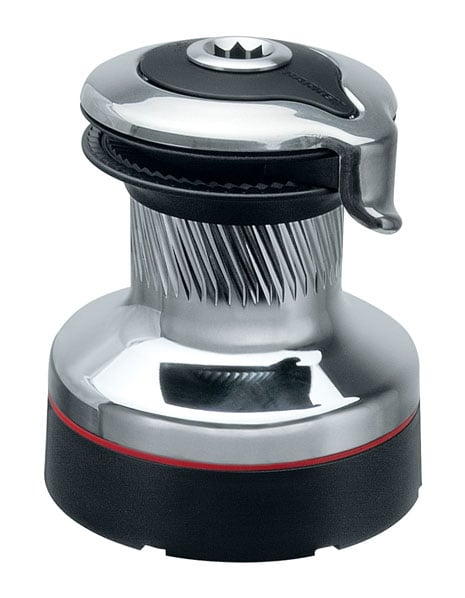
Harken #40 Radial self-tailing chrome two-speed winch. Harken Radial Winches have angled ribs that drive the line down on the drum when you ease.
Most sailors can produce 50 pounds of tension on a line by hand. Jumping a halyard, you can exert roughly your own body weight. But large cruising and racing boats have sheet loads in the 500–5,000-pound range, requiring significant mechanical multiplication. Winches provide this through the Power Ratio — the theoretical mechanical advantage combining gear ratio and the difference in radii between the handle arc and the drum.
The formula: Power Ratio = (Handle Length ÷ Drum Radius) × Gear Ratio
Example: a winch with a 10” handle, 5” drum diameter (2.5” radius), and a 6:1 gear ratio gives a power ratio of (10 ÷ 2.5) × 6 = 24:1. A higher power ratio means your strength is multiplied more, and the line comes in more slowly. We say “theoretical” because friction reduces real-world efficiency.
Winch manufacturers publish sizing charts that cross-reference winch size by sail area and application type — mainsheet, spinnaker halyard, genoa sheet, and so on. Consult these charts for your specific boat and use.
How Many Gears Do You Need?
One-speed winches: One drum revolution per handle revolution. Limited mechanical advantage, lowest cost. Suitable only for small winches in low-load applications.
One-speed geared winches: The handle acts on the drum through a gear set to increase mechanical advantage beyond a direct-drive winch. The handle ratchets when turned in the reverse direction.
Two-speed winches: Clockwise for a 1:1 ratio (fast, low power); counterclockwise for a 5:1 or 6:1 ratio (slow, high power). An economical way to get two power ratios in one winch. Note: the jump between first and second speed on a typical two-speed winch (5:1 or 6:1) is widely considered too large, which is a known limitation of this design.
Two-speed geared winches: Use gear reductions in both directions. First gear might be 2:1, second gear 7:1. Both directions are geared, so the jump between speeds is more manageable. First speed (the fast speed) direction may vary by manufacturer, so confirm before use.
Three-speed winches: Popular on big racing boats. Direct drive in first speed (one drum revolution per handle revolution) allows very fast trimming under low loads; higher gears provide the power needed for heavy conditions. The Harken 60.3ST is a well-known example.
Four-speed winches: Typically three-speed winches with a selectable direct-drive or geared first speed. The crew selects the appropriate first gear for conditions — direct drive for light air or spinnaker work, geared first for tacking in a breeze — and then uses the three available gears from there.
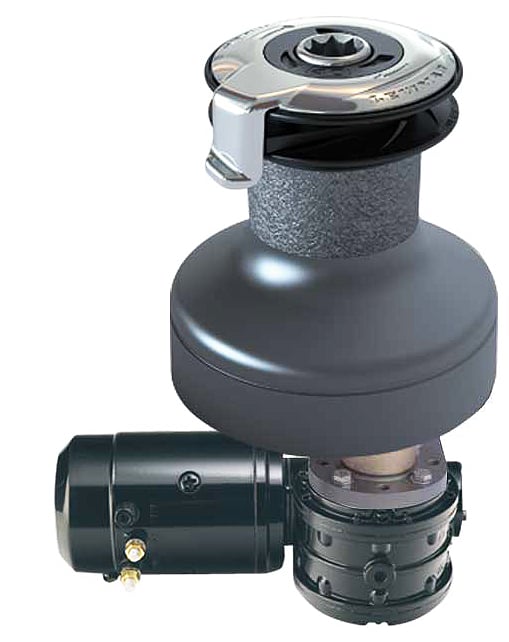
Lewmar EVO® 40ST Self-Tailing Electric Winch can be serviced with no tools required. Size 40 and above convert to electric operation.
Winch Handles
Handle length directly affects both power and speed. A longer handle produces more power but swings in a wider arc, making it slower to rotate. A shorter handle is faster but reduces power by the same proportion — reducing handle length by 20% reduces power ratio by 20%.
- 10” handles are standard for most cruising and racing winches, providing the best balance of power and speed.
- 8” handles swing a smaller arc and allow faster rotation — useful for light-air trimming where speed matters more than power.
- Locking handles lock into the winch and can be released with a button or lever. Essential offshore and recommended for all passages where a dropped handle could be lost overboard.
- Non-locking handles slide in and out of the winch socket without a lock mechanism. Faster to insert and remove for racing applications where the handle moves frequently between winches.
- Single-grip handles are lighter and more compact. Double-grip (dogbone) handles allow two-handed operation and are preferred for high-load grinding on large winches.
Winch Materials
Anodized aluminum: Lightest and least expensive, and reasonably durable. Black anodizing looks good on many boats but absorbs heat significantly in tropical climates.
Chrome on bronze: The durability of bronze with the appearance of chrome. Weighs up to 20% more than aluminum.
Bronze: Durable and long-lasting but requires frequent polishing to stay bright. Seen on traditional boats, increasingly rare. Special order only.
Stainless steel: The most durable drum material. Maintains appearance indefinitely without polishing. More expensive than aluminum or bronze. Andersen specializes in stainless steel drums.
Composite: Forespar makes a Marelon winch that is significantly lighter than bronze, less expensive, and free from galvanic corrosion concerns. Carbon fiber winches are a premium racing option.
Electric and Hydraulic Winches
Electric winches are increasingly popular because they reduce physical demand, particularly for shorthanded sailing, passages, and for crew members for whom heavy grinding is a limitation.
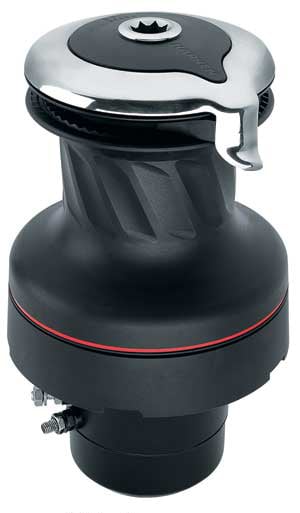
Harken UniPower 900 electric winch has a very compact below-deck motor for cabintop installations where headroom is limited.
Power-in or power in/out: Most electric winches power the line in; you ease manually as with a conventional winch. Reversible winches like the Harken Rewind Radial operate in both directions and are activated by remote in/out buttons without removing the line from the self-tailer.
Motor placement: Above-deck motors require less below-deck space and smaller deck penetrations. The Andersen Compact Electric Winch is a well-known above-deck option. Below-deck motors offer a cleaner deck appearance; Harken’s UniPower 900 is among the most compact for cabintop locations where headroom is a concern.
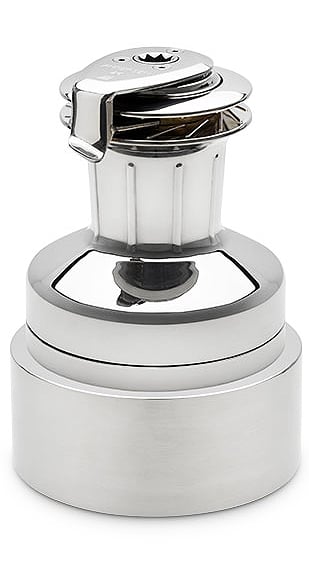
Andersen Compact Electric Winch has the motor located above the deck, minimizing below-deck space requirements.
Power consumption: Electric winches draw significant current — motors commonly range from 700 to 2,000 watts, with amp draws of 80–150A. Treat electric winches as you would a bow thruster or electric windlass when planning your electrical system.
Battery requirements: Calculate total daily electrical draw for all boat systems. For optimal battery life and performance, battery capacity should be three times the daily amp-hour draw. For example, 100Ah daily draw requires 300Ah of battery capacity.
Amp-hours explained: Amps multiplied by hours of use equals amp-hours. An electric winch drawing 100A for 12 minutes (0.2 hours) consumes 20Ah. Total this with other systems when sizing your battery bank.
Daily amp-hour estimates by system voltage:
- 24-volt system: approximately 30–35Ah per day for typical winch use
- 12-volt system: approximately 50–55Ah per day
- Larger winches (size 66 and above): 50–55Ah at 24 volts
Separate battery for electric winches? No. A unified house battery bank is better than a dedicated winch battery — a large bank allows slow draw from a large supply and provides better overall battery performance. Run a separate battery bank solely for engine starting to ensure starting power is always available.
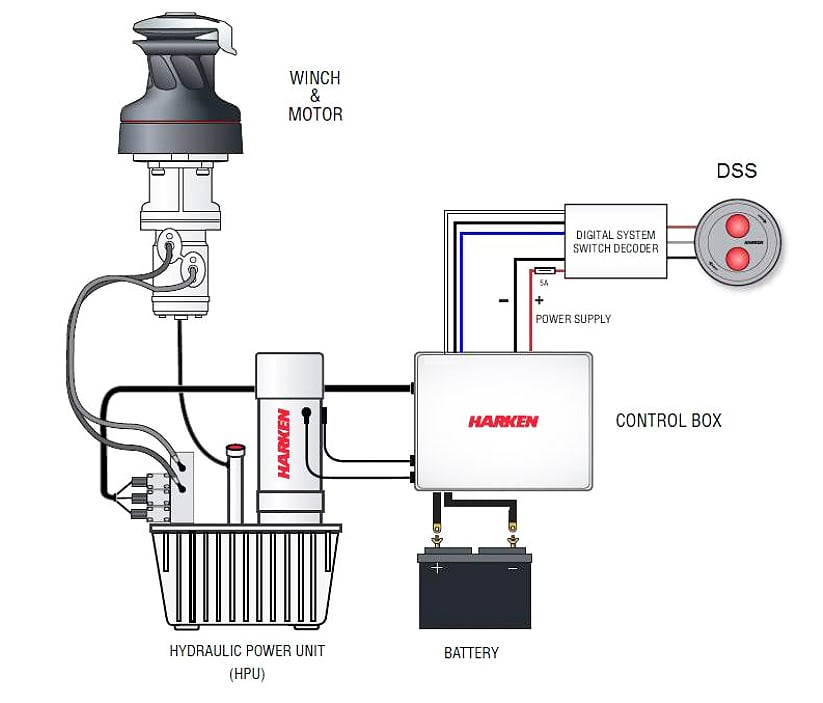
What else do you need? Appropriately sized wiring, two switches, a control box, and a circuit breaker. An optional load controller protects the winch from overload. Match wire size to winch size, system voltage, and wire length.
Hydraulic winches: These are large-boat products (generally over 50 feet) installed as part of whole-boat hydraulic systems. Selecting and specifying hydraulic winches requires consultation with your winch supplier and a hydraulics specialist.
Frequently Asked Questions
What size winch do I need for my sailboat?
Use the sizing charts published by Lewmar, Harken, Andersen, or Antal, which cross-reference winch size by sail area and application. As a general principle, genoa sheet winches are the largest on most boats, followed by spinnaker and halyard winches, with mainsheet winches often smaller depending on the boat’s traveler system. The correct size ensures you can trim efficiently without overloading the winch or under-sizing to the point where heavy-air trimming is impossible.
What is the power ratio on a winch and how do I calculate it?
Power ratio is the theoretical mechanical advantage of the winch: (Handle Length ÷ Drum Radius) × Gear Ratio. A 10” handle, 2.5” drum radius, and 6:1 gear ratio gives a 24:1 power ratio, meaning your input force is multiplied 24 times (minus friction losses). Higher power ratios bring the line in more slowly but require less physical effort. Most sailors choose winches by published sizing charts rather than calculating power ratios directly.
Should I get a self-tailing winch?
For most sailors and most applications, yes. Self-tailing winches free both hands for grinding, making them significantly more versatile and particularly important when sailing shorthanded. Non-self-tailing winches are preferred by some racing sailors in applications where the sheet is in constant motion and a dedicated tailer is always available — but for cruising, coastal sailing, and shorthanded use, self-tailers are the practical choice.
How do I maintain my winches?
Disassemble, clean, and re-grease winches at least annually — more frequently if used heavily or in saltwater. Most modern winches from Lewmar, Harken, Andersen, and Antal can be disassembled with minimal or no tools. Remove the top cap, lift out the drum, and clean the pawls, springs, gear sets, and bearings. Re-lubricate with winch grease (not oil, which washes out too quickly) and reassemble. Inspect pawls and springs for wear and replace as needed — a broken pawl allows the drum to spin backward under load, which can cause injury. Annual servicing significantly extends winch life and ensures reliable operation.
What is the difference between a locking and non-locking winch handle?
A locking handle locks into the winch socket and requires pressing a release button or lever to remove it. This prevents the handle from flying out under load or being knocked overboard. Locking handles are strongly recommended for offshore sailing and all passages. Non-locking handles slide in and out freely without a release mechanism, which makes them faster to move between winches — a preference for competitive racing crews who frequently transfer handles. For cruising, locking handles are the safer and more practical choice.
